Corporate legal and M&A teams face a critical bottleneck: manually extracting key terms—like termination dates, liability caps, and auto-renewal clauses—from thousands of legacy contracts is a slow, costly, and inconsistent process. This creates significant business risk, including missed obligations, unclaimed rebates, and unexpected liabilities that directly impact the bottom line. The sheer volume makes comprehensive review by humans impractical, leaving value trapped in filing cabinets and digital repositories.

Use Case
AI-Powered Contract Abstraction
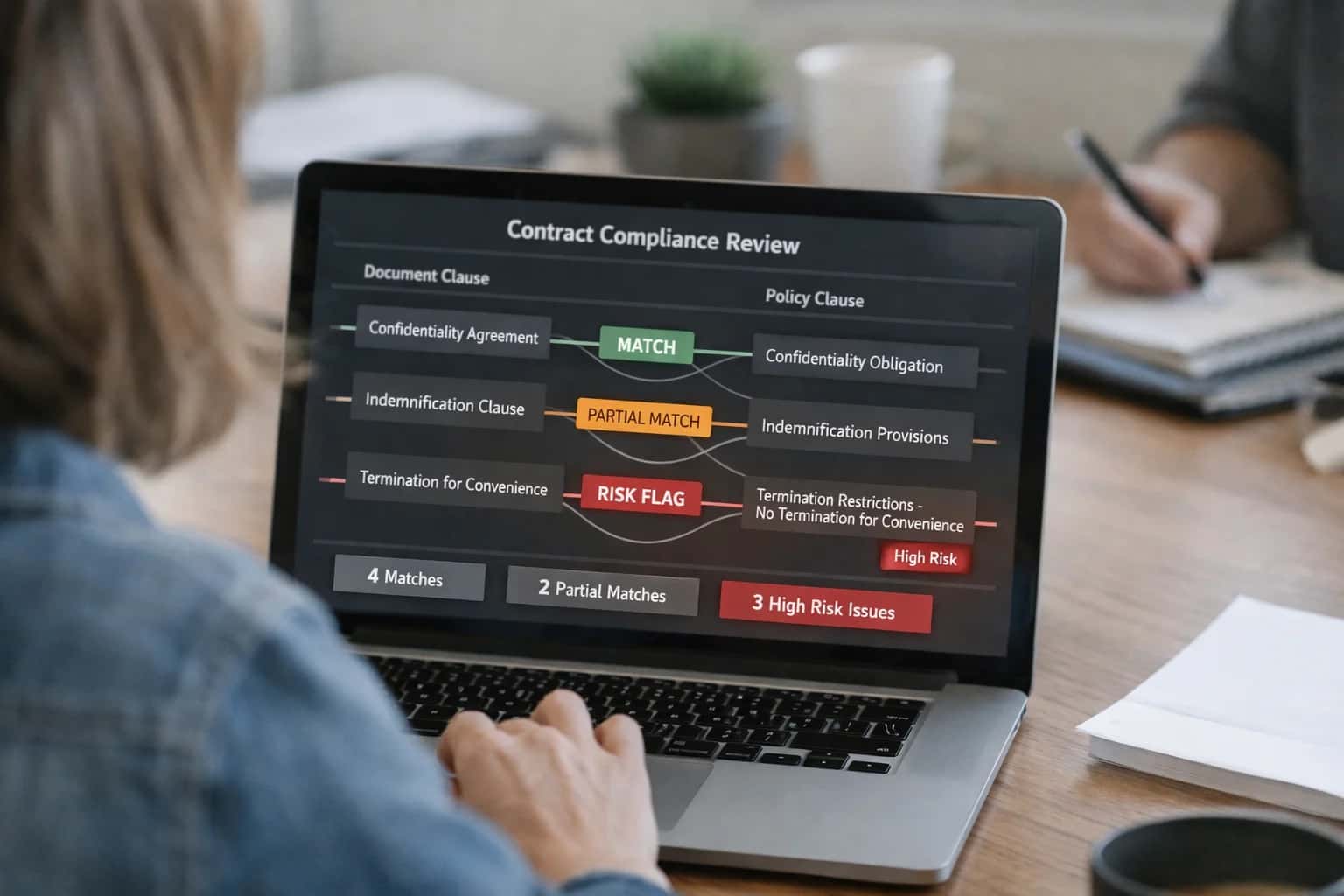
Transform unstructured legacy contracts into structured, searchable data. Automatically extract key obligations, dates, and clauses to unlock trapped value, ensure compliance, and accelerate business decisions.
UNLOCKING TRAPPED VALUE
What is AI-Powered Contract Abstraction Used For?
Legacy contracts are a goldmine of obligations and risks, but manual review is slow and error-prone. AI-powered abstraction transforms this unstructured data into actionable intelligence.
AI-powered contract abstraction provides the fix. Using natural language processing (NLP), the system automatically scans documents to identify and extract critical data points into a structured, searchable database. This delivers measurable outcomes: reducing review time by over 80%, ensuring 100% obligation tracking, and unlocking savings from optimized vendor terms. It transforms contracts from static documents into a dynamic asset for strategic decision-making, directly supporting initiatives like AI Contract Risk Scoring and Smart Contract Lifecycle Management.
TARGETED BUSINESS OUTCOMES
Common Use Cases: Where AI Contract Abstraction Drives Immediate ROI
AI-powered contract abstraction transforms static documents into structured, actionable data. These real-world applications demonstrate how enterprises unlock trapped value, mitigate risk, and accelerate operations.
06
Intellectual Property (IP) & Royalty Auditing
Protect revenue streams and ensure compliance in licensing agreements. AI abstracts royalty rates, payment terms, field-of-use restrictions, and audit rights from complex IP and technology licenses.
- Real Example: A media company recovered over $8M in under-reported royalties from licensees by systematically auditing its abstracted contract database.
- ROI Driver: Secures IP revenue and ensures contractual compliance.
FROM LEGACY TO LEGIBLE
How It Works: The AI Abstraction Process
AI-powered contract abstraction transforms dense, unstructured legal documents into actionable business intelligence. This process unlocks trapped value and ensures contractual obligations are never missed.
The pain point is clear: critical business terms are buried in thousands of pages of legacy contracts. Manual review is slow, expensive, and error-prone, leading to missed deadlines, unclaimed rebates, and compliance risks. This trapped data creates operational blind spots and prevents strategic portfolio management, turning contracts from assets into liabilities. For more on automating high-volume legal review, see our page on Automated E-Discovery and Review.
The AI fix is a structured, auditable pipeline. Our system ingests contracts, uses specialized models to identify and extract key clauses - obligations, dates, parties, and liabilities - and populates a structured database. This delivers a searchable obligation register, enabling proactive management, reducing review time by over 70%, and providing a single source of truth for finance, legal, and operations. To extend this intelligence into risk assessment, explore AI Contract Risk Scoring.
AI-POWERED CONTRACT ABSTRACTION
Implementation Roadmap: From Pilot to Scale
A structured, phased approach to deploying AI for contract abstraction, designed to deliver rapid ROI, build internal confidence, and ensure seamless enterprise-wide scaling.
01
Phase 1: The Strategic Pilot
De-risk the investment by starting with a contained, high-value use case. Select a specific contract type (e.g., NDAs, MSAs, or procurement agreements) and a defined historical dataset. This phase focuses on quantifying the baseline inefficiency and proving the AI's accuracy.
- Real-World Example: A manufacturing CIO targeted 5,000 legacy vendor agreements. The pilot demonstrated AI could extract key dates and termination clauses with 95%+ accuracy, identifying $2.3M in auto-renewal liabilities previously missed.
- Key Outcome: A clear, data-backed business case for scaling, measured in hours saved and risk uncovered.
8-12
Weeks to Value
95%+
Target Accuracy
02
Phase 2: Process Integration & Team Enablement
Move from a standalone tool to an integrated workflow. Connect the AI abstraction engine to your CLM (Contract Lifecycle Management) system or legal matter management platform. This phase is about augmenting your legal team, not replacing it.
- Implementation Focus: Develop human-in-the-loop review protocols where AI handles the first-pass extraction, and legal staff validates and handles exceptions. This builds trust and ensures quality control.
- ROI Driver: Reduces manual review time by 70-80%, allowing lawyers to shift from administrative tasks to strategic advisory and negotiation.
03
Phase 3: Enterprise Scaling & Obligation Intelligence
Expand across all contract types and business units. The goal shifts from simple data extraction to creating a living obligation intelligence platform.
- Strategic Benefit: Structured data from thousands of contracts feeds analytics dashboards, providing real-time visibility into financial commitments, risk exposure, and compliance status.
- Competitive Advantage: Enables proactive management of renewals, ensures regulatory adherence (e.g., data privacy clauses), and uncovers optimization opportunities across supplier and customer portfolios.
70-80%
Faster Review
100%
Portfolio Visibility
04
Phase 4: Predictive Insights & Automated Governance
Leverage the centralized, structured contract database to move from reactive to predictive operations. This is where AI delivers its maximum strategic value.
- Predictive Analytics: Model the impact of clause changes on future liability, forecast litigation risk based on historical patterns, and simulate negotiation outcomes.
- Automated Governance: Implement AI-driven alerts for upcoming obligations, non-standard clause deviations, and compliance drift against new regulations. This transforms the legal function from a cost center to a strategic risk and value manager.
05
Measuring ROI: The CIO's Dashboard
Justification requires hard metrics. A successful AI contract abstraction program delivers quantifiable returns across three key dimensions:
- Cost Savings: Direct reduction in outside counsel and paralegal review hours. Typical ROI achieves payback in under 12 months.
- Risk Reduction: Monetary value of uncovered auto-renewals, penalties avoided, and improved compliance posture.
- Velocity & Revenue: Faster deal cycle times (e.g., M&A due diligence) and accelerated revenue recognition from quicker contract turnaround.
< 12
Month Payback
40-60%
Faster Deals
06
Common Pitfalls & Mitigation Strategies
Acknowledge and plan for challenges to ensure smooth scaling.
- Pitfall 1: Poor Data Quality. Solution: Start with a data readiness assessment; AI is only as good as the documents it reads.
- Pitfall 2: Lack of Internal Champions. Solution: Partner with a forward-thinking General Counsel or Head of Procurement to co-own the business outcomes.
- Pitfall 3: Treating AI as a 'Set-and-Forget' Tool. Solution: Budget for continuous model tuning as new contract types and clauses emerge, ensuring long-term accuracy and value.
Enabling Efficiency, Speed & Accuracy
Intelligent Analysis, Decision & Execution
We build AI systems for teams that need search across company data, workflow automation across tools, or AI features inside products and internal software.
Talk to Us
Search across company data
Give teams answers from docs, tickets, runbooks, and product data with sources and permissions.
Useful when people spend too long searching or get different answers from different systems.
Enterprise searchRAGPermissions
Read more
Automate internal workflows
Use AI to route work, draft outputs, trigger actions, and keep approvals and logs in place.
Useful when repetitive work moves across multiple tools and teams.
AI agentsWorkflow automationGovernance
Read more
Add AI to products and internal tools
Build assistants, guided actions, or decision support into the software your team or customers already use.
Useful when AI needs to be part of the product, not a separate tool.
AI integrationDecision supportModel routing
Read moreAI-POWERED CONTRACT ABSTRACTION
Common Challenges & How to Mitigate Them
Implementing AI for contract abstraction delivers immense value, but enterprises face predictable hurdles. This guide addresses the top objections with practical, ROI-focused solutions.
Accuracy is non-negotiable in legal contexts. Our approach uses a neuro-symbolic AI framework, which combines the pattern recognition of neural networks with the rule-based logic of symbolic systems. This ensures the AI not only finds clauses but understands their legal context and relationships.
- Human-in-the-Loop Validation: Critical clauses are flagged for attorney review, creating a continuous feedback loop that improves the model.
- Audit Trail: Every abstraction is logged with the AI's confidence score and the human reviewer's decision, providing a clear compliance audit trail for regulators.
- Domain-Specific Training: Models are fine-tuned on your firm's historical contracts and specific regulatory frameworks (e.g., GDPR, SOX), not generic public data.
This hybrid approach typically achieves 95%+ accuracy on first-pass extraction, with the remaining 5% efficiently handled by legal staff, ensuring robust compliance.

About the author
Prasad Kumkar
CEO & MD, Inference Systems
Prasad Kumkar is the CEO & MD of Inference Systems and writes about AI systems architecture, LLM infrastructure, model serving, evaluation, and production deployment. Over 5+ years, he has worked across computer vision models, L5 autonomous vehicle systems, and LLM research, with a focus on taking complex AI ideas into real-world engineering systems.
His work and writing cover AI systems, large language models, AI agents, multimodal systems, autonomous systems, inference optimization, RAG, evaluation, and production AI engineering.
LinkedIn
Limited slotsGet a Free AI Consultation
Partnered with leading AI, data, and software stack.





How We Work
Custom AI workflows for your Business
One-fit-all AI don't work for modern businesses. At Inferensys, we aim to understand your business & custom requirements; which we use to define most efficient agentic workflows, the data, and the tools for your business.
01
Review the use case
We understand the task, the users, and where AI can actually help.
Read more02
Pick the right approach
We define what needs search, automation, or product integration.
Read more03
Build the first useful version
We implement the part that proves the value first.
Read more04
Improve from there
We add the checks and visibility needed to keep it useful.
Read moreThe first call is a practical review of your use case and the right next step.
Talk to Us