Manual contract review is a slow, expensive bottleneck that exposes businesses to hidden liabilities like non-standard clauses, compliance gaps, and auto-renewal traps. Legal teams drown in volume, struggling to prioritize high-risk agreements, while business units face delayed deals and unpredictable financial exposure from unfavorable terms buried in legacy documents. This reactive process turns legal from a strategic partner into a cost center.

Use Case
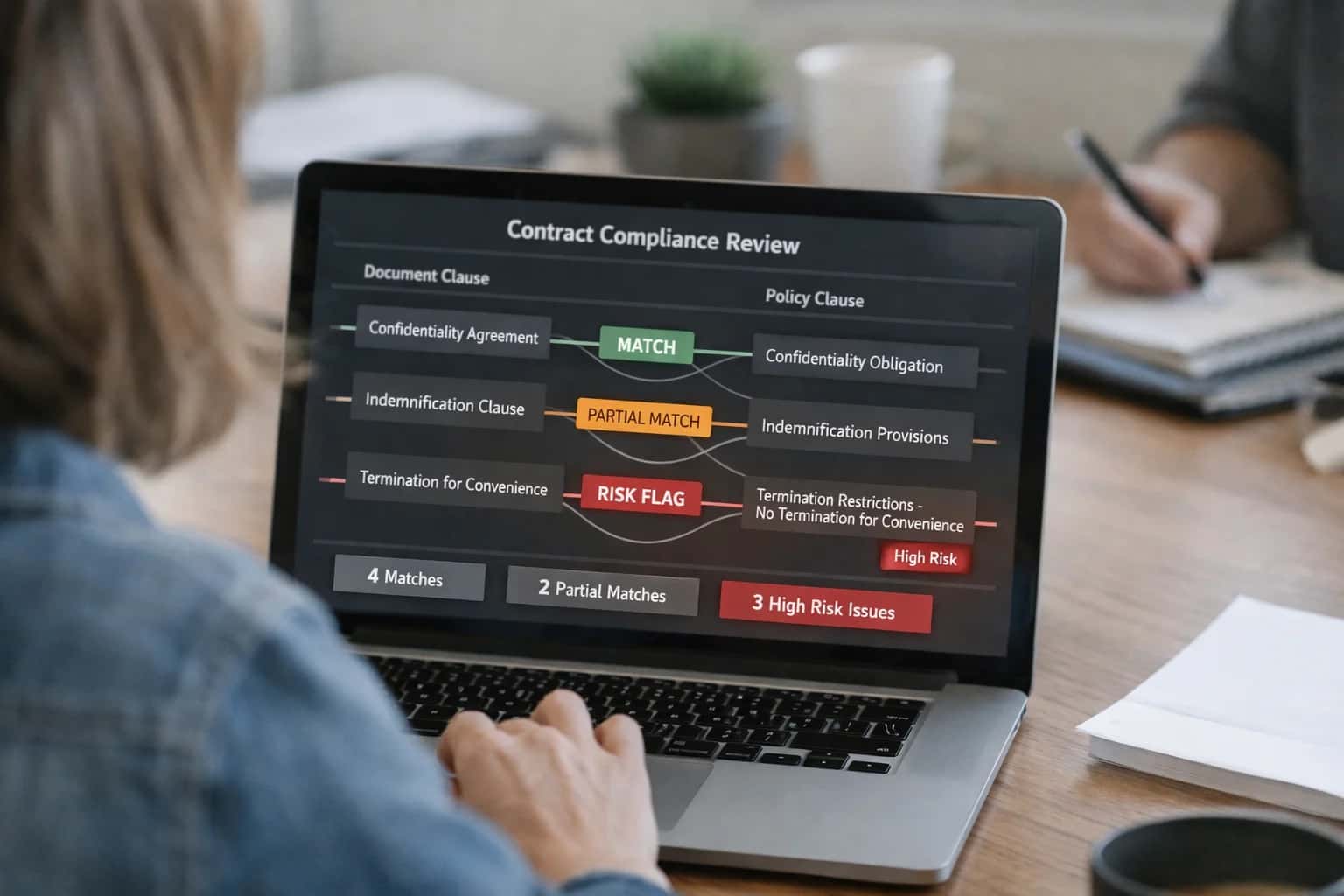
AI Contract Risk Scoring
Instantly analyze and score contracts for hidden liabilities, non-standard clauses, and compliance gaps to accelerate deal velocity and reduce legal exposure.
USE CASES
What is AI Contract Risk Scoring Used For?
AI Contract Risk Scoring transforms legal review from a manual bottleneck into a strategic, data-driven business process. It is used to instantly identify hidden liabilities, quantify exposure, and accelerate deal velocity.
AI Contract Risk Scoring provides an instant, objective risk assessment by analyzing language against your playbooks and historical data. It flags deviations, quantifies financial exposure, and prioritizes review, enabling faster, safer deal closure. This shifts legal to a proactive, value-driven function, directly contributing to cost savings and competitive advantage by mitigating risk before it materializes. For a deeper dive into automating the entire agreement process, explore our guide on Smart Contract Lifecycle Management.
AI CONTRACT RISK SCORING
Common Use Cases
Move beyond manual review. AI-powered risk scoring quantifies legal and financial exposure in contracts, accelerating deals and protecting the enterprise.
01
Accelerate M&A Due Diligence
Analyze thousands of target company contracts in hours, not weeks. AI flags non-standard clauses, change-of-control provisions, and hidden liabilities that could derail a deal or impact valuation. This enables faster, more informed negotiation and integration planning.
- Real Example: A private equity firm reduced due diligence time by 70% on a $2B acquisition, identifying a critical indemnity clause that saved an estimated $50M in post-close liabilities.
70%
Faster Review
$50M+
Risk Identified
02
Standardize Vendor & Procurement Contracts
Enforce corporate standards automatically. Score every incoming vendor agreement against your approved playbook, highlighting deviations in indemnity, liability caps, auto-renewal terms, and data security clauses. This empowers procurement teams to negotiate from a position of strength.
- Real Example: A global manufacturer automated first-pass review of 5,000+ annual supplier contracts, reducing legal team workload by 40% and improving compliance with data residency requirements by 95%.
03
Mitigate Third-Party & Supply Chain Risk
Proactively manage risk exposure across your partner ecosystem. Continuously score active contracts for force majeure adequacy, termination rights, and financial stability triggers. AI provides an early warning system for contractual vulnerabilities that could disrupt operations.
- Real Example: A retailer used AI to audit its logistics contracts, identifying 120 agreements with insufficient pandemic-related clauses, enabling proactive renegotiation before major disruptions occurred.
04
Ensure Regulatory & Compliance Adherence
Automatically detect clauses that conflict with evolving regulations like GDPR, CCPA, or industry-specific rules. AI scans for non-compliant data processing terms, inadequate audit rights, or missing regulatory disclosures, preventing costly fines and reputational damage.
- Real Example: A financial services firm scans its master service agreements for new ESG disclosure requirements, ensuring 100% of new contracts align with upcoming EU CSRD mandates, avoiding potential penalties.
05
Optimize Lease & Real Estate Portfolios
Unlock hidden value and obligation in complex real estate contracts. AI extracts and scores key terms like rent escalations, CAM charges, renewal options, and subletting rights. This provides a clear, quantifiable view of portfolio risk and opportunity.
- Real Example: A REIT analyzed 500+ property leases in days, identifying $8M in annual savings from incorrectly calculated pass-through expenses and optimizing its renewal strategy.
06
Benchmark & Improve Contracting Performance
Move from reactive review to strategic improvement. AI risk scoring provides data on which clauses most frequently cause negotiation delays or increase liability. Use these insights to refine your standard templates and negotiation playbooks, turning legal from a cost center into a strategic advantage.
- Real Example: A tech company used historical risk scores to identify that 'IP indemnity' clauses were the top cause of sales cycle delays. By creating a tiered, pre-approved clause library, they reduced average sales contract cycle time by 15 days.
FROM MANUAL REVIEW TO AUTOMATED INSIGHT
How AI Contract Risk Scoring Works: A 4-Step Implementation
Manual contract review is a bottleneck that delays deals and exposes companies to hidden liabilities. This guide outlines the four-step process to implement AI-powered risk scoring, transforming legal review from a cost center into a strategic accelerator.
Legal teams are overwhelmed by contract volume, leading to slow deal cycles and inconsistent risk assessment. Manual reviews are error-prone, missing critical non-standard clauses, hidden liabilities, and compliance gaps. This creates significant financial exposure and operational delays, turning legal review into a major business bottleneck rather than an enabler of growth. The pain is acute in high-velocity areas like procurement, sales, and M&A, where speed and accuracy are paramount.
AI contract risk scoring automates this analysis. The solution involves: 1) Ingestion of contracts in any format; 2) AI-Powered Analysis using natural language processing to identify clauses and obligations; 3) Risk Scoring against your playbook and regulatory frameworks; and 4) Actionable Reporting with prioritized insights. This delivers measurable outcomes: accelerating review by 80%, reducing legal exposure, and providing the data needed for smarter negotiation, as detailed in our overview of Intelligent Content Management (ICM) and Document Intelligence.
Enabling Efficiency, Speed & Accuracy
Intelligent Analysis, Decision & Execution
We build AI systems for teams that need search across company data, workflow automation across tools, or AI features inside products and internal software.
Talk to Us
Search across company data
Give teams answers from docs, tickets, runbooks, and product data with sources and permissions.
Useful when people spend too long searching or get different answers from different systems.
Enterprise searchRAGPermissions
Read more
Automate internal workflows
Use AI to route work, draft outputs, trigger actions, and keep approvals and logs in place.
Useful when repetitive work moves across multiple tools and teams.
AI agentsWorkflow automationGovernance
Read more
Add AI to products and internal tools
Build assistants, guided actions, or decision support into the software your team or customers already use.
Useful when AI needs to be part of the product, not a separate tool.
AI integrationDecision supportModel routing
Read moreTOTAL COST OF OWNERSHIP
ROI Breakdown: Manual Review vs. AI-Powered Scoring
A direct comparison of the operational and financial impact of traditional contract review versus implementing an AI Contract Risk Scoring solution.
| Key Metric | Manual Legal Review | AI-Powered Scoring (Inference Systems) |
|---|---|---|
Average Review Time Per Contract | 5-8 hours | < 5 minutes |
Cost Per Contract Review | $2,500 - $5,000 | $50 - $200 |
Throughput (Contracts/FTE/Month) | 5-10 | 500+ |
Deal Velocity Impact | Weeks to months delay | Accelerated by 80-90% |
Risk of Human Error / Missed Clause | High | Low (< 2% variance) |
Scalability for Volume Peaks | Requires costly temporary staff | Instant, elastic scaling |
Standardization & Consistency | Varies by reviewer | 100% consistent policy application |
Actionable Risk Insights & Reporting | Manual, post-review compilation | Real-time dashboards & executive summaries |

About the author
Prasad Kumkar
CEO & MD, Inference Systems
Prasad Kumkar is the CEO & MD of Inference Systems and writes about AI systems architecture, LLM infrastructure, model serving, evaluation, and production deployment. Over 5+ years, he has worked across computer vision models, L5 autonomous vehicle systems, and LLM research, with a focus on taking complex AI ideas into real-world engineering systems.
His work and writing cover AI systems, large language models, AI agents, multimodal systems, autonomous systems, inference optimization, RAG, evaluation, and production AI engineering.
LinkedIn
Limited slotsGet a Free AI Consultation
Partnered with leading AI, data, and software stack.





How We Work
Custom AI workflows for your Business
One-fit-all AI don't work for modern businesses. At Inferensys, we aim to understand your business & custom requirements; which we use to define most efficient agentic workflows, the data, and the tools for your business.
01
Review the use case
We understand the task, the users, and where AI can actually help.
Read more02
Pick the right approach
We define what needs search, automation, or product integration.
Read more03
Build the first useful version
We implement the part that proves the value first.
Read more04
Improve from there
We add the checks and visibility needed to keep it useful.
Read moreThe first call is a practical review of your use case and the right next step.
Talk to Us