The pain point is regulatory volatility. Manual reviews of contracts, reports, and communications cannot keep pace with evolving frameworks like GDPR, HIPAA, or industry-specific mandates. This creates a constant risk of costly violations, audit failures, and reputational damage. Non-compliant documents—whether containing outdated clauses, improper data sharing, or missing disclosures—often go undetected until it's too late, turning compliance into a high-stakes guessing game.

Use Case
Real-Time Compliance Monitoring for Documents
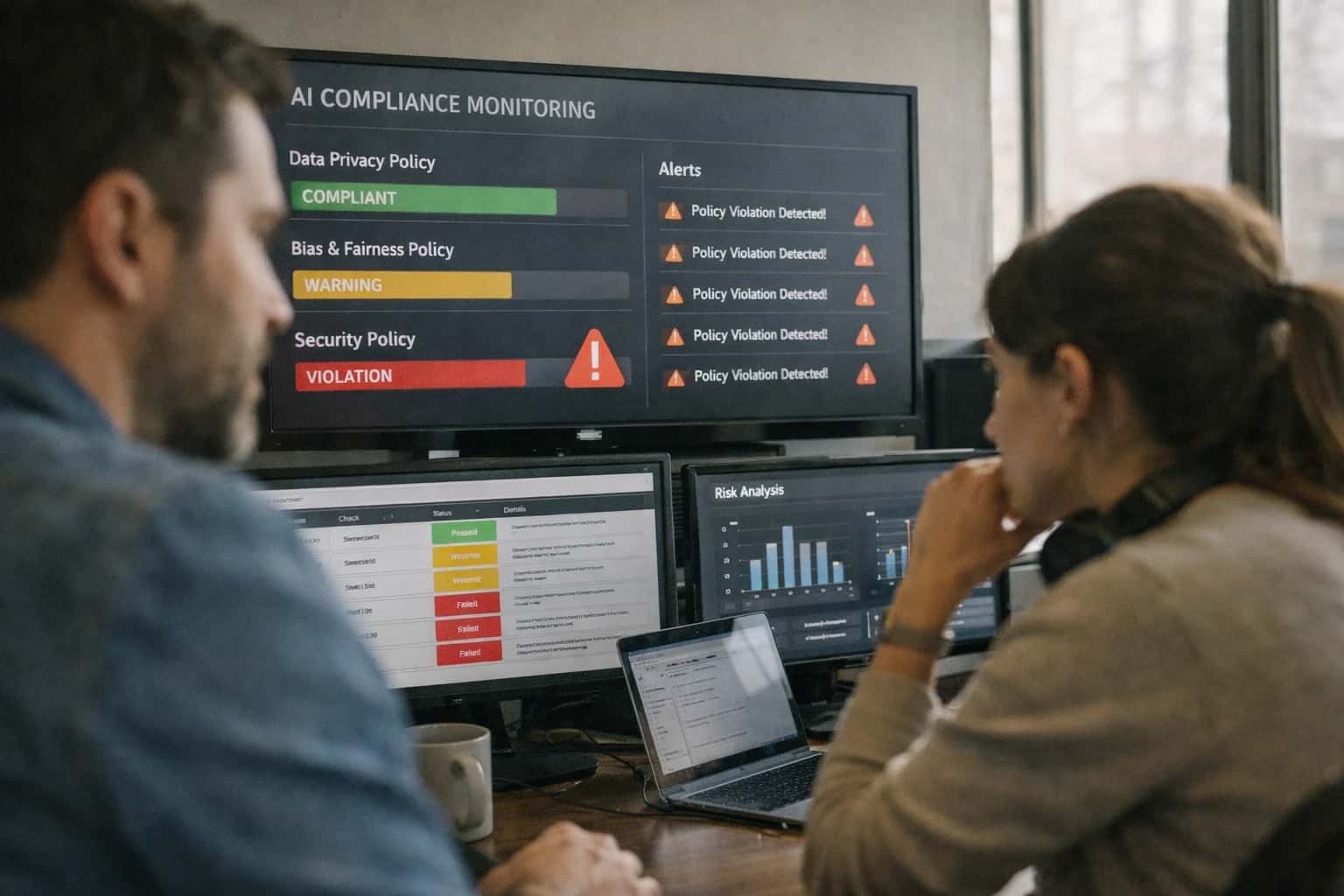
Continuously scan document repositories against evolving regulatory frameworks, automatically flagging non-compliant content to prevent costly violations and audit failures.
USE CASE
What is Real-Time Compliance Monitoring for Documents Used For?
Real-time compliance monitoring transforms document governance from a reactive audit burden into a proactive, automated control system.
The AI fix is continuous, automated scanning. An Intelligent Content Management (ICM) platform equipped with specialized models acts as a 24/7 sentinel. It ingests documents as they are created or uploaded, instantly checking them against a dynamic rulebook. The measurable outcome is risk prevention: non-compliant content is flagged in real-time for correction, slashing audit preparation time by over 60% and virtually eliminating fines from inadvertent breaches. This transforms compliance from a cost center into a demonstrable competitive shield. For deeper insights, explore our pillar on Intelligent Content Management (ICM) and Document Intelligence and related solutions like AI-Driven Document Classification for Security.
REAL-TIME COMPLIANCE MONITORING
Common Use Cases & Business Problems Solved
Move from reactive, manual audits to proactive, automated governance. These solutions continuously scan your document repositories against evolving regulations, preventing costly violations and audit failures before they occur.
01
Automated Regulatory Change Management
Manually tracking regulatory updates is slow and error-prone. Our AI continuously ingests new rules from sources like the Federal Register, EU directives, and industry bodies. It then scans your entire document library—contracts, policies, reports—to flag content that is now non-compliant. Key benefits:
- Proactive Alerts: Receive notifications for documents affected by new regulations within hours, not months.
- Audit Trail: Maintain a complete, timestamped log of all scans and flagged items for auditor review.
- Example: A financial institution automatically identified 500+ customer agreements requiring updates for new consumer data rights, preventing potential fines.
02
Continuous Policy & Contract Adherence
Ensure internal policies and contractual obligations are consistently followed across thousands of documents. The system establishes a digital rulebook based on your compliance frameworks (e.g., ISO standards, internal SOX controls) and scans all incoming and existing documents.
- Real-Time Flagging: Instantly highlights clauses that violate payment terms, data handling rules, or disclosure requirements.
- Risk Scoring: Assigns a compliance risk score to each document, prioritizing reviewer workload.
- ROI Driver: Reduces the cost of compliance reviews by over 60% and cuts contract breach risks significantly.
03
GDPR, CCPA & Global Data Privacy Enforcement
Avoid multi-million dollar penalties for data privacy violations. AI models trained on GDPR, CCPA, LGPD, and other global frameworks automatically detect and classify Personal Identifiable Information (PII) across all documents.
- Sensitive Data Discovery: Finds unprotected PII in emails, spreadsheets, and scanned forms.
- Retention Policy Automation: Flags documents past their legal retention date for secure deletion.
- Real-World Impact: A healthcare provider automated the discovery of PHI in non-clinical documents, ensuring HIPAA compliance and avoiding a potential $1.5M penalty.
04
Audit-Ready Documentation & Reporting
Transform the stressful, quarter-end audit scramble into a routine, automated process. The platform maintains a continuous compliance posture, generating on-demand reports that prove adherence.
- Automated Evidence Packets: Compiles all relevant documents, scan results, and remediation actions for any audit period.
- Gap Analysis: Highlights areas of control weakness before the auditor arrives.
- Business Justification: Slashes audit preparation time from weeks to days, freeing legal and compliance teams for strategic work.
05
Industry-Specific Compliance (FDA, SOX, FERC)
Generic tools fail against complex, industry-specific regulations. Our solutions use domain-trained models for verticals like pharmaceuticals (21 CFR Part 11), finance (SOX), and energy (FERC).
- Pre-Built Frameworks: Accelerate deployment with models pre-trained on your industry's regulatory language.
- Document Validation: Ensures clinical trial reports, financial statements, or operational logs contain all required data points and signatures.
- Competitive Advantage: Enables faster product submissions and market entry by ensuring documentation is compliant from day one.
06
Third-Party & Supply Chain Risk Mitigation
Your compliance extends to your partners. Automate the review of vendor contracts, SOC reports, and compliance certificates to ensure third-party risk is managed.
- Automated Vendor Onboarding: Scans and validates supplier documents against your compliance requirements.
- Ongoing Monitoring: Periodically re-scans vendor-provided documents for renewed certifications or new risks.
- ROI Example: A manufacturer reduced third-party risk assessment time by 75%, ensuring faster onboarding of critical suppliers without compromising standards.
THE PAIN POINT
How It Works: The AI-Powered Compliance Engine
Manual compliance reviews are a slow, costly, and error-prone bottleneck, leaving enterprises exposed to regulatory risk and audit failures.
For regulated industries, manually reviewing thousands of documents against evolving frameworks like GDPR, HIPAA, or SOX is a monumental task. It's slow, expensive, and prone to human error. A single missed clause or outdated policy can trigger severe fines, legal exposure, and reputational damage. This reactive, document-by-document approach creates a constant state of compliance anxiety, where the risk of violation is a persistent threat to the business.
Our AI engine acts as a continuous, automated auditor. It ingests documents from your repositories—contracts, reports, emails—and scans them in real-time against a dynamic rulebook of regulatory requirements. The system flags non-compliant content, outdated clauses, and missing attestations with pinpoint accuracy. This transforms compliance from a costly, periodic audit to a proactive, always-on safeguard, reducing manual review effort by over 70% and virtually eliminating surprise violations.
Enabling Efficiency, Speed & Accuracy
Intelligent Analysis, Decision & Execution
We build AI systems for teams that need search across company data, workflow automation across tools, or AI features inside products and internal software.
Talk to Us
Search across company data
Give teams answers from docs, tickets, runbooks, and product data with sources and permissions.
Useful when people spend too long searching or get different answers from different systems.
Enterprise searchRAGPermissions
Read more
Automate internal workflows
Use AI to route work, draft outputs, trigger actions, and keep approvals and logs in place.
Useful when repetitive work moves across multiple tools and teams.
AI agentsWorkflow automationGovernance
Read more
Add AI to products and internal tools
Build assistants, guided actions, or decision support into the software your team or customers already use.
Useful when AI needs to be part of the product, not a separate tool.
AI integrationDecision supportModel routing
Read moreENTERPRISE FAQ
Real-Time Compliance Monitoring: Key Implementation Challenges & Mitigations
Deploying AI for continuous compliance monitoring delivers immense ROI but faces predictable hurdles. This guide addresses the top objections from CIOs and legal teams, providing a clear path to mitigate risk and secure value.
The core ROI is risk mitigation and operational efficiency. Manual reviews are slow, expensive, and prone to human error, leaving organizations exposed to regulatory fines and audit failures. An AI system provides:
- Cost Avoidance: Prevents fines (often millions) for missed deadlines or non-compliant content.
- Efficiency Gains: Reduces manual review workload by 60-80%, freeing legal and compliance teams for high-value work.
- Proactive Defense: Continuously scans repositories against evolving frameworks (e.g., GDPR, HIPAA, SOX), flagging issues before an audit, not during.
Quantifiable benefits include slashing audit preparation time from weeks to days and reducing compliance-related operational costs by up to 40%.

About the author
Prasad Kumkar
CEO & MD, Inference Systems
Prasad Kumkar is the CEO & MD of Inference Systems and writes about AI systems architecture, LLM infrastructure, model serving, evaluation, and production deployment. Over 5+ years, he has worked across computer vision models, L5 autonomous vehicle systems, and LLM research, with a focus on taking complex AI ideas into real-world engineering systems.
His work and writing cover AI systems, large language models, AI agents, multimodal systems, autonomous systems, inference optimization, RAG, evaluation, and production AI engineering.
LinkedIn
Limited slotsGet a Free AI Consultation
Partnered with leading AI, data, and software stack.





How We Work
Custom AI workflows for your Business
One-fit-all AI don't work for modern businesses. At Inferensys, we aim to understand your business & custom requirements; which we use to define most efficient agentic workflows, the data, and the tools for your business.
01
Review the use case
We understand the task, the users, and where AI can actually help.
Read more02
Pick the right approach
We define what needs search, automation, or product integration.
Read more03
Build the first useful version
We implement the part that proves the value first.
Read more04
Improve from there
We add the checks and visibility needed to keep it useful.
Read moreThe first call is a practical review of your use case and the right next step.
Talk to Us