The core pain point is technical debt: mission-critical data trapped in on-premises mainframes, ERPs, and proprietary databases. This creates AI project paralysis, as teams cannot access unified, real-time data for analytics or inference. The business cost is lost competitive advantage, manual reporting inefficiencies, and an inability to leverage modern AI services for automation or customer insight. Legacy systems become a liability, not an asset.

Use Case
Hybrid AI Architecture for Legacy System Integration
Bridge on-premises legacy data and applications with modern cloud AI services, creating a unified data pipeline for inference and analytics without costly, risky 'rip-and-replace' projects.
THE BUSINESS CASE
What is Hybrid AI Architecture for Legacy System Integration Used For?
Legacy systems hold critical business data but create data silos that block AI innovation. A hybrid AI architecture is the strategic bridge, unlocking value without a risky, costly 'rip-and-replace'.
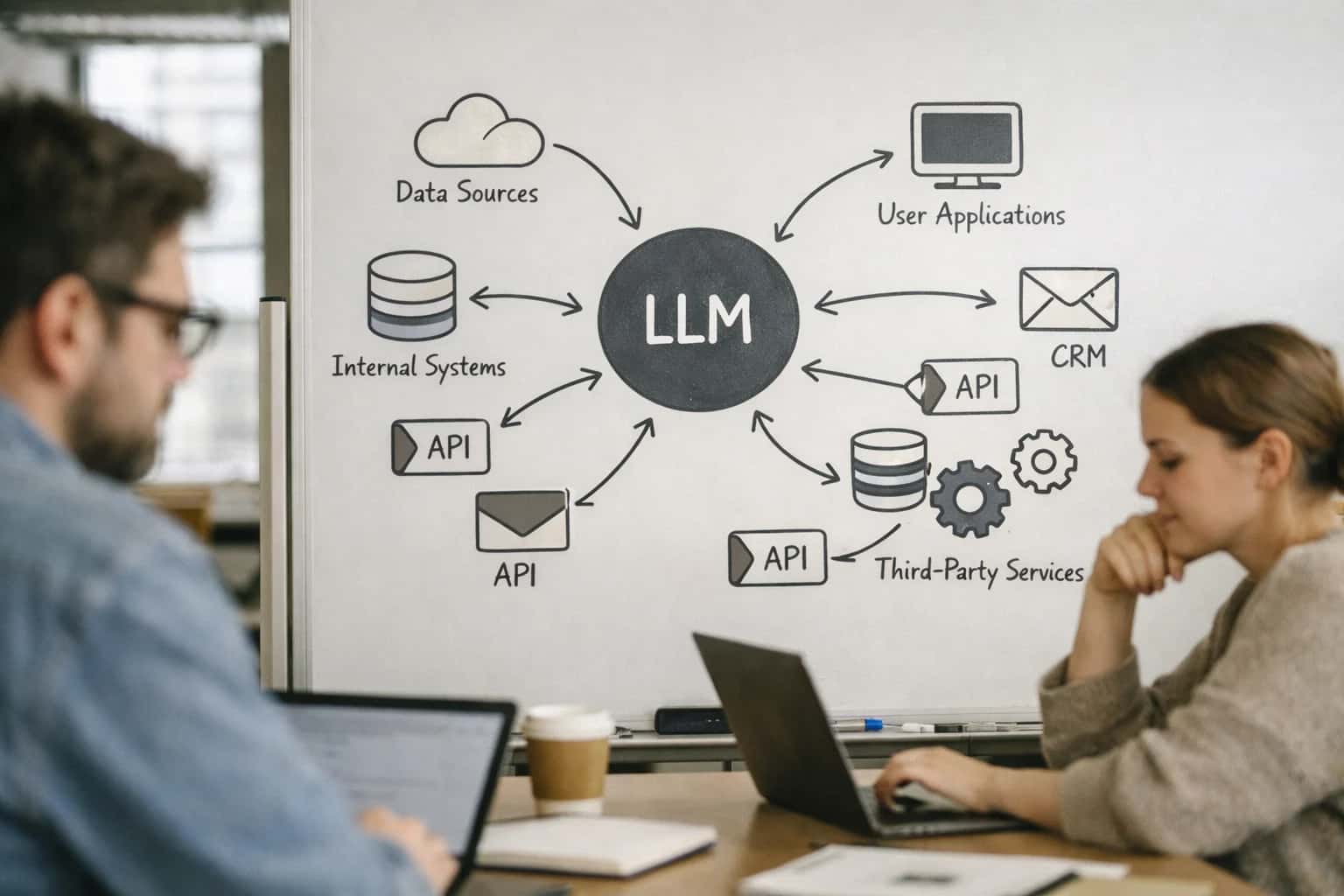
The solution is a hybrid AI architecture that creates a unified data pipeline. It uses secure APIs, middleware, and edge processing nodes to stream legacy data to cloud AI services for analytics, while keeping sensitive operations on-premises. The measurable outcome is a 20-40% reduction in manual data processing costs and the ability to deploy modern AI applications—like predictive maintenance or intelligent document processing—without disrupting core operations. This approach directly reduces technical debt and accelerates AI ROI. For a deeper dive on managing this transition, see our guide on Automated Code Modernization and Tech Debt Mitigation.
HYBRID AI FOR LEGACY INTEGRATION
Common Use Cases & Business Outcomes
Bridge on-premises legacy systems with modern cloud AI to unlock trapped data value. These proven architectures deliver rapid ROI by extending the life of core investments while enabling new intelligence.
01
Unified Customer 360 from Silos
Integrate decades of customer data from on-premises mainframes (e.g., IBM z/OS) and ERP systems with cloud-based AI for real-time personalization. Key benefits:
- Eliminate data silos to create a single customer view without risky migration.
- Deploy cloud-native recommendation engines that pull real-time signals from legacy transactional systems.
- Example: A global insurer used a hybrid pipeline to combine policy data from AS/400 systems with cloud AI, reducing customer churn by 15% through hyper-personalized offers.
15%
Reduction in Customer Churn
< 6 mos
Typical ROI Timeline
02
Predictive Maintenance for Industrial Assets
Connect real-time sensor data from SCADA and MES systems on the factory floor to cloud AI models for failure prediction. Key benefits:
- Avoid unplanned downtime by predicting equipment failures weeks in advance.
- Process high-velocity IoT data at the edge, sending only aggregated insights to the cloud for model retraining.
- Example: A manufacturing firm integrated 20-year-old PLC data with a cloud AI platform, achieving a 12% increase in Overall Equipment Effectiveness (OEE) and reducing maintenance costs by 25%.
03
AI-Powered Financial Fraud Detection
Securely augment core banking transaction systems (like legacy Tandem or custom COBOL applications) with cloud-scale machine learning for real-time anomaly detection. Key benefits:
- Detect complex fraud patterns that rule-based legacy systems miss, without modifying core banking logic.
- Maintain data sovereignty by keeping sensitive PII on-premises while sending encrypted feature vectors to the cloud for inference.
- Example: A regional bank implemented a hybrid model, catching 40% more fraudulent transactions in the first quarter while keeping customer account data securely behind its firewall.
04
Modernizing Supply Chain Intelligence
Integrate inventory and logistics data from legacy WMS and AS/400 systems with cloud AI for dynamic orchestration. Key benefits:
- Achieve end-to-end visibility and respond to disruptions in real-time.
- Use cloud-based optimization algorithms to improve fleet routing and warehouse picking, fed by legacy system data.
- Example: A distributor used a hybrid architecture to connect its legacy JD Edwards system, reducing inventory carrying costs by 18% and improving on-time delivery to 98.5%.
05
Automated Document Processing at Scale
Create a pipeline where legacy content management systems (e.g., Documentum, SharePoint on-prem) feed documents to cloud-based OCR and NLP services for intelligent extraction and classification. Key benefits:
- Eliminate manual data entry from invoices, contracts, and forms, reducing processing time from days to minutes.
- Keep original documents secure on-premises while leveraging the superior accuracy of cloud AI models.
- Example: A healthcare provider automated medical record processing, cutting administrative costs by 30% and accelerating patient onboarding by 70%.
06
Legacy Application Cognitive Front-End
Deploy a conversational AI layer (chatbot or voice assistant) in front of complex green-screen or client-server applications to improve user productivity and reduce training time. Key benefits:
- Boost user adoption of critical legacy systems with a modern, natural language interface.
- Reduce help desk tickets by 50%+ for common transactional queries.
- Example: A government agency added an AI assistant to its 30-year-old case management system, enabling field workers to retrieve case status via simple voice commands, cutting average query time from 5 minutes to 15 seconds.
Enabling Efficiency, Speed & Accuracy
Intelligent Analysis, Decision & Execution
We build AI systems for teams that need search across company data, workflow automation across tools, or AI features inside products and internal software.
Talk to Us
Search across company data
Give teams answers from docs, tickets, runbooks, and product data with sources and permissions.
Useful when people spend too long searching or get different answers from different systems.
Enterprise searchRAGPermissions
Read more
Automate internal workflows
Use AI to route work, draft outputs, trigger actions, and keep approvals and logs in place.
Useful when repetitive work moves across multiple tools and teams.
AI agentsWorkflow automationGovernance
Read more
Add AI to products and internal tools
Build assistants, guided actions, or decision support into the software your team or customers already use.
Useful when AI needs to be part of the product, not a separate tool.
AI integrationDecision supportModel routing
Read moreTHE ROI-DRIVEN APPROACH
Hybrid AI Architecture for Legacy System Integration
Unlock the value trapped in your legacy systems without a risky, all-or-nothing overhaul. A phased hybrid AI architecture delivers measurable business outcomes by bridging on-premises data with modern cloud intelligence.
The core challenge is data isolation. Legacy mainframes, on-premises databases, and proprietary applications hold mission-critical data but lack the agility for modern AI analytics. This creates a competitive disadvantage, as real-time insights and automated decision-making remain out of reach. The business pain is tangible: slower time-to-market, inefficient manual processes, and an inability to leverage historical data for predictive models. A 'rip-and-replace' strategy is prohibitively expensive and risky.
Our solution implements a phased, low-risk integration using a hybrid AI architecture. We deploy lightweight API gateways and secure data connectors to create a unified data pipeline, streaming legacy data to cloud AI services for real-time inference and analytics. This delivers immediate ROI through automated report generation, predictive maintenance alerts, and enhanced customer personalization, all while your core systems remain operational. This approach is foundational for scaling AI and is a key component of our broader Hybrid Multi-Cloud AI Architectures and Resilience strategy, enabling future capabilities like Dynamic AI Workload Migration for Cost Optimization.

About the author
Prasad Kumkar
CEO & MD, Inference Systems
Prasad Kumkar is the CEO & MD of Inference Systems and writes about AI systems architecture, LLM infrastructure, model serving, evaluation, and production deployment. Over 5+ years, he has worked across computer vision models, L5 autonomous vehicle systems, and LLM research, with a focus on taking complex AI ideas into real-world engineering systems.
His work and writing cover AI systems, large language models, AI agents, multimodal systems, autonomous systems, inference optimization, RAG, evaluation, and production AI engineering.
LinkedIn
Limited slotsGet a Free AI Consultation
Partnered with leading AI, data, and software stack.





How We Work
Custom AI workflows for your Business
One-fit-all AI don't work for modern businesses. At Inferensys, we aim to understand your business & custom requirements; which we use to define most efficient agentic workflows, the data, and the tools for your business.
01
Review the use case
We understand the task, the users, and where AI can actually help.
Read more02
Pick the right approach
We define what needs search, automation, or product integration.
Read more03
Build the first useful version
We implement the part that proves the value first.
Read more04
Improve from there
We add the checks and visibility needed to keep it useful.
Read moreThe first call is a practical review of your use case and the right next step.
Talk to Us