The pain point is immense: HR teams manually track hundreds of evolving labor laws across jurisdictions, risking six-figure fines for missed updates. This reactive, error-prone process consumes specialist time and creates a constant state of audit anxiety. A single oversight in I-9 verification or minimum wage adjustments can trigger costly penalties and reputational damage, making compliance a major operational liability rather than a value driver.

Use Case
Continuous Compliance Monitoring
Automated AI surveillance of labor law changes and policy adherence across jurisdictions, mitigating six-figure compliance fines and freeing HR for strategic work.
THE HR COMPLIANCE FIX
What is Continuous Compliance Monitoring Used For?
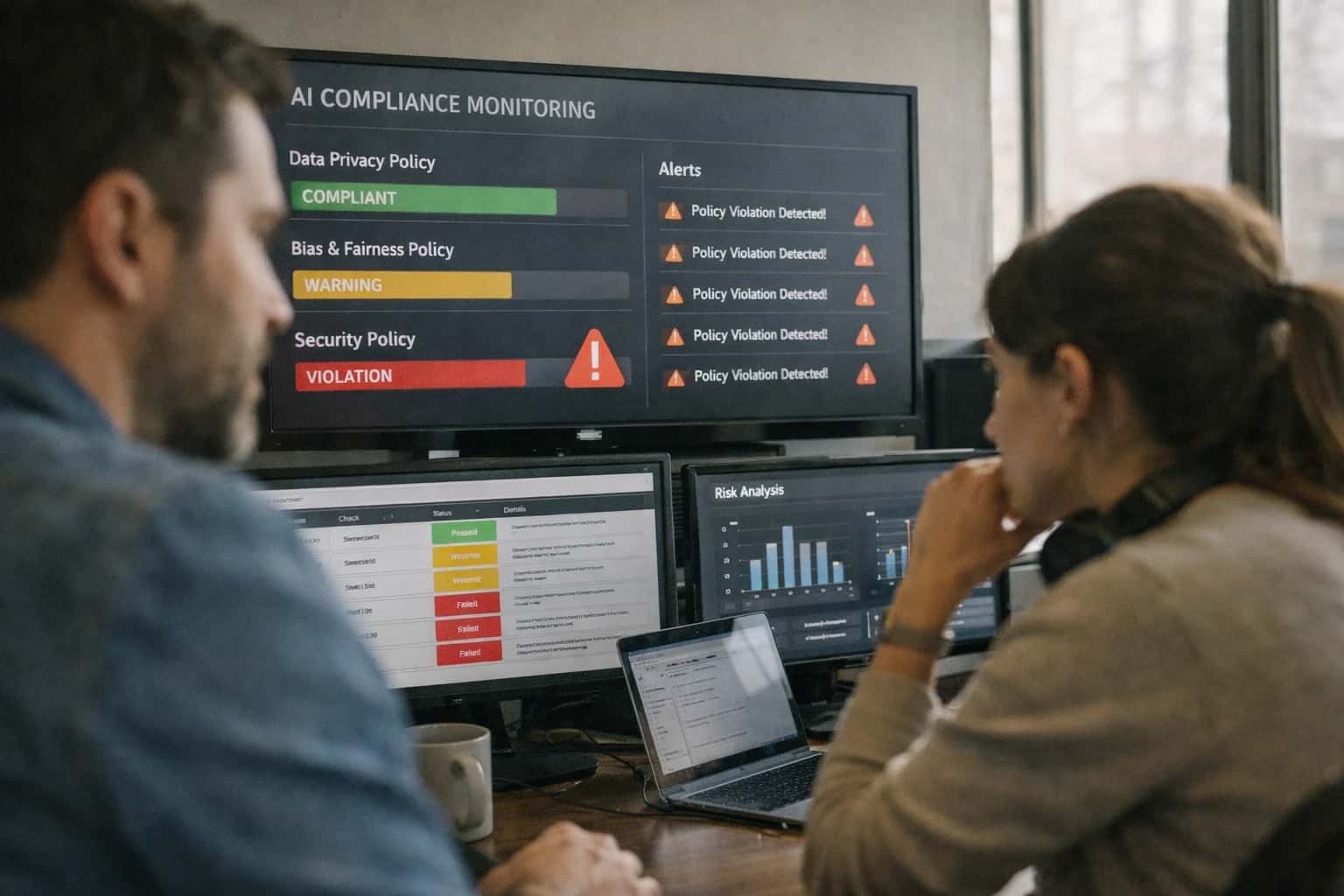
Continuous compliance monitoring is the AI-driven, automated surveillance of labor law changes and policy adherence, transforming a reactive, high-risk function into a proactive strategic asset.
The AI fix is automated, continuous surveillance. Systems like ours ingest regulatory feeds, interpret changes, and automatically flag required policy updates or employee communications. This shifts compliance from a quarterly scramble to a real-time, managed process. The measurable outcome is risk mitigation—drastically reducing fine exposure—and efficiency gains, freeing HR for strategic work like the AI-driven succession planning and predictive attrition risk scoring that directly impact the bottom line.
HR TECH & TALENT LIFECYCLE
Common Use Cases: Where AI Delivers Immediate ROI
In regulated HR environments, compliance isn't a quarterly audit—it's a daily operational risk. These AI-driven solutions transform a reactive cost center into a proactive strategic asset.
02
Policy Acknowledgment & Audit Trail
Ensuring 100% employee acknowledgment of updated handbooks, codes of conduct, and safety protocols is a logistical nightmare. AI-driven workflow orchestration automates the distribution, tracking, and escalation of policy acknowledgments.
- Key Features: Integrates with your HCM (Workday, SAP SuccessFactors) to trigger mandatory reviews, sends personalized reminders, and generates instant audit-ready reports.
- Business Value: Provides a defensible, immutable audit trail for regulators or litigation. For a 10,000-person organization, this reclaims over 500 hours of HR admin time annually while guaranteeing compliance coverage.
03
I-9 & Visa Document Compliance
Form I-9 errors are among the most common and expensive compliance failures, with fines per violation. Intelligent Document Processing (IDP) AI extracts data from passports, driver's licenses, and social security cards, auto-fills forms, and validates information against E-Verify.
- Process Fix: Flags discrepancies (e.g., expired documents) before submission and manages re-verification timelines automatically.
- ROI Quantified: Reduces manual data entry errors to near zero and cuts the average I-9 completion time from 15 minutes to under 2. For companies with high turnover or seasonal hiring, this directly translates to six-figure risk mitigation and operational savings.
04
Real-Time Fair Workweek & Scheduling Compliance
Cities and states are increasingly enacting predictive scheduling and fair workweek laws with complex rules on shift changes, rest periods, and premium pay. AI scheduling assistants analyze proposed schedules against a dynamic rules engine of local ordinances.
- How It Works: Before publishing schedules, the AI validates them for compliance, preventing violations related to clopening shifts, overtime thresholds, and mandated rest periods.
- Business Justification: Proactively avoids employee grievances and penalties. A logistics company using this system reduced scheduling-related compliance penalties by 95% within one quarter, protecting both margins and employer brand.
05
AI-Powered Harassment & Conduct Monitoring
Creating a safe workplace requires proactive measures, not just reaction to complaints. Natural Language Processing (NLP) models analyze anonymized patterns in internal communications (e.g., Slack, Teams, email) and employee survey text to identify early signals of toxic culture, bias, or harassment risk.
- Strategic Benefit: Provides HR and legal teams with early-warning insights, allowing for targeted intervention and training before issues escalate into lawsuits or public relations crises.
- CIO Consideration: This is a force multiplier for your Ethics & Compliance team, extending their reach and enabling data-driven decisions on culture initiatives. It turns subjective perception into auditable, objective metrics.
06
Automated Pay Equity & Compensation Audits
Annual compensation reviews are too slow to catch equity drift and leave organizations exposed. Continuous compensation monitoring AI analyzes pay data across roles, departments, and demographics in real-time, controlling for legitimate factors like experience and performance.
- Compliance & Competitive Edge: Continuously ensures adherence to equal pay laws (like the EPA) and surfaces actionable insights to correct disparities proactively. It also benchmarks against market data to ensure competitive offers.
- ROI Narrative: Mitigates multi-million dollar litigation risk from class-action suits. Furthermore, companies with certified pay equity see a 5-10% boost in employee trust and retention, directly impacting productivity and reducing turnover costs.
CONTINUOUS COMPLIANCE MONITORING
How It Works: The AI Implementation Blueprint
Manual compliance tracking is a reactive, high-risk burden. This blueprint details how AI transforms it into a proactive, automated safeguard.
The pain point is immense: HR teams manually track thousands of evolving labor laws across jurisdictions, risking six-figure fines for missed updates. This reactive process consumes hundreds of hours annually, distracts from strategic work, and leaves the organization perpetually vulnerable to costly audits and reputational damage from non-compliance.
The AI fix is an autonomous surveillance agent. It continuously ingests regulatory updates, cross-references them against internal policies and employee data, and flags discrepancies in real-time. This system automates the validation and filing of critical documents like I-9s and policy acknowledgments, ensuring 100% audit readiness and eliminating manual errors, transforming compliance from a cost center into a controlled, predictable operation.
HR TECH: CONTINUOUS COMPLIANCE MONITORING
Your 90-Day Implementation Roadmap to ROI
Move from reactive, manual compliance checks to an automated, always-on surveillance system. This roadmap delivers measurable ROI by mitigating six-figure fines and freeing HR teams for strategic work.
01
Eliminate Manual Policy Tracking
Manually tracking federal, state, and local labor law changes across hundreds of jurisdictions is a high-risk, low-value task. Our AI agents continuously monitor regulatory databases, news, and legal updates, automatically flagging relevant changes to your policies.
- Real-World Impact: A retail chain avoided $250k in potential fines when the system flagged a new predictive scheduling law 90 days before enactment, allowing for proactive payroll system updates.
- Key Benefit: Reduces compliance research time by over 70%, allowing your legal and HR teams to focus on implementation strategy, not discovery.
02
Automate Document Audits & Validation
Audit preparation for I-9s, visa documentation, and policy acknowledgments is a manual, error-prone process that consumes weeks annually.
Our AI extracts, validates, and cross-references data from employee documents against current rules, generating audit-ready reports and flagging discrepancies for human review.
- Quantifiable ROI: One manufacturing client reduced their annual I-9 audit preparation time from 3 weeks to 2 days, while cutting error rates to near zero.
- Proactive Defense: Continuously ensures your employee files are always in an audit-ready state, transforming compliance from a periodic panic to a managed process.
03
Mitigate Wage & Hour Violation Risk
Misclassification of employees and miscalculation of overtime are among the costliest compliance failures. Our system analyzes job descriptions, work patterns, and payroll data against the latest FLSA and state-specific rulings.
- Risk Scoring: AI assigns a risk score to each role or department, highlighting potential misclassification before it becomes a Department of Labor investigation.
- Business Justification: For a national services firm, this proactive analysis identified a $1.2M annual exposure in a single state, enabling a corrective reclassification that cost $150k—a clear 8:1 ROI on risk mitigation.
04
Ensure Global Policy Adherence
For multinational organizations, compliance is a multi-jurisdictional nightmare. Our platform maintains a dynamic rulebook for each country of operation, monitoring changes in leave entitlements, data privacy (GDPR, etc.), and termination laws.
- Localized Alerts: HRBP in Germany receives an alert about a new works council consultation requirement, while the team in California is notified of a modified paid sick leave accrual rate.
- Strategic Advantage: Enables confident, rapid expansion into new markets by providing a scalable compliance framework, reducing legal onboarding time for new entities by 50%.
05
Integrate with HRIS for Proactive Enforcement
Monitoring is useless without enforcement. Our agents integrate directly with your Workday, SAP SuccessFactors, or other HRIS to enact preventive controls.
- Automated Workflow Triggers: System automatically prevents a manager in a new jurisdiction from scheduling an employee in violation of rest-period laws.
- Real-World Example: Prevents the system from approving a PTO request that would violate mandatory leave laws, prompting the manager with the correct policy and alternative options. This closes the loop between insight and action.
06
Build an Audit Trail for Regulators
When regulators come knocking, demonstrating a systematic, good-faith compliance program is your best defense. Our platform generates a continuous, immutable log of all monitoring activities, policy updates, and employee acknowledgments.
- Demonstrable Due Diligence: Provides a clear narrative of proactive compliance management, which can significantly reduce penalties in the event of an inadvertent violation.
- CIO Value: Transforms compliance from a cost center into a demonstrable asset that protects corporate reputation and reduces liability insurance premiums.
Enabling Efficiency, Speed & Accuracy
Intelligent Analysis, Decision & Execution
We build AI systems for teams that need search across company data, workflow automation across tools, or AI features inside products and internal software.
Talk to Us
Search across company data
Give teams answers from docs, tickets, runbooks, and product data with sources and permissions.
Useful when people spend too long searching or get different answers from different systems.
Enterprise searchRAGPermissions
Read more
Automate internal workflows
Use AI to route work, draft outputs, trigger actions, and keep approvals and logs in place.
Useful when repetitive work moves across multiple tools and teams.
AI agentsWorkflow automationGovernance
Read more
Add AI to products and internal tools
Build assistants, guided actions, or decision support into the software your team or customers already use.
Useful when AI needs to be part of the product, not a separate tool.
AI integrationDecision supportModel routing
Read moreFAQ FOR DECISION MAKERS
Continuous Compliance Monitoring
Navigating the complexities of labor law across jurisdictions is a high-stakes, resource-intensive challenge. This FAQ addresses the key business, technical, and ROI questions for leaders evaluating AI-driven continuous compliance monitoring.
Continuous compliance monitoring is the automated, real-time surveillance of policy and regulatory adherence across your entire workforce. Traditional methods rely on manual audits, which are slow, error-prone, and reactive. AI-powered monitoring transforms this by using natural language processing (NLP) to ingest and interpret changes in labor laws from hundreds of global, state, and municipal sources. It then cross-references these changes against your internal HR policies, employee data, and payroll systems to flag discrepancies—such as a new minimum wage law in a specific county or updated overtime rules. This creates a proactive, always-on system that mitigates the risk of six-figure fines for non-compliance.

About the author
Prasad Kumkar
CEO & MD, Inference Systems
Prasad Kumkar is the CEO & MD of Inference Systems and writes about AI systems architecture, LLM infrastructure, model serving, evaluation, and production deployment. Over 5+ years, he has worked across computer vision models, L5 autonomous vehicle systems, and LLM research, with a focus on taking complex AI ideas into real-world engineering systems.
His work and writing cover AI systems, large language models, AI agents, multimodal systems, autonomous systems, inference optimization, RAG, evaluation, and production AI engineering.
LinkedIn
Limited slotsGet a Free AI Consultation
Partnered with leading AI, data, and software stack.





How We Work
Custom AI workflows for your Business
One-fit-all AI don't work for modern businesses. At Inferensys, we aim to understand your business & custom requirements; which we use to define most efficient agentic workflows, the data, and the tools for your business.
01
Review the use case
We understand the task, the users, and where AI can actually help.
Read more02
Pick the right approach
We define what needs search, automation, or product integration.
Read more03
Build the first useful version
We implement the part that proves the value first.
Read more04
Improve from there
We add the checks and visibility needed to keep it useful.
Read moreThe first call is a practical review of your use case and the right next step.
Talk to Us