Marketing leaders face a critical pain point: wasted creative spend. Teams invest heavily in producing multiple ad variations, social posts, and landing pages, only to discover post-launch that most underperform. This process relies on gut instinct and slow, costly A/B testing, leading to missed revenue opportunities and inefficient allocation of marketing budgets. The core problem is a lack of foresight, turning creative development into a high-stakes guessing game.

Use Case
Predictive Creative Performance Analytics
Use AI to forecast which designs, copy, and campaigns will perform best before launch, shifting creative investment from guesswork to a data-driven strategy for maximum ROI.
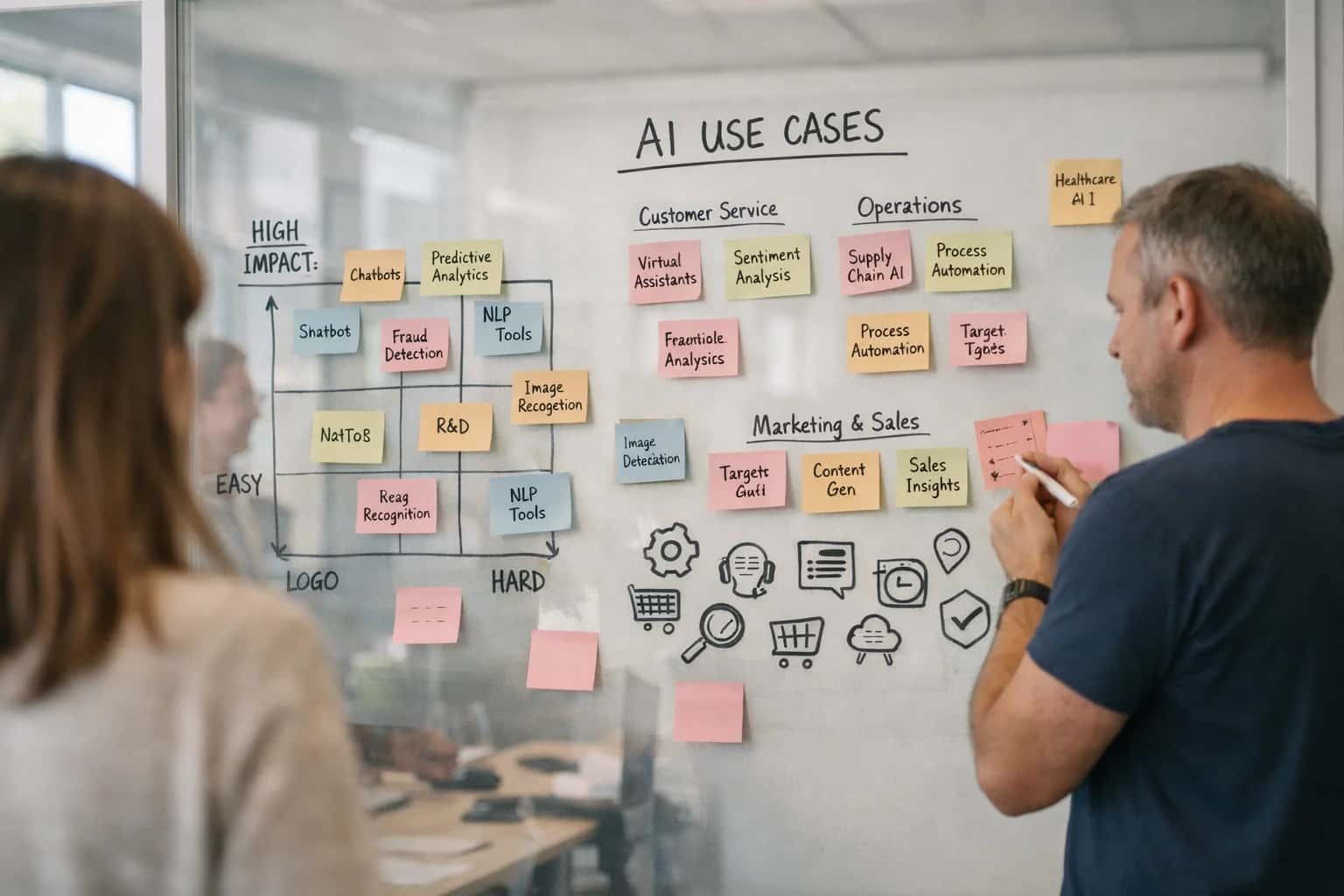
FROM GUESSWORK TO GUARANTEE
What is Predictive Creative Performance Analytics Used For?
Predictive Creative Performance Analytics uses AI to forecast which designs, copy, and campaigns will perform best before launch, shifting creative investment from intuition to data-driven strategy.
The AI fix applies machine learning models trained on historical performance data—engagement rates, conversion metrics, audience demographics—to score new creative concepts before production. This predicts winners with high accuracy, allowing teams to invest only in the highest-potential assets. The measurable outcome is a dramatic shift in ROI: reduced production waste, faster time-to-impact, and a competitive edge through consistently higher-performing campaigns. Learn how this integrates with broader AI-Powered Creative Workflow Orchestration and Dynamic Ad Creative Optimization.
PREDICTIVE CREATIVE PERFORMANCE ANALYTICS
Common Use Cases
Move creative investment from guesswork to data-driven strategy. These use cases demonstrate how AI forecasts the performance of designs, copy, and campaigns before launch, delivering measurable ROI.
01
Campaign Creative Pre-Testing
Eliminate the risk of underperforming ad spend by predicting which creative concepts will drive the highest engagement before launch. Our AI analyzes historical performance data, audience sentiment, and market trends to score new designs and copy variants.
- Real Example: A global CPG brand used this to identify the top 3 ad variations from 50 concepts, resulting in a 37% higher click-through rate for the launch campaign.
- Shifts budget allocation from post-launch optimization to proactive, high-confidence investment.
02
Packaging & Shelf Impact Prediction
Forecast which packaging design will maximize sales at the point of purchase. The system simulates shelf visibility, consumer attention patterns, and brand recognition to score design effectiveness.
- Key Benefit: Reduces costly physical mock-ups and in-store trials by providing a data-backed shortlist.
- ROI Driver: One retail client avoided a nationwide packaging redesign that predictive analytics showed would have reduced sales by an estimated 15%, saving millions in production and lost revenue.
03
Dynamic Creative Optimization at Scale
Automate the generation and real-time selection of thousands of creative variants (imagery, copy, CTAs) tailored to micro-audiences. AI continuously predicts performance and serves the highest-converting combination.
- Efficiency Gain: Reduces manual creative production and A/B testing overhead by over 80%.
- Performance Lift: Consistently achieves 20-40% higher conversion rates compared to static champion-challenger testing by adapting to real-time engagement signals.
04
Brand Asset Performance Intelligence
Transform your digital asset library from a cost center into a performance engine. AI tags and scores every image, video, and graphic based on its historical engagement and conversion contribution across channels.
- Business Value: Empowers teams to repurpose top-performing assets confidently, increasing creative ROI.
- Cost Savings: Identifies underutilized or low-performing assets, enabling rationalization of storage and license spend. One media company reclaimed $250k annually in wasted SaaS licenses.
05
Video Content Engagement Forecasting
Predict viewer retention and conversion potential for video content in pre-production. Analyze script sentiment, pacing, visual hooks, and thumbnail effectiveness to guide creative direction.
- Application: Used by streaming services and B2B marketers to greenlight video projects with the highest predicted completion rates.
- Outcome: A software company increased demo video completion rates by 52%, directly boosting qualified lead generation.
06
Website & UI Design Conversion Analytics
Model how proposed UX/UI changes will impact user conversion funnels before development begins. Simulate user flow and predict drop-off points for new layouts, CTAs, and navigation structures.
- Strategic Advantage: Shifts design debates from opinion to evidence, accelerating decision velocity.
- ROI Example: An e-commerce client used predictive modeling to optimize a checkout page redesign, resulting in a 22% reduction in cart abandonment and an estimated $4.8M in annual revenue recovery.
FROM PILOT TO PRODUCTION
Predictive Creative Performance Analytics: The Implementation Roadmap
Moving from creative guesswork to data-driven strategy requires a structured, phased approach. This roadmap outlines the critical steps to deploy AI that forecasts campaign success before launch.
The core pain point is creative waste. Teams invest heavily in designs, copy, and campaigns based on intuition, only to see 70-80% underperform post-launch. This squanders budget, delays time-to-market, and cedes competitive advantage to rivals who can predict what resonates. The challenge isn't a lack of data, but an inability to synthesize historical performance, market signals, and audience psychographics into a reliable forecast for new creative concepts.
The solution is a phased integration of a predictive analytics layer into your existing creative and marketing stacks. Phase 1 establishes a unified data foundation, ingesting past campaign KPIs, asset metadata, and audience engagement signals. Phase 2 trains domain-specific models to score new concepts against predicted performance metrics like engagement and conversion. The outcome is a shift in creative investment: resources flow to high-probability winners, increasing campaign ROI by 30-50% and accelerating the creative cycle. For a deeper dive on automating the creative process, see our guide on AI-Powered Creative Workflow Orchestration.
Enabling Efficiency, Speed & Accuracy
Intelligent Analysis, Decision & Execution
We build AI systems for teams that need search across company data, workflow automation across tools, or AI features inside products and internal software.
Talk to Us
Search across company data
Give teams answers from docs, tickets, runbooks, and product data with sources and permissions.
Useful when people spend too long searching or get different answers from different systems.
Enterprise searchRAGPermissions
Read more
Automate internal workflows
Use AI to route work, draft outputs, trigger actions, and keep approvals and logs in place.
Useful when repetitive work moves across multiple tools and teams.
AI agentsWorkflow automationGovernance
Read more
Add AI to products and internal tools
Build assistants, guided actions, or decision support into the software your team or customers already use.
Useful when AI needs to be part of the product, not a separate tool.
AI integrationDecision supportModel routing
Read morePREDICTIVE CREATIVE PERFORMANCE ANALYTICS
Key Challenges & Mitigations
Transitioning from creative guesswork to data-driven strategy presents significant operational hurdles. This section addresses the most common enterprise objections to implementing predictive analytics for creative assets, focusing on practical solutions for compliance, ROI, and integration.
ROI is measured by shifting spend from underperforming assets to proven winners before launch. Key metrics include:
- Reduced Media Waste: Decrease in budget spent on creative variations that historically underperform.
- Increased Creative Efficiency: Reduction in time and cost for A/B testing cycles by predicting top performers upfront.
- Uplift in Key Performance Indicators (KPIs): Measurable improvements in click-through rates (CTR), conversion rates, and engagement attributed to deploying higher-confidence creative.
A typical enterprise campaign can see a 15-25% reduction in cost-per-acquisition (CPA) by reallocating budget based on predictive scores, delivering a clear payback period often within a single quarter.

About the author
Prasad Kumkar
CEO & MD, Inference Systems
Prasad Kumkar is the CEO & MD of Inference Systems and writes about AI systems architecture, LLM infrastructure, model serving, evaluation, and production deployment. Over 5+ years, he has worked across computer vision models, L5 autonomous vehicle systems, and LLM research, with a focus on taking complex AI ideas into real-world engineering systems.
His work and writing cover AI systems, large language models, AI agents, multimodal systems, autonomous systems, inference optimization, RAG, evaluation, and production AI engineering.
LinkedIn
Limited slotsGet a Free AI Consultation
Partnered with leading AI, data, and software stack.





How We Work
Custom AI workflows for your Business
One-fit-all AI don't work for modern businesses. At Inferensys, we aim to understand your business & custom requirements; which we use to define most efficient agentic workflows, the data, and the tools for your business.
01
Review the use case
We understand the task, the users, and where AI can actually help.
Read more02
Pick the right approach
We define what needs search, automation, or product integration.
Read more03
Build the first useful version
We implement the part that proves the value first.
Read more04
Improve from there
We add the checks and visibility needed to keep it useful.
Read moreThe first call is a practical review of your use case and the right next step.
Talk to Us