The core pain point is unmanaged risk. Agents, under pressure to close deals or resolve issues, may inadvertently make non-compliant statements—failing to provide required disclosures, making unverified promises, or mishandling sensitive data. Traditional post-call audits are a lagging indicator, discovering breaches weeks later when corrective action is costly and damage is already done. This reactive approach turns compliance from a strategic asset into a constant liability.

Use Case
Real-Time Compliance Monitoring in Calls
AI-powered systems that analyze live customer conversations to automatically detect and flag potential regulatory breaches, ensuring adherence and reducing compliance risk in real-time.
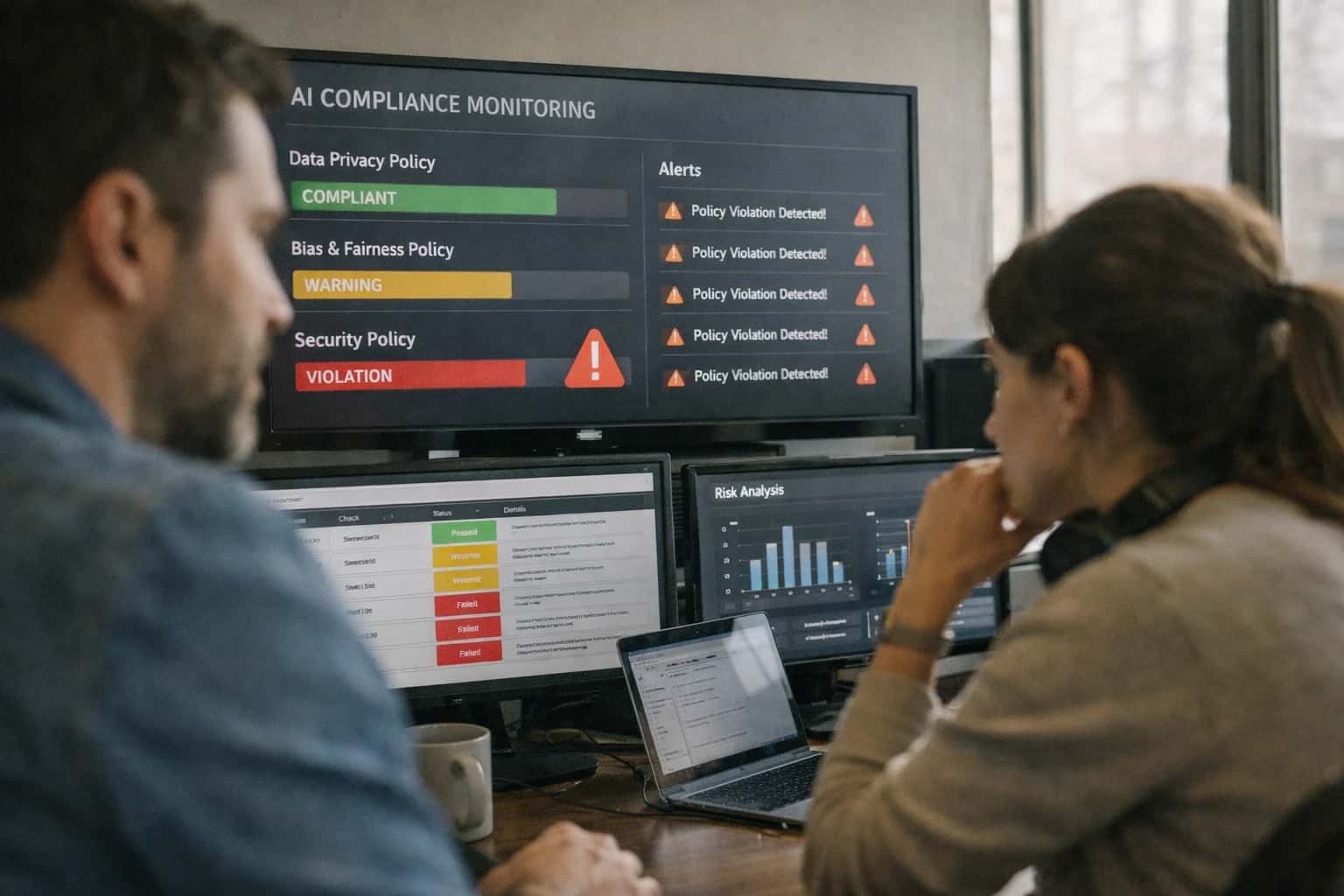
THE PAIN POINT
What is Real-Time Compliance Monitoring in Calls Used For?
In regulated industries like finance and healthcare, every customer call is a potential compliance minefield. Manual monitoring is slow, expensive, and prone to human error, leaving organizations exposed to regulatory fines and reputational damage.
The AI fix is proactive protection. Our real-time monitoring solution uses NLP to analyze live audio streams, instantly flagging potential violations like unauthorized fee discussions or missing HIPAA acknowledgments. It provides agents with on-screen prompts to correct course mid-conversation. This transforms compliance from a cost center into a competitive advantage, ensuring every interaction builds trust. For a deeper dive into how NLP powers these systems, explore our pillar on Conversational AI, NLP, and Voice Interfaces.
CONVERSATIONAL AI
Common Use Cases: Where Real-Time Monitoring Drives ROI
Move beyond post-call audits. Real-time AI monitoring transforms compliance from a reactive cost center into a proactive competitive advantage. Here’s where it delivers measurable business value.
01
Prevent Costly Regulatory Fines
Financial penalties for non-compliance can reach millions per incident. Real-time monitoring acts as a digital compliance officer, instantly flagging breaches like unauthorized fee disclosures or missed mandatory scripts during live calls.
- Example: A major bank avoided a potential $2.5M fine by catching and correcting an agent's misstatement of loan terms before the call ended.
- ROI Driver: Direct cost avoidance of regulatory penalties and associated legal fees.
02
Reduce Audit Preparation Time by 70%
Traditional compliance audits require weeks of manual call sampling and review. AI automates this process, providing audit-ready transcripts with pre-flagged issues and sentiment analysis.
- Key Benefit: Compliance teams shift from manual reviewers to strategic analysts, focusing on root-cause correction.
- ROI Driver: Slashes labor costs and frees expert resources for higher-value risk mitigation programs.
03
Enhance Customer Trust & Reduce Litigation Risk
Consistent, compliant communication builds trust. Real-time prompts guide agents to use approved language, ensuring accurate information and protecting against mis-selling claims.
- Real-World Impact: A healthcare provider reduced patient dispute escalations by 40% by ensuring HIPAA-compliant data handling was verbally confirmed in real-time.
- ROI Driver: Lower customer churn, reduced legal defense costs, and strengthened brand reputation.
04
Accelerate Agent Onboarding & Performance
New agents are a high compliance risk. Real-time monitoring provides in-the-moment coaching, delivering subtle prompts or warnings to keep conversations on track.
- Efficiency Gain: Reduces time-to-proficiency by up to 50% by embedding compliance into daily workflow.
- ROI Driver: Increases agent productivity faster, reduces supervisory overhead, and improves first-call resolution on regulated topics.
05
Enable Proactive Risk Intelligence
Transform compliance data from a historical record into a strategic intelligence asset. AI identifies emerging risk patterns—like a new script causing customer confusion—enabling proactive policy updates.
- Business Advantage: Move from 'checking the box' to predictive risk management, staying ahead of regulator focus areas.
- ROI Driver: Minimizes business disruption from reactive policy changes and enables competitive differentiation through superior customer assurance.
06
Ensure Third-Party Vendor Compliance
Outsourced contact centers extend your compliance risk. Real-time monitoring provides continuous oversight of vendor interactions, ensuring adherence to your standards without invasive manual checks.
- Cost Control: Enforce contract SLAs automatically and provide data-driven feedback for vendor performance reviews.
- ROI Driver: Mitigates brand and financial risk from vendor non-compliance, protecting the value of outsourcing partnerships.
REAL-TIME COMPLIANCE MONITORING IN CALLS
How It Works: The AI Compliance Layer
Transform regulatory adherence from a reactive audit burden into a proactive, automated business process.
The Pain Point: In regulated industries like finance and healthcare, every customer call is a potential compliance minefield. Manual monitoring is slow, expensive, and misses critical nuances. A single misstatement—a missed disclosure, an unapproved promise—can trigger massive fines, legal exposure, and brand damage. This reactive, post-call audit model leaves you perpetually at risk, turning compliance from a strategic asset into a costly liability.
The AI Fix: Our AI layer acts as a real-time guardian, analyzing live audio streams for regulatory keywords, sentiment shifts, and procedural deviations. It instantly flags potential breaches to supervisors and provides agents with on-screen guidance to self-correct. This shifts compliance from a cost center to a competitive advantage, ensuring 100% call coverage, reducing audit preparation by up to 70%, and protecting your brand. For a deeper dive into AI-driven compliance, explore our insights on LegalTech, RegTech, and AI-Driven Compliance and Ethics, Bias Mitigation, and Fair AI Frameworks.
Enabling Efficiency, Speed & Accuracy
Intelligent Analysis, Decision & Execution
We build AI systems for teams that need search across company data, workflow automation across tools, or AI features inside products and internal software.
Talk to Us
Search across company data
Give teams answers from docs, tickets, runbooks, and product data with sources and permissions.
Useful when people spend too long searching or get different answers from different systems.
Enterprise searchRAGPermissions
Read more
Automate internal workflows
Use AI to route work, draft outputs, trigger actions, and keep approvals and logs in place.
Useful when repetitive work moves across multiple tools and teams.
AI agentsWorkflow automationGovernance
Read more
Add AI to products and internal tools
Build assistants, guided actions, or decision support into the software your team or customers already use.
Useful when AI needs to be part of the product, not a separate tool.
AI integrationDecision supportModel routing
Read moreREAL-TIME COMPLIANCE MONITORING
Key Implementation Challenges & Mitigations
Deploying real-time AI for compliance monitoring in calls delivers immense ROI but faces specific technical and operational hurdles. This guide addresses the most common enterprise objections with proven mitigation strategies.
False positives are the primary barrier to agent adoption and workflow efficiency. Our approach uses a multi-layered detection model combining keyword spotting, contextual NLP, and acoustic analysis to reduce noise.
- Context-Aware NLP: Models are trained on domain-specific jargon (e.g., FINRA, HIPAA) to distinguish between casual mentions and substantive violations.
- Confidence Scoring & Escalation: Each flag is assigned a confidence score. Only high-confidence breaches trigger real-time agent alerts; lower-confidence items are routed for post-call supervisor review.
- Continuous Feedback Loop: Agent feedback on alerts is used to continuously retrain the model, creating a self-improving system that reduces false positives by 15-25% quarterly.
This precision ensures agents see only relevant, actionable guidance, maintaining call flow and trust in the system.

About the author
Prasad Kumkar
CEO & MD, Inference Systems
Prasad Kumkar is the CEO & MD of Inference Systems and writes about AI systems architecture, LLM infrastructure, model serving, evaluation, and production deployment. Over 5+ years, he has worked across computer vision models, L5 autonomous vehicle systems, and LLM research, with a focus on taking complex AI ideas into real-world engineering systems.
His work and writing cover AI systems, large language models, AI agents, multimodal systems, autonomous systems, inference optimization, RAG, evaluation, and production AI engineering.
LinkedIn
Limited slotsGet a Free AI Consultation
Partnered with leading AI, data, and software stack.





How We Work
Custom AI workflows for your Business
One-fit-all AI don't work for modern businesses. At Inferensys, we aim to understand your business & custom requirements; which we use to define most efficient agentic workflows, the data, and the tools for your business.
01
Review the use case
We understand the task, the users, and where AI can actually help.
Read more02
Pick the right approach
We define what needs search, automation, or product integration.
Read more03
Build the first useful version
We implement the part that proves the value first.
Read more04
Improve from there
We add the checks and visibility needed to keep it useful.
Read moreThe first call is a practical review of your use case and the right next step.
Talk to Us