CIOs face a critical blind spot: technical debt and compliance drift accumulate silently between quarterly audits, eroding system stability and developer velocity. A single non-compliant library or a degrading architectural pattern can introduce security vulnerabilities, cause production outages, and derail project timelines. This isn't just a developer problem—it's a direct threat to operational resilience, regulatory standing, and the ROI of your modernization investments in areas like Automated Legacy Code Refactoring.

Use Case
Real-Time Code Health and Compliance Monitoring
AI-driven continuous analysis of code quality, architectural adherence, and regulatory compliance, providing actionable dashboards to prevent technical debt accumulation and accelerate development.
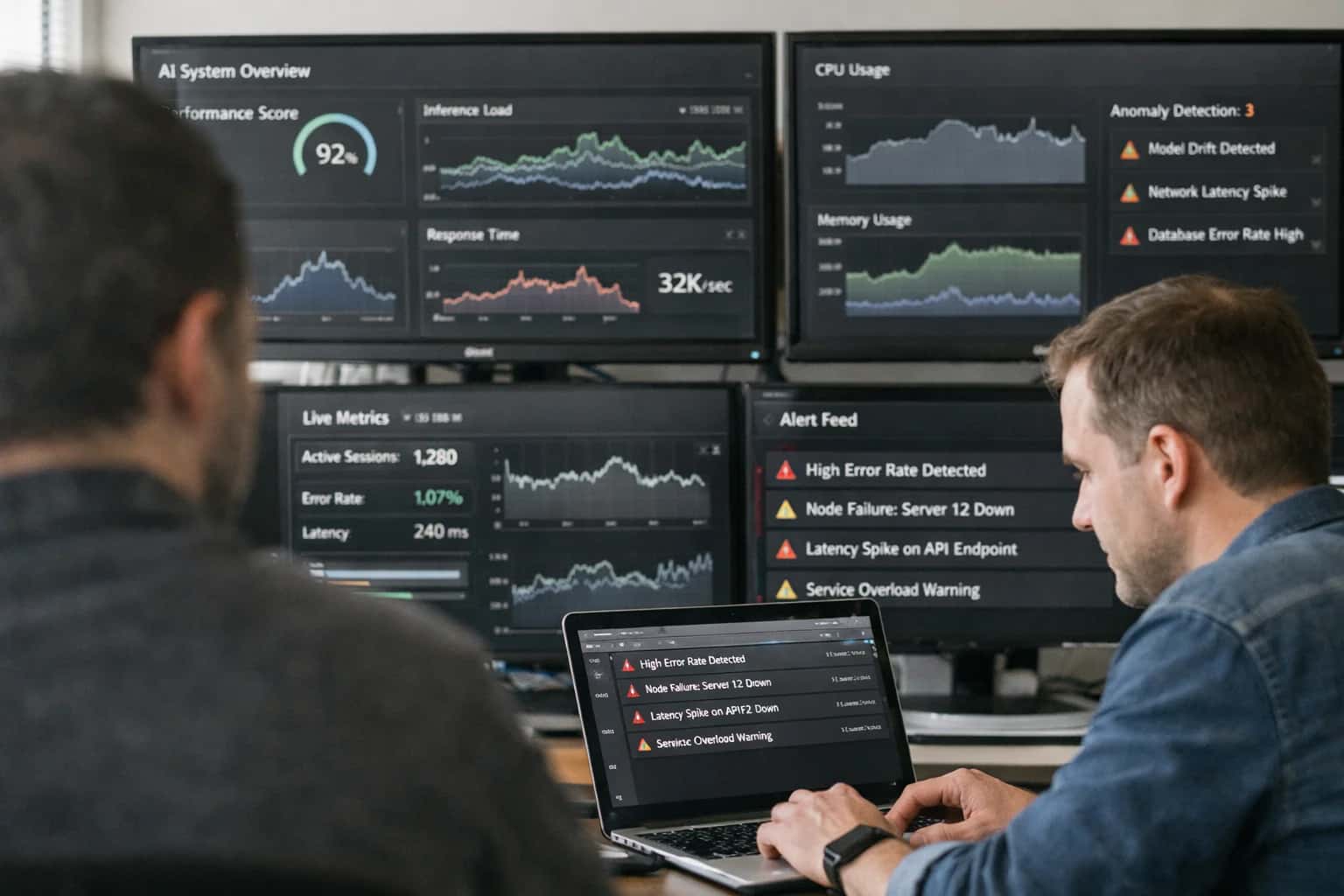
THE BUSINESS CASE
What is Real-Time Code Health and Compliance Monitoring Used For?
Real-time monitoring transforms code quality and compliance from a reactive audit burden into a proactive business safeguard. It's the operational intelligence layer that prevents technical debt from crippling your digital transformation.
The solution is continuous, AI-powered analysis that acts as a 'flight recorder' for your entire codebase. It enforces architectural guardrails, flags security anti-patterns in real-time, and automatically validates against standards like SOC 2 or HIPAA. The outcome is measurable: up to a 30% reduction in critical production incidents, ensured audit readiness, and reclaimed developer hours previously lost to firefighting. This creates the stable foundation required to successfully execute complex initiatives like AI-Powered Mainframe-to-Cloud Migration.
AUTOMATED CODE MODERNIZATION
Common Use Cases: Solving Core Business Problems
Real-time monitoring transforms code quality from a reactive audit to a proactive business asset. These use cases demonstrate how continuous AI oversight delivers measurable ROI by preventing technical debt and ensuring compliance.
01
Prevent Costly Security & Compliance Breaches
Manual code reviews miss subtle vulnerabilities and policy violations. Our AI continuously scans every commit against OWASP Top 10, PCI-DSS, HIPAA, and internal security baselines. It flags non-compliant patterns—like hard-coded secrets or improper data handling—before they reach production.
- Real Example: A financial client prevented a potential GDPR violation by automatically detecting and blocking code that would have logged PII in plaintext.
- ROI Impact: Reduces audit preparation time by 70% and cuts the cost of post-breach remediation, which averages $4.45M per incident.
02
Enforce Architectural Standards at Scale
Architecture drift silently increases system complexity and slows development. Our AI acts as a virtual architect, enforcing patterns like microservice boundaries, API contracts, and cloud best practices.
- Real Example: A retail enterprise ensured 100+ teams adhered to a new event-driven architecture standard, preventing costly integration debt.
- ROI Impact: Accelerates onboarding of new developers by 40% and reduces the "time to first commit" by providing immediate, contextual feedback on architectural fit.
03
Quantify & Prioritize Technical Debt
Not all technical debt is equal. Move from gut feeling to data-driven prioritization. Our system analyzes code to calculate a Maintainability Index, Cyclomatic Complexity, and Code Churn to identify the modules that pose the highest business risk.
- Real Example: A SaaS company identified a legacy billing module with spiraling complexity, justifying its refactor with a projected 30% reduction in incident-related downtime.
- ROI Impact: Enables CIOs to allocate modernization budgets strategically, targeting code that directly impacts system stability and feature velocity.
04
Automate Regulatory Documentation & Audit Trails
Generating compliance evidence for SOC 2, ISO 27001, or FedRAMP is a manual, error-prone burden. Our AI automatically creates audit-ready reports, mapping code changes to specific control requirements and maintaining an immutable history of adherence.
- Real Example: A healthcare provider automated 80% of its annual HIPAA compliance report, saving over 200 engineering hours.
- ROI Impact: Transforms compliance from a cost center to a streamlined byproduct of development, reducing manual overhead and audit risk.
05
Boost Developer Productivity with Contextual Feedback
Shift quality left by providing developers with actionable insights in their pull requests. Instead of generic linting rules, the AI explains why a change violates a pattern and suggests fixes, turning code review into a learning opportunity.
- Real Example: Developers at a tech firm reduced their "code review to merge" cycle time by 50% by resolving quality issues earlier in the workflow.
- ROI Impact: Improves developer satisfaction and retention by eliminating frustrating, repetitive feedback loops and freeing senior engineers for high-value design work.
06
Monitor Third-Party Dependency Risk in Real-Time
Modern applications are built on a fragile stack of open-source libraries. Our system continuously monitors dependencies for new CVEs, license changes, and deprecation notices. It provides actionable upgrade paths and impact analysis.
- Real Example: An e-commerce platform automatically patched the Log4j vulnerability across 500+ microservices within 24 hours of CVE publication.
- ROI Impact: Dramatically reduces mean time to remediation (MTTR) for critical vulnerabilities, protecting brand reputation and avoiding regulatory penalties.
REAL-TIME CODE HEALTH AND COMPLIANCE MONITORING
How It Works: The AI-Powered Feedback Loop
Legacy systems and sprawling codebases create a hidden tax on innovation. This AI-driven feedback loop provides continuous, actionable intelligence to prevent technical debt from accumulating.
The Pain Point: Technical debt and compliance drift are silent killers of velocity. Manual code reviews are slow and inconsistent, while security audits are periodic snapshots, not continuous protection. This leads to escalating maintenance costs, delayed releases, and regulatory exposure as vulnerabilities and architectural flaws go undetected until they cause a major incident or audit failure. The business impact is a direct drain on ROI and competitive agility.
The AI Fix: Our system deploys AI agents as continuous guardians, analyzing every commit against a living model of quality, architecture, and compliance rules. It provides real-time dashboards with prioritized remediation steps, shifting from reactive firefighting to proactive governance. The outcome is measurable: a 30-50% reduction in critical vulnerabilities at release and automated audit trails that cut compliance review cycles from weeks to hours. This transforms code health from a cost center into a strategic asset, directly supporting our Automated Code Modernization and Tech Debt Mitigation pillar.
REAL-TIME CODE HEALTH
Phased Implementation Roadmap
A strategic, incremental approach to deploying AI-powered monitoring that delivers immediate ROI while building towards a comprehensive compliance and quality assurance platform.
01
Phase 1: Automated Code Quality Gate
Deploy AI agents as a mandatory quality gate in your CI/CD pipeline. This initial phase focuses on automated static analysis to catch critical issues before they merge. The system scans every pull request for security vulnerabilities, code smells, and architectural deviations against predefined standards.
- Real-World Impact: A major financial institution reduced critical security flaws in production by 65% within three months by blocking non-compliant code at the source.
- ROI Driver: Prevents costly post-release hotfixes and reduces mean-time-to-resolution (MTTR) for defects by identifying the root cause at commit time.
65%
Reduction in Critical Flaws
< 2 min
Average Analysis Time
02
Phase 2: Architectural Drift & Dependency Dashboard
Expand monitoring to the application portfolio level. AI models create a living architectural map and continuously compare it against your target state (e.g., microservices, clean architecture). This phase provides actionable dashboards showing:
- Architectural Drift: Visualizations of where codebases deviate from approved patterns.
- Dependency Risk: Real-time alerts on outdated, vulnerable, or incompatible third-party libraries.
- Technical Debt Heatmap: Quantifies the cost and impact of accumulated debt per service or team.
This transforms subjective code reviews into data-driven portfolio management.
03
Phase 3: Proactive Compliance & Regulatory Alignment
Integrate regulatory rulebooks (SOC2, HIPAA, GDPR, PCI-DSS) directly into the analysis engine. The AI doesn't just flag issues; it maps code artifacts to specific control requirements and generates audit-ready evidence.
- Example: Automatically detects unencrypted data handling in logs or improper PII storage patterns, linking the finding to the exact GDPR article violated.
- Business Value: Cuts manual compliance audit preparation time by up to 70% and provides continuous assurance versus point-in-time snapshots. This is critical for industries like finance and healthcare.
04
Phase 4: Predictive Technical Debt & Capacity Forecasting
Leverage historical data to move from reactive to predictive. AI models forecast future technical debt accumulation and its impact on team velocity and system stability.
- Predictive Insights: Alerts that "If current patterns continue, Team X's feature delivery will slow by 40% in 6 months due to mounting complexity."
- Capacity Planning: Provides data to justify refactoring sprints or additional headcount based on quantifiable debt metrics.
- Strategic ROI: Enables CIOs to allocate modernization budgets precisely where they will have the greatest impact on business agility and innovation capacity.
05
Phase 5: Autonomous Remediation & Self-Healing Code
The final phase introduces agentic workflows for automated fixes. For well-defined, repetitive issues (e.g., dependency updates, linting violations, simple security patches), the system can automatically create, test, and submit remediation pull requests for developer approval.
- Efficiency Gain: Frees senior developers from ~30% of routine maintenance work, redirecting them to high-value feature development.
- Risk Reduction: Ensures critical patches are applied consistently and immediately, without human delay or oversight gaps.
- Evolution: This creates a self-improving codebase where health monitoring directly fuels continuous, low-risk modernization.
06
ROI & Business Justification Summary
This phased approach de-risks investment and demonstrates quick wins. The cumulative business case is built on:
- Cost Avoidance: Preventing major security breaches, compliance fines, and costly emergency rework.
- Developer Productivity: Unlocking 20-30% of developer capacity currently spent on debugging and manual compliance checks.
- Release Velocity: Reducing cycle times by ensuring code is 'born healthy' and reducing integration failures.
- Strategic Agility: Creating a transparent, metrics-driven foundation for managing technical debt as a balance sheet item, enabling smarter investment in modernization aligned with business priorities.
Enabling Efficiency, Speed & Accuracy
Intelligent Analysis, Decision & Execution
We build AI systems for teams that need search across company data, workflow automation across tools, or AI features inside products and internal software.
Talk to Us
Search across company data
Give teams answers from docs, tickets, runbooks, and product data with sources and permissions.
Useful when people spend too long searching or get different answers from different systems.
Enterprise searchRAGPermissions
Read more
Automate internal workflows
Use AI to route work, draft outputs, trigger actions, and keep approvals and logs in place.
Useful when repetitive work moves across multiple tools and teams.
AI agentsWorkflow automationGovernance
Read more
Add AI to products and internal tools
Build assistants, guided actions, or decision support into the software your team or customers already use.
Useful when AI needs to be part of the product, not a separate tool.
AI integrationDecision supportModel routing
Read moreREAL-TIME CODE HEALTH
Common Adoption Challenges (And How to Overcome Them)
Implementing real-time monitoring for code health and compliance is a strategic imperative, but enterprises often face predictable hurdles. This guide addresses the top objections and provides actionable solutions to secure buy-in and ensure a smooth, high-ROI deployment.
The ROI is not in the monitoring itself, but in preventing cost escalation. Quantify the business impact of technical debt: every hour developers spend fixing legacy bugs is an hour not spent on innovation. Real-time monitoring provides a continuous audit that identifies issues as they are introduced, preventing the 30-40% project overruns common with late-stage remediation. Frame the investment against the cost of a major security breach or compliance failure, which can run into millions. For a deeper dive on connecting AI to business value, see our guide on Outcome-Based AI Service Models and ROI Analytics.

About the author
Prasad Kumkar
CEO & MD, Inference Systems
Prasad Kumkar is the CEO & MD of Inference Systems and writes about AI systems architecture, LLM infrastructure, model serving, evaluation, and production deployment. Over 5+ years, he has worked across computer vision models, L5 autonomous vehicle systems, and LLM research, with a focus on taking complex AI ideas into real-world engineering systems.
His work and writing cover AI systems, large language models, AI agents, multimodal systems, autonomous systems, inference optimization, RAG, evaluation, and production AI engineering.
LinkedIn
Limited slotsGet a Free AI Consultation
Partnered with leading AI, data, and software stack.





How We Work
Custom AI workflows for your Business
One-fit-all AI don't work for modern businesses. At Inferensys, we aim to understand your business & custom requirements; which we use to define most efficient agentic workflows, the data, and the tools for your business.
01
Review the use case
We understand the task, the users, and where AI can actually help.
Read more02
Pick the right approach
We define what needs search, automation, or product integration.
Read more03
Build the first useful version
We implement the part that proves the value first.
Read more04
Improve from there
We add the checks and visibility needed to keep it useful.
Read moreThe first call is a practical review of your use case and the right next step.
Talk to Us