Modern supply chains are fragile. A single port closure, geopolitical event, or supplier failure can trigger weeks of delays, stockouts, and millions in lost revenue. Traditional monitoring relies on human teams sifting through news and spreadsheets—a slow, manual process that misses subtle, early-warning signals. The result is a constant state of reactive scrambling, where mitigation is always more expensive and less effective.

Use Case
Supply Chain Disruption Analyst
An AI teammate that monitors global events and logistics data to predict and recommend mitigations for supply chain bottlenecks before they cause costly delays.
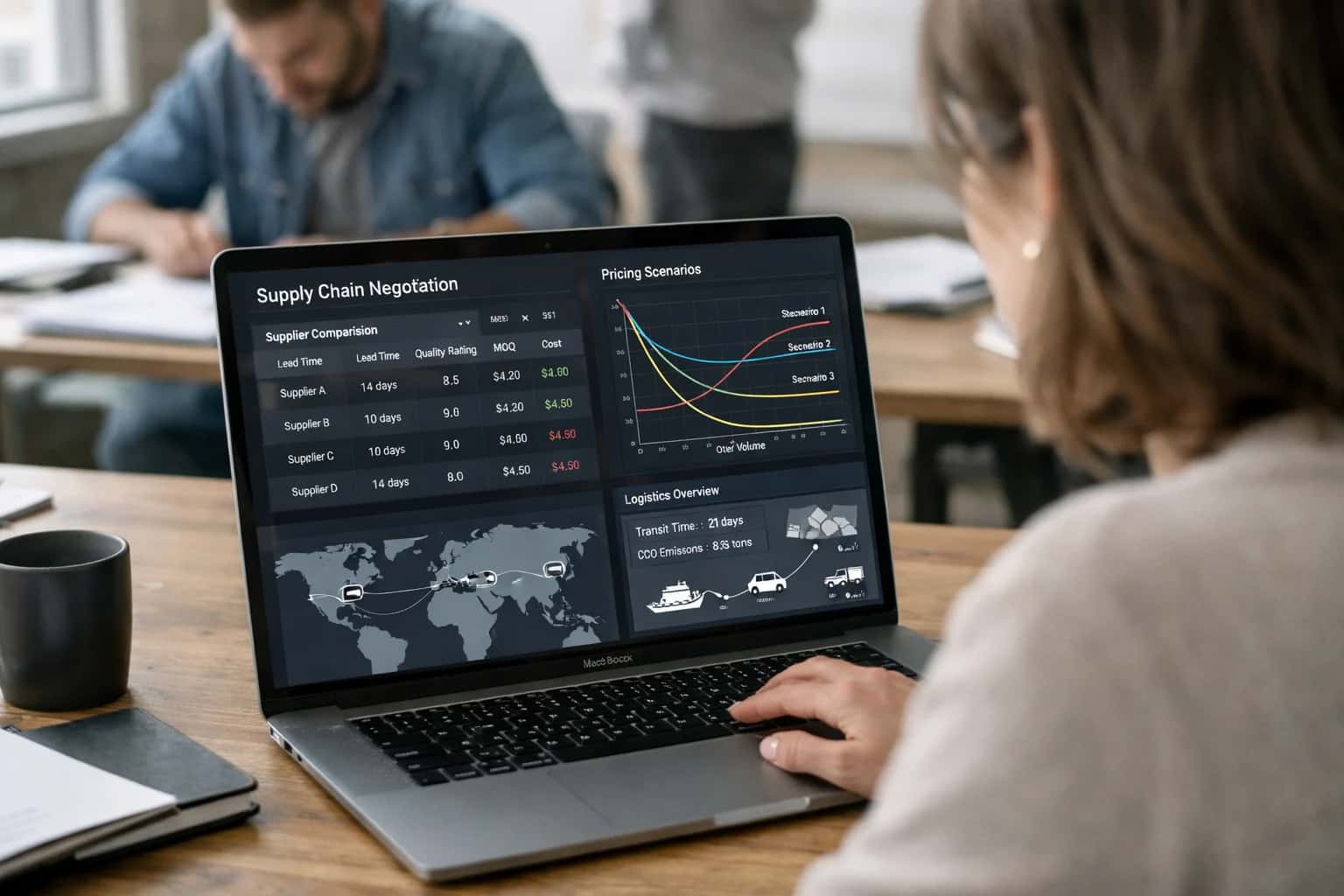
AI-HUMAN COLLABORATION
What is a Supply Chain Disruption Analyst Used For?
A Supply Chain Disruption Analyst is an AI teammate that transforms reactive firefighting into proactive risk management. It continuously monitors global events and logistics data to predict bottlenecks before they cause costly delays.
The AI analyst solves this by acting as a 24/7 digital sentinel. It ingests data from shipping APIs, weather feeds, news, and social sentiment to model your unique network. When a risk emerges—like a potential labor strike at a key port—it doesn't just alert you; it simulates impacts and recommends specific, ranked mitigations (e.g., reroute via Singapore, expedite air freight for critical SKUs). This shifts the human role from data gatherer to strategic decision-maker, enabling pre-emptive action that protects margins and service levels. For a deeper dive, see our framework for AI-Human Collaboration and Super-Agency Frameworks or explore Supply Chain Resilience and Logistics Intelligence.
SUPPLY CHAIN DISRUPTION ANALYST
Common Use Cases: From Prediction to Prescription
Move from reactive firefighting to proactive orchestration. These AI-powered use cases transform your supply chain from a cost center into a competitive moat by predicting disruptions and prescribing optimal responses.
01
Dynamic Risk Sensing & Early Warning
Traditional monitoring misses subtle, interconnected signals. An AI analyst continuously ingests global event data—from geopolitical news and port closures to weather anomalies and social sentiment—to identify emerging risks weeks before they impact your lanes.
- Example: Flag potential delays from a labor strike at a key Asian port by analyzing local news and union activity, allowing for rerouting 10 days in advance.
- ROI Driver: Reduces surprise stockouts by 40% and cuts expedited freight costs by 25%.
02
Prescriptive Mitigation & Scenario Planning
Knowing a disruption is coming isn't enough. The AI moves from prediction to prescription, simulating thousands of mitigation scenarios in minutes. It evaluates cost, time, and reliability trade-offs to recommend the optimal action.
- Prescribes actions like: 'Switch 60% of volume to Port B, activate secondary supplier C, and increase safety stock for SKU-123 by 15%.'
- Business Impact: Enables decision-makers to act with confidence, reducing mean time to resolution (MTTR) by 65% and protecting margin.
03
Autonomous Supplier & Carrier Performance Management
Manual scorecards are outdated and reactive. The AI analyst acts as an autonomous procurement agent, continuously evaluating supplier and carrier performance against real-time benchmarks for on-time delivery, quality, and cost.
- Continuously negotiates and triggers automated RFQs when performance dips or market rates shift.
- Quantifiable Benefit: Achieves 5-8% annual savings on freight and procurement spend through dynamic optimization and reduced maverick spending.
04
Inventory Optimization & Demand-Supply Rebalancing
Static inventory models fail in volatile markets. This AI applies multi-echelon inventory optimization powered by real-time demand signals and disruption forecasts. It dynamically rebalances stock across nodes to maximize service levels with less capital tied up.
- Automatically generates purchase orders and inter-warehouse transfer requests to prevent bottlenecks.
- ROI Evidence: Typically increases inventory turns by 20-30% while improving fill rates by 3-5 percentage points.
05
Logistics Control Tower & ETA Intelligence
Provide customers and internal teams with predictive, reliable ETAs. The AI control tower integrates live telemetry, traffic, and customs data to provide accurate arrival times and automatically notify stakeholders of delays, along with revised plans.
- Shifts customer service from reactive 'Where's my order?' calls to proactive status updates.
- Value Created: Improves customer satisfaction (CSAT) scores by 15+ points and reduces inbound logistics queries by 70%.
06
Resilience Modeling & Network Design
Stress-test your supply chain before a crisis hits. Use the AI analyst to run 'digital twin' simulations of your end-to-end network, modeling the impact of hurricanes, trade policy shifts, or supplier bankruptcies.
- Identifies single points of failure and recommends strategic changes, like dual-sourcing critical components or adding a regional fulfillment hub.
- Strategic Advantage: Builds a quantified case for capital investments in resilience, future-proofing operations against black swan events.
SUPPLY CHAIN DISRUPTION ANALYST
How It Works: The AI-Human Collaboration Framework
Modern supply chains are fragile, reactive systems. This framework introduces an AI analyst as a proactive teammate, transforming disruption management from a costly scramble into a strategic advantage.
Supply chain leaders face a constant barrage of invisible threats—port closures, supplier insolvencies, geopolitical shifts—that materialize as costly delays and stockouts. Traditional monitoring is manual, slow, and siloed, leaving teams perpetually reactive. The pain point is a lack of predictive insight, forcing expensive expedited shipping and lost revenue while teams scramble for information. This operational fragility directly impacts customer trust and the bottom line.
The AI analyst acts as a 24/7 sensor, ingesting thousands of global data streams—news, logistics APIs, weather, satellite imagery—to identify risks weeks earlier. It doesn't just alert; it recommends specific mitigations, such as rerouting shipments or activating alternate suppliers, with projected cost/impact analysis. This shifts the human role to strategic decision-making, approving AI-generated playbooks. Measurable outcomes include a 15-30% reduction in expedited freight costs and a 20% improvement in on-time delivery rates, turning resilience into a competitive moat. Explore our related insights on Supply Chain Resilience and Logistics Intelligence and Agentic Enterprise Orchestration.
Enabling Efficiency, Speed & Accuracy
Intelligent Analysis, Decision & Execution
We build AI systems for teams that need search across company data, workflow automation across tools, or AI features inside products and internal software.
Talk to Us
Search across company data
Give teams answers from docs, tickets, runbooks, and product data with sources and permissions.
Useful when people spend too long searching or get different answers from different systems.
Enterprise searchRAGPermissions
Read more
Automate internal workflows
Use AI to route work, draft outputs, trigger actions, and keep approvals and logs in place.
Useful when repetitive work moves across multiple tools and teams.
AI agentsWorkflow automationGovernance
Read more
Add AI to products and internal tools
Build assistants, guided actions, or decision support into the software your team or customers already use.
Useful when AI needs to be part of the product, not a separate tool.
AI integrationDecision supportModel routing
Read moreSUPPLY CHAIN DISRUPTION ANALYST
Real-World Examples & ROI
Move from reactive firefighting to proactive resilience. These examples demonstrate how AI-driven disruption analysts deliver measurable ROI by predicting bottlenecks and prescribing mitigations before they impact your bottom line.
01
Predict Port Congestion & Reroute Freight
An AI analyst monitors satellite imagery, port authority feeds, and weather data to predict congestion at major hubs like Los Angeles or Rotterdam weeks in advance. It automatically evaluates alternative routes and carriers, presenting cost/benefit trade-offs.
- Real Example: A global electronics manufacturer avoided a 3-week delay by rerouting a critical component shipment via air freight, justified by the AI's forecast of a $12M potential revenue loss from a stockout.
- ROI Driver: Reduces expedited shipping premiums by 15-25% and prevents costly production line stoppages.
02
Mitigate Supplier Risk with Financial & Event Monitoring
The system continuously analyzes news, financial filings, and geopolitical events for tier-2 and tier-3 suppliers that are invisible to traditional risk tools. It flags potential insolvencies or political instability, triggering a pre-approved diversification plan.
- Real Example: An automotive OEM received an alert on a key battery component supplier facing regulatory action. The AI recommended and initiated qualification of two alternate suppliers, preventing a 6-month launch delay for a new EV model.
- ROI Driver: Protects against single-point-of-failure risks that can halt production for months, safeguarding multi-million dollar product launches.
03
Optimize Safety Stock with Dynamic Demand-Sensing
Instead of static, historical safety stock levels, the AI analyst integrates real-time point-of-sale data, promotional calendars, and even social sentiment to dynamically adjust inventory targets. It factors in current lead times and disruption probabilities.
- Real Example: A consumer packaged goods company used this to reduce safety stock for 300+ SKUs by 18% while simultaneously improving in-stock rates by 2.5%, freeing up $47M in working capital.
- ROI Driver: Direct working capital release and reduced carrying costs, without increasing stockout risk.
04
Automate Force Majeure & Contractual Compliance
When a disruptive event occurs (e.g., an earthquake), the AI instantly cross-references impacted shipment IDs with contractual force majeure clauses and carrier service level agreements (SLAs). It generates breach notifications and gathers supporting evidence automatically.
- Real Example: A retailer automatically filed claims for 22 delayed shipments after a hurricane, recovering over $850,000 in penalties from carriers, a process that previously took a legal team 3 months.
- ROI Driver: Turns supply chain disruptions from pure cost centers into potential recovery opportunities, while ensuring contractual compliance.
05
Model "What-If" Scenarios for Strategic Sourcing
Enable procurement teams to stress-test sourcing strategies against hundreds of potential disruption scenarios (tariff changes, regional conflict, pandemic). The AI quantifies cost, carbon, and resilience trade-offs of dual-sourcing or nearshoring.
- Real Example: A medical device company modeled shifting 30% of production from Asia to Mexico. The AI projected a 12% cost increase but a 65% improvement in resilience score, justifying the strategic shift to the board.
- ROI Driver: Informs multi-million dollar capital allocation decisions with data-driven risk intelligence, avoiding costly strategic missteps.
06
Integrate with Logistics Control Towers for Autonomous Action
The disruption analyst acts as the cognitive core for a Logistics Control Tower. It doesn't just alert; it can execute pre-authorized mitigations—like automatically booking backup freight capacity on a spot market or triggering a pre-negotiated alternate supplier contract.
- Real Example: A control tower AI detected a looming trucker strike in Europe. It autonomously re-allocated warehouse labor to pre-pull orders and secured intermodal rail capacity, maintaining 98% on-time delivery while competitors faced weeks of delays.
- ROI Driver: Compresses response time from days to minutes, turning supply chain into a competitive advantage. This aligns with our focus on Agentic Enterprise Orchestration and Workflow Autonomy.

About the author
Prasad Kumkar
CEO & MD, Inference Systems
Prasad Kumkar is the CEO & MD of Inference Systems and writes about AI systems architecture, LLM infrastructure, model serving, evaluation, and production deployment. Over 5+ years, he has worked across computer vision models, L5 autonomous vehicle systems, and LLM research, with a focus on taking complex AI ideas into real-world engineering systems.
His work and writing cover AI systems, large language models, AI agents, multimodal systems, autonomous systems, inference optimization, RAG, evaluation, and production AI engineering.
LinkedIn
Limited slotsGet a Free AI Consultation
Partnered with leading AI, data, and software stack.





How We Work
Custom AI workflows for your Business
One-fit-all AI don't work for modern businesses. At Inferensys, we aim to understand your business & custom requirements; which we use to define most efficient agentic workflows, the data, and the tools for your business.
01
Review the use case
We understand the task, the users, and where AI can actually help.
Read more02
Pick the right approach
We define what needs search, automation, or product integration.
Read more03
Build the first useful version
We implement the part that proves the value first.
Read more04
Improve from there
We add the checks and visibility needed to keep it useful.
Read moreThe first call is a practical review of your use case and the right next step.
Talk to Us