The Pain Point: Traditional supply chain negotiations are slow, reactive, and based on static contracts. Procurement teams struggle to adapt to volatile fuel costs, material shortages, or sudden demand spikes. This rigidity leads to inflated costs, missed delivery windows, and eroded margins, leaving companies vulnerable to market shocks. Manual renegotiation is a bottleneck, preventing agile responses to opportunity or risk.

Use Case
Dynamic Supply Chain Negotiator
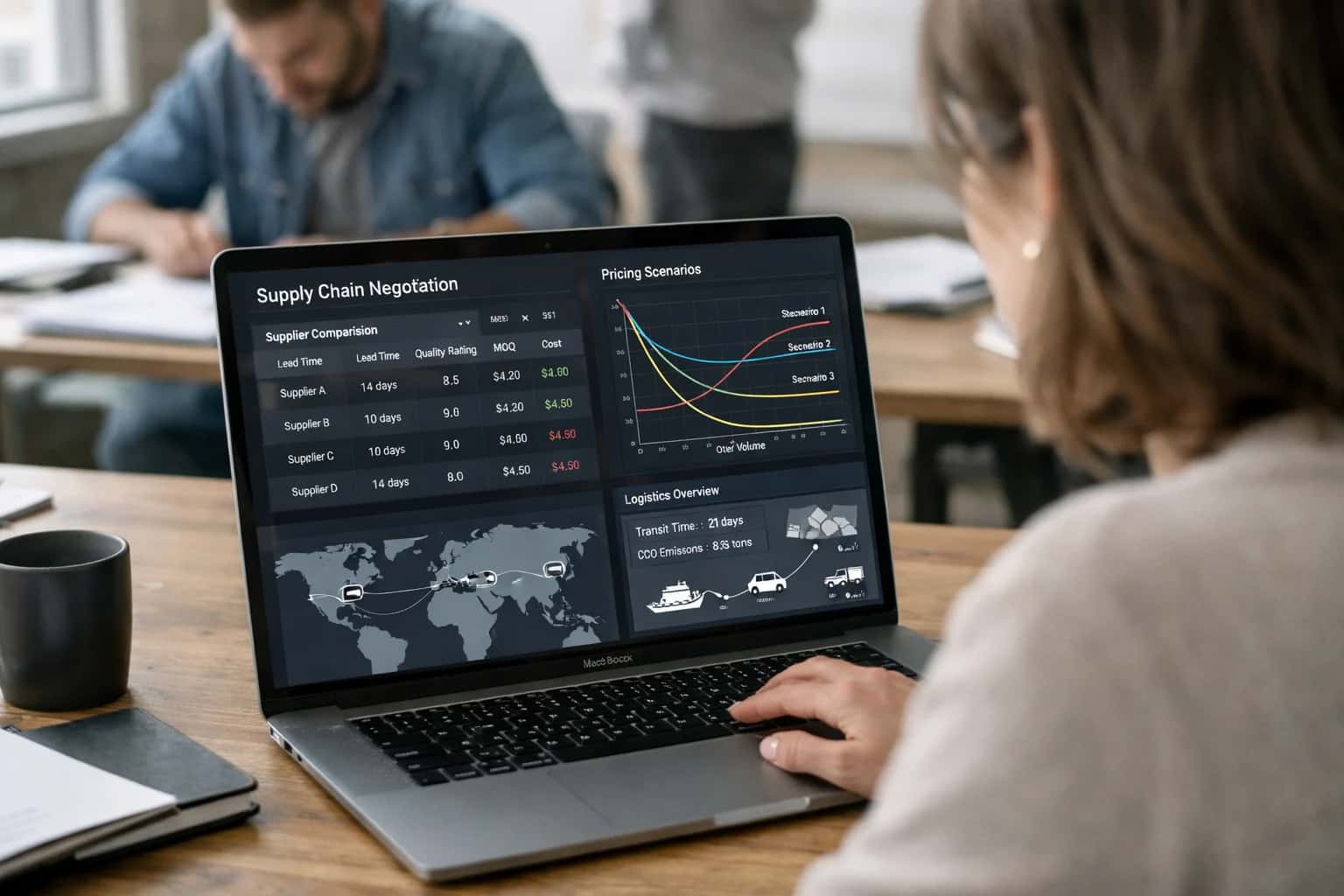
An AI agent that autonomously negotiates terms, pricing, and delivery schedules with suppliers in real-time based on market conditions, securing optimal terms and improving supply chain resilience.
AGENTIC WORKFLOW AUTONOMY
What is Dynamic Supply Chain Negotiator Used For?
An AI agent that autonomously negotiates terms, pricing, and delivery schedules with suppliers in real-time based on market conditions, securing optimal terms and improving supply chain resilience.
The AI Fix: A Dynamic Supply Chain Negotiator acts as a virtual procurement specialist. It continuously analyzes market data, internal inventory levels, and alternative supplier options. Using this intelligence, it autonomously engages in multi-round negotiations via email or APIs to secure optimal pricing, adjust delivery schedules, and lock in favorable terms—all in real-time. This transforms procurement from a cost center into a strategic, profit-protecting function. For more on autonomous workflows, see our pillar on Agentic Enterprise Orchestration and Workflow Autonomy.
DYNAMIC SUPPLY CHAIN NEGOTIATOR
Common Use Cases: Where Autonomous Negotiation Drives ROI
Move from reactive procurement to proactive, AI-driven supply chain orchestration. These use cases demonstrate how autonomous negotiation agents secure optimal terms, mitigate risk, and deliver measurable financial returns.
01
Real-Time Raw Material Sourcing
An AI agent continuously monitors commodity markets and supplier capacity, autonomously negotiating spot and forward contracts to lock in favorable pricing and secure supply before shortages occur. Key benefits include:
- 15-25% reduction in raw material costs by exploiting market dips.
- Supply assurance through predictive risk modeling and proactive contract execution.
- Example: A chemical manufacturer uses the agent to hedge against price volatility in key feedstocks, saving millions annually.
02
Dynamic Freight & Logistics Contracting
The agent negotiates with carriers and 3PLs in real-time, adjusting rates and capacity based on fuel costs, lane congestion, and shipment urgency. This transforms logistics from a fixed cost to a variable, optimized expense:
- Optimized routing that balances speed and cost, reducing freight spend by 10-18%.
- Automated carrier selection based on real-time performance data and negotiated SLAs.
- Example: A global retailer uses the agent to manage peak-season logistics, avoiding premium spot market rates by securing capacity in advance.
03
Automated MRO (Maintenance, Repair, Operations) Procurement
For thousands of low-value, high-frequency MRO purchases, the agent autonomously sources, negotiates, and orders from pre-vetted suppliers. This eliminates manual PO processing and captures volume discounts:
- 60-70% reduction in procurement cycle time and administrative overhead.
- Consolidated spend leading to 5-10% better pricing through aggregated negotiations.
- Example: A manufacturing plant automates its spare parts procurement, ensuring critical components are always in stock at the best price.
04
Resilient Multi-Tier Supplier Orchestration
The agent maps the multi-tier supply network and negotiates contingency contracts and buffer stock agreements with secondary suppliers to build resilience. This mitigates the risk of single-source dependency:
- Proactive risk mitigation by diversifying supply sources before a disruption occurs.
- Cost-effective resilience through negotiated standby agreements, avoiding panic buying.
- Example: An automotive OEM uses the agent to secure alternative chip suppliers, preventing production line stoppages.
05
Sustainability-Linked Contract Negotiation
The agent negotiates contracts that tie pricing and terms to supplier ESG performance (e.g., carbon emissions, ethical sourcing). This aligns procurement with corporate sustainability goals while managing cost:
- Automated compliance with Scope 3 emissions reporting requirements.
- Incentivized supplier improvement through financial rewards for hitting sustainability milestones.
- Example: A consumer goods company uses the agent to embed carbon reduction targets into packaging supplier contracts.
06
Capacity Reservation & Demand Shaping
By analyzing internal demand forecasts, the agent negotiates flexible capacity reservations with key suppliers, enabling the business to shape demand and secure better terms. This turns forecasting into a strategic lever:
- Guaranteed capacity during demand surges without paying exorbitant premiums.
- Improved supplier relationships through transparent, forecast-driven collaboration.
- Example: An electronics company uses the agent to reserve factory capacity with its CM partner months in advance, securing priority and favorable payment terms.
DYNAMIC SUPPLY CHAIN NEGOTIATOR
How It Works: The Architecture of Autonomous Negotiation
Traditional procurement is a slow, rigid process that fails to adapt to market volatility, leaving millions in savings and resilience on the table. The Dynamic Supply Chain Negotiator is an AI agent that autonomously executes real-time, multi-round negotiations to secure optimal terms.
The pain point is a static, human-led process. Procurement teams rely on quarterly RFPs and fixed contracts, unable to react to sudden price shifts, port delays, or supplier disruptions. This rigidity leads to inflated costs, missed discounts, and brittle supply chains. In today's volatile market, this isn't just inefficiency—it's a direct threat to profitability and operational continuity, locking in suboptimal terms for months.
The AI fix is an autonomous agent built on agentic orchestration. It ingests real-time data—market indices, logistics costs, inventory levels—and uses an LLM as a reasoning engine to formulate negotiation strategies. The agent then executes multi-step workflows, engaging suppliers via API to dynamically negotiate pricing, payment terms, and delivery schedules, securing 3-8% better terms and building inherent supply chain resilience. Explore our broader vision for Agentic Enterprise Orchestration and Workflow Autonomy.
Enabling Efficiency, Speed & Accuracy
Intelligent Analysis, Decision & Execution
We build AI systems for teams that need search across company data, workflow automation across tools, or AI features inside products and internal software.
Talk to Us
Search across company data
Give teams answers from docs, tickets, runbooks, and product data with sources and permissions.
Useful when people spend too long searching or get different answers from different systems.
Enterprise searchRAGPermissions
Read more
Automate internal workflows
Use AI to route work, draft outputs, trigger actions, and keep approvals and logs in place.
Useful when repetitive work moves across multiple tools and teams.
AI agentsWorkflow automationGovernance
Read more
Add AI to products and internal tools
Build assistants, guided actions, or decision support into the software your team or customers already use.
Useful when AI needs to be part of the product, not a separate tool.
AI integrationDecision supportModel routing
Read moreDYNAMIC SUPPLY CHAIN NEGOTIATOR
Real-World Examples & Early Adopters
See how leading enterprises are deploying autonomous AI negotiators to secure optimal terms, build resilience, and drive measurable ROI in volatile markets.
03
Compress Sourcing Cycle Times by 70%
A consumer goods company integrated the negotiator into its New Product Introduction (NPI) process. For packaging and logistics contracts, what was a 3-week manual RFP and negotiation cycle is now completed in under 3 days.
- Efficiency Gain: The agent drafts RFPs, analyzes responses, and negotiates SLAs concurrently.
- Business Value: Faster time-to-market for seasonal products, capturing early market share.
- CIO Justification: Reallocated 4 FTEs from tactical sourcing to strategic supplier development.
70%
Faster Sourcing
4 FTEs
Redeployed
04
Enforce Sustainability & Compliance in Real-Time
A food & beverage leader uses the agent to embed ESG criteria into every negotiation. The system autonomously:
- Validates supplier certifications (e.g., carbon footprint, ethical sourcing).
- Negotiates premium pricing for suppliers meeting higher sustainability tiers.
- Generates an audit trail for Scope 3 emissions reporting.
Outcome: Achieved 100% compliance with corporate sustainability pledges while maintaining cost targets, a key differentiator for ESG-focused investors.
05
Optimize Working Capital via Dynamic Payment Terms
A mid-market industrial distributor leveraged the negotiator's cash flow intelligence. The agent trades off unit price against payment terms, dynamically offering early payment discounts or requesting extended terms based on the company's real-time cash position and cost of capital.
- Financial Impact: Improved Days Payable Outstanding (DPO) by 15 days, freeing up $4.2M in working capital annually.
- Strategic Benefit: Created a flexible, self-funding mechanism for growth without additional debt.
$4.2M
Working Capital Freed
15 Days
DPO Improvement
06
From Cost Center to Profit Center
A 3PL (Third-Party Logistics) provider productized its internal negotiator as a managed service for clients. The AI agent now negotiates freight rates and capacity on behalf of hundreds of shippers, using aggregated buying power.
- New Revenue Stream: Service fees are tied to cost savings delivered, aligning with client ROI.
- Scale Advantage: The agent's learning improves with every negotiation across the network.
- Market Shift: Transforms procurement from an overhead function into a value-generating platform.

About the author
Prasad Kumkar
CEO & MD, Inference Systems
Prasad Kumkar is the CEO & MD of Inference Systems and writes about AI systems architecture, LLM infrastructure, model serving, evaluation, and production deployment. Over 5+ years, he has worked across computer vision models, L5 autonomous vehicle systems, and LLM research, with a focus on taking complex AI ideas into real-world engineering systems.
His work and writing cover AI systems, large language models, AI agents, multimodal systems, autonomous systems, inference optimization, RAG, evaluation, and production AI engineering.
LinkedIn
Limited slotsGet a Free AI Consultation
Partnered with leading AI, data, and software stack.





How We Work
Custom AI workflows for your Business
One-fit-all AI don't work for modern businesses. At Inferensys, we aim to understand your business & custom requirements; which we use to define most efficient agentic workflows, the data, and the tools for your business.
01
Review the use case
We understand the task, the users, and where AI can actually help.
Read more02
Pick the right approach
We define what needs search, automation, or product integration.
Read more03
Build the first useful version
We implement the part that proves the value first.
Read more04
Improve from there
We add the checks and visibility needed to keep it useful.
Read moreThe first call is a practical review of your use case and the right next step.
Talk to Us