Traditional inventory management is a reactive, manual process plagued by static rules and siloed data. This leads to two costly extremes: excess inventory that ties up working capital and incurs holding costs, and stockouts that result in lost sales, production delays, and eroded customer trust. The core pain point is a lack of real-time, holistic visibility and decision-making agility, forcing planners to rely on outdated forecasts and gut feelings.

Use Case
Dynamic Inventory Replenishment Orchestrator
An AI agent that autonomously manages inventory levels, places orders, and adjusts safety stock in real-time to optimize capital and prevent stockouts.
AGENTIC ENTERPRISE ORCHESTRATION
What is Dynamic Inventory Replenishment Orchestrator Used For?
This intelligent agent autonomously manages inventory levels across the supply chain, placing orders and adjusting safety stock in real-time to optimize capital and prevent stockouts.
The Dynamic Inventory Replenishment Orchestrator acts as a virtual inventory manager. It uses an LLM as a reasoning engine to autonomously analyze real-time signals—sales velocity, supplier lead times, market trends, and warehouse capacity—then executes multi-step workflows to place purchase orders, adjust safety stock parameters, and trigger expedited shipping. The outcome is a self-optimizing supply chain that reduces carrying costs by 15-25% and increases in-stock rates to over 98%, directly boosting profitability and service levels. This is a core component of our Agentic Enterprise Orchestration and Workflow Autonomy pillar, delivering the autonomous action promised by Multi-Agent System (MAS) Coordination.
DYNAMIC INVENTORY REPLENISHMENT ORCHESTRATOR
Common Use Cases
Transform inventory from a static cost center into a dynamic, self-optimizing asset. These use cases demonstrate how our AI agent delivers tangible ROI by autonomously managing stock levels, preventing lost sales, and freeing up working capital.
01
Eliminate Stockouts & Capture Lost Revenue
The Pain: Manual forecasting fails to predict demand spikes, leading to stockouts that directly lose sales and damage customer loyalty.
The AI Fix: Our orchestrator acts as a 24/7 inventory analyst, integrating real-time signals from POS systems, market trends, and even weather forecasts. It autonomously triggers replenishment orders before a stockout occurs, ensuring optimal shelf availability.
- Real Example: A national retailer reduced out-of-stock events by 35% within one quarter, capturing an estimated $12M in previously lost revenue.
- ROI Driver: Direct revenue protection and increased customer lifetime value.
02
Optimize Working Capital & Reduce Carrying Costs
The Pain: Excess 'safety stock' ties up millions in working capital and incurs high storage and insurance costs.
The AI Fix: The agent dynamically calculates precision safety stock levels for each SKU based on real supplier lead times and demand volatility. It reduces blanket overstocking, freeing capital for strategic investment.
- Real Example: A consumer goods manufacturer reduced total inventory value by 22% while maintaining service levels, freeing over $50M in working capital.
- ROI Driver: Reduced capital tied up in inventory and lower warehousing expenses.
03
Automate Multi-Tier Supplier Replenishment
The Pain: Managing replenishment across a complex network of distributors, wholesalers, and manufacturers is slow, error-prone, and lacks coordination.
The AI Fix: The orchestrator acts as a central command hub, autonomously placing orders with the optimal supplier based on cost, availability, and logistics. It manages the entire workflow from PO creation to tracking.
- Real Example: An automotive parts distributor automated 80% of its replenishment orders, cutting procurement cycle time by 60% and reducing manual errors to near zero.
- ROI Driver: Labor cost savings, improved procurement efficiency, and stronger supplier relationships.
04
Mitigate Supply Chain Shock with Predictive Buffering
The Pain: Unexpected port delays, geopolitical events, or supplier issues cause catastrophic disruptions, forcing expensive air freight or production halts.
The AI Fix: By analyzing global logistics data and news feeds, the agent identifies early risk signals. It can autonomously initiate strategic buffer orders or pivot to alternative suppliers proactively, not reactively.
- Real Example: An electronics manufacturer avoided a 3-week production stoppage by pre-emptively sourcing a critical component, saving an estimated $8M in potential downtime costs.
- ROI Driver: Business continuity protection and avoidance of expedited shipping premiums.
05
Enable Perpetual Inventory & Cycle Count Accuracy
The Pain: Annual physical inventory counts are disruptive, and perpetual inventory systems are plagued by data inaccuracies from receiving/shipping errors.
The AI Fix: The orchestrator integrates with IoT sensors and WMS data to maintain a continuously accurate digital twin of inventory. It autonomously reconciles discrepancies and schedules targeted cycle counts for high-value or high-variance items.
- Real Example: A logistics provider achieved 99.8% inventory record accuracy, reducing annual count labor by 70% and eliminating costly fulfillment mistakes.
- ROI Driver: Operational efficiency, reduced shrinkage, and perfect order fulfillment.
06
Seamless Integration with Broader Agentic Orchestration
The Pain: Siloed inventory systems create friction with procurement, finance, and sales, leading to suboptimal decisions.
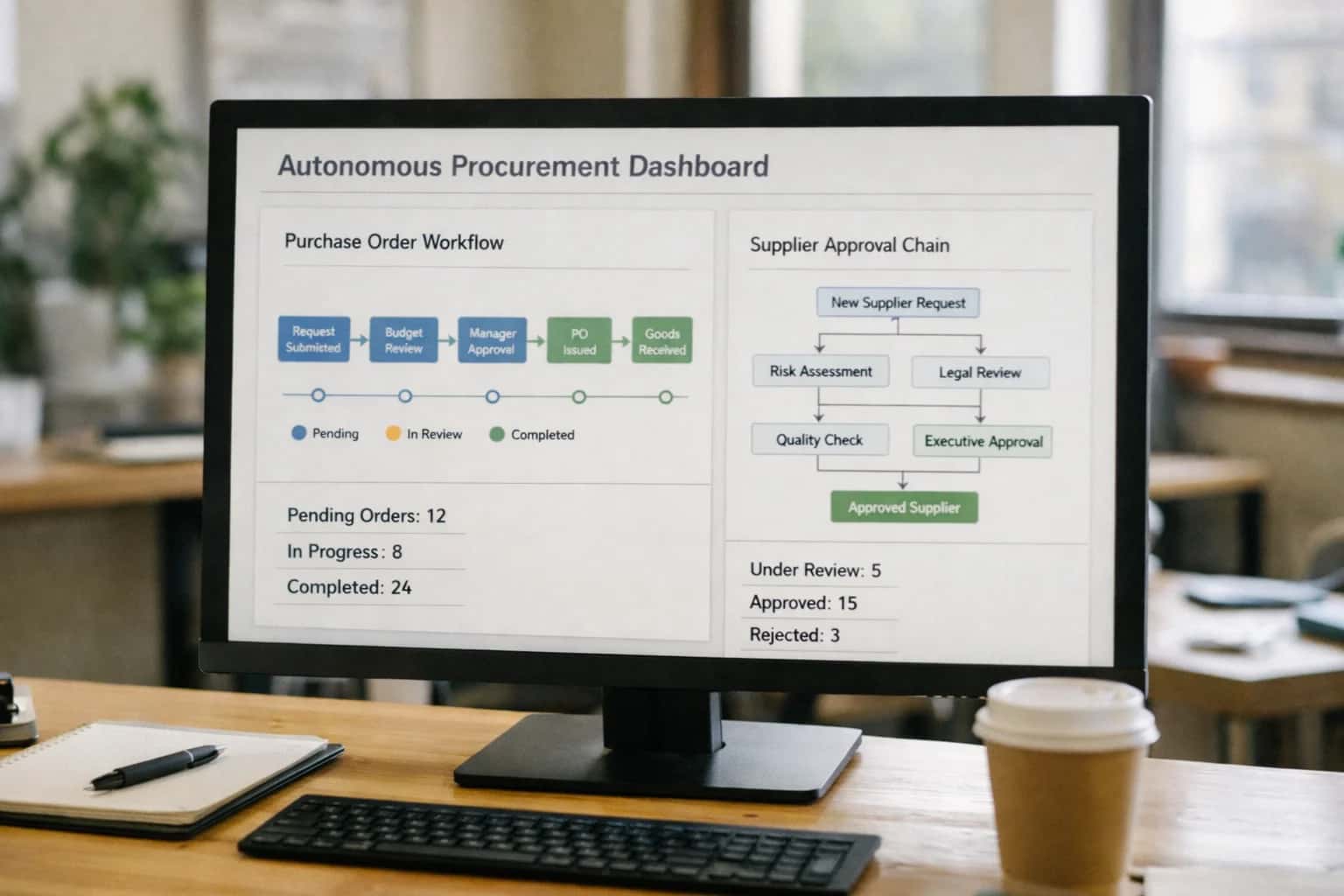
The AI Fix: This agent is designed to collaborate with other Agentic Enterprise Orchestration systems. It can directly trigger our Autonomous Procurement Orchestrator for ordering and provide real-time data to our Dynamic Supply Chain Negotiator.
- Real Example: A unified agentic workflow from demand sensing to payment reduced end-to-end supply chain decision latency from days to minutes.
- ROI Driver: Holistic process automation, superior cross-functional outcomes, and a foundation for autonomous supply chain operations.
DYNAMIC INVENTORY REPLENISHMENT ORCHESTRATOR
How It Works: The AI Orchestration Engine
This intelligent agent autonomously manages inventory levels across the supply chain, placing orders and adjusting safety stock in real-time to optimize capital and prevent stockouts.
The traditional pain point is a reactive, siloed supply chain. Static safety stock formulas and manual reorder processes fail to account for real-world volatility—sudden demand spikes, supplier delays, or logistics bottlenecks. This leads to a costly double bind: excess inventory tying up working capital and stockouts causing lost sales and eroding customer trust. The financial impact is direct, hitting both the balance sheet and the income statement.
Our AI Orchestration Engine acts as a virtual inventory manager. It integrates real-time signals from ERP, point-of-sale, and supplier systems, using an LLM as a 'reasoning engine' to dynamically plan and execute replenishment. The outcome is a self-optimizing system that reduces carrying costs by 15-25% and cuts stockouts by over 50%, transforming inventory from a cost center into a strategic asset. Explore our broader vision for Agentic Enterprise Orchestration and Workflow Autonomy or see how this connects to Dynamic Supply Chain Orchestration.
Enabling Efficiency, Speed & Accuracy
Intelligent Analysis, Decision & Execution
We build AI systems for teams that need search across company data, workflow automation across tools, or AI features inside products and internal software.
Talk to Us
Search across company data
Give teams answers from docs, tickets, runbooks, and product data with sources and permissions.
Useful when people spend too long searching or get different answers from different systems.
Enterprise searchRAGPermissions
Read more
Automate internal workflows
Use AI to route work, draft outputs, trigger actions, and keep approvals and logs in place.
Useful when repetitive work moves across multiple tools and teams.
AI agentsWorkflow automationGovernance
Read more
Add AI to products and internal tools
Build assistants, guided actions, or decision support into the software your team or customers already use.
Useful when AI needs to be part of the product, not a separate tool.
AI integrationDecision supportModel routing
Read moreDYNAMIC INVENTORY REPLENISHMENT ORCHESTRATOR
Implementation Roadmap: From Pilot to Scale
A phased approach to deploying an intelligent agent that autonomously manages inventory levels, optimizing working capital and preventing stockouts.
01
Phase 1: Pilot & Proof of Value
Deploy the orchestrator on a single product line or distribution center to validate core logic and establish a baseline ROI. This phase focuses on integrating with existing ERP and supply chain data to demonstrate autonomous order placement and safety stock adjustments.
- Real-World Example: A consumer electronics pilot reduced stockouts by 15% and cut excess inventory by 22% within the first quarter.
- Key Activities: Data pipeline setup, agent behavior tuning, and establishing key performance indicators (KPIs) like inventory turnover ratio and service level attainment.
02
Phase 2: Business Unit Expansion
Scale the proven agent across a full business unit or region. This phase integrates supplier APIs and real-time logistics data, enabling the agent to negotiate lead times and dynamically reroute orders based on carrier performance.
- Quantified Benefit: A mid-market manufacturer expanded the orchestrator to three plants, achieving a 30% reduction in manual planner workload and a 12% improvement in working capital efficiency.
- Focus: Building trust with procurement and logistics teams, and refining the agent's multi-criteria decision-making for cost vs. service level trade-offs.
03
Phase 3: Enterprise Orchestration
Achieve full-scale, end-to-end autonomy by connecting the inventory agent to sibling financial and procurement agents. The system now acts as a unified supply chain brain, triggering payments, managing supplier relationships, and optimizing cash flow in a closed loop.
- ROI Driver: At this stage, enterprises report total inventory carrying cost reductions of 18-25% and near-elimination of expedited freight charges.
- Integration Points: Seamless handoffs to our Autonomous Procurement Orchestrator and Intelligent Invoice-to-Pay Agent create a fully agentic back-office.
04
Phase 4: Predictive & Adaptive Intelligence
Leverage the orchestrator's operational data to feed predictive models for demand sensing and risk mitigation. The agent evolves from reactive to proactively shaping supply chain strategy.
- Advanced Capability: The system uses external signals (weather, geopolitical events, commodity prices) to pre-position safety stock and suggest alternative sourcing strategies before disruptions occur.
- Outcome: Transforms inventory from a cost center into a strategic competitive lever, enabling faster response to market shifts and capturing emergent demand.
05
ROI Justification for the CIO
The business case is built on hard cost savings and released capital, not just efficiency gains.
- Direct Cost Reduction: Slash costs associated with excess inventory, stockout penalties, and manual planning labor.
- Working Capital Optimization: Free up millions in cash trapped in safety stock, improving the cash conversion cycle.
- Strategic Advantage: Move from a fragile, human-dependent supply chain to a resilient, autonomous system that operates 24/7, adapting to volatility faster than competitors.
06
Overcoming Implementation Challenges
Acknowledge and plan for common hurdles to ensure a smooth scale-up.
- Data Quality & Integration: Start with the cleanest data streams first. Use the pilot to pressure-test ERP connectivity.
- Change Management: Frame the agent as a planner's copilot, automating tedious tasks and elevating their role to exception management and strategy.
- Governance & Oversight: Implement clear human-in-the-loop controls for high-value or anomalous decisions, ensuring trust and auditability as the system scales.

About the author
Prasad Kumkar
CEO & MD, Inference Systems
Prasad Kumkar is the CEO & MD of Inference Systems and writes about AI systems architecture, LLM infrastructure, model serving, evaluation, and production deployment. Over 5+ years, he has worked across computer vision models, L5 autonomous vehicle systems, and LLM research, with a focus on taking complex AI ideas into real-world engineering systems.
His work and writing cover AI systems, large language models, AI agents, multimodal systems, autonomous systems, inference optimization, RAG, evaluation, and production AI engineering.
LinkedIn
Limited slotsGet a Free AI Consultation
Partnered with leading AI, data, and software stack.





How We Work
Custom AI workflows for your Business
One-fit-all AI don't work for modern businesses. At Inferensys, we aim to understand your business & custom requirements; which we use to define most efficient agentic workflows, the data, and the tools for your business.
01
Review the use case
We understand the task, the users, and where AI can actually help.
Read more02
Pick the right approach
We define what needs search, automation, or product integration.
Read more03
Build the first useful version
We implement the part that proves the value first.
Read more04
Improve from there
We add the checks and visibility needed to keep it useful.
Read moreThe first call is a practical review of your use case and the right next step.
Talk to Us