Deploying AI in defense, intelligence, or critical infrastructure requires a zero-trust architecture with no external network connectivity. Air-gapped systems are the only solution for data where compromise is unacceptable.

Service
Air-Gapped AI System Deployment
Design and implement fully isolated AI training and inference environments with no external network connectivity, providing the highest security assurance for defense, intelligence, and critical infrastructure applications where data exfiltration is unacceptable.
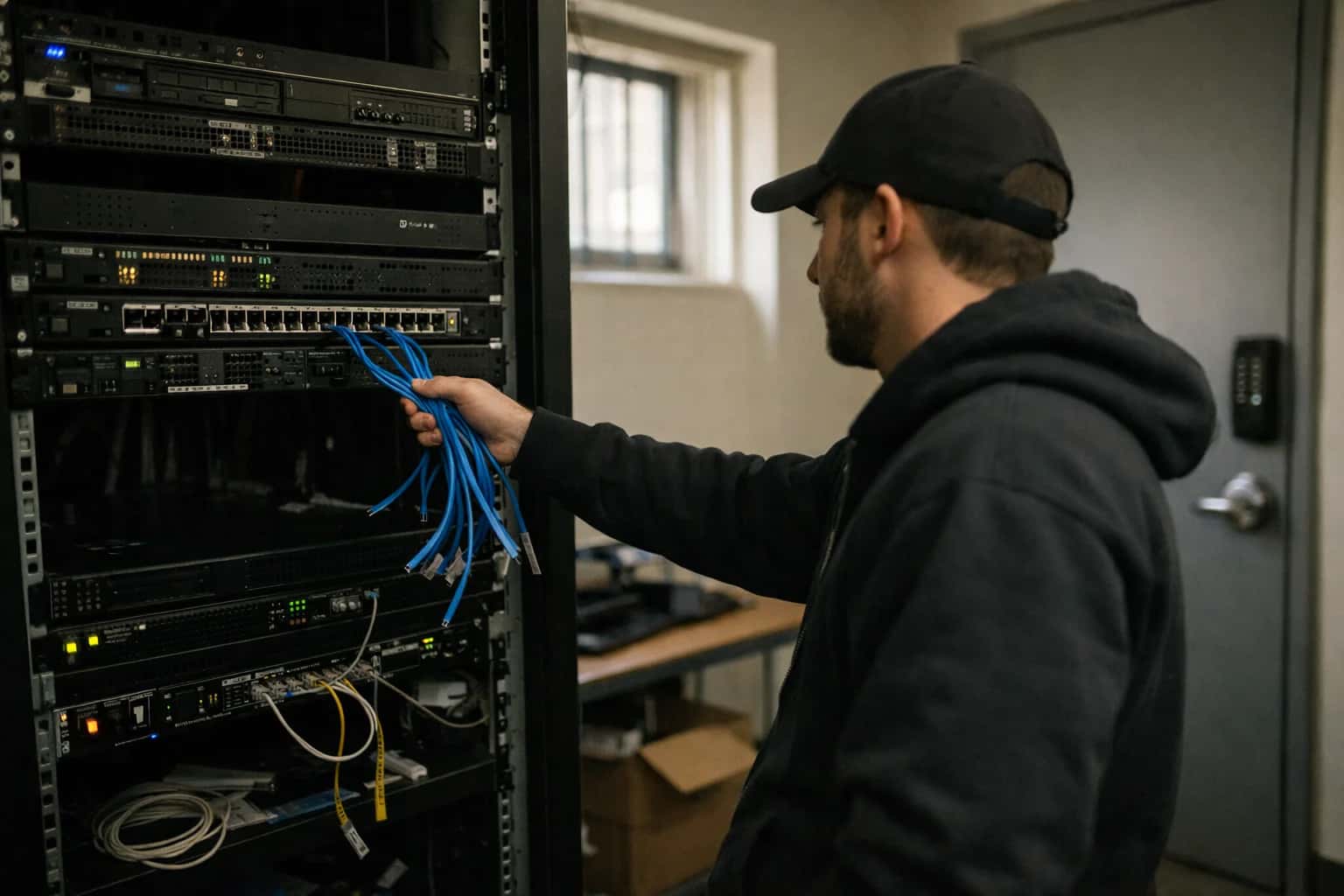
AIR-GAPPED AI SYSTEM DEPLOYMENT
The Challenge of Deploying AI in High-Security Environments
Design and implement fully isolated AI environments where data exfiltration is physically impossible.
We engineer end-to-end AI pipelines—from training to inference—that operate entirely within your secure perimeter, delivering 99.9% uptime SLAs without ever touching the public internet.
Our deployment delivers:
- Physical and logical isolation using custom
Kubernetesclusters andOpenStackprivate clouds. - On-premises model training for sensitive datasets, with 2-4 week MVP timelines.
- Hardware-segmented inference on dedicated
NVIDIAGPUs to prevent resource contention. - Provable audit trails for all data lineage and model activity, essential for
FedRAMPandEU AI Actcompliance. - Localized MLOps tooling for version control, CI/CD, and monitoring that never requires external APIs.
This approach is foundational for Sovereign AI Infrastructure Development. For related architectures, explore our services on Sovereign AI Data Center Design and Confidential Computing for AI Workloads.
TANGIBLE SECURITY AND OPERATIONAL GAINS
Business Outcomes of a Properly Deployed Air-Gapped AI System
Deploying a fully isolated AI environment is a strategic investment that delivers measurable, high-impact returns beyond basic compliance. These are the concrete outcomes our clients achieve.
01
Eliminate Data Exfiltration Risk
Achieve absolute data sovereignty by physically and logically severing all external network connections. This prevents remote attacks, insider threats, and supply chain compromises from accessing your most sensitive AI models and training datasets, a critical requirement for defense and intelligence applications.
0
External Attack Vectors
100%
Data Residency Assurance
02
Accelerate Regulatory Compliance
Meet the strictest mandates of frameworks like the EU AI Act, ITAR, and internal governance policies by design. Our air-gapped deployments provide the provable audit trails and technical safeguards needed for certification, reducing time-to-compliance from months to weeks.
> 70%
Faster Audit Readiness
ISO 27001
Aligned Foundation
03
Guaranteed Model & Supply Chain Integrity
Ensure the provenance and integrity of every model weight and software component. By controlling the entire software bill of materials (SBOM) within the isolated environment, you eliminate risks from poisoned training data, compromised pre-trained models, or malicious upstream dependencies.
End-to-End
Supply Chain Control
Verifiable
Model Provenance
04
Predictable, Isolated Performance
Eliminate noisy neighbor effects and public cloud latency spikes. Dedicated, on-premises AI hardware (GPUs/NPUs) within the air-gapped environment delivers consistent, high-performance inference and training, essential for time-sensitive operational intelligence and real-time analytics.
99.9%
Performance SLA
< 1ms
Intra-Cluster Latency
05
Operational Continuity in Contested Environments
Maintain full AI capability during network outages, cyber attacks, or geopolitical disruptions. Air-gapped systems enable continuous operation of critical decision-support and autonomous systems without reliance on external services or updates.
24/7/365
Autonomous Operation
Zero Trust
Inherent Architecture
06
Long-Term Total Cost of Ownership (TCO) Control
Move from variable, unpredictable public cloud AI spend to a fixed, capital investment model. While upfront costs exist, our optimized architectures for Sovereign AI Infrastructure eliminate egress fees, provide hardware depreciation benefits, and protect against future vendor price inflation.
Predictable
Infrastructure Spend
No Egress
Data Transfer Costs
A structured, risk-mitigated approach to total isolation
Phased Deployment Timeline and Deliverables
Our proven methodology for deploying fully air-gapped AI systems, from initial assessment to operational handover, ensuring zero data exfiltration risk.
| Phase & Key Activities | Timeline | Primary Deliverables | Client Involvement |
|---|---|---|---|
Phase 1: Security Architecture & Design Review | 1-2 weeks | Threat model document, Approved network segmentation diagram, Hardware Bill of Materials (BOM) | Provide network topology maps, Approve security requirements |
Phase 2: On-Premise Environment Build-Out | 2-3 weeks | Racked & configured hardware, Validated air-gapped network, Base OS & container platform images | Facility access, Power & cooling validation |
Phase 3: Secure Data Ingestion & Model Transfer | 1 week | Cryptographically verified data on target system, Validated model weights in secure registry, Data lineage report | Provide encrypted source data & models, Witness verification process |
Phase 4: MLOps Pipeline & Validation Deployment | 2-3 weeks | Operational training/inference pipelines, Automated security scanning integrated, Performance & accuracy validation report | Review validation results, Approve pipeline for production data |
Phase 5: Staging & Production Cutover | 1-2 weeks | Production-ready AI application, Full system documentation & runbooks, Incident response plan | User acceptance testing (UAT), Final security sign-off |
Phase 6: Knowledge Transfer & Support Handoff | 1 week | Admin & operator training completed, 30-day support SLA activated, Architecture as-code repository | Key personnel training attendance, Support contract execution |
Total Project Timeline | 8-12 weeks | Fully operational, air-gapped AI system | — |
Ongoing Support Options | Post-handoff | Optional managed service with 99.9% uptime SLA, Quarterly security patching cadence | — |
HIGH-ASSURANCE USE CASES
Primary Applications for Air-Gapped AI Systems
Air-gapped AI deployment is engineered for scenarios where data sovereignty and security are non-negotiable. These isolated environments are critical for protecting sensitive information and ensuring operational integrity in highly regulated and contested domains.
01
Classified Intelligence Analysis
Deploy multimodal AI models for processing top-secret signals intelligence (SIGINT), geospatial imagery (GEOINT), and open-source intelligence (OSINT) within secure facilities. Ensures analysis of sensitive data never touches an external network, preventing exfiltration.
Learn about secure model development in our guide to Defense and National Intelligence AI.
Zero
External Data Egress
FIPS 140-3
Compliant
02
Critical Infrastructure Protection
Implement predictive maintenance and anomaly detection AI for energy grids, water treatment, and transportation systems. Air-gapped deployment protects operational technology (OT) networks from remote cyber-physical attacks, ensuring continuous service.
Related infrastructure planning is covered in Energy Grid Optimization and Predictive Maintenance.
99.99%
OT Network Isolation
< 100ms
On-Prem Inference
03
Secure Weapons System Development
Host simulation, testing, and training environments for autonomous defense systems and next-generation platforms. Isolates developmental AI, including reinforcement learning models, from supply chain vulnerabilities and external interference.
Explore autonomous system integration in Physical AI and Industrial Robotics Integration.
ITAR/EAR
Compliant
Full
Lifecycle Isolation
04
Sensitive R&D and IP Protection
Safeguard proprietary research in pharmaceuticals, advanced materials, and chip design. Air-gapped AI accelerates discovery—like generative biology for novel compounds—while ensuring intellectual property never leaves the secure lab environment.
See how this applies to life sciences in Bio-AI and Generative Biology Solutions.
Zero
Cloud Dependencies
On-Site
Model Training
05
Financial Market Analysis & Trading
Run ultra-low-latency algorithmic trading and fraud detection models within exchange co-location facilities or secure bank data centers. Eliminates network latency for competitive advantage and isolates proprietary trading strategies from external threats.
For more on financial AI, see Financial Services Algorithmic AI and Risk Modeling.
µs Latency
Inference Speed
PCI DSS
Aligned
06
Healthcare Data Analysis & Clinical Trials
Process Protected Health Information (PHI) and sensitive clinical trial data for predictive analytics and drug efficacy studies. Air-gapped systems ensure compliance with HIPAA, GDPR, and clinical protocols without the risk of cloud-based data breaches.
Learn about healthcare AI applications in Healthcare Clinical Decision Support and Ambient AI.
HIPAA/GDPR
Compliant by Design
De-Identified
Output Only
Enabling Efficiency, Speed & Accuracy
Intelligent Analysis, Decision & Execution
We build AI systems for teams that need search across company data, workflow automation across tools, or AI features inside products and internal software.
Talk to Us
Search across company data
Give teams answers from docs, tickets, runbooks, and product data with sources and permissions.
Useful when people spend too long searching or get different answers from different systems.
Enterprise searchRAGPermissions
Read more
Automate internal workflows
Use AI to route work, draft outputs, trigger actions, and keep approvals and logs in place.
Useful when repetitive work moves across multiple tools and teams.
AI agentsWorkflow automationGovernance
Read more
Add AI to products and internal tools
Build assistants, guided actions, or decision support into the software your team or customers already use.
Useful when AI needs to be part of the product, not a separate tool.
AI integrationDecision supportModel routing
Read moreSecurity, Process, and Timeline
Frequently Asked Questions on Air-Gapped AI
Get clear answers on the deployment process, security guarantees, and operational details for implementing fully isolated AI systems.
A standard air-gapped AI system deployment takes 2-4 weeks from hardware provisioning to operational handover. This includes physical installation, secure OS configuration, model deployment, and validation testing. Complex multi-node clusters or custom hardware integrations can extend this to 6-8 weeks. We provide a detailed project plan with weekly milestones during the initial scoping phase.

About the author
Prasad Kumkar
CEO & MD, Inference Systems
Prasad Kumkar is the CEO & MD of Inference Systems and writes about AI systems architecture, LLM infrastructure, model serving, evaluation, and production deployment. Over 5+ years, he has worked across computer vision models, L5 autonomous vehicle systems, and LLM research, with a focus on taking complex AI ideas into real-world engineering systems.
His work and writing cover AI systems, large language models, AI agents, multimodal systems, autonomous systems, inference optimization, RAG, evaluation, and production AI engineering.
LinkedIn
Limited slotsGet a Free AI Consultation
Partnered with leading AI, data, and software stack.





How We Work
Custom AI workflows for your Business
One-fit-all AI don't work for modern businesses. At Inferensys, we aim to understand your business & custom requirements; which we use to define most efficient agentic workflows, the data, and the tools for your business.
01
Review the use case
We understand the task, the users, and where AI can actually help.
Read more02
Pick the right approach
We define what needs search, automation, or product integration.
Read more03
Build the first useful version
We implement the part that proves the value first.
Read more04
Improve from there
We add the checks and visibility needed to keep it useful.
Read moreThe first call is a practical review of your use case and the right next step.
Talk to Us