Traditional factories operate as a collection of isolated systems—scheduling, maintenance, quality control—creating bottlenecks and suboptimal performance. Our architecture solves this by deploying a network of specialized AI agents that autonomously manage distinct operational facets and negotiate to optimize global plant KPIs.

Service
Industrial Multi-agent System Architecture
We design and implement collaborative networks of specialized AI agents that autonomously manage scheduling, maintenance, and quality control, negotiating to optimize global plant performance and reduce operational costs.
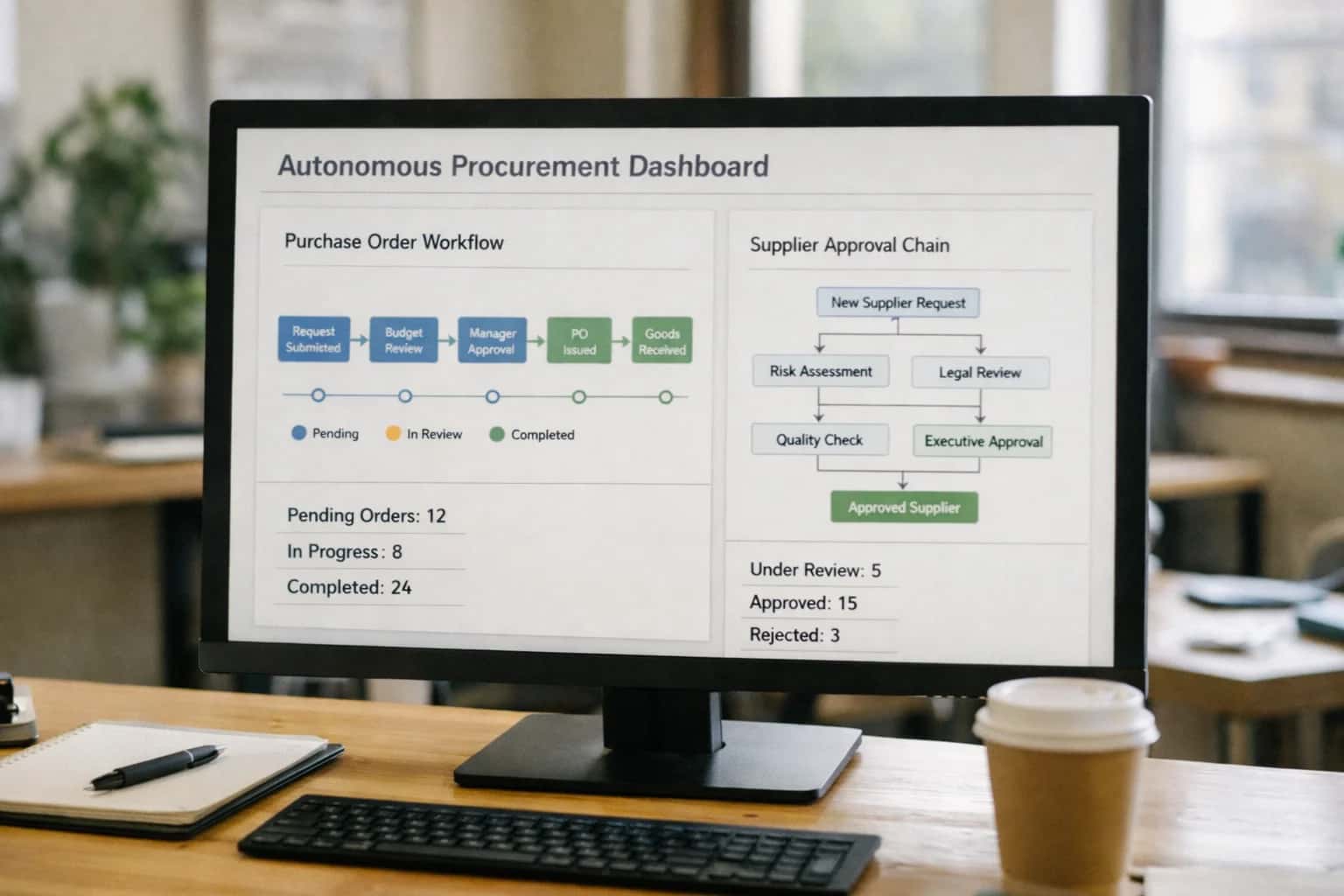
Replace disconnected factory systems with a collaborative network of specialized AI agents.
This transforms rigid, sequential workflows into a dynamic, self-optimizing system where agents collaborate in real-time to maximize throughput and minimize downtime.
- Scheduling Agents negotiate with Maintenance Agents to preemptively reschedule production around predicted equipment failures.
- Quality Control Agents share defect patterns with Process Optimization Agents to adjust machine parameters autonomously.
- Inventory Agents coordinate with Supply Chain Visibility Platforms to trigger autonomous replenishment, preventing line stoppages.
We engineer these systems using frameworks like Ray or AutoGen with custom inter-agent communication protocols, ensuring secure, deterministic negotiation. The result is a measurable shift from local optimization to global plant performance, delivering:
- 15-25% increase in Overall Equipment Effectiveness (OEE)
- 30% reduction in unplanned downtime through predictive coordination
- 2-3 week ROI on pilot deployments in targeted production cells
MEASURABLE IMPACT
Business Outcomes of a Multi-Agent Factory
Our industrial multi-agent system architecture delivers concrete operational and financial results by orchestrating specialized AI agents to autonomously manage and optimize your factory floor. Move beyond theoretical AI to achieve quantifiable improvements in efficiency, cost, and resilience.
01
Dynamic Production Scheduling
Autonomous scheduling agents continuously analyze orders, machine availability, and material flow to generate optimal production sequences in real-time. This reduces machine idle time by up to 25% and cuts work-in-progress (WIP) inventory by 30%, directly improving cash flow.
25%
Reduced Machine Idle Time
30%
Lower WIP Inventory
02
Predictive & Collaborative Maintenance
Maintenance agents negotiate with scheduling agents to plan non-disruptive service windows based on real-time sensor predictions. This prevents catastrophic failures and extends asset life, achieving over 95% schedule adherence for planned maintenance and reducing unplanned downtime by up to 40%.
>95%
Planned Maintenance Adherence
40%
Less Unplanned Downtime
03
Autonomous Quality Control Networks
A network of vision and sensor-based agents collaborates to perform multi-modal defect detection. Agents debate ambiguous cases to reach consensus, reducing false positives and ensuring consistent quality. Achieve a defect escape rate reduction of over 50% and lower scrap/rework costs by 35%.
>50%
Lower Defect Escape Rate
35%
Reduced Scrap/Rework Costs
04
Self-Optimizing Energy Management
Specialized agents monitor and control energy consumption across the plant, negotiating with production schedules to shift non-critical loads and leverage real-time pricing. This system typically delivers a 15-20% reduction in total energy costs while maintaining production throughput.
15-20%
Lower Energy Costs
Continuous
Real-time Optimization
05
Resilient Supply Chain Integration
Logistics agents interface directly with external supplier systems and internal inventory agents. They autonomously trigger replenishment, re-route shipments around delays, and model tariff impacts, improving on-time in-full (OTIF) delivery by 20% and reducing safety stock requirements.
20%
Higher OTIF Rate
Reduced
Safety Stock Levels
06
Centralized AI Governance & Audit
A dedicated oversight agent provides a single pane of glass for all multi-agent activities, ensuring compliance with operational rules and generating explainable audit trails for every decision. This built-in governance is essential for regulated industries and aligns with frameworks like the EU AI Act. Learn more about our approach to Enterprise AI Governance and Compliance Frameworks.
EXPLORE
Structured Implementation Roadmap
Typical Engagement Phases & Deliverables
Our proven methodology for designing and deploying collaborative multi-agent AI systems for industrial operations, ensuring clear milestones, predictable outcomes, and seamless integration.
| Phase & Key Activities | Starter (Proof-of-Concept) | Professional (Plant-Wide Deployment) | Enterprise (Multi-Site Orchestration) |
|---|---|---|---|
Discovery & Agent Blueprinting | Single-process analysis (e.g., scheduling) | Cross-departmental process mapping | Enterprise-wide workflow audit & strategic roadmap |
Agent Specialization Design | 2-3 specialized agents (e.g., scheduler, monitor) | 5-8 agents with defined negotiation protocols | Custom agent taxonomy with >10 agent types & hierarchical coordination |
Multi-Agent Communication Layer | Basic pub/sub messaging | Advanced contract-net protocols & conflict resolution | Federated, secure inter-agent framework across cloud/edge |
Integration with Legacy Systems (MES, SCADA, ERP) | API connection to 1-2 core systems | Deep integration with 3-5 plant-floor systems | Full-stack integration across legacy & modern systems at all sites |
Simulation & Digital Twin Validation | Single-line simulation in sandbox environment | Full plant digital twin for pre-deployment stress testing | Multi-factory simulation for global optimization scenarios |
Pilot Deployment & Calibration | 4-6 week pilot on non-critical line | 8-12 week phased rollout with live optimization | Coordinated global rollout with continuous learning feedback loops |
Performance Monitoring Dashboard | Basic agent health & KPI metrics | Comprehensive plant performance & agent contribution analytics | Enterprise command center with predictive insights & prescriptive actions |
Ongoing Support & Evolution | 3 months of support & minor tuning | 12-month SLA with quarterly optimization reviews | Dedicated engineering team & roadmap for continuous agent evolution |
Typical Timeline | 8-12 weeks | 16-24 weeks | Custom (6+ months) |
Starting Investment | $50K - $80K | $150K - $300K | Custom Quote |
PROVEN ARCHITECTURE
Our Methodology for Deploying Agent Networks
We deploy collaborative AI agent networks using a structured, four-phase methodology designed for rapid integration and measurable operational impact in industrial environments. This approach ensures your multi-agent system delivers on its promise of autonomous optimization from day one.
01
Strategic Agent Role Definition
We conduct a joint workshop to map your operational domains (scheduling, maintenance, quality) to specialized agent personas. This establishes clear responsibilities, negotiation protocols, and success metrics for each digital worker, preventing overlap and ensuring cohesive system goals.
Learn more about our approach in our guide to Multiagent Systems (MAS) Architecture.
2-3 days
Workshop Duration
Clear KPIs
Per Agent
02
Modular & Interoperable Architecture
We architect your agent network using containerized microservices and standardized communication protocols (e.g., gRPC, WebSockets). This ensures each agent is independently deployable, scalable, and can seamlessly integrate with existing PLCs, SCADA, and MES systems without creating vendor lock-in.
This modularity is a core principle of our Agentic Workflow Design and Integration services.
API-First
Design
Zero Downtime
Agent Updates
03
Simulation & Digital Twin Validation
Before physical deployment, we validate agent behaviors and negotiation logic within a high-fidelity digital twin of your production line. This sandbox environment tests millions of operational scenarios, stress-tests communication flows, and optimizes global KPIs (like OEE) without risking live operations.
Explore the power of simulation in our AI-Powered Digital Twin Engineering offerings.
> 90%
Accuracy Target
Weeks Ahead
Risk Mitigation
04
Phased Rollout with Human-in-the-Loop
We deploy agents incrementally, starting with a single domain or production line. A human-in-the-loop oversight layer allows operators to monitor, approve, or override agent decisions initially, building trust and facilitating smooth knowledge transfer before granting full autonomy.
Controlled Scale
Deployment
Gradual Autonomy
Trust Building
05
Continuous Learning & Co-optimization
Post-deployment, agents enter a continuous learning phase. Using federated learning techniques, they share anonymized insights on performance anomalies and optimization strategies, enabling the entire network to co-evolve and improve global plant performance without centralizing sensitive operational data.
Federated Learning
Data Privacy
Adaptive
System Behavior
06
Enterprise-Grade Security & Governance
Every agent and communication channel is built with security-by-design. We implement role-based access control, audit trails for all agent decisions, and encryption for inter-agent messaging. The entire system aligns with industrial security standards (IEC 62443) and our Enterprise AI Governance and Compliance Frameworks.
End-to-End
Audit Trail
Compliant
By Design
Enabling Efficiency, Speed & Accuracy
Intelligent Analysis, Decision & Execution
We build AI systems for teams that need search across company data, workflow automation across tools, or AI features inside products and internal software.
Talk to Us
Search across company data
Give teams answers from docs, tickets, runbooks, and product data with sources and permissions.
Useful when people spend too long searching or get different answers from different systems.
Enterprise searchRAGPermissions
Read more
Automate internal workflows
Use AI to route work, draft outputs, trigger actions, and keep approvals and logs in place.
Useful when repetitive work moves across multiple tools and teams.
AI agentsWorkflow automationGovernance
Read more
Add AI to products and internal tools
Build assistants, guided actions, or decision support into the software your team or customers already use.
Useful when AI needs to be part of the product, not a separate tool.
AI integrationDecision supportModel routing
Read moreTechnical Implementation
Industrial Multi-agent System Architecture FAQs
Get specific answers on timelines, costs, and technical details for deploying collaborative AI agent networks in your factory.
A phased deployment typically takes 8-12 weeks from initial architecture design to a pilot agent network running in a controlled production environment. This includes 2-3 weeks for discovery and agent role definition, 4-6 weeks for core development and integration with your MES/SCADA systems, and 2-3 weeks for pilot deployment and validation. Full-scale rollout across multiple production lines or facilities follows the pilot, often adding another 4-8 weeks depending on complexity.

About the author
Prasad Kumkar
CEO & MD, Inference Systems
Prasad Kumkar is the CEO & MD of Inference Systems and writes about AI systems architecture, LLM infrastructure, model serving, evaluation, and production deployment. Over 5+ years, he has worked across computer vision models, L5 autonomous vehicle systems, and LLM research, with a focus on taking complex AI ideas into real-world engineering systems.
His work and writing cover AI systems, large language models, AI agents, multimodal systems, autonomous systems, inference optimization, RAG, evaluation, and production AI engineering.
LinkedIn
Limited slotsGet a Free AI Consultation
Partnered with leading AI, data, and software stack.





How We Work
Custom AI workflows for your Business
One-fit-all AI don't work for modern businesses. At Inferensys, we aim to understand your business & custom requirements; which we use to define most efficient agentic workflows, the data, and the tools for your business.
01
Review the use case
We understand the task, the users, and where AI can actually help.
Read more02
Pick the right approach
We define what needs search, automation, or product integration.
Read more03
Build the first useful version
We implement the part that proves the value first.
Read more04
Improve from there
We add the checks and visibility needed to keep it useful.
Read moreThe first call is a practical review of your use case and the right next step.
Talk to Us