
Inferensys

Service

Edge AI for Real-time Production Monitoring

Deploy lightweight, optimized AI models directly on factory edge devices to enable sub-second anomaly detection, immediate corrective actions, and continuous production monitoring without cloud dependency.
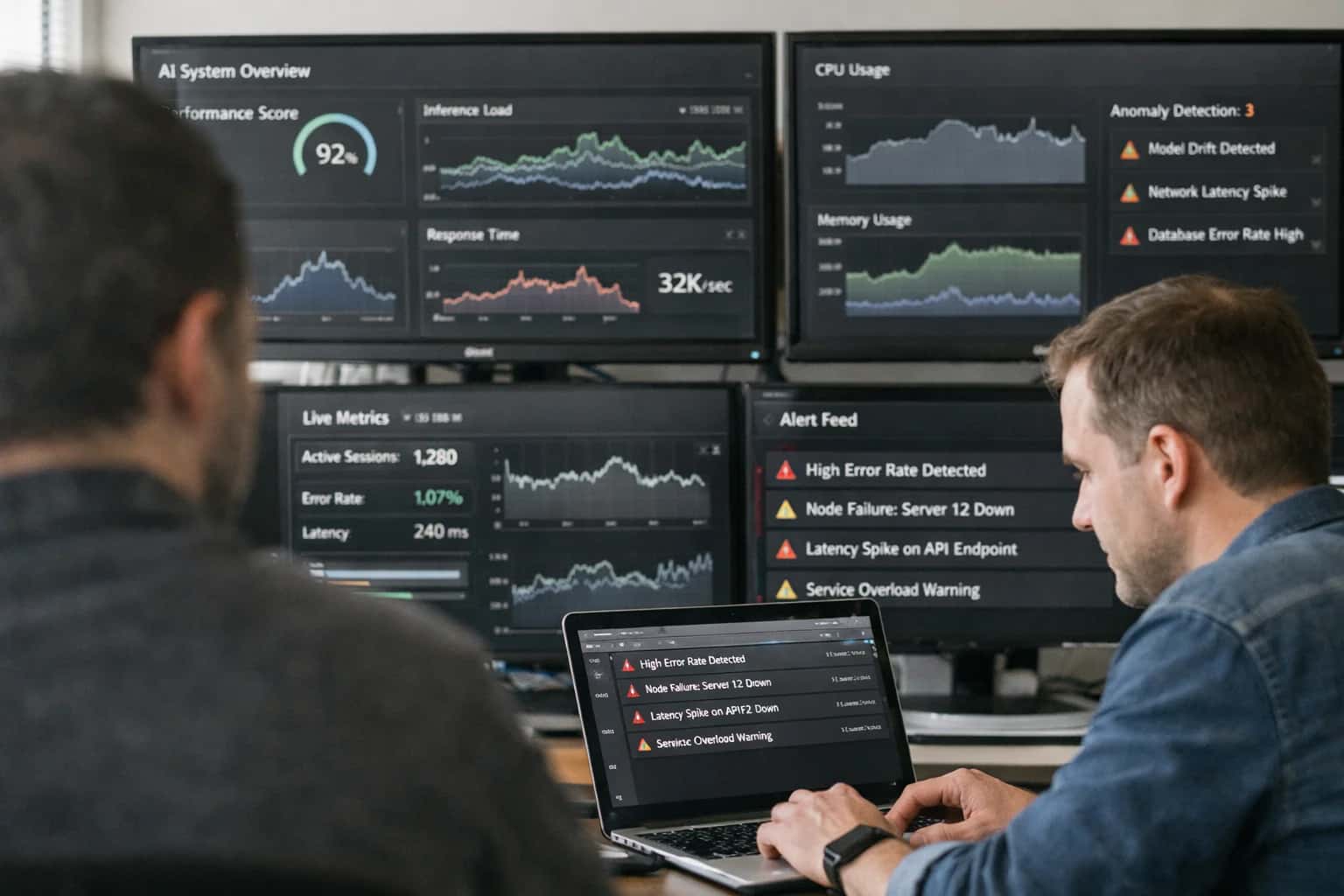
SRE continuously monitoring AI systems on multiple screens, real-time dashboards visible, dark mode NOC setup.
REAL-TIME DECISIONS

The Cloud Latency Problem in Modern Manufacturing

Eliminate cloud dependency for sub-second anomaly detection and corrective actions on the factory floor.

Cloud-based AI introduces critical 100-500ms latency for video streams and sensor data. This delay makes real-time intervention impossible, turning monitoring into a post-mortem analysis.

Edge AI enables sub-100ms anomaly detection, allowing immediate line stops or robotic adjustments to prevent defective batches and material waste.


Our service deploys optimized, lightweight models directly on NVIDIA Jetson or Intel Movidius edge hardware within your facility. This architecture delivers:

  • Zero cloud dependency for core inference, ensuring 99.9% uptime even during network outages.
  • Bandwidth reduction by processing raw video streams locally, sending only alerts and metadata.
  • Data sovereignty by keeping sensitive production imagery and process data on-premises.

We implement Edge AI for Real-time Production Monitoring to deliver measurable outcomes:

  • Reduce defect escape rate by 40-60% with immediate visual inspection triggers.
  • Cut cloud AI inference costs by 70% by moving processing to the edge.
  • Achieve <50ms P50 latency for time-critical quality gates and safety checks.

This approach is foundational for building Smart Manufacturing and Industrial Copilot Integration, providing the low-latency sensory layer that AI copilots require for effective operator assistance.

DELIVERING TANGIBLE ROI

Measurable Business Outcomes

Our Edge AI deployment for production monitoring is engineered to deliver specific, quantifiable improvements to your manufacturing operations, from reducing downtime to optimizing quality control.

01

Sub-Second Anomaly Detection

Deploy lightweight, optimized models directly on edge devices to detect production line defects and equipment anomalies with latency under 500ms, enabling immediate corrective actions without cloud dependency.

< 500ms
Detection Latency
99.9%
On-Premise Uptime
02

Predictive Downtime Reduction

Leverage real-time sensor data and ML models to predict equipment failures up to 3 weeks in advance, shifting from reactive to condition-based maintenance. This directly protects your Overall Equipment Effectiveness (OEE).

Up to 70%
Unplanned Downtime Reduction
3+ Weeks
Advanced Failure Prediction
03

Automated Quality Inspection

Implement multi-modal AI systems combining computer vision and acoustic analysis for automated, 24/7 defect detection. Achieve inspection accuracy exceeding human operators while freeing skilled personnel for higher-value tasks.

> 99.5%
Inspection Accuracy
24/7
Automated Operation
04

Reduced Cloud & Bandwidth Costs

Process data locally at the edge, eliminating the need to stream terabytes of video and sensor data to the cloud. This drastically reduces bandwidth expenses and associated cloud compute costs.

Up to 80%
Bandwidth Cost Reduction
On-Device
Primary Inference
05

Enhanced Data Security & Sovereignty

Keep sensitive production data and proprietary processes confined within your factory's network. Our edge deployment architecture ensures compliance with data residency requirements and mitigates external data leakage risks.

Air-Gapped
Optional Deployment
Zero External
Raw Data Transfer
06

Rapid Deployment & Scalability

Utilize our pre-validated hardware templates and containerized model deployment pipelines to go from pilot to full-scale production monitoring across multiple lines in under 8 weeks.

< 8 Weeks
Full-Scale Deployment
Modular
Line-by-Line Scaling
A Proven, Phased Approach

From Assessment to Live Deployment in 8 Weeks

Our structured delivery framework ensures a rapid, low-risk path to operational edge AI, moving from initial feasibility to a production-grade system monitoring your factory floor.

Phase & Key ActivitiesWeeks 1-2: Discovery & AssessmentWeeks 3-6: Development & TestingWeeks 7-8: Deployment & Handover

Core Objective

Define success metrics & technical feasibility

Build & validate the edge AI pipeline

Deploy to production & enable your team

Key Deliverables

Technical architecture blueprint ROI & TCO analysis report

Optimized edge AI models On-premise inference pipeline Integration test suite

Production deployment on your hardware Operational runbook & monitoring dashboards Knowledge transfer sessions

Inference Systems Team

Solution Architect AI Engineer

AI Engineer MLOps Engineer QA Engineer

MLOps Engineer DevOps Engineer Project Lead

Your Team Involvement

Stakeholder workshops Data access provision

Feedback on model outputs Test environment setup

Final acceptance testing Operational training

Technical Milestones

Edge hardware specification finalized Data pipeline strategy approved

Model accuracy >99% on test set Inference latency <200ms validated

System integrated with live production data 99.9% uptime SLA demonstrated

Risk Mitigation

Identify data quality & integration risks early

Iterative model tuning in simulated environment

Phased rollout with canary deployment

Outcome

Clear go/no-go decision with projected ROI

A fully functional, validated edge AI system

Autonomous, real-time production monitoring live on your floor

Next Steps

Transition to optional ongoing support & scaling

DELIVERING SUB-SECOND INSIGHTS

Core Technical Capabilities

We architect and deploy purpose-built Edge AI systems that transform raw sensor data into immediate, actionable intelligence on the factory floor. Our solutions eliminate cloud latency, ensure operational continuity, and provide the deterministic performance required for mission-critical production monitoring.

01

Ultra-Low Latency Model Inference

Deployment of highly optimized, quantized AI models directly on edge hardware (NVIDIA Jetson, Intel Movidius) to achieve sub-100ms inference latency for real-time anomaly detection and quality checks, enabling immediate corrective actions without cloud round-trip delays.

< 100ms
Inference Latency
NVIDIA Jetson
Target Hardware
02

Offline-First Operational Resilience

Engineered systems that function autonomously during network outages. Local inference and buffered logging ensure continuous production monitoring and data integrity, with seamless synchronization once connectivity is restored, guaranteeing 24/7 operational visibility.

100%
Offline Capable
Zero Data Loss
Guarantee
03

Lightweight Model Optimization

Expert application of techniques like quantization, pruning, and knowledge distillation to shrink large models by 60-80% without sacrificing critical accuracy. This enables deployment on resource-constrained edge devices, drastically reducing hardware costs and power consumption.

60-80%
Model Size Reduction
TinyML
Framework Expertise
04

Secure Edge-to-Cloud Data Pipeline

Implementation of encrypted, zero-trust data pipelines for secure aggregation of edge insights. We ensure end-to-end data sovereignty and compliance with frameworks like NIST and ISO/IEC 27001, protecting proprietary process data from the sensor to the analytics dashboard.

TLS 1.3 / AES-256
Encryption
ISO/IEC 27001
Compliance
05

Predictive Anomaly Detection

Development of unsupervised and semi-supervised ML models that learn normal operational baselines from telemetry data to identify subtle deviations and predict failures hours or days in advance, shifting maintenance from reactive to proactive. Learn more about our approach in our guide to Predictive Machine Maintenance Systems.

> 95%
Detection Accuracy
Days in Advance
Failure Prediction
06

Industrial-Grade Deployment & MLOps

Full lifecycle management with robust MLOps for the edge, including containerized deployment (Docker), automated CI/CD pipelines, and remote model updates. We ensure reliable, version-controlled rollouts across thousands of devices with minimal downtime. This foundational capability supports complex integrations like Industrial AI Copilot.

< 2 Weeks
Typical Deployment
OTA Updates
Supported
Tailored solutions for industry-specific challenges

Edge AI Applications by Manufacturing Vertical

Real-Time Assembly Line Monitoring

Achieve zero-defect production with sub-second anomaly detection. Our edge AI systems process video streams directly on factory-floor devices to identify misalignments, missing components, and tooling errors before they cause costly rework.

  • Predictive Quality Control: Computer vision models detect surface defects (scratches, dents) on painted bodies and components with >99.5% accuracy.
  • Tool Presence Verification: Ensure all required tools and fasteners are present and correctly torqued in real-time.
  • Cycle Time Optimization: Analyze workstation ergonomics and process flow to identify bottlenecks, improving Overall Equipment Effectiveness (OEE) by 15-25%.

Integrate with existing Manufacturing Execution Systems (MES) and PLCs for closed-loop corrective actions. Learn more about our approach to Industrial AI Copilot Integration Services for operator assistance.

Technical and Commercial Details

Edge AI for Production Monitoring: FAQs

Get specific answers on timelines, costs, and technical implementation for deploying real-time AI monitoring directly on your factory floor.

Standard deployments for a single production line or monitoring point take 2-4 weeks from kickoff to pilot. This includes model optimization for your target edge hardware, integration with your existing PLCs/SCADA systems, and validation. Multi-line or plant-wide rollouts typically follow a phased approach over 6-12 weeks. Our methodology is detailed in our AI Supercomputing and Hybrid Cloud Architecture service.

Prasad Kumkar

About the author

Prasad Kumkar

CEO & MD, Inference Systems

Prasad Kumkar is the CEO & MD of Inference Systems and writes about AI systems architecture, LLM infrastructure, model serving, evaluation, and production deployment. Over 5+ years, he has worked across computer vision models, L5 autonomous vehicle systems, and LLM research, with a focus on taking complex AI ideas into real-world engineering systems.

His work and writing cover AI systems, large language models, AI agents, multimodal systems, autonomous systems, inference optimization, RAG, evaluation, and production AI engineering.


