Deploy a secure, air-gapped AI assistant in under 4 weeks, ensuring zero data egress and full compliance with strict data sovereignty mandates.

Service
Secure Internal AI Assistant Deployment
End-to-end deployment of secure, air-gapped AI assistants for internal enterprise use. All data, models, and inference remain within your corporate network to meet strict data sovereignty and IP protection requirements.
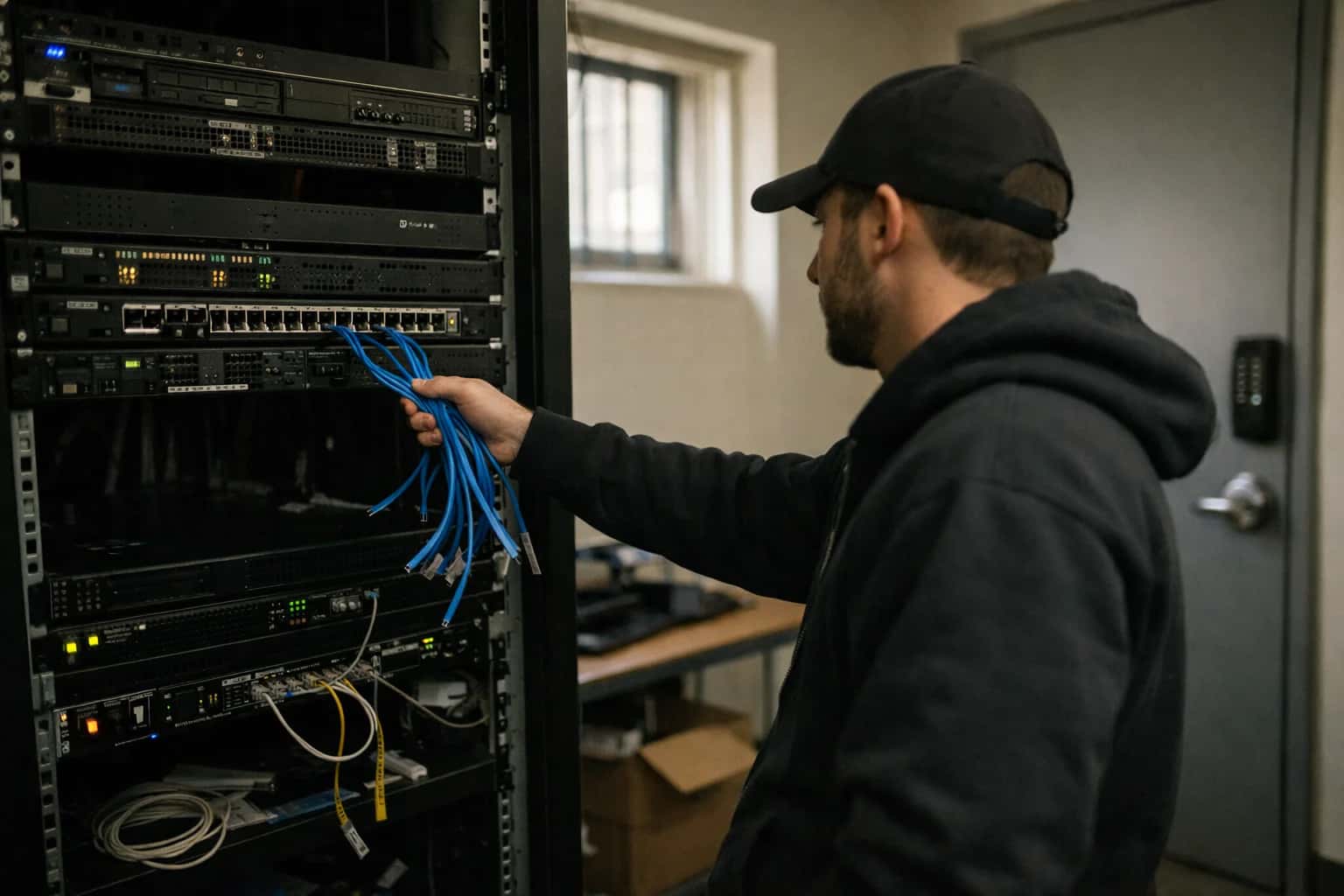
Deploy fully isolated AI assistants that keep all data, models, and inference securely within your corporate network.
We engineer end-to-end solutions where all data, models, and inference remain on-premises. This eliminates cloud data transfer risks and provides ironclad IP protection for your proprietary workflows and datasets.
- Full Network Isolation: Deploy within your existing VPC or private cloud with no external API calls.
- Compliance by Design: Architect for frameworks like HIPAA, GDPR, and CMMC from day one.
- Enterprise Integration: Seamlessly connect to your legacy ERPs, data warehouses, and internal knowledge bases.
- Continuous On-Prem Training: Safely fine-tune models on your latest internal data without ever leaving your firewall.
This service is part of our broader Enterprise AI Copilot Customization pillar, which also includes solutions for Legacy ERP AI Copilot Integration and Proprietary Software AI Overlay Engineering. For the highest security requirements, explore our Confidential Computing for AI Workloads services.
ENTERPRISE-GRADE SECURITY
Business Outcomes of an Air-Gapped AI Assistant
Deploying a secure, internal AI assistant delivers measurable business value by protecting intellectual property, accelerating workflows, and ensuring compliance. Our air-gapped solutions guarantee data never leaves your network.
01
Absolute Data Sovereignty
All model inference, training data, and user interactions remain within your corporate firewall. Eliminate data leakage risks and meet strict data residency requirements for finance, healthcare, and government sectors.
0%
External Data Transfer
On-Prem
Full Deployment
02
Accelerated Internal Workflows
Reduce time spent searching internal wikis, databases, and legacy systems. Employees get instant, conversational answers from proprietary data, cutting research time by over 60%. Learn more about our approach to Enterprise Search and Retrieval AI.
> 60%
Faster Information Retrieval
24/7
Internal Support
03
Protected Intellectual Property
Sensitive R&D data, proprietary code, and strategic documents are used to train and power the assistant without exposure to third-party APIs. This is a core component of our Sovereign AI Infrastructure Development practice.
Air-Gapped
Network Isolation
Private
Model Training
04
Regulatory Compliance by Design
Built-in audit trails, access controls, and policy enforcement ensure compliance with frameworks like HIPAA, FINRA, GDPR, and the EU AI Act from day one. Explore our technical frameworks for Enterprise AI Governance.
Built-In
Audit Logging
Policy-as-Code
Enforcement
05
Reduced Operational Risk
Eliminate dependency on external AI service outages, API rate limits, and pricing changes. Maintain business continuity with a fully controlled, high-availability system that integrates with your existing AIOps monitoring.
99.9%
Controlled Uptime SLA
No Vendor Lock-in
Independence
06
Domain-Specific Expertise On-Demand
Train the assistant on your unique corporate corpus—legal documents, engineering specs, support tickets—to provide expert-level guidance, reducing bottlenecks and preserving institutional knowledge. This is powered by our Domain-Specific Language Model (DSLM) Training capabilities.
> 90%
Accuracy on Internal Data
Continuous
Knowledge Capture
A structured, predictable path to a secure, air-gapped AI assistant
Phased Deployment Timeline and Deliverables
Our proven methodology for deploying secure internal AI assistants ensures a controlled, low-risk implementation with clear deliverables at each phase. This timeline is typical for a mid-sized enterprise with a single data source.
| Phase & Key Activities | Timeline | Core Deliverables | Client Involvement |
|---|---|---|---|
Phase 1: Discovery & Architecture Design
| 1-2 Weeks |
| Stakeholder workshops Provide security policies Grant infrastructure access |
Phase 2: Secure Environment Provisioning
| 2-3 Weeks |
| Approve network design Provide security certificates Validate internal access |
Phase 3: Model Selection & Data Pipeline Integration
| 3-4 Weeks |
| Approve model selection Validate data source connections Review initial query responses |
Phase 4: Assistant Development & Security Hardening
| 3-5 Weeks |
| Participate in UI/UX review Define user roles & permissions Approve security test results |
Phase 5: Pilot Deployment & User Training
| 2 Weeks |
| Identify pilot group Participate in training sessions Provide structured feedback |
Phase 6: Full Rollout & Handover
| 1-2 Weeks |
| Approve rollout schedule Final acceptance testing Sign-off on documentation |
AIR-GAPPED DEPLOYMENT
Ideal for Enterprises with Strict Data Control Mandates
Our deployment architecture ensures all data, models, and inference remain within your corporate network, meeting the highest standards for data sovereignty and intellectual property protection.
01
On-Premises & Private Cloud Deployment
Full-stack deployment of your AI assistant within your data center or approved private cloud (AWS GovCloud, Azure Government). We manage the entire lifecycle—from initial provisioning to ongoing updates—without any data ever leaving your controlled environment.
Zero egress
Data Policy
Full root access
Client Control
02
End-to-End Encryption & Hardware Security
Implement encryption for data at rest, in transit, and in use via hardware-based Trusted Execution Environments (TEEs). Integrates with your existing HSM and key management systems for a defense-in-depth security posture.
FIPS 140-2
Compliance
TEE/Enclave
In-Use Protection
04
Continuous Security Posture Management
Proactive monitoring and governance to detect and manage any unsanctioned AI usage or configuration drift. Our systems provide continuous vulnerability assessment against frameworks like MITRE ATLAS to defend against novel AI-specific threats.
MITRE ATLAS
Threat Framework
Real-time
Policy Enforcement
05
Sovereign Data Pipelines
Engineered data pipelines ensure proprietary training data and model outputs are strictly confined within sovereign borders. Enables safe contribution to global federated learning models without raw data exchange, crucial for multinationals.
Geopatriated
Data Routing
Federated Ready
Architecture
06
Certified Infrastructure & Audits
Deploy on infrastructure that meets FedRAMP, SOC 2 Type II, and ISO 27001 standards. We facilitate third-party security audits (e.g., Trail of Bits) and provide penetration testing reports to validate the security of your AI deployment.
SOC 2 Type II
Certification
Third-Party
Security Audits
Enabling Efficiency, Speed & Accuracy
Intelligent Analysis, Decision & Execution
We build AI systems for teams that need search across company data, workflow automation across tools, or AI features inside products and internal software.
Talk to Us
Search across company data
Give teams answers from docs, tickets, runbooks, and product data with sources and permissions.
Useful when people spend too long searching or get different answers from different systems.
Enterprise searchRAGPermissions
Read more
Automate internal workflows
Use AI to route work, draft outputs, trigger actions, and keep approvals and logs in place.
Useful when repetitive work moves across multiple tools and teams.
AI agentsWorkflow automationGovernance
Read more
Add AI to products and internal tools
Build assistants, guided actions, or decision support into the software your team or customers already use.
Useful when AI needs to be part of the product, not a separate tool.
AI integrationDecision supportModel routing
Read moreEnterprise Security & Implementation
Frequently Asked Questions on Secure AI Assistant Deployment
Common questions from CTOs and security leaders about deploying secure, air-gapped AI assistants within corporate networks.
A standard deployment for a secure, air-gapped AI assistant takes 2-4 weeks from kickoff to production handoff. This timeline includes environment provisioning, model containerization, RAG pipeline integration, and security hardening. Complex integrations with multiple legacy ERPs or proprietary databases can extend this to 6-8 weeks. We provide a fixed-scope project plan during the discovery phase.

About the author
Prasad Kumkar
CEO & MD, Inference Systems
Prasad Kumkar is the CEO & MD of Inference Systems and writes about AI systems architecture, LLM infrastructure, model serving, evaluation, and production deployment. Over 5+ years, he has worked across computer vision models, L5 autonomous vehicle systems, and LLM research, with a focus on taking complex AI ideas into real-world engineering systems.
His work and writing cover AI systems, large language models, AI agents, multimodal systems, autonomous systems, inference optimization, RAG, evaluation, and production AI engineering.
LinkedIn
Limited slotsGet a Free AI Consultation
Partnered with leading AI, data, and software stack.





How We Work
Custom AI workflows for your Business
One-fit-all AI don't work for modern businesses. At Inferensys, we aim to understand your business & custom requirements; which we use to define most efficient agentic workflows, the data, and the tools for your business.
01
Review the use case
We understand the task, the users, and where AI can actually help.
Read more02
Pick the right approach
We define what needs search, automation, or product integration.
Read more03
Build the first useful version
We implement the part that proves the value first.
Read more04
Improve from there
We add the checks and visibility needed to keep it useful.
Read moreThe first call is a practical review of your use case and the right next step.
Talk to Us