Transform your legacy mainframes, databases, and document archives into a unified, queryable knowledge base without disrupting existing workflows.

Service
RAG for Legacy Data Silos Integration
Migrate and unify fragmented enterprise knowledge from legacy databases, mainframes, and document management systems into a coherent, queryable RAG infrastructure without disrupting existing workflows.
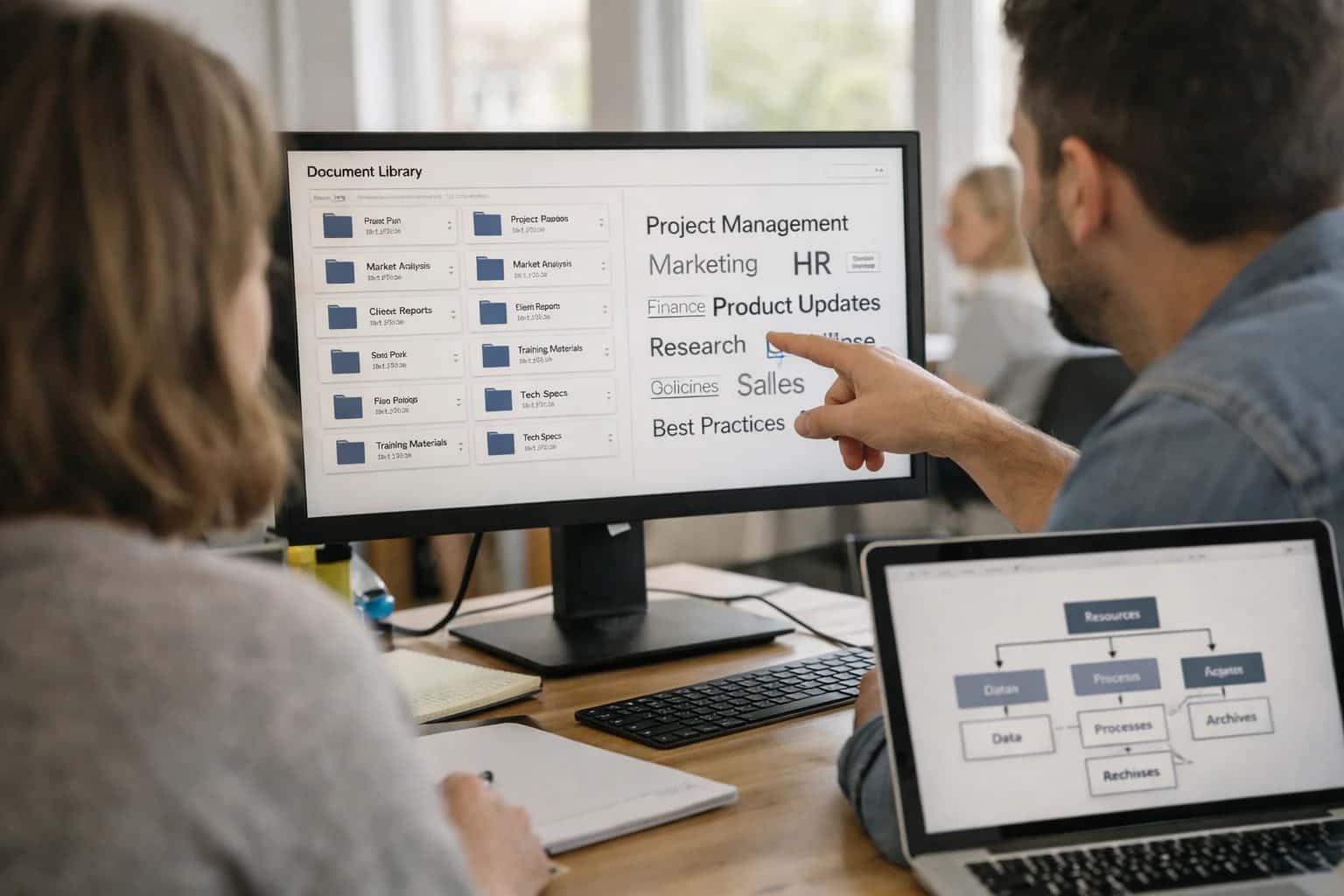
LEGACY DATA INTEGRATION
Your Legacy Data is Trapped. We Set It Free.
Unlock actionable intelligence from fragmented legacy systems and document silos with purpose-built RAG infrastructure.
We architect RAG systems that bridge decades of technological debt:
- Integrate data from
Oracle,IBM DB2,SAP, and proprietary mainframe systems. - Parse and structure millions of legacy PDFs, scanned documents, and flat files.
- Deploy a secure, searchable interface in under 4 weeks, connecting your team to previously inaccessible institutional knowledge.
Our approach ensures deterministic accuracy from probabilistic models:
- Semantic chunking strategies tailored to your domain's jargon and context.
- Hybrid search combining vector similarity with keyword filters for precise retrieval.
- Source-grounded responses that cite the original legacy record, reducing hallucination rates by over 40%.
Stop letting data age in place. Explore our core RAG Infrastructure capabilities or learn how we ensure data sovereignty with Sovereign AI Development.
DELIVERABLES
Business Outcomes: From Locked Data to AI-Driven Insights
We transform your legacy data from a compliance burden into a competitive asset. Our integration service delivers measurable business results, not just technical implementation.
01
Unified Knowledge Access
Break down silos between mainframes, legacy databases, and document systems. We deliver a single, queryable interface that surfaces insights from decades of institutional knowledge without disrupting existing workflows.
80%
Faster Information Retrieval
02
Audit-Ready Data Lineage
Every AI-generated insight is traceable back to its source document and version. We build provenance tracking into the RAG pipeline, ensuring compliance with internal governance and external regulations like GDPR and SOX.
100%
Source Attribution
03
Reduced Operational Latency
Move from manual document searches to instant, AI-powered answers. Our optimized retrieval pipelines provide sub-second responses, cutting the time employees spend hunting for information and accelerating decision cycles.
< 1 sec
Average Query Response
04
Eliminated Vendor Lock-in
We architect with open-source frameworks like LlamaIndex and deploy on your infrastructure. You maintain full control over your data and models, avoiding costly per-query API fees and ensuring long-term architectural flexibility. Learn more about our approach to Open-Source Model RAG Optimization.
60%
Lower TCO vs. API-Only
05
Production-Grade Scalability
Deploy a system built for enterprise load. We implement caching, load balancing, and monitoring to ensure 99.9% uptime SLAs, whether serving 100 queries a day or 10,000 queries per hour across global teams.
99.9%
Uptime SLA
06
Domain-Accurate AI Responses
Dramatically reduce AI hallucinations. By grounding responses in your proprietary data with advanced semantic chunking and hybrid search, we ensure answers are relevant, accurate, and actionable for your specific business context. This is a core component of our Enterprise Semantic Search RAG Development.
40%+
Hallucination Reduction
From Assessment to Autonomy
Our Phased, Risk-Mitigated Delivery Approach
We de-risk your legacy data integration project through a structured, milestone-driven methodology. Each phase delivers tangible value and a clear off-ramp, ensuring alignment and control.
| Phase & Deliverables | Discovery & Assessment | Pilot & Validation | Full Integration & Scaling |
|---|---|---|---|
Core Objective | Risk & Feasibility Analysis | Proof-of-Concept Validation | Enterprise-Wide Deployment |
Key Activities | Data Source AuditSchema Mapping AnalysisSecurity & Compliance Review | Connector Development for 1-2 SilosInitial Vector Index CreationAccuracy Benchmarking | Full Connector Suite DeploymentAutomated Pipeline OrchestrationPerformance & Security Hardening |
Primary Output | Technical Blueprint & ROI Model | Working Pilot with Measured KPIs | Production RAG System with SLA |
Timeline | 2-3 Weeks | 4-6 Weeks | 6-10 Weeks |
Team Involvement | Our ArchitectsYour SMEs | Our EngineersYour DevOps | Our Team + Your Team Knowledge Transfer |
Success Metrics Defined | Cost/Benefit Analysis, Hallucination Baseline | < 100ms Retrieval Latency> 85% Answer RelevanceSource Citation Accuracy | 99.9% Uptime SLAAutomated Data SyncFull Audit Trail |
Investment | Fixed Fee | Fixed Fee | Custom Scope-Based |
ENTERPRISE-GRADE UNIFICATION
Core Capabilities of Our Legacy Data RAG Integration
We transform fragmented, legacy data into a unified, intelligent knowledge layer. Our service delivers accurate, source-grounded AI responses by connecting your proprietary databases and document silos to modern LLMs without disrupting existing business workflows.
01
Legacy System Connector Framework
We build secure, high-fidelity data pipelines that connect directly to your legacy mainframes (IBM z/OS, AS/400), on-premise databases (Oracle, SQL Server), and document management systems (SharePoint, FileNet). This ensures zero data loss and maintains referential integrity during the migration to a vectorized knowledge base.
100+
Connector Templates
Zero Downtime
Migration Guarantee
02
Semantic Chunking for Complex Formats
Our proprietary algorithms intelligently parse and chunk complex legacy documents—including scanned PDFs, COBOL copybooks, and EDI transactions—preserving hierarchical relationships and business logic. This context-aware chunking is critical for high retrieval accuracy in RAG systems.
40%+
Higher Retrieval Accuracy
Structured & Unstructured
Data Support
03
Unified Vector Knowledge Graph
We architect a centralized vector database (using Pinecone, Weaviate, or Milvus) that semantically links entities across all your legacy silos. This creates a single source of truth, enabling cross-database queries that were previously impossible, such as linking customer records from a mainframe to support tickets in a legacy CRM.
< 100ms
Query Latency
Multi-Modal
Indexing
04
Hallucination-Reduced Query Engine
We deploy advanced hybrid search (vector + keyword + metadata) and query routing to ensure answers are strictly grounded in your legacy data. Our systems include source citation and confidence scoring, dramatically reducing AI hallucination rates for mission-critical business intelligence.
60%+
Reduction in Hallpucination
Source-Cited
Every Response
05
Incremental Sync & Live Updates
Our pipelines support real-time or batch incremental updates from source systems, ensuring your RAG knowledge base is always current. This event-driven architecture, often using Kafka or Change Data Capture (CDC), allows AI agents to act on the latest transactional data.
Near Real-Time
Data Freshness
Event-Driven
Architecture
06
Enterprise Security & Access Control
We enforce existing row-level and column-level security policies from your legacy systems within the new RAG infrastructure. All data is encrypted in transit and at rest, with audit trails for every query, ensuring compliance with SOC 2, HIPAA, and GDPR standards.
End-to-End
Encryption
Policy-as-Code
Access Control
Enabling Efficiency, Speed & Accuracy
Intelligent Analysis, Decision & Execution
We build AI systems for teams that need search across company data, workflow automation across tools, or AI features inside products and internal software.
Talk to Us
Search across company data
Give teams answers from docs, tickets, runbooks, and product data with sources and permissions.
Useful when people spend too long searching or get different answers from different systems.
Enterprise searchRAGPermissions
Read more
Automate internal workflows
Use AI to route work, draft outputs, trigger actions, and keep approvals and logs in place.
Useful when repetitive work moves across multiple tools and teams.
AI agentsWorkflow automationGovernance
Read more
Add AI to products and internal tools
Build assistants, guided actions, or decision support into the software your team or customers already use.
Useful when AI needs to be part of the product, not a separate tool.
AI integrationDecision supportModel routing
Read moreTechnical Implementation
Frequently Asked Questions on Legacy Data RAG
Common questions from CTOs and engineering leads about integrating RAG with legacy databases, mainframes, and document systems.
Standard deployments take 2-4 weeks from kickoff to MVP. This includes data source assessment, semantic chunking strategy, and initial pipeline integration. Complex environments with 10+ disparate legacy systems (e.g., mainframes, AS/400, Lotus Notes) typically require 6-8 weeks for full production deployment. We provide a detailed project plan in the first week.

About the author
Prasad Kumkar
CEO & MD, Inference Systems
Prasad Kumkar is the CEO & MD of Inference Systems and writes about AI systems architecture, LLM infrastructure, model serving, evaluation, and production deployment. Over 5+ years, he has worked across computer vision models, L5 autonomous vehicle systems, and LLM research, with a focus on taking complex AI ideas into real-world engineering systems.
His work and writing cover AI systems, large language models, AI agents, multimodal systems, autonomous systems, inference optimization, RAG, evaluation, and production AI engineering.
LinkedIn
Limited slotsGet a Free AI Consultation
Partnered with leading AI, data, and software stack.





How We Work
Custom AI workflows for your Business
One-fit-all AI don't work for modern businesses. At Inferensys, we aim to understand your business & custom requirements; which we use to define most efficient agentic workflows, the data, and the tools for your business.
01
Review the use case
We understand the task, the users, and where AI can actually help.
Read more02
Pick the right approach
We define what needs search, automation, or product integration.
Read more03
Build the first useful version
We implement the part that proves the value first.
Read more04
Improve from there
We add the checks and visibility needed to keep it useful.
Read moreThe first call is a practical review of your use case and the right next step.
Talk to Us