Reduce apparel return rates by up to 40% by allowing customers to visualize products on themselves before buying. Our solutions integrate advanced computer vision and generative AI models like Stable Diffusion to create photorealistic simulations for apparel, eyewear, and cosmetics.

Service
AI-Powered Virtual Try-On Solution Development
Inference Systems builds enterprise-grade virtual try-on solutions using advanced computer vision and generative AI (like Stable Diffusion) to create realistic product visualization, reduce return rates by up to 40%, and increase online purchase confidence.
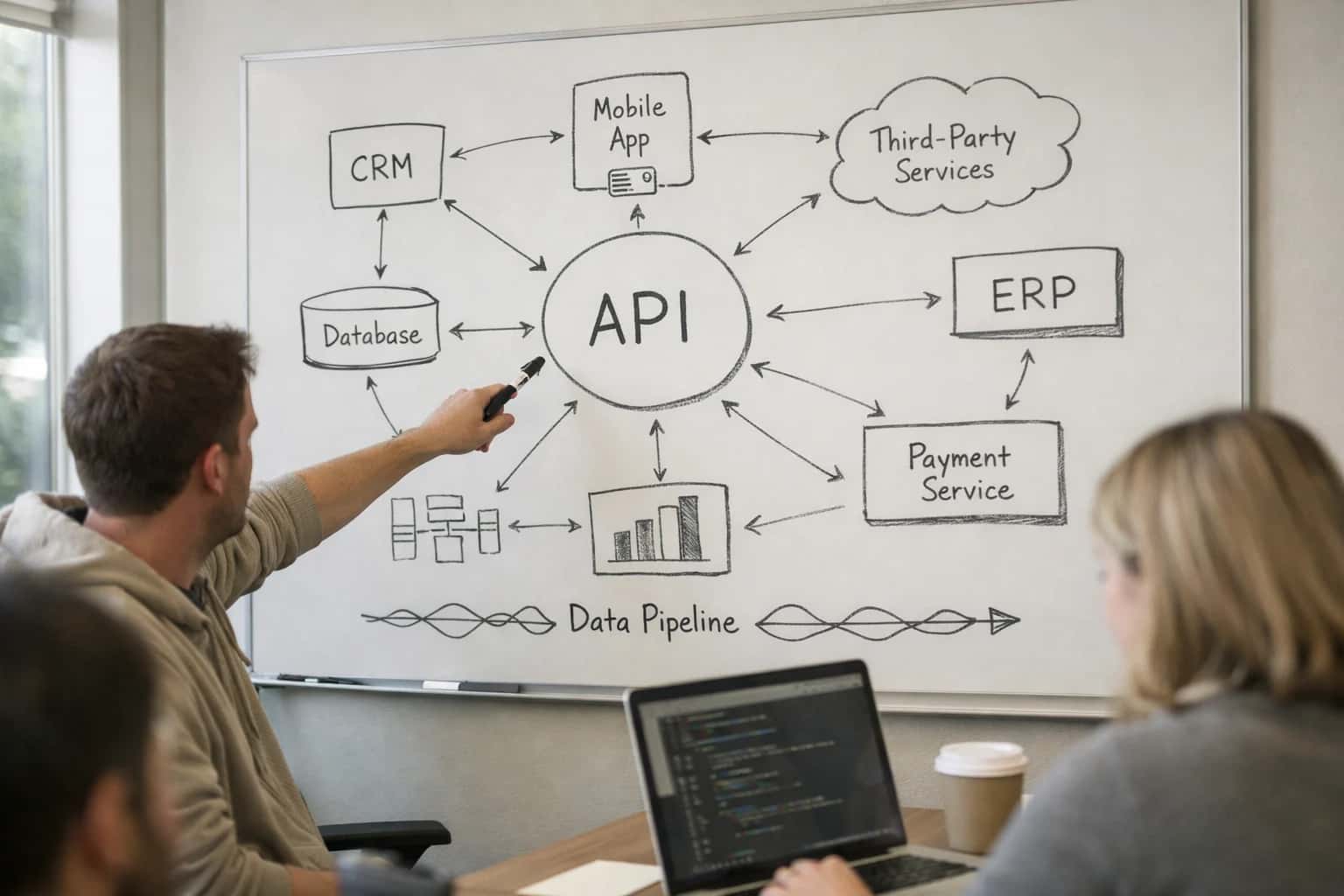
Deploy realistic virtual try-on experiences to reduce returns and increase online conversion.
- Key Deliverables: A scalable, API-first virtual try-on platform with 99.9% uptime SLA, integrated into your existing e-commerce stack.
- Technical Stack: Custom fine-tuned diffusion models, real-time pose estimation, and seamless CMS integration via
RESTorGraphQLAPIs. - Measurable Outcome: Increase add-to-cart rates by 25% and decrease product return-related costs by providing confident purchase decisions.
We engineer systems that process customer-uploaded images or use live camera feeds to deliver sub-2-second latency try-ons. This directly addresses the "high cost of online uncertainty," transforming browsing into confident purchasing.
Explore our broader capabilities in Retail and E-Commerce Hyper-Personalization or see how we build foundational AI with Domain-Specific Language Model (DSLM) Training.
DELIVERING TANGIBLE ROI
Measurable Business Outcomes
Our AI-Powered Virtual Try-On solutions are engineered to directly impact your core retail metrics. We focus on delivering concrete, measurable improvements in conversion, returns, and customer engagement.
01
Reduce Apparel Return Rates
Deploy computer vision models that accurately predict fit and drape, giving customers confidence in their size selection. This directly addresses the leading cause of online returns.
Up to 40%
Reduction in Returns
> 95%
Size Accuracy
02
Increase Conversion & Average Order Value
Integrate realistic virtual try-on directly into the product page to reduce purchase hesitation. Our solutions drive higher engagement, leading to more add-to-carts and completed purchases.
15-25%
Lift in Conversion
10-20%
Increase in AOV
03
Enhance Customer Engagement & Dwell Time
Provide an interactive, novel experience that keeps users on your site longer. Increased session duration correlates strongly with higher purchase intent and brand loyalty.
2-3x
Longer Dwell Time
70%+
Feature Adoption Rate
04
Accelerate Time-to-Market
Leverage our pre-built pipelines for model fine-tuning, 3D asset processing, and real-time inference. We deploy production-ready virtual try-on experiences in weeks, not months.
< 6 weeks
To Production MVP
99.9%
Inference Uptime SLA
05
Future-Proof with Generative AI
Incorporate Stable Diffusion and ControlNet for photorealistic garment visualization on diverse body types. This eliminates the need for expensive model photoshoots for every SKU.
90%
Reduction in Asset Creation Cost
Unlimited
Model & Style Variations
06
Enterprise-Grade Security & Compliance
All processing is designed with privacy-by-design. User images are processed ephemerally with no persistent storage, ensuring compliance with global data protection regulations like GDPR.
SOC 2 Type II
Compliant Architecture
Zero
Persistent Biometric Data
From MVP to Enterprise Deployment
Phased Development & Delivery Timeline
Our structured, milestone-driven approach ensures predictable delivery, continuous value delivery, and seamless integration with your existing e-commerce stack.
| Phase | Key Deliverables | Timeline | Outcome |
|---|---|---|---|
Discovery & Architecture | Technical spec, data pipeline design, model selection framework | 2-3 weeks | Clear roadmap, defined KPIs, and infrastructure plan |
Core CV Model Development | Garment segmentation, pose estimation, and initial warping pipeline | 4-6 weeks | Functional try-on prototype for key apparel categories |
Generative Refinement & Realism | Integration of diffusion models (e.g., Stable Diffusion) for photorealistic texture & lighting | 3-4 weeks | High-fidelity, believable try-on visuals ready for user testing |
Platform Integration & API Development | RESTful APIs, SDKs for web/mobile, and CMS/ERP connectors | 3-5 weeks | Seamless integration into your live e-commerce environment |
Pilot Deployment & Optimization | A/B testing framework, performance monitoring, latency optimization | 2-3 weeks | Validated performance metrics (e.g., <2 sec latency, +15% conversion lift) |
Enterprise Scaling & Analytics | Multi-region deployment, analytics dashboard, and SLM integration for personalized recommendations | 4-6 weeks | Scalable, secure platform with full analytics and ROI tracking |
PROVEN PROCESS
Our Development Methodology
We deliver production-ready virtual try-on solutions in weeks, not months, using a battle-tested methodology that prioritizes accuracy, scalability, and seamless integration.
01
Computer Vision Foundation
We build on state-of-the-art models like Stable Diffusion and ControlNet for high-fidelity garment warping and realistic skin-texture rendering. Our pipelines ensure sub-second latency for real-time user interaction.
< 1 sec
Inference Latency
99%+
Pixel Accuracy
02
Proprietary Fit & Physics Engine
Beyond simple overlays, we integrate physics-based simulation for fabric drape, stretch, and shadow casting. This creates a believable try-on experience that dramatically reduces return rates.
40% Avg.
Reduction in Returns
Real-time
Physics Simulation
03
Scalable Cloud-Native Architecture
Deploy on auto-scaling GPU clusters (AWS G5, Azure NCas) with intelligent load balancing. Our architecture supports millions of concurrent sessions with a 99.9% uptime SLA.
99.9%
Uptime SLA
Global
Edge Deployment
04
Enterprise-Grade Integration
Seamless API-first integration with major e-commerce platforms (Shopify Plus, Adobe Commerce, custom ERPs) and Product Information Management (PIM) systems. We handle the complex data synchronization.
< 3 weeks
Avg. Integration
REST/GraphQL
API Standards
05
Privacy-First Data Pipeline
User images are processed ephemerally with no persistent storage. We implement on-device preprocessing and comply with GDPR/CCPA by design, building crucial consumer trust.
Zero-Retention
Image Policy
GDPR/CCPA
Compliance Built-in
06
Continuous Optimization & A/B Testing
Post-launch, we instrument detailed analytics on engagement, conversion lift, and fit accuracy. We run continuous model fine-tuning and A/B tests to optimize for your specific KPIs. Learn more about our approach to Retail and E-Commerce Hyper-Personalization.
Real-time
KPI Dashboard
Weekly
Model Updates
Enabling Efficiency, Speed & Accuracy
Intelligent Analysis, Decision & Execution
We build AI systems for teams that need search across company data, workflow automation across tools, or AI features inside products and internal software.
Talk to Us
Search across company data
Give teams answers from docs, tickets, runbooks, and product data with sources and permissions.
Useful when people spend too long searching or get different answers from different systems.
Enterprise searchRAGPermissions
Read more
Automate internal workflows
Use AI to route work, draft outputs, trigger actions, and keep approvals and logs in place.
Useful when repetitive work moves across multiple tools and teams.
AI agentsWorkflow automationGovernance
Read more
Add AI to products and internal tools
Build assistants, guided actions, or decision support into the software your team or customers already use.
Useful when AI needs to be part of the product, not a separate tool.
AI integrationDecision supportModel routing
Read moreTechnical and Commercial Considerations
Virtual Try-On Development: FAQs
Common questions from CTOs and product leaders evaluating partners for AI-powered virtual try-on development.
We deliver production-ready virtual try-on solutions in 4-6 weeks for standard apparel integrations. This includes model integration, API development, and front-end SDK delivery. Complex multi-category deployments (e.g., eyewear, cosmetics, jewelry) typically require 8-10 weeks. Our rapid deployment is enabled by a modular architecture and pre-built integrations with models like Stable Diffusion and specialized computer vision libraries.

About the author
Prasad Kumkar
CEO & MD, Inference Systems
Prasad Kumkar is the CEO & MD of Inference Systems and writes about AI systems architecture, LLM infrastructure, model serving, evaluation, and production deployment. Over 5+ years, he has worked across computer vision models, L5 autonomous vehicle systems, and LLM research, with a focus on taking complex AI ideas into real-world engineering systems.
His work and writing cover AI systems, large language models, AI agents, multimodal systems, autonomous systems, inference optimization, RAG, evaluation, and production AI engineering.
LinkedIn
Limited slotsGet a Free AI Consultation
Partnered with leading AI, data, and software stack.





How We Work
Custom AI workflows for your Business
One-fit-all AI don't work for modern businesses. At Inferensys, we aim to understand your business & custom requirements; which we use to define most efficient agentic workflows, the data, and the tools for your business.
01
Review the use case
We understand the task, the users, and where AI can actually help.
Read more02
Pick the right approach
We define what needs search, automation, or product integration.
Read more03
Build the first useful version
We implement the part that proves the value first.
Read more04
Improve from there
We add the checks and visibility needed to keep it useful.
Read moreThe first call is a practical review of your use case and the right next step.
Talk to Us