Traditional teach pendants and 2D screens create a steep learning curve, slowing deployment and limiting operator effectiveness. We design spatial computing interfaces that bridge this gap, enabling natural collaboration between humans and industrial AI systems.

Service
Spatial Computing Interface Design
We design and develop intuitive AR/VR and 3D spatial interfaces that allow human operators to program, monitor, and collaborate with industrial robots and AI systems using natural gestures and visual overlays.
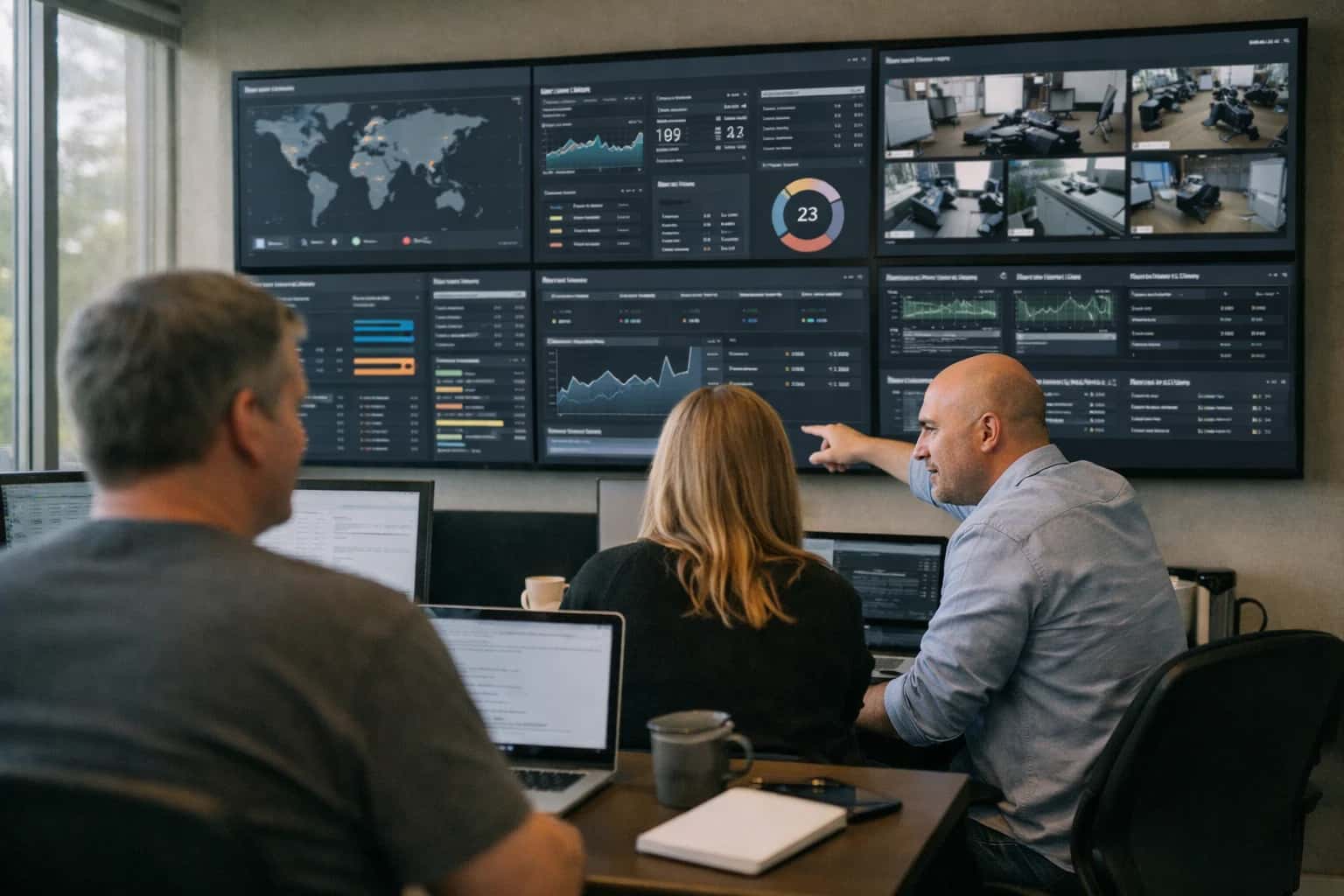
Transform complex robotic programming into intuitive, gesture-based control with AR/VR interfaces.
Reduce robot programming time by 70% and cut operator training from weeks to days with intuitive 3D overlays and gesture commands.
Our development process delivers:
- AR-assisted task programming using devices like Microsoft HoloLens or Apple Vision Pro.
- Real-time 3D visualization of robot paths, sensor data, and digital twins within the physical workspace.
- Natural gesture and voice control protocols for issuing commands and adjusting parameters hands-free.
- Seamless integration with existing robotic control stacks (
ROS 2,Ignition Gazebo) and PLC networks.
This transforms operators from manual controllers to high-level supervisors, boosting throughput and safety. For a complete physical AI integration, explore our services for Industrial AI Agent Development and Edge AI Deployment for Robotics.
TANGIBLE BUSINESS IMPACT
Measurable Outcomes of Spatial Interfaces
Our spatial computing interface design delivers more than just advanced UI. We focus on quantifiable improvements to operational efficiency, safety, and workforce productivity, directly impacting your bottom line.
01
Reduced Operator Training Time
Intuitive AR/VR interfaces with natural gesture controls cut complex machinery training from weeks to days. Operators learn through immersive simulation, reducing errors and accelerating time-to-competency.
60-80%
Faster Training
< 3 days
Average Ramp-Up
02
Enhanced Operational Safety
Real-time visual overlays and predictive hazard zones reduce workplace incidents. Operators receive contextual safety warnings and step-by-step procedural guidance directly in their field of view.
> 40%
Fewer Safety Violations
99.9%
Procedural Compliance
03
Accelerated Maintenance & Diagnostics
Spatial interfaces overlay equipment schematics, sensor telemetry, and AI-powered fault predictions onto physical machinery. Technicians diagnose issues 3x faster with guided repair instructions.
70%
Faster Diagnostics
45%
Reduced Downtime
05
Increased First-Pass Yield
Precision-guided AR overlays for assembly, welding, and inspection eliminate guesswork. Operators achieve sub-millimeter accuracy consistently, dramatically reducing rework and material waste.
> 25%
Quality Improvement
15-30%
Waste Reduction
06
Remote Expert Collaboration
Enable off-site experts to see a live operator's view, annotate the physical environment, and provide hands-free guidance. This reduces travel costs and resolves critical issues in minutes, not days.
90%
Faster Remote Resolution
$50K+
Annual Travel Savings
Structured, predictable outcomes
Typical Project Timeline & Deliverables
Our phased approach to spatial computing interface design ensures clear milestones, predictable costs, and rapid deployment of intuitive AR/VR interfaces for industrial control.
| Phase & Key Deliverables | Timeline | Your Team's Role | Inference Systems' Deliverables |
|---|---|---|---|
Phase 1: Discovery & Requirements | 1-2 weeks | Provide access to subject matter experts, legacy system documentation, and operational environment. | Technical specification document, user journey maps, and a prioritized feature backlog for the spatial interface. |
Phase 2: Prototype & UI/UX Design | 2-3 weeks | Review interactive prototypes and provide feedback on gesture mappings and visual overlays. | Interactive AR/VR prototype, 3D spatial UI wireframes, and a validated user interaction model. |
Phase 3: Core Development & Integration | 4-6 weeks | Provide staging environment, API access to robotic controllers/PLCs, and conduct weekly integration reviews. | Fully functional spatial interface MVP, integration SDK for your industrial systems, and comprehensive API documentation. |
Phase 4: Pilot Deployment & Validation | 2-3 weeks | Conduct pilot with designated operators, collect performance and usability metrics. | Deployed pilot system, performance analytics dashboard, and a detailed validation report with optimization recommendations. |
Phase 5: Scaling & Handoff | 1-2 weeks | Plan for broader rollout, assign internal technical owners. | Production-ready application, source code, deployment runbooks, and knowledge transfer sessions for your engineering team. |
Total Project Duration | 10-16 weeks | Collaborative partnership with focused reviews. | A deployable, intuitive spatial computing interface that reduces operator training time and increases robotic system utilization. |
Ongoing Support Options | Post-launch | Optional: Engage for enhancements, new feature development, or SLA-backed maintenance. | Available tiers: Ad-hoc consulting, Priority Support SLA (99.9% uptime), or Dedicated Retainer for continuous evolution. |
PROVEN OUTCOMES
Industrial Applications & Use Cases
Our spatial computing interfaces are engineered for tangible operational impact. We translate complex robotic and AI data into intuitive visual overlays that enhance human decision-making and system control.
Enabling Efficiency, Speed & Accuracy
Intelligent Analysis, Decision & Execution
We build AI systems for teams that need search across company data, workflow automation across tools, or AI features inside products and internal software.
Talk to Us
Search across company data
Give teams answers from docs, tickets, runbooks, and product data with sources and permissions.
Useful when people spend too long searching or get different answers from different systems.
Enterprise searchRAGPermissions
Read more
Automate internal workflows
Use AI to route work, draft outputs, trigger actions, and keep approvals and logs in place.
Useful when repetitive work moves across multiple tools and teams.
AI agentsWorkflow automationGovernance
Read more
Add AI to products and internal tools
Build assistants, guided actions, or decision support into the software your team or customers already use.
Useful when AI needs to be part of the product, not a separate tool.
AI integrationDecision supportModel routing
Read moreTechnical and Commercial Questions
Spatial Computing Interface Development FAQ
Answers to common questions about our process, timeline, and technical approach for building spatial interfaces that connect human operators with industrial AI systems.
A minimum viable product (MVP) for a focused industrial task, such as a machine monitoring overlay, can be deployed in 4-6 weeks. Full-scale interfaces for complex environments, like multi-robot fleet orchestration, typically require 8-12 weeks of development, including integration with existing PLCs and data systems. We use agile sprints with bi-weekly demos to ensure alignment and accelerate delivery.

About the author
Prasad Kumkar
CEO & MD, Inference Systems
Prasad Kumkar is the CEO & MD of Inference Systems and writes about AI systems architecture, LLM infrastructure, model serving, evaluation, and production deployment. Over 5+ years, he has worked across computer vision models, L5 autonomous vehicle systems, and LLM research, with a focus on taking complex AI ideas into real-world engineering systems.
His work and writing cover AI systems, large language models, AI agents, multimodal systems, autonomous systems, inference optimization, RAG, evaluation, and production AI engineering.
LinkedIn
Limited slotsGet a Free AI Consultation
Partnered with leading AI, data, and software stack.





How We Work
Custom AI workflows for your Business
One-fit-all AI don't work for modern businesses. At Inferensys, we aim to understand your business & custom requirements; which we use to define most efficient agentic workflows, the data, and the tools for your business.
01
Review the use case
We understand the task, the users, and where AI can actually help.
Read more02
Pick the right approach
We define what needs search, automation, or product integration.
Read more03
Build the first useful version
We implement the part that proves the value first.
Read more04
Improve from there
We add the checks and visibility needed to keep it useful.
Read moreThe first call is a practical review of your use case and the right next step.
Talk to Us