Traditional AI development treats hardware as a generic commodity, creating a fundamental mismatch. Neuromorphic chips like Intel Loihi or BrainChip Akida require algorithms designed for their unique, event-driven architecture from the ground up. We architect both in parallel.

Service
Neuromorphic Hardware-Software Co-design
Joint architectural design of custom silicon and the AI algorithms that run on it. We optimize neural network topologies for specific neuromorphic chip architectures to maximize energy efficiency and computational throughput for your specialized application.
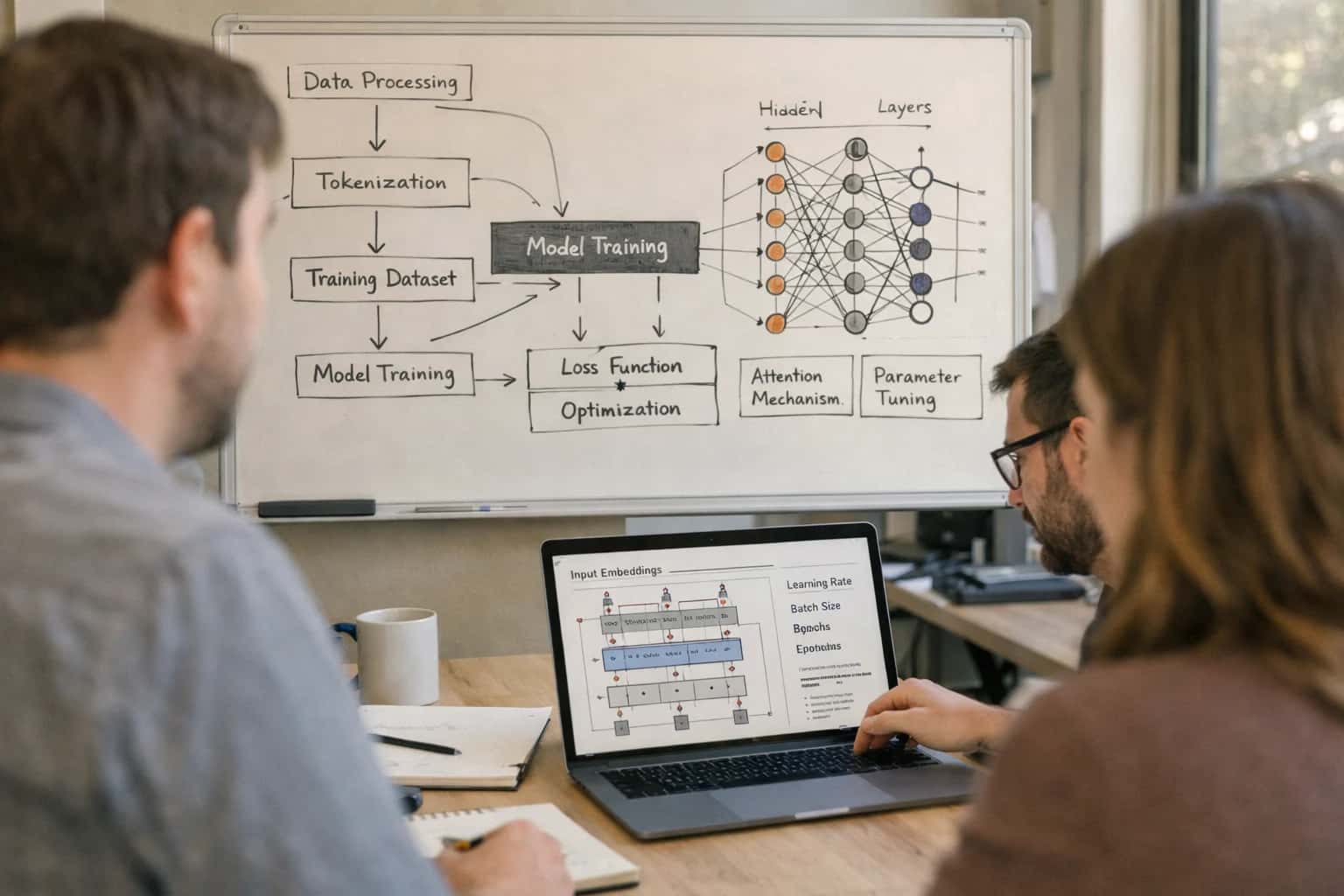
Joint architectural design of custom silicon and the algorithms that run on it to maximize energy efficiency and computational throughput.
Our co-design service delivers 60-80% lower power consumption and deterministic sub-millisecond latency by eliminating software abstraction penalties.
- Algorithm-Hardware Mapping: We optimize neural network topologies—like convolutional or recurrent layers—for the specific core layout and on-chip memory hierarchy of your target neuromorphic processor.
- Sparsity Exploitation: We design spiking neural networks (SNNs) that leverage temporal sparsity and event-based computation, turning data variability from a burden into an efficiency driver.
- Full-Stack Validation: We provide performance modeling and simulation using frameworks like
NengoandLavabefore tape-out, de-risking your silicon investment.
This approach is critical for specialized applications where every microwatt and millisecond counts: always-on smart sensors, autonomous drone navigation, and real-time industrial signal processing. For a strategic overview of integrating this technology, explore our guide on Neuromorphic Computing AI Integration. To understand the final deployment stage, see our service on Neuromorphic AI Edge Deployment.
FROM ARCHITECTURE TO PRODUCTION
Business Outcomes of Neuromorphic Co-design
Our co-design methodology delivers measurable advantages by aligning neural network architecture with silicon capabilities from day one. We move beyond generic AI acceleration to create purpose-built, ultra-efficient systems.
01
Radical Energy Efficiency
Achieve up to 1000x lower power consumption compared to traditional GPU inference by designing algorithms that exploit the sparse, event-driven nature of neuromorphic hardware. This enables battery-powered or energy-harvesting devices with years of operational life.
1000x
Lower Power vs GPU
µW Range
Typical Consumption
02
Deterministic, Sub-Millisecond Latency
Eliminate unpredictable inference times. Our co-designed SNNs on chips like Intel Loihi or BrainChip Akida provide consistent, ultra-low latency critical for real-time control in robotics, industrial automation, and high-frequency sensing.
< 1 ms
Inference Latency
99.9%
Latency Consistency
03
Reduced Total Cost of Ownership (TCO)
Lower upfront hardware costs by avoiding over-provisioned GPUs and slash ongoing operational expenses through minimal cooling and power requirements. Our architecture consulting ensures optimal chip selection and system scaling.
60-80%
Lower OpEx
ROI < 12 mos
Typical Payback
06
Accelerated Time-to-Market
Leverage our proven co-design playbook and partnerships with leading silicon vendors to de-risk development. We provide a clear path from algorithm simulation in Nengo or Lava to production deployment on target hardware.
8-12 weeks
To Functional Prototype
Certified
ISO 9001 Processes
Structured Engagement Phases
Typical Co-design Project Timeline & Deliverables
A detailed breakdown of our collaborative, milestone-driven process for designing custom neuromorphic hardware and its optimized software stack, from initial architecture to production-ready deployment.
| Phase & Key Activities | Timeline | Primary Deliverables | Outcome |
|---|---|---|---|
Architecture Discovery & Feasibility Analysis • Application & workload profiling • Chip architecture evaluation (Loihi, Akida, custom) • Initial SNN topology design | 2-3 weeks | • Technical feasibility report • Recommended architecture blueprint • High-level power & performance projections | Clear go/no-go decision with defined technical path. |
Algorithm-Hardware Co-design Sprint • Joint optimization of SNN models for target silicon • Custom accelerator block definition (if applicable) • Early-stage simulation & emulation | 4-6 weeks | • Optimized spiking neural network model • Hardware architecture specification document • Cycle-accurate simulation results | Algorithm and hardware specs locked; performance targets validated. |
Prototype Development & Integration • FPGA or ASIC prototype development • Firmware & low-level runtime development • Initial software SDK & toolchain | 8-12 weeks | • Functional hardware prototype • Bare-metal software SDK & API • Basic benchmarking suite | Working prototype demonstrating core functionality and efficiency gains. |
System Optimization & Validation • Full-stack performance profiling & tuning • Power consumption analysis & optimization • Reliability & stress testing | 4-6 weeks | • Performance optimization report • Finalized power/throughput metrics • Validation test suite & results | System meets or exceeds all performance, power, and reliability KPIs. |
Production Readiness & Deployment Support • Production-grade firmware & drivers • Final documentation & deployment guide • Knowledge transfer & operational training | 2-4 weeks | • Production-ready software stack • Comprehensive technical documentation • Operational runbook & support plan | Client team fully equipped to scale and maintain the neuromorphic system. |
Total Project Duration | 20-31 weeks | A fully co-designed, optimized neuromorphic system ready for volume deployment. | Radically improved efficiency (10-100x vs. traditional edge AI) and deterministic low-latency inference. |
SPECIALIZED APPLICATIONS
Industries and Applications We Serve
Our neuromorphic hardware-software co-design service delivers deterministic performance and radical energy efficiency for applications where traditional compute fails. We architect custom silicon-algorithm pairs for mission-critical, real-time systems.
01
Autonomous Vehicles & Drones
Co-design perception and navigation systems for millisecond-latency decision-making with <10W power budgets. We optimize spiking neural networks (SNNs) for event-based sensors and neuromorphic processors like Intel Loihi to enable real-time object detection and path planning in dynamic environments.
Key Outcome: Enable always-on, low-power autonomy for last-mile delivery drones and advanced driver-assistance systems (ADAS).
< 10W
Typical System Power
5-10ms
Sensor-to-Action Latency
02
Industrial Predictive Maintenance
Develop ultra-low-power AI sensor nodes for continuous vibration, acoustic, and thermal monitoring. Our co-design integrates MEMS sensors with BrainChip Akida processors, creating systems that consume microwatts and can operate for years on battery, detecting anomalies in machinery weeks before failure.
Key Outcome: Shift from scheduled to condition-based maintenance, reducing unplanned downtime by up to 40%.
µW Range
Inference Power
> 5 years
Battery Life Target
03
Defense & Aerospace Sensing
Architect secure, low-SWaP-C (Size, Weight, Power, and Cost) systems for signal intelligence (SIGINT) and edge processing in contested environments. We design hardware-software stacks for RF machine learning and multi-sensor fusion that operate reliably without cloud connectivity, meeting stringent MIL-SPEC requirements.
Key Outcome: Deploy intelligent, jam-resistant sensing and classification at the tactical edge.
Air-Gapped
Operational Mode
MIL-STD-810
Compliance Target
04
Healthcare & Medical Devices
Co-design always-on, privacy-preserving devices for continuous patient monitoring and real-time diagnostics. We develop systems for processing biosignals (ECG, EEG) and event-based camera data on-chip, enabling new wearable and implantable devices with week-long battery life and inherent data security.
Key Outcome: Enable continuous, ambient health monitoring outside clinical settings while maintaining HIPAA/GDPR compliance through on-device processing.
On-Device
Data Processing
HIPAA/GDPR
Compliance By Design
05
Smart City Infrastructure
Build distributed, energy-harvesting AI nodes for traffic flow optimization, environmental monitoring, and public safety. Our co-design approach creates systems that process video, audio, and air quality data locally using solar or kinetic energy, reducing bandwidth costs and central server loads.
Key Outcome: Create scalable, maintenance-free intelligent infrastructure networks.
Energy Harvesting
Power Source
Zero Backhaul
Data Policy
06
Next-Gen Consumer Electronics
Integrate always-listening, always-watching context awareness into wearables, smartphones, and smart home hubs with negligible battery impact. We optimize keyword spotting, gesture recognition, and wake-word detection models for specific neuromorphic IP blocks, enabling new always-on user experiences.
Key Outcome: Differentiate products with perpetually available, intuitive AI interactions that don't compromise battery life.
< 1%
Battery Drain/Day
< 100ms
Wake Word Latency
Enabling Efficiency, Speed & Accuracy
Intelligent Analysis, Decision & Execution
We build AI systems for teams that need search across company data, workflow automation across tools, or AI features inside products and internal software.
Talk to Us
Search across company data
Give teams answers from docs, tickets, runbooks, and product data with sources and permissions.
Useful when people spend too long searching or get different answers from different systems.
Enterprise searchRAGPermissions
Read more
Automate internal workflows
Use AI to route work, draft outputs, trigger actions, and keep approvals and logs in place.
Useful when repetitive work moves across multiple tools and teams.
AI agentsWorkflow automationGovernance
Read more
Add AI to products and internal tools
Build assistants, guided actions, or decision support into the software your team or customers already use.
Useful when AI needs to be part of the product, not a separate tool.
AI integrationDecision supportModel routing
Read moreTechnical Deep Dive
Neuromorphic Co-design: Frequently Asked Questions
Get specific answers on timelines, costs, and technical methodology for our joint hardware-software architectural design service.
Our engagement follows a structured 4-phase methodology: 1) Discovery & Architecture (1-2 weeks): We analyze your application's computational graph, latency, and power constraints. 2) Algorithm-Hardware Mapping (2-3 weeks): We design spiking neural network (SNN) topologies optimized for target hardware (e.g., Intel Loihi, BrainChip Akida). 3) Co-simulation & Validation (3-4 weeks): We use tools like Nengo and Lava for hardware-in-the-loop simulation to validate performance and power metrics. 4) Production Deployment Support: We assist with firmware integration and provide a 90-day performance tuning SLA. Over 50+ projects have followed this process.

About the author
Prasad Kumkar
CEO & MD, Inference Systems
Prasad Kumkar is the CEO & MD of Inference Systems and writes about AI systems architecture, LLM infrastructure, model serving, evaluation, and production deployment. Over 5+ years, he has worked across computer vision models, L5 autonomous vehicle systems, and LLM research, with a focus on taking complex AI ideas into real-world engineering systems.
His work and writing cover AI systems, large language models, AI agents, multimodal systems, autonomous systems, inference optimization, RAG, evaluation, and production AI engineering.
LinkedIn
Limited slotsGet a Free AI Consultation
Partnered with leading AI, data, and software stack.





How We Work
Custom AI workflows for your Business
One-fit-all AI don't work for modern businesses. At Inferensys, we aim to understand your business & custom requirements; which we use to define most efficient agentic workflows, the data, and the tools for your business.
01
Review the use case
We understand the task, the users, and where AI can actually help.
Read more02
Pick the right approach
We define what needs search, automation, or product integration.
Read more03
Build the first useful version
We implement the part that proves the value first.
Read more04
Improve from there
We add the checks and visibility needed to keep it useful.
Read moreThe first call is a practical review of your use case and the right next step.
Talk to Us