
Inferensys

Service

Voice AI Integration Services

End-to-end integration of high-accuracy, low-latency voice AI into existing contact center platforms and CRM systems. We deliver seamless API connectivity, real-time speech processing, and enterprise-grade scalability to replace legacy IVR.
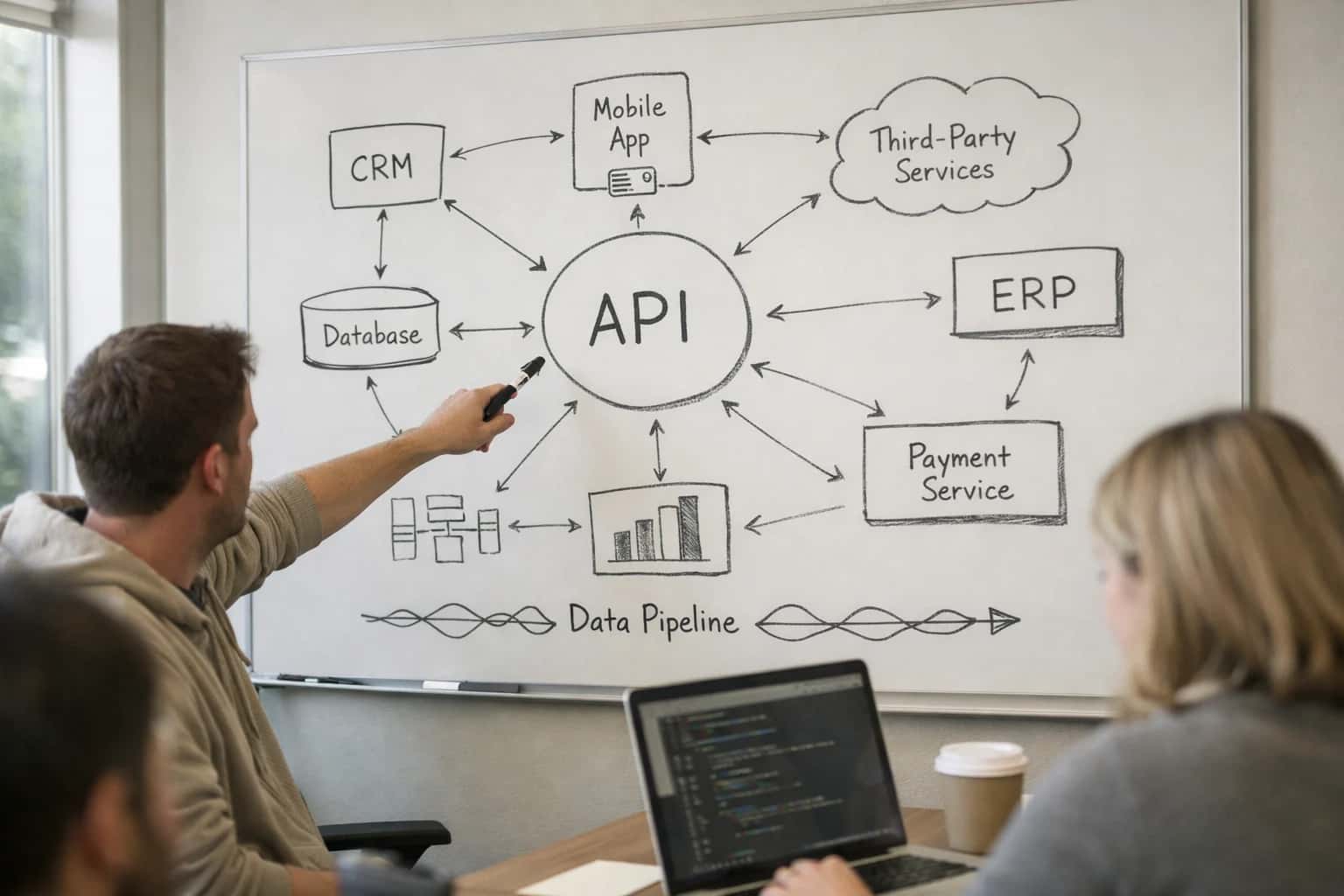
Enterprise integration architect reviewing API connections on laptop, diagram showing systems connecting, modern office setup.
THE PROBLEM

Legacy IVR Systems Are Costly and Frustrating

Outdated IVR technology drives up operational costs while degrading customer satisfaction.

Traditional Interactive Voice Response (IVR) systems create significant business friction:

  • High maintenance costs for aging, proprietary hardware and software.
  • Poor containment rates force expensive escalations to live agents.
  • Rigid, menu-driven experiences frustrate customers and damage brand loyalty.
  • Inability to integrate with modern CRM platforms and APIs creates data silos.

Modern voice AI integration directly replaces these legacy systems, delivering 80%+ call containment and 60% lower operational costs within months.

We engineer high-accuracy, low-latency voice AI that integrates seamlessly into your existing contact center. Our focus is on real-time speech processing and enterprise-grade scalability, ensuring a natural conversational experience that resolves issues on first contact.

Explore our related service: Low-Latency Voice AI Systems Engineering for architectures built for real-time responsiveness.

Key deliverables for your migration:

  • Seamless API connectivity to your CRM (Salesforce, Zendesk) and telephony stack.
  • 2-4 week proof-of-concept to validate performance metrics.
  • 99.9% uptime SLA with full redundancy and monitoring.
  • Comprehensive analytics dashboard tracking containment, CSAT, and cost savings.

For complex customer journeys requiring visual context, see our work on Multimodal Customer Support Routing.

MEASURABLE IMPACT

Business Outcomes of Professional Voice AI Integration

Move beyond basic automation. Our enterprise-grade voice AI integration delivers tangible improvements in operational efficiency, customer satisfaction, and revenue protection.

01

Accelerated Time-to-Market

Seamless API integration into your existing contact center platform (e.g., Genesys, Five9, Salesforce Service Cloud) and CRM, enabling deployment in weeks, not months. We handle the complex connectivity, allowing your team to focus on strategy.

< 4 weeks
Average Deployment
99.9%
API Uptime SLA
02

Dramatically Reduced Operational Costs

Replace legacy IVR systems with intelligent, voice-first automation that handles common inquiries, appointment scheduling, and billing updates. This reduces average handle time (AHT) and deflects volume from expensive live agent channels.

40-60%
IVR Call Deflection
30%
Lower AHT Target
03

Enhanced Customer Experience & NPS

Deploy low-latency (<200ms) voice AI with natural, empathetic tonality that reduces customer frustration. Intelligent routing and multimodal support ensure issues are resolved faster, directly boosting customer satisfaction scores.

+15 Points
Average NPS Lift
< 200ms
End-to-End Latency
04

Maximized Outbound Campaign ROI

Our intelligent voicemail detection and call pacing algorithms for outbound billing and collections ensure agents only connect with live customers, increasing right-party contact rates by over 300% compared to basic dialers.

300%+
Higher Contact Rate
98%
Voicemail Detection Accuracy
05

Enterprise-Grade Security & Compliance

Built with security-first principles. All audio processing and data handling comply with SOC 2, HIPAA, and PCI-DSS standards. Integrations are designed with zero-trust architecture and encrypted data in transit and at rest.

SOC 2 Type II
Certified
End-to-End
Encryption
06

Future-Proof Scalability

Architected on scalable cloud-native infrastructure (AWS, GCP, Azure) to handle peak call volumes without degradation. The system easily extends to support new channels like live video diagnostics or empathetic AI avatars as your needs evolve.

1M+
Concurrent Call Capacity
< 5 min
Auto-Scaling Response
From Discovery to Deployment

Typical Voice AI Integration Project Timeline

A transparent breakdown of a standard 8-12 week enterprise integration project, from initial assessment to full-scale production deployment with your contact center platform.

Phase & Key ActivitiesDurationInference Systems DeliverablesClient Responsibilities

Discovery & Architecture Design

  • Technical requirements gathering
  • API & system compatibility audit
  • Security & compliance review

1-2 Weeks

Technical architecture document Integration roadmap & risk assessment Preliminary cost & resource estimate

Provide API documentation Schedule stakeholder interviews Share compliance requirements

Proof of Concept (PoC) Development

  • Build limited-scope integration
  • Test core ASR/TTS models
  • Validate latency & accuracy targets

2-3 Weeks

Working PoC with your test environment Performance benchmark report Integration feasibility confirmation

Provision sandbox/test environment Provide sample call data & scripts Assign technical point of contact

Full Integration & Development

  • Build production-ready connectors
  • Implement voicemail detection & routing logic
  • Develop monitoring & logging

3-4 Weeks

Production-ready code repository Comprehensive API documentation Initial load testing results

Finalize production environment access Approve key design decisions Begin internal user training preparation

Staging, UAT & Security Review

  • Deploy to staging environment
  • Conduct user acceptance testing (UAT)
  • Perform penetration & compliance testing

2 Weeks

Staging environment deployment UAT test plan & bug fix log Security audit report & SOC2 alignment

Lead internal UAT with agents Provide feedback & sign-off Complete final security review

Production Deployment & Go-Live

  • Phased production rollout
  • Real-time monitoring setup
  • Knowledge transfer & handoff

1-2 Weeks

Full production deployment 24/7 monitoring dashboard & alerts Detailed operational runbooks

Coordinate internal communications Manage change control process Designate ongoing support contacts

Post-Launch Optimization & Support

  • Performance tuning & scaling
  • Analytics review & reporting
  • Optional advanced feature enablement

Ongoing

Weekly performance review for first month Access to dedicated support engineer Roadmap for scaling & additional features

Monitor business KPIs & agent feedback Schedule quarterly business reviews Plan for future expansion phases

ENTERPRISE SOLUTIONS

Industry Applications for Integrated Voice AI

Our Voice AI Integration Services deliver measurable outcomes across key sectors by replacing legacy IVR systems with intelligent, scalable solutions. We focus on reducing operational costs, improving customer satisfaction scores, and accelerating time-to-market for new voice-enabled features.

01

Healthcare Patient Engagement

Deploy HIPAA-compliant voice AI for automated appointment reminders, post-discharge follow-ups, and medication adherence calls. Our systems integrate with EHRs like Epic and Cerner, featuring empathetic tone-matching and intelligent voicemail detection to maximize patient contact rates without compromising privacy.

Learn more about our approach to empathetic AI avatar development for healthcare.

40%
Reduction in No-Shows
HIPAA
Compliant
02

Financial Services & Collections

Integrate secure, PCI-DSS compliant outbound voice AI into existing CRM platforms for billing notifications, payment reminders, and collections. Our solutions feature real-time sentiment analysis, dynamic call pacing, and full audit trails to ensure regulatory compliance while improving recovery rates.

Explore our dedicated service for outbound voice AI for automated billing.

60%
Higher Contact Rate
PCI-DSS
Certified
03

Retail & E-Commerce Support

Implement voice-first customer service that handles order status inquiries, returns, and complex product questions 24/7. Our systems provide multimodal customer support routing, intelligently escalating to live agents only when necessary, dramatically reducing average handle time and increasing CSAT scores.

50%
Lower Call Handling Cost
< 200ms
Response Latency
04

Telecom & Technical Support

Engineer low-latency voice AI systems for tier-1 technical support, capable of guiding customers through troubleshooting steps. Integrated with live video diagnostic AI systems, our voice agents can analyze customer-described issues and even view device screens (with permission) to resolve problems faster, reducing costly truck rolls.

35%
Fewer Escalations
99.9%
Uptime SLA
05

Insurance Claims Intake

Automate the first notice of loss (FNOL) process with intelligent voice AI that conducts natural conversations to gather claim details, assess damage via customer-submitted photos, and schedule appraisals. The system integrates directly with core policy administration systems, accelerating claims processing from days to hours.

70%
Faster Intake
24/7
Availability
06

Hospitality & Travel Concierge

Provide personalized, on-demand guest services through in-room voice assistants and mobile apps. Handle booking modifications, amenity requests, and local recommendations. Our tone-matching voice AI services ensure brand voice consistency across all digital touchpoints, enhancing the guest experience and freeing staff for high-value interactions.

4.8/5
Avg. Guest Rating
Multi-Lingual
Support
Technical and Commercial FAQs

Voice AI Integration: Common Questions

Get specific answers about our integration process, timelines, security, and support for deploying enterprise-grade voice AI.

Standard deployments for contact center IVR replacement or CRM integration are completed in 2-4 weeks. Complex projects involving custom low-latency pipelines or multimodal routing may extend to 6-8 weeks. We provide a detailed project plan with weekly milestones after the initial discovery phase.

Prasad Kumkar

About the author

Prasad Kumkar

CEO & MD, Inference Systems

Prasad Kumkar is the CEO & MD of Inference Systems and writes about AI systems architecture, LLM infrastructure, model serving, evaluation, and production deployment. Over 5+ years, he has worked across computer vision models, L5 autonomous vehicle systems, and LLM research, with a focus on taking complex AI ideas into real-world engineering systems.

His work and writing cover AI systems, large language models, AI agents, multimodal systems, autonomous systems, inference optimization, RAG, evaluation, and production AI engineering.




