Deploying individual AI agents creates islands of automation. Without orchestration, you face:
- Costly handoff failures between agents.
- Inconsistent outputs from conflicting logic.
- Unmanageable complexity as your agent count grows.

Service
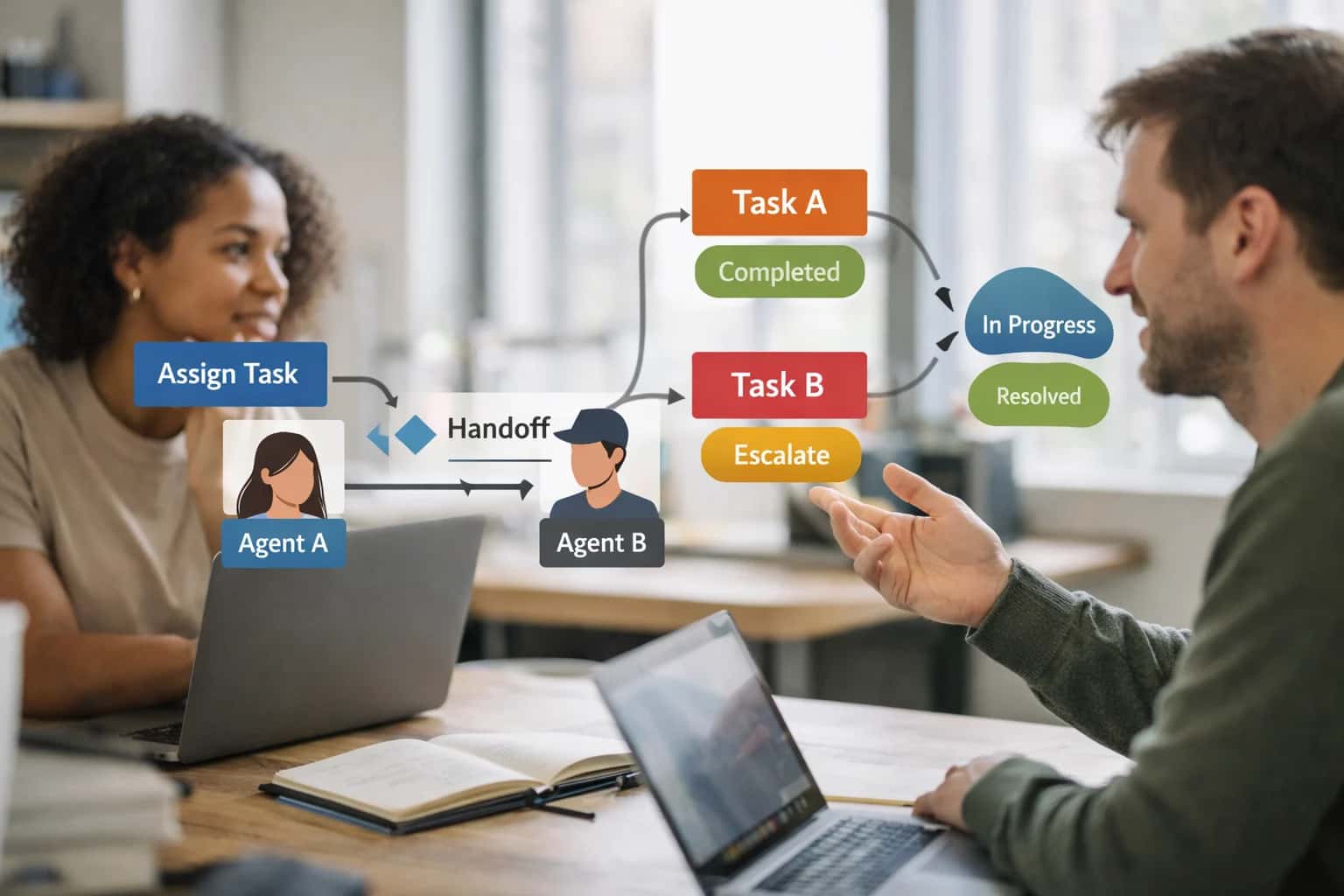
Build a central command system to coordinate specialized AI agents, ensuring seamless collaboration and reliable business outcomes.
Deploying individual AI agents creates islands of automation. Without orchestration, you face:
We engineer central control platforms using frameworks like
LangGraphandAutoGento sequence tasks, manage state, and synthesize final results from your agent workforce.
Deliverables include:
Move from fragmented automation to a cohesive, intelligent system. Explore our broader approach to Multiagent Systems (MAS) Architecture or learn how we secure these networks with Multiagent System Security Architecture.
Our multiagent orchestration platform development delivers more than just technical coordination. It translates directly into measurable business advantages, accelerating time-to-market, reducing operational risk, and unlocking new levels of AI-driven efficiency.
Deploy complex, collaborative AI workflows in weeks, not months. Our platform engineering with LangGraph and AutoGen provides pre-built, battle-tested orchestration patterns, eliminating the need to build foundational coordination logic from scratch.
Key Deliverables:
Achieve consistent SLAs for multi-step AI processes under variable load. Our architecture ensures reliable agent execution, intelligent queuing, and resource-aware scheduling, preventing cascading failures and meeting strict throughput requirements.
Key Deliverables:
Centralize the management, monitoring, and security of your entire agentic workforce. A single pane of glass for logging, tracing, and cost attribution replaces the overhead of managing disparate scripts and microservices, leading to significant OpEx savings.
Key Deliverables:
Ensure the final output of collaborative agent chains is coherent, accurate, and actionable. Our orchestration logic manages context aggregation, validates intermediate results, and applies business rules to synthesize a single, trustworthy outcome from distributed agent work.
Key Deliverables:
Build on a platform designed for evolution. Easily integrate new agent types, swap underlying LLMs, or adopt emerging frameworks without re-architecting your core coordination logic, protecting your investment as the multiagent ecosystem rapidly advances.
Key Deliverables:
A transparent breakdown of the phased development process for a custom multiagent orchestration platform, from initial architecture to full-scale deployment and ongoing support.
| Phase & Key Deliverables | Starter (Proof-of-Concept) | Professional (Production-Ready) | Enterprise (Scaled Deployment) | |
|---|---|---|---|---|
Architecture & Design (Weeks 1-2) | Core agent role definitions & basic LangGraph workflow diagram | Full system architecture, security model, and integration spec | Enterprise-scale topology with failover, DR, and compliance mapping | |
Core Orchestrator Development (Weeks 3-6) | Basic sequential agent coordination with manual error handling | Robust LangGraph/AutoGen state machine with automated handoffs & retry logic | Advanced orchestration with dynamic routing, load balancing, and agent negotiation protocols | |
Agent Integration & Tooling (Weeks 7-10) | Integration of 2-3 core agents (e.g., LLM, RAG) | Integration of 5-8 specialized agents with custom tools & APIs | Integration of 10+ agents, legacy system adapters, and real-time data connectors | |
Security & Observability Layer | Basic API authentication | Agent-level auth, audit logging, and basic monitoring dashboard | Full MITRE ATLAS-aligned security, real-time collaboration analytics, and anomaly detection | |
Testing & Validation | Unit tests for core orchestration logic | End-to-end workflow simulation & adversarial testing suite | Load testing at scale, red teaming, and compliance validation (e.g., for AI Act) | |
Deployment & Go-Live Support | Deployment to a single cloud environment with documentation | CI/CD pipeline, cloud-agnostic deployment, and 2 weeks of launch support | Multi-region/ hybrid-cloud deployment, full knowledge transfer, and dedicated SRE handoff | |
Ongoing Maintenance & Scaling | Ad-hoc support | Optional SLA with priority support and quarterly reviews | Managed service option with 99.9% uptime SLA, performance tuning, and roadmap planning | |
Typical Timeline | 8-10 weeks | 12-16 weeks | 16-24+ weeks (scalable phases) | Typical Investment Range$50K - $80K$120K - $250K$300K+ (custom quote) |
Enabling Efficiency, Speed & Accuracy
We build AI systems for teams that need search across company data, workflow automation across tools, or AI features inside products and internal software.
Talk to Us
Give teams answers from docs, tickets, runbooks, and product data with sources and permissions.
Useful when people spend too long searching or get different answers from different systems.

Use AI to route work, draft outputs, trigger actions, and keep approvals and logs in place.
Useful when repetitive work moves across multiple tools and teams.

Build assistants, guided actions, or decision support into the software your team or customers already use.
Useful when AI needs to be part of the product, not a separate tool.
Get specific answers on timelines, costs, and technical capabilities for building a central control system to coordinate specialized AI agents.
A standard deployment for a foundational orchestration platform using frameworks like LangGraph or AutoGen takes 2-4 weeks. This includes core agent coordination, basic task handoff logic, and a single integration point. Complex deployments with 10+ specialized agents, custom communication protocols, and multiple legacy system integrations typically require 6-10 weeks. We provide a phased roadmap, often delivering a minimum viable orchestrator in the first 2 weeks to validate the approach.

About the author
CEO & MD, Inference Systems
Prasad Kumkar is the CEO & MD of Inference Systems and writes about AI systems architecture, LLM infrastructure, model serving, evaluation, and production deployment. Over 5+ years, he has worked across computer vision models, L5 autonomous vehicle systems, and LLM research, with a focus on taking complex AI ideas into real-world engineering systems.
His work and writing cover AI systems, large language models, AI agents, multimodal systems, autonomous systems, inference optimization, RAG, evaluation, and production AI engineering.
How We Work
One-fit-all AI don't work for modern businesses. At Inferensys, we aim to understand your business & custom requirements; which we use to define most efficient agentic workflows, the data, and the tools for your business.
01
We understand the task, the users, and where AI can actually help.
Read more02
We define what needs search, automation, or product integration.
Read more03
We implement the part that proves the value first.
Read more04
We add the checks and visibility needed to keep it useful.
Read moreThe first call is a practical review of your use case and the right next step.
Talk to Us





