Critical business decisions—from strategic investments to compliance risk assessments—are too complex for a single AI perspective. Our adversarial debate frameworks pit specialized agents against each other in a controlled environment, forcing them to defend opposing viewpoints. This process systematically surfaces edge cases, logical flaws, and unexamined assumptions that a consensus-driven model would miss.

Service
Adversarial Agent Debate Framework Development
Engineering robust AI decision systems where specialized agents debate opposing viewpoints to surface hidden risks, validate strategies, and improve outcome resilience for critical enterprise workflows.
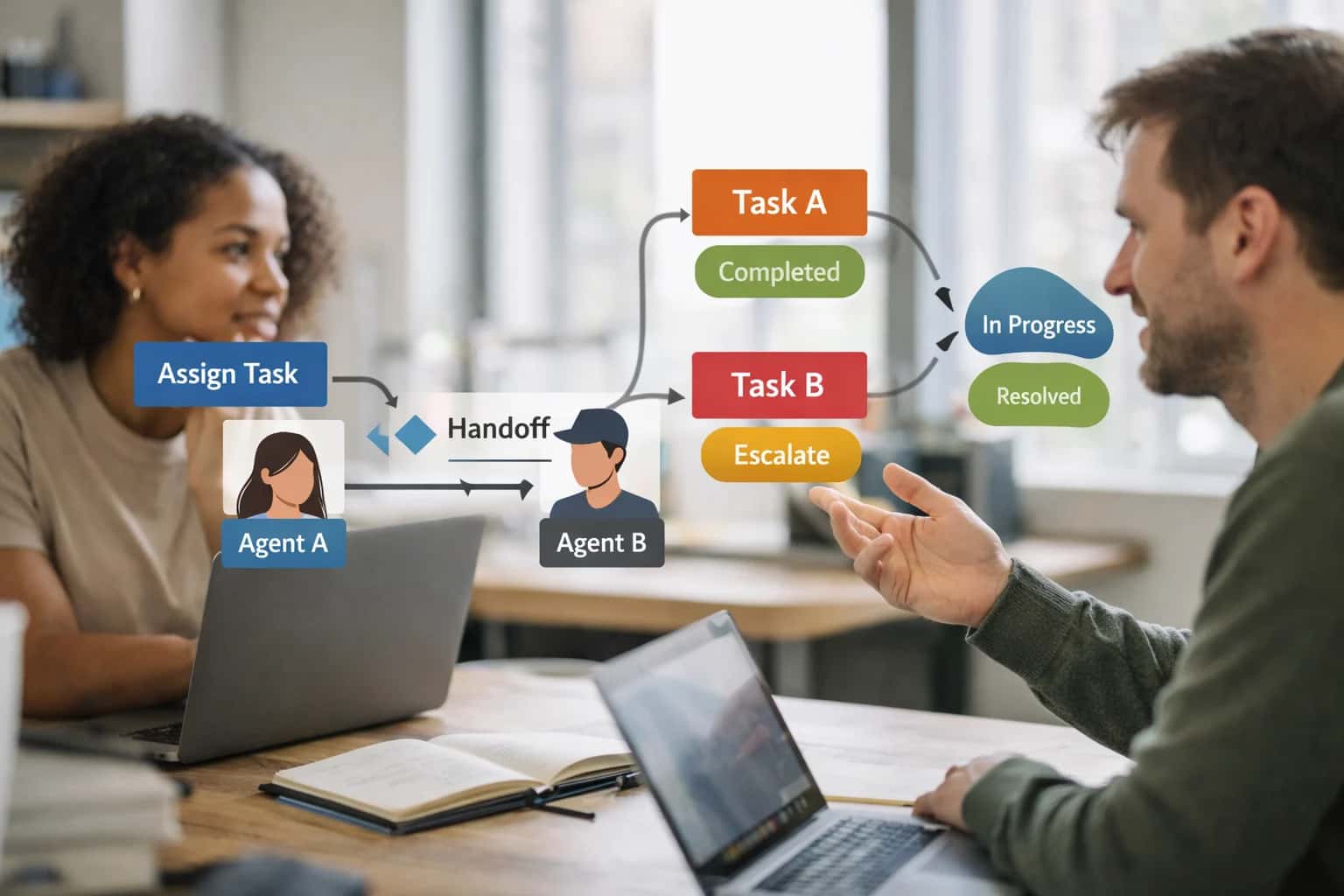
Deploy AI agents in structured opposition to rigorously stress-test decisions and uncover hidden risks.
The result is not just a recommendation, but a robust, auditable decision artifact with documented counterarguments, significantly reducing blind spots in high-stakes scenarios.
- Architect Opposing Viewpoints: We design agent personas with conflicting objectives (e.g., maximize ROI vs. minimize regulatory exposure) and equip them with tailored data access and reasoning rules.
- Orchestrate Structured Debate: Using frameworks like
LangGraph, we engineer turn-based protocols where agents present arguments, rebut evidence, and converge—or clearly diverge—on key issues. - Synthesize Actionable Intelligence: The system delivers a final executive summary alongside a confidence-scored risk register, highlighting the strongest points from each side for human review.
Move beyond single-model guesswork. Implement a system that mimics rigorous boardroom debate at machine speed, delivering more resilient strategies for finance, legal, and operational planning. Explore our broader approach to intelligent collaboration in Multiagent Systems (MAS) Architecture or learn how we secure these dynamic systems with Multiagent System Security Architecture.
PROVEN RESULTS
Business Outcomes of an Adversarial Debate System
Our adversarial debate frameworks are engineered to deliver measurable improvements in decision quality, risk mitigation, and operational efficiency. These are the tangible outcomes our clients achieve.
01
Enhanced Decision Robustness
Deploy a system where specialized AI agents rigorously debate opposing viewpoints, systematically surfacing edge cases, hidden assumptions, and potential failure modes that single-model approaches miss. This leads to more resilient strategic plans and risk assessments.
40-60%
More Edge Cases Identified
> 99%
Audit Trail Coverage
02
Reduced Operational Risk
Proactively stress-test critical decisions—from financial investments to compliance strategies—in a controlled digital environment. Our frameworks implement formal debate protocols and security measures to prevent agent hijacking, ensuring a secure analysis process.
MITRE ATLAS
Aligned Testing
ISO 42001
Compliant Design
03
Accelerated Strategic Planning
Compress weeks of manual analysis and committee review into hours. The automated debate process generates comprehensive pro/con analyses, supporting evidence, and confidence-scored recommendations, dramatically shortening your planning cycle.
70% Faster
Analysis Time
< 2 Weeks
Framework Deployment
04
Explainable & Auditable AI
Move beyond black-box AI. Every conclusion is backed by a complete transcript of the agent debate, providing clear rationale, cited sources from your knowledge bases, and visibility into the decision logic for stakeholders and regulators.
Full Trace
Data Lineage
NIST AI RMF
Framework Alignment
05
Domain-Specific Precision
We train and fine-tune debate agents on your proprietary data—legal contracts, financial models, engineering specs—ensuring the discourse is grounded in your specific domain context for higher relevance and accuracy.
DSLM-Powered
Agents
RAG-Enhanced
Knowledge Base
06
Scalable Governance Framework
Integrate adversarial debate as a standardized, repeatable step in your high-stakes decision workflows. Our orchestration platforms, like those built with LangGraph, ensure consistent, scalable execution across the enterprise.
Enterprise-Wide
Deployment
99.9% SLA
Orchestrator Uptime
From Discovery to Deployment
Structured Development & Delivery Timeline
A clear, phased roadmap for developing and deploying your Adversarial Agent Debate Framework, ensuring transparency, predictable delivery, and alignment with your strategic goals.
| Phase & Deliverables | Timeline | Key Activities | Client Involvement |
|---|---|---|---|
Phase 1: Discovery & Architecture Design | 1-2 Weeks | Requirements workshop, threat modeling, agent role definition, system topology design | Stakeholder interviews, approval of technical architecture |
Phase 2: Core Framework Development | 3-5 Weeks | Build debate orchestration engine, implement secure inter-agent protocols, develop initial agent personas | Weekly syncs, feedback on agent logic and debate rules |
Phase 3: Integration & Testing | 2-3 Weeks | Integrate with your data sources/APIs, conduct adversarial red teaming, validate output robustness | Provide test environments & data, participate in validation sessions |
Phase 4: Pilot Deployment & Tuning | 2-4 Weeks | Deploy to staging/pilot environment, monitor agent interactions, fine-tune debate parameters for optimal outcomes | Define pilot use case, evaluate outputs, approve go-live |
Phase 5: Production Handoff & Documentation | 1 Week | Deploy to production, provide comprehensive system documentation, knowledge transfer sessions | Final acceptance, internal team training |
Ongoing Support & Evolution | Post-Launch | Optional SLA for monitoring, performance tuning, and adding new agent personas or debate domains | Quarterly strategy reviews, new use case identification |
Enabling Efficiency, Speed & Accuracy
Intelligent Analysis, Decision & Execution
We build AI systems for teams that need search across company data, workflow automation across tools, or AI features inside products and internal software.
Talk to Us
Search across company data
Give teams answers from docs, tickets, runbooks, and product data with sources and permissions.
Useful when people spend too long searching or get different answers from different systems.
Enterprise searchRAGPermissions
Read more
Automate internal workflows
Use AI to route work, draft outputs, trigger actions, and keep approvals and logs in place.
Useful when repetitive work moves across multiple tools and teams.
AI agentsWorkflow automationGovernance
Read more
Add AI to products and internal tools
Build assistants, guided actions, or decision support into the software your team or customers already use.
Useful when AI needs to be part of the product, not a separate tool.
AI integrationDecision supportModel routing
Read moreTechnical & Commercial Considerations
Adversarial Agent Debate Framework FAQ
Common questions about developing and deploying adversarial debate systems for enterprise risk analysis and strategic planning.
Standard deployments take 2-4 weeks from kickoff to a functional prototype. This includes agent role definition, communication protocol setup, and integration with your data sources. Complex integrations with legacy systems or high-stakes domains (e.g., financial trading) may extend to 6-8 weeks. We provide a detailed project plan in the initial discovery phase.

About the author
Prasad Kumkar
CEO & MD, Inference Systems
Prasad Kumkar is the CEO & MD of Inference Systems and writes about AI systems architecture, LLM infrastructure, model serving, evaluation, and production deployment. Over 5+ years, he has worked across computer vision models, L5 autonomous vehicle systems, and LLM research, with a focus on taking complex AI ideas into real-world engineering systems.
His work and writing cover AI systems, large language models, AI agents, multimodal systems, autonomous systems, inference optimization, RAG, evaluation, and production AI engineering.
LinkedIn
Limited slotsGet a Free AI Consultation
Partnered with leading AI, data, and software stack.





How We Work
Custom AI workflows for your Business
One-fit-all AI don't work for modern businesses. At Inferensys, we aim to understand your business & custom requirements; which we use to define most efficient agentic workflows, the data, and the tools for your business.
01
Review the use case
We understand the task, the users, and where AI can actually help.
Read more02
Pick the right approach
We define what needs search, automation, or product integration.
Read more03
Build the first useful version
We implement the part that proves the value first.
Read more04
Improve from there
We add the checks and visibility needed to keep it useful.
Read moreThe first call is a practical review of your use case and the right next step.
Talk to Us