Unmonitored R&D, third-party code, and global product launches create silent IP liabilities. We build deterministic AI tools that act as your 24/7 compliance layer, scanning internal repositories, external channels, and patent databases to surface risks before they escalate into litigation or revenue loss.

Service
Intellectual Property Compliance AI Development
We build custom AI systems that automate IP monitoring, patent searches, and licensing compliance across global portfolios, reducing infringement risk and accelerating R&D cycles.
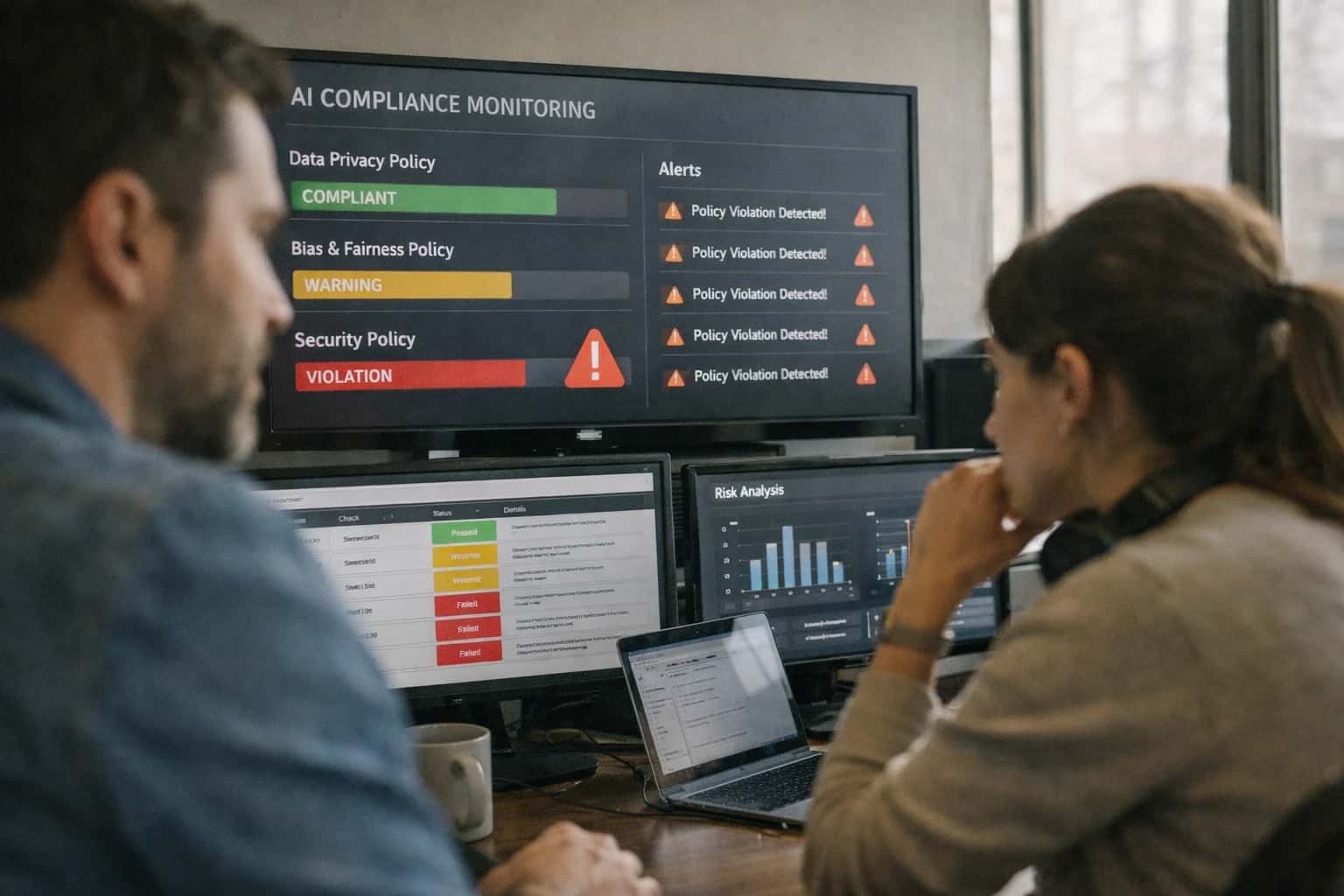
INTELLECTUAL PROPERTY COMPLIANCE
The Hidden IP Risk in Your Global Operations
Deploy AI systems to proactively monitor for IP infringement, automate patent searches, and enforce licensing compliance across your global portfolio.
Reduce manual patent prior art search time from weeks to hours and cut licensing audit cycles by 70% with automated, auditable AI workflows.
- Automated Infringement Monitoring: Continuously scan codebases, app stores, and marketplaces for unauthorized use of your trademarks, logos, and proprietary algorithms.
- AI-Powered Patent Analysis: Train domain-specific models on your technical corpus to automate
prior artsearches and novelty assessments for new inventions. - Global Licensing Compliance: Parse thousands of active agreements to track usage rights, royalty obligations, and territorial restrictions, flagging deviations in real-time.
- Human-in-the-Loop Safeguards: Integrate expert review gates to ensure all AI-generated flags meet legal standards, creating a defensible audit trail.
Move from reactive legal defense to proactive IP governance. Our systems integrate with your existing PLM and legal tech stack, providing a single pane of glass for global IP risk. Explore related capabilities in AI Contract Lifecycle Management and Predictive Litigation Analytics.
TANGIBLE RESULTS
Business Outcomes: From Risk Reduction to Accelerated Innovation
Our Intellectual Property Compliance AI development delivers measurable business impact, moving beyond basic monitoring to become a strategic asset for your R&D and product teams.
02
Accelerated Patent Prior Art Searches
Leverage custom-trained Domain-Specific Language Models (DSLMs) to parse millions of technical documents, returning highly relevant prior art in hours instead of weeks. This accelerates your patent filing process and strengthens application quality. Learn more about our approach to Domain-Specific Language Model (DSLM) Training.
Days → Hours
Search Time
>90%
Relevance Accuracy
03
Automated Licensing Compliance
Ensure adherence to complex, global licensing agreements across your entire product portfolio. Our AI maps software dependencies to license terms, automatically flags violations in development pipelines, and generates compliance reports, mitigating legal and financial risk.
100%
Portfolio Coverage
Real-time
Pipeline Integration
05
Secure, Sovereign Data Handling
Built with privacy-by-design principles. We implement data processing architectures that keep sensitive R&D data within required geopolitical boundaries, using techniques from Confidential Computing for AI Workloads to protect in-use data, ensuring compliance with regulations like the EU AI Act.
In-region
Data Processing
TEE-Based
In-Use Security
06
Integration with Legal Workflows
Seamlessly connect IP intelligence to your existing legal operations. Our systems feed actionable alerts directly into case management software and support tools for Predictive Litigation Analytics, enabling your legal team to act on data, not just data.
API-First
Architecture
Zero Friction
Team Adoption
Structured Delivery Approach
Intellectual Property Compliance AI Development Timeline
A phased, milestone-driven approach to building and deploying secure, auditable AI systems for IP monitoring, patent analysis, and licensing compliance.
| Phase & Key Deliverables | Timeline | Core Activities | Outcome |
|---|---|---|---|
Discovery & Requirements Analysis | 1-2 weeks | Stakeholder workshops, data source audit, compliance framework mapping (e.g., NIST AI RMF) | Technical specification document & project roadmap |
Data Pipeline & Model Architecture | 2-3 weeks | Secure data ingestion pipeline build, model selection (e.g., custom DSLM vs. fine-tuned open-source), vector database setup for prior art | Operational data pipeline & approved model architecture |
Core Model Development & Training | 3-4 weeks | Proprietary corpus training, validation against known infringement cases, bias testing for geographic/IP class fairness | Validated IP compliance model with performance metrics |
System Integration & UI Development | 2-3 weeks | API development, integration with existing PLM/legal systems, dashboard build for compliance officers | Fully integrated MVP in staging environment |
Security Audit & Compliance Validation | 1-2 weeks | Penetration testing, data lineage verification, algorithmic fairness audit, documentation for internal governance | Security sign-off & compliance readiness report |
Pilot Deployment & Training | 1 week | Limited user group rollout, administrator training, feedback loop establishment | Live pilot with monitored performance & user feedback |
Full Deployment & SLA Activation | 1 week | Enterprise-wide deployment, 99.9% uptime SLA activation, ongoing monitoring setup | Production system live with support SLA |
Ongoing Optimization & Support | Ongoing | Monthly performance reviews, model retraining with new data, adaptation to new IP regulations | Continuous improvement & risk mitigation |
A PROVEN FRAMEWORK
Our Development Methodology for IP Compliance AI
We deliver production-ready AI systems that protect your intellectual property portfolio. Our methodology is built on enterprise-grade security, domain-specific accuracy, and rapid deployment to mitigate infringement risks faster.
01
Proprietary IP Corpus Training
We pre-train and fine-tune language models on your specific patent libraries, technical documentation, and licensing agreements. This creates a Domain-Specific Legal Model (DSLM) with up to 40% higher accuracy for prior art searches and clause analysis compared to general-purpose models.
Learn more about our approach to Domain-Specific Language Model (DSLM) Training.
40%
Higher Accuracy
Proprietary
Model Ownership
02
Multi-Channel Infringement Monitoring
Our systems deploy multimodal AI agents to continuously scan global patent databases, product listings, code repositories (e.g., GitHub), and dark web channels for potential IP violations. We engineer real-time alerting with human-in-the-loop validation to ensure high-fidelity signals.
This capability is powered by our expertise in Unstructured Dark Data Intelligence.
24/7
Global Monitoring
Real-time
Alerting
03
Automated Compliance & Licensing Audits
We build AI agents that autonomously cross-reference active product features and R&D activities against your global licensing agreements and patent filings. The system identifies compliance gaps, unauthorized usage, and royalty calculation discrepancies, generating audit-ready reports.
This integrates with our broader AI Agent Orchestration for Compliance Platforms.
Weeks
vs. Manual Months
Automated
Report Generation
04
Confidential Computing Architecture
Your sensitive IP data is protected in-use via hardware-based Trusted Execution Environments (TEEs). We design air-gapped or sovereign AI deployments where model training and inference on confidential data occurs within secure memory enclaves, ensuring zero data leakage.
This is part of our foundational Confidential Computing for AI Workloads service.
TEEs
Data In-Use Security
Air-Gapped
Deployment Options
05
Deterministic RAG for Legal Precedents
We architect Retrieval-Augmented Generation (RAG) systems grounded in your internal legal knowledge base and authoritative external sources like USPTO data. This ensures AI-generated compliance opinions and infringement analyses are based on verified facts, drastically reducing hallucinations.
Explore our specialized Legal RAG Infrastructure Architecture.
>90%
Source Citation Accuracy
Vector DB
Semantic Search
06
Explainable AI & Audit Trails
Every AI-generated flag or recommendation includes a clear, traceable rationale pointing to the source data and logic used. We build immutable audit trails for all system decisions, which is critical for internal governance and potential legal proceedings.
This aligns with our principles for Explainable AI for Legal Decision Support.
Immutable
Audit Logs
Regulatory
Acceptance Ready
Enabling Efficiency, Speed & Accuracy
Intelligent Analysis, Decision & Execution
We build AI systems for teams that need search across company data, workflow automation across tools, or AI features inside products and internal software.
Talk to Us
Search across company data
Give teams answers from docs, tickets, runbooks, and product data with sources and permissions.
Useful when people spend too long searching or get different answers from different systems.
Enterprise searchRAGPermissions
Read more
Automate internal workflows
Use AI to route work, draft outputs, trigger actions, and keep approvals and logs in place.
Useful when repetitive work moves across multiple tools and teams.
AI agentsWorkflow automationGovernance
Read more
Add AI to products and internal tools
Build assistants, guided actions, or decision support into the software your team or customers already use.
Useful when AI needs to be part of the product, not a separate tool.
AI integrationDecision supportModel routing
Read moreTechnical Implementation & Process
Frequently Asked Questions on IP Compliance AI
Get clear, specific answers about how we build, deploy, and support custom AI systems for intellectual property monitoring and compliance.
Our standard engagement follows a 4-phase process: Discovery & Scoping (1-2 weeks), Model Development & Training (2-3 weeks), System Integration & Testing (1-2 weeks), and Go-Live & Support Handoff (1 week). For a typical IP monitoring system, total time-to-production is 6-8 weeks. Complex deployments involving global patent databases or real-time web crawling may extend to 10-12 weeks. We provide a detailed project plan with weekly milestones at kickoff.

About the author
Prasad Kumkar
CEO & MD, Inference Systems
Prasad Kumkar is the CEO & MD of Inference Systems and writes about AI systems architecture, LLM infrastructure, model serving, evaluation, and production deployment. Over 5+ years, he has worked across computer vision models, L5 autonomous vehicle systems, and LLM research, with a focus on taking complex AI ideas into real-world engineering systems.
His work and writing cover AI systems, large language models, AI agents, multimodal systems, autonomous systems, inference optimization, RAG, evaluation, and production AI engineering.
LinkedIn
Limited slotsGet a Free AI Consultation
Partnered with leading AI, data, and software stack.





How We Work
Custom AI workflows for your Business
One-fit-all AI don't work for modern businesses. At Inferensys, we aim to understand your business & custom requirements; which we use to define most efficient agentic workflows, the data, and the tools for your business.
01
Review the use case
We understand the task, the users, and where AI can actually help.
Read more02
Pick the right approach
We define what needs search, automation, or product integration.
Read more03
Build the first useful version
We implement the part that proves the value first.
Read more04
Improve from there
We add the checks and visibility needed to keep it useful.
Read moreThe first call is a practical review of your use case and the right next step.
Talk to Us