
Inferensys

Service

Supply Chain Carbon Footprint AI Tracking

Deploy AI systems that automatically calculate and attribute Scope 3 emissions across complex, multi-tier supply chains, ensuring accurate reporting for ESG compliance and sustainability goals.
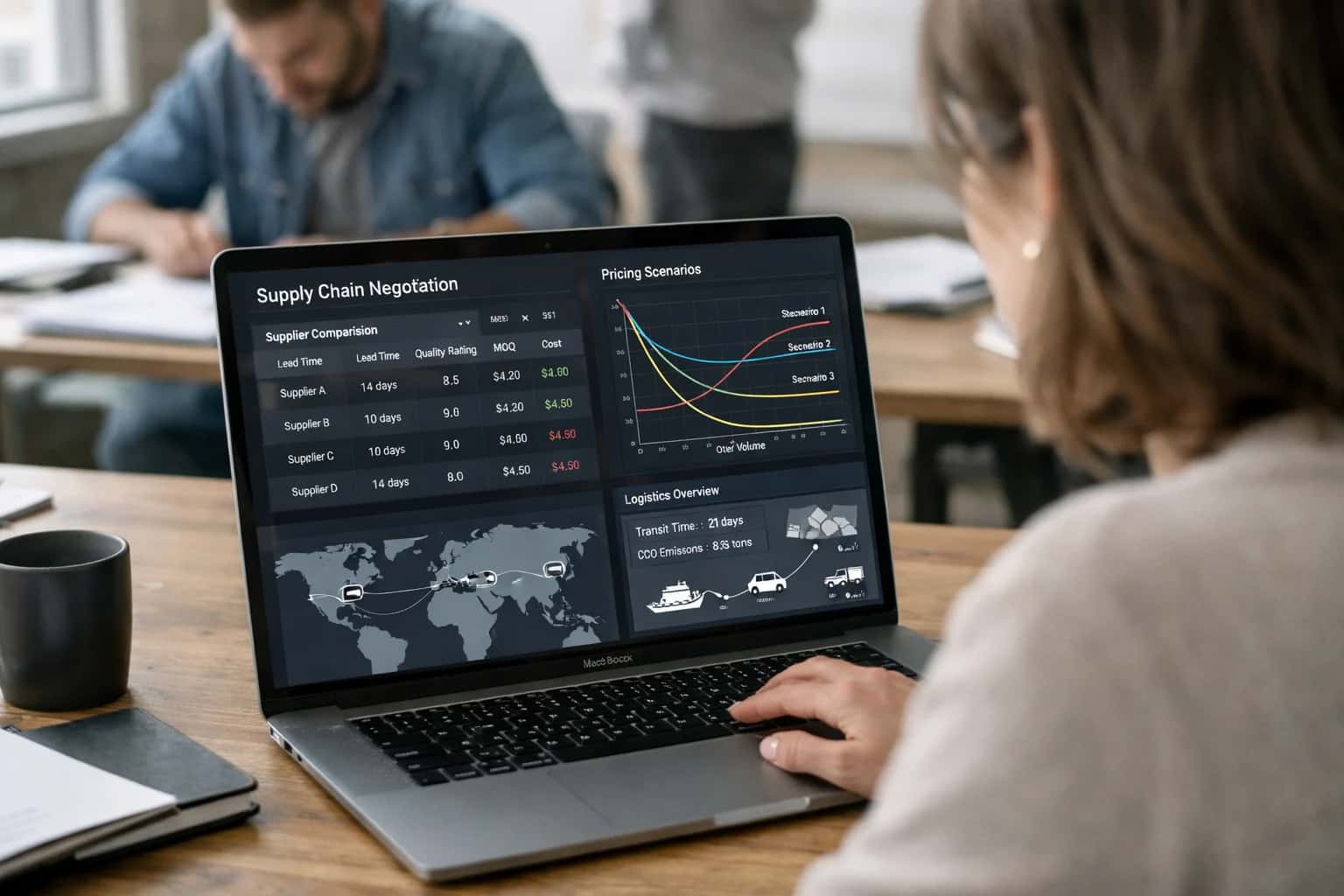
Supply chain manager using AI negotiator on laptop, supplier data visible, casual office afternoon setup.
SCOPE 3 COMPLEXITY

The Manual Carbon Accounting Bottleneck

Manual, error-prone carbon tracking across multi-tier supply chains creates compliance risk and obscures true sustainability performance.

Traditional methods for calculating Scope 3 emissions are a manual, spreadsheet-driven nightmare. They rely on incomplete supplier surveys, outdated emission factors, and lack the granularity to attribute emissions to specific products or transactions. This results in:

  • Inaccurate reporting vulnerable to audit and greenwashing accusations.
  • Months-long data collection cycles that delay ESG disclosures.
  • Zero operational insight to drive actual emission reductions.

Our AI systems automate this entire process, delivering 95%+ data coverage and audit-ready carbon ledgers in real-time.

We engineer AI agents that autonomously:

  • Ingest and parse multi-modal data from supplier EDI feeds, ERP systems, logistics APIs, and procurement databases.
  • Apply dynamic, product-level emission factors (e.g., GLEC Framework, GHG Protocol) instead of generic industry averages.
  • Attribute emissions down to the SKU and purchase order level across complex, multi-tier networks.
  • Continuously monitor for data anomalies and regulatory changes (e.g., CSRD, SEC Climate Rules).

The outcome is a single source of truth for your supply chain carbon footprint. Move from a costly compliance exercise to a strategic lever for reducing costs, mitigating risk, and validating sustainability claims to stakeholders and regulators. Explore our broader approach to supply chain intelligence with our Digital Supply Chain Twin Engineering and Supply Chain Risk Intelligence Modeling services.

FROM COMPLIANCE TO COMPETITIVE ADVANTAGE

Business Outcomes of AI-Powered Carbon Tracking

Move beyond manual reporting. Our AI systems deliver precise, auditable Scope 3 emissions data that drives cost reduction, mitigates regulatory risk, and creates tangible value across your supply chain.

02

Supplier Risk & Performance Scoring

Our systems generate dynamic risk scores for each supplier based on emissions intensity, geographic exposure, and decarbonization progress. This enables data-driven procurement decisions, helps prioritize engagement with high-impact partners, and protects your brand from association with laggard suppliers. Learn more about our broader approach to supply chain risk intelligence modeling.

03

Cost-Optimized Decarbonization Pathways

We build simulation models that identify the most cost-effective levers for emissions reduction—from modal shifts and nearshoring to material substitution—projecting ROI and sequencing initiatives. Clients typically identify savings opportunities covering 20-40% of their implementation costs within the first analysis cycle.

04

Audit-Ready Data Lineage & Compliance

Every emission factor and calculation is cryptographically traced to its source, creating an immutable audit trail. Our systems enforce data integrity and methodology alignment with GHG Protocol, ensuring your reports withstand internal audit and regulatory scrutiny. This technical rigor is core to our enterprise AI governance and compliance frameworks.

05

Real-Time Carbon Insights for Product Teams

We integrate carbon data directly into product lifecycle management (PLM) and design tools, allowing engineers and designers to see the emissions impact of material and logistics choices in real-time. This embeds sustainability into the innovation process, enabling the development of lower-carbon products.

06

Proactive Regulatory Change Management

Our AI monitors global regulatory databases, news, and policy drafts to alert you to new carbon disclosure mandates, tax schemes (like CBAM), and compliance deadlines affecting your operations and suppliers. This transforms compliance from a reactive burden to a managed, strategic process.

A structured, outcome-driven engagement

Typical Project Phases & Deliverables

Our proven methodology for delivering a production-ready Scope 3 emissions tracking system, from initial data assessment to ongoing optimization.

Project PhaseKey ActivitiesPrimary DeliverablesTypical Timeline

Phase 1: Data & Process Assessment

Supply chain mapping, data source identification, emission factor library setup, compliance framework gap analysis.

Data readiness report, prioritized emission source list, project roadmap with KPIs.

2-3 weeks

Phase 2: Core System Development

Data pipeline engineering, supplier data ingestion API development, initial calculation engine build, basic dashboard.

Functional MVP: automated Scope 3 calculation engine, supplier data portal, initial compliance report.

4-6 weeks

Phase 3: Model Refinement & Integration

Multi-tier attribution model tuning, integration with ERP/PLM systems, anomaly detection ML model training.

Production-grade AI tracking system, integrated dashboards, automated anomaly alerts, API documentation.

3-5 weeks

Phase 4: Validation & Deployment

Calculation audit against standards (GHG Protocol), user acceptance testing (UAT), security review, production deployment.

Audited emissions report, deployment runbook, trained internal team, go-live sign-off.

2-3 weeks

Phase 5: Optimization & Support (Ongoing)

Performance monitoring, model retraining with new data, expansion to new supply chain tiers, quarterly compliance updates.

Monthly performance reports, updated emission factors, access to expert support, roadmap for future enhancements.

Ongoing

VERTICAL EXPERTISE

Industries We Serve

Our AI-powered carbon tracking solutions are engineered for the unique data challenges and compliance pressures of global industries. We deliver accurate, auditable Scope 3 emissions attribution to meet stringent ESG reporting mandates.

01

Manufacturing & Heavy Industry

Track emissions across complex, multi-tier supplier networks for raw materials, components, and logistics. Our AI models attribute carbon costs to specific production lines and finished goods, enabling precise product-level reporting and low-carbon sourcing decisions.

>95%
Supplier Coverage
Automated
Data Ingestion
02

Retail & Consumer Goods

Calculate the full lifecycle footprint from raw material extraction to last-mile delivery. Our systems integrate with ERP and PLM data to provide carbon transparency for SKUs, essential for consumer-facing labels and compliance with regulations like the EU's CBAM.

SKU-Level
Granularity
CBAM Ready
Compliance
03

Logistics & Transportation

Model emissions from fleet operations, warehousing, and third-party carrier networks. Our AI optimizes for lowest-carbon routing and modal shifts while generating auditable reports for Scope 1, 2, and 3 emissions required by corporate clients and regulators.

25%
Route Optimization
Real-Time
Fuel Tracking
04

Technology & Electronics

Navigate highly fragmented global supply chains for rare earth minerals, semiconductors, and assemblies. Our AI tracks embodied carbon and energy use across fabrication, assembly, and global distribution, supporting compliance with evolving e-waste and circular economy directives.

Component-Level
Tracking
ISO 14064
Aligned
05

Financial Services & Investment

Integrate supply chain carbon data into portfolio risk scoring and ESG fund reporting. Our APIs feed accurate, AI-validated emissions data into financial models, enabling lenders and investors to assess climate transition risk and avoid greenwashing liabilities.

API-First
Integration
SFDR / TCFD
Reporting
06

Energy & Utilities

Attribute Scope 3 emissions from infrastructure projects, fuel supply chains, and purchased goods/services. Our systems handle complex upstream and downstream emissions for oil & gas, renewables, and power generation, ensuring accurate reporting under frameworks like GRI and SASB.

Well-to-Wheel
Analysis
GRI 305
Compliance
Implementation & Compliance

Supply Chain Carbon Tracking AI: FAQs

Get specific answers on how we engineer AI systems to automate Scope 3 emissions calculation and reporting for ESG compliance.

Our systems use a multi-modal data pipeline architecture. We integrate with your ERP, procurement, and logistics platforms to ingest transactional data (purchase orders, invoices, shipment manifests). For deeper tiers, we deploy AI agents to scrape supplier sustainability reports, apply emission factor databases (like Ecoinvent or DEFRA), and use predictive models to fill data gaps. The core is a supply chain knowledge graph that maps material flows and ownership, enabling precise activity-based attribution. This methodology aligns with the GHG Protocol Corporate Standard and can achieve >90% data coverage for Scope 3 Categories 1 & 11.

Prasad Kumkar

About the author

Prasad Kumkar

CEO & MD, Inference Systems

Prasad Kumkar is the CEO & MD of Inference Systems and writes about AI systems architecture, LLM infrastructure, model serving, evaluation, and production deployment. Over 5+ years, he has worked across computer vision models, L5 autonomous vehicle systems, and LLM research, with a focus on taking complex AI ideas into real-world engineering systems.

His work and writing cover AI systems, large language models, AI agents, multimodal systems, autonomous systems, inference optimization, RAG, evaluation, and production AI engineering.



