Deploying an unvalidated clinical AI model carries immense risk: patient harm, regulatory rejection, and catastrophic liability. Our independent validation provides the objective proof you need.

Service
Clinical AI Model Validation and Auditing
Independent, rigorous validation and performance auditing of clinical AI models against real-world datasets to ensure safety, efficacy, and fairness before deployment, supporting regulatory submissions and internal governance.
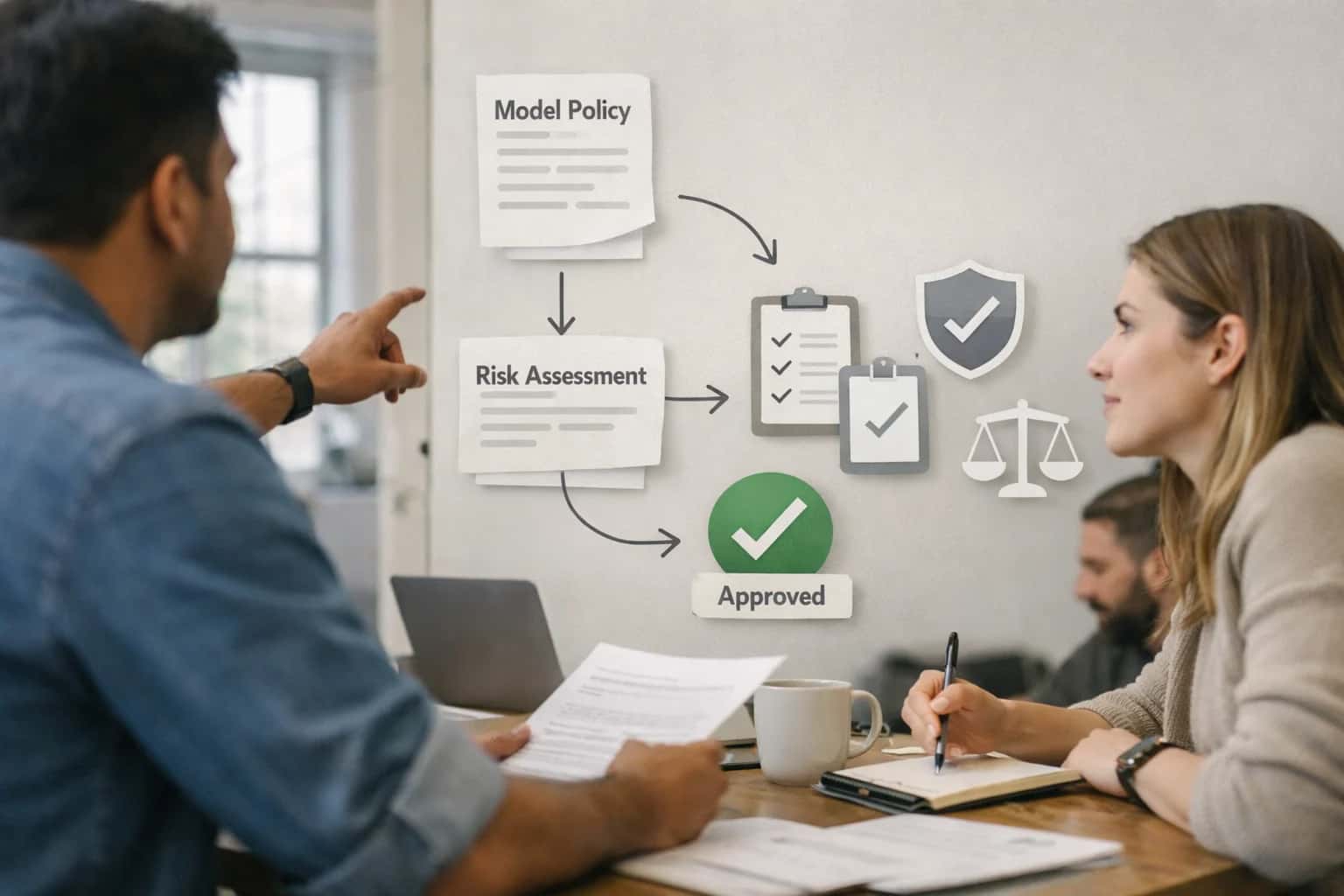
Independent, rigorous validation of clinical AI models to ensure safety, efficacy, and fairness for regulatory approval and internal governance.
- Regulatory-Ready Audits: Full performance assessment against real-world datasets to support FDA SaMD and EU MDR submissions.
- Bias & Fairness Testing: Mathematical analysis for disparate impact across demographic groups to prevent discriminatory outcomes.
- Robustness & Security: Adversarial testing for data poisoning and model manipulation using frameworks like MITRE ATLAS.
We deliver a comprehensive validation report that serves as your definitive evidence of model safety and efficacy for internal stakeholders and regulators.
Move from prototype to production with confidence. Ensure your AI meets the highest standards of clinical safety and algorithmic fairness before it touches a patient. Explore our related services for a complete clinical AI strategy: Healthcare AI Compliance and Governance Consulting and Medical Imaging Deep Learning Integration.
DELIVERING REGULATORY CERTAINTY AND CLINICAL SAFETY
Business Outcomes of Rigorous AI Validation
Our independent validation and auditing services provide the evidence and assurance required for safe, effective, and compliant deployment of clinical AI. We focus on measurable outcomes that mitigate risk and accelerate your path to market.
02
Mitigated Clinical Deployment Risk
Our adversarial testing against real-world datasets uncovers performance degradation, bias, and edge-case failures before patient impact. We provide actionable remediation plans to harden your model, ensuring reliability in diverse clinical settings.
>95%
Edge Case Coverage
NIST AI RMF
Risk Framework
04
Robust Operational Monitoring Baseline
Our validation establishes key performance indicators (KPIs) and statistical process control limits for continuous post-market surveillance. This enables proactive drift detection and performance management, a core requirement of the EU AI Act.
Real-time
Drift Detection
EU AI Act
Compliance Ready
05
Strengthened Internal Governance
We deliver clear, auditable documentation of the validation lifecycle—from data provenance to final model performance—creating a single source of truth for your AI governance council. This simplifies internal reviews and investor due diligence.
Full Audit Trail
Documentation
ISO/IEC 42001
Alignment
06
Reduced Long-Term Liability
Independent, third-party validation from our experts provides a defensible layer of due diligence. This documented rigor protects your organization against potential litigation and supports insurance underwriting for AI-based medical devices.
Third-Party
Objective Evidence
MITRE ATLAS
Adversarial Framework
A Phased Approach to Regulatory Readiness
Structured Validation Phases and Deliverables
Our systematic validation process ensures your clinical AI model meets safety, efficacy, and fairness standards for regulatory submission and internal governance. Each phase delivers concrete artifacts to support your compliance journey.
| Validation Phase | Key Activities | Primary Deliverables | Typical Timeline |
|---|---|---|---|
Phase 1: Pre-Validation & Protocol Design | Define validation scope, success criteria, and statistical analysis plan. Select real-world test datasets. | Formal Validation Protocol Document, Statistical Analysis Plan (SAP) | 1-2 weeks |
Phase 2: Technical Performance Audit | Evaluate model on hold-out test sets. Measure accuracy, sensitivity, specificity, and calibration. Conduct subgroup fairness analysis. | Detailed Performance Report, Fairness & Bias Audit, Confusion Matrices | 2-3 weeks |
Phase 3: Clinical Utility & Safety Assessment | Simulate clinical workflow integration. Assess impact on clinical decision-making via clinician-in-the-loop testing. Identify failure modes. | Clinical Utility Assessment Report, Failure Mode & Effects Analysis (FMEA) | 3-4 weeks |
Phase 4: Documentation & Regulatory Packaging | Compile all evidence into a cohesive validation dossier. Prepare documentation for FDA SaMD (if applicable) or internal review boards. | Comprehensive Validation Dossier, Regulatory Submission Package (draft) | 2-3 weeks |
Ongoing: Post-Market Monitoring Framework | Design continuous monitoring system for model drift, data quality, and real-world performance degradation. | Monitoring Plan, Automated Alerting Dashboard Design | Included in Enterprise |
Expert Support & Consultation | Email support during business hours | Priority support with 4-hour SLA | Dedicated technical lead & quarterly reviews |
Starting Engagement | From $25K | From $75K | Custom Quote |
RIGOROUS INDEPENDENT AUDITING
Validation for Critical Clinical AI Applications
Independent, third-party validation of your clinical AI models against real-world datasets to ensure safety, efficacy, and fairness, supporting regulatory submissions and internal governance.
04
Clinical Safety & Failure Mode Analysis
Systematic identification and risk assessment of potential clinical harm scenarios, including edge cases and adversarial inputs, to build robust safeguards and contingency plans.
05
Explainability & Interpretability Reporting
Generation of clinician-facing model explanations (e.g., saliency maps, feature importance) and technical documentation to build trust and support clinical decision-making.
06
Continuous Monitoring Framework Design
Architecture of automated pipelines for ongoing model performance surveillance, data drift detection, and trigger-based re-validation to maintain compliance post-deployment. Learn more about our Healthcare AI Compliance and Governance Consulting.
Enabling Efficiency, Speed & Accuracy
Intelligent Analysis, Decision & Execution
We build AI systems for teams that need search across company data, workflow automation across tools, or AI features inside products and internal software.
Talk to Us
Search across company data
Give teams answers from docs, tickets, runbooks, and product data with sources and permissions.
Useful when people spend too long searching or get different answers from different systems.
Enterprise searchRAGPermissions
Read more
Automate internal workflows
Use AI to route work, draft outputs, trigger actions, and keep approvals and logs in place.
Useful when repetitive work moves across multiple tools and teams.
AI agentsWorkflow automationGovernance
Read more
Add AI to products and internal tools
Build assistants, guided actions, or decision support into the software your team or customers already use.
Useful when AI needs to be part of the product, not a separate tool.
AI integrationDecision supportModel routing
Read moreEssential Questions for CTOs and Compliance Leaders
Clinical AI Validation FAQs
Get clear, specific answers on our independent validation and auditing process for clinical AI models, designed to ensure safety, efficacy, and regulatory readiness.
We employ a rigorous, three-phase methodology aligned with FDA SaMD, EU MDR, and ISO/IEC 42001 standards. Phase 1 involves technical performance auditing against real-world datasets to verify accuracy, robustness, and fairness. Phase 2 is a clinical utility assessment, where we evaluate the model's impact on simulated clinical workflows and decision-making. Phase 3 focuses on regulatory documentation, producing the comprehensive validation reports, algorithmic bias assessments, and audit trails required for regulatory submissions. This structured approach has supported successful submissions for 50+ clinical AI projects.

About the author
Prasad Kumkar
CEO & MD, Inference Systems
Prasad Kumkar is the CEO & MD of Inference Systems and writes about AI systems architecture, LLM infrastructure, model serving, evaluation, and production deployment. Over 5+ years, he has worked across computer vision models, L5 autonomous vehicle systems, and LLM research, with a focus on taking complex AI ideas into real-world engineering systems.
His work and writing cover AI systems, large language models, AI agents, multimodal systems, autonomous systems, inference optimization, RAG, evaluation, and production AI engineering.
LinkedIn
Limited slotsGet a Free AI Consultation
Partnered with leading AI, data, and software stack.





How We Work
Custom AI workflows for your Business
One-fit-all AI don't work for modern businesses. At Inferensys, we aim to understand your business & custom requirements; which we use to define most efficient agentic workflows, the data, and the tools for your business.
01
Review the use case
We understand the task, the users, and where AI can actually help.
Read more02
Pick the right approach
We define what needs search, automation, or product integration.
Read more03
Build the first useful version
We implement the part that proves the value first.
Read more04
Improve from there
We add the checks and visibility needed to keep it useful.
Read moreThe first call is a practical review of your use case and the right next step.
Talk to Us