We build semantic knowledge graphs from your emails, reports, and presentations, revealing hidden relationships and insights across your entire organization.

Service
Enterprise Knowledge Graph Construction
Transform disparate, unstructured data silos into a connected, queryable intelligence layer. We build semantic knowledge graphs from emails, reports, and legacy documents to reveal hidden relationships and drive data-driven decisions.
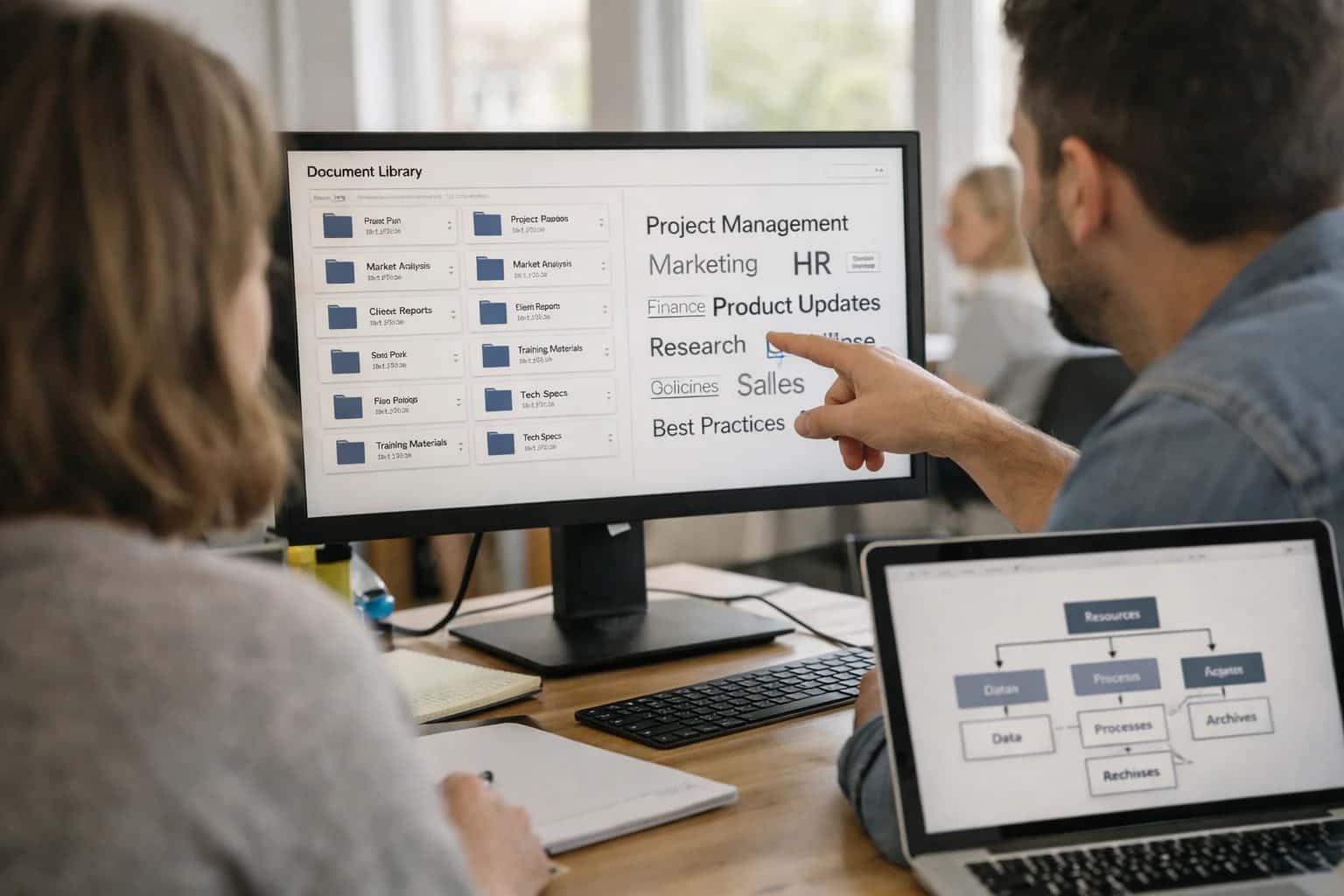
Transform disconnected documents into a connected, queryable intelligence layer.
Our process delivers a single source of truth by:
- Extracting entities and relationships from disparate, unstructured data sources using advanced NLP.
- Mapping connections between people, projects, products, and processes that were previously invisible.
- Enabling complex queries (e.g., "Show all projects impacted by regulation X") across your entire data estate.
The result is a dramatic reduction in research time and the ability to uncover strategic opportunities buried in your data silos. This is the foundation for powerful enterprise semantic search and advanced agentic AI workflows.
TANGIBLE ROI
Business Outcomes You Can Measure
Our Enterprise Knowledge Graph Construction service delivers quantifiable business value by turning unstructured data into a connected intelligence asset. Here are the specific outcomes our clients achieve.
01
Accelerated Decision Velocity
Reduce the time to find critical connections across departments from weeks to seconds. Our knowledge graphs create a unified, queryable intelligence layer, enabling real-time discovery of hidden relationships in customer data, R&D notes, and market intelligence.
Learn more about our approach to Retrieval-Augmented Generation (RAG) Infrastructure for deterministic enterprise search.
80%
Faster Insight Discovery
< 1 sec
Query Latency
02
Enhanced R&D Innovation Yield
Uncover hidden intellectual property and novel research pathways buried in legacy documents and internal communications. Our semantic linking reveals non-obvious connections between past projects, accelerating time-to-market for new products.
Explore our Intellectual Property Discovery from Archives service for systematic innovation mining.
30%
Increase in IP Identification
4x
ROI on Research Spend
03
Reduced Compliance & Legal Risk
Proactively identify regulatory exposure and contractual obligations scattered across millions of emails and PDFs. Our knowledge graphs map data lineage and clause relationships, enabling automated compliance checks and predictive risk modeling.
For rigorous policy enforcement, see our Enterprise AI Governance and Compliance Frameworks.
70%
Faster Audit Response
99.5%
Clause Recall Accuracy
04
Optimized Customer Intelligence
Build a 360-degree view of customer sentiment and intent by connecting support tickets, call transcripts, and dark social channel mentions. This unified profile drives hyper-personalization and churn prediction.
Complement this with insights from Dark Social Channel Intelligence Mining.
25%
Increase in CSAT
40%
Reduction in Churn Risk
05
Operational Cost Reduction
Automate manual data reconciliation and reporting tasks by creating a single source of truth. Eliminate redundant data silos and reduce the FTE hours spent on manual research and data aggregation across business units.
50%
Lower Data Management Costs
10k+ hrs/year
FTE Time Saved
06
Future-Proof Data Architecture
Deploy a scalable foundation for all future AI initiatives. A production-ready knowledge graph acts as the central nervous system for agentic workflows, advanced RAG, and predictive analytics, preventing vendor lock-in and technical debt.
This architecture integrates seamlessly with Multimodal AI Data Pipelines.
3-6 months
Faster AI Project Starts
Zero
Data Migration for New AI
Structured Phased Delivery
Typical Project Timeline & Deliverables
A transparent breakdown of our phased approach to building your enterprise knowledge graph, from initial data assessment to a fully operational intelligence layer.
| Phase & Key Deliverables | Timeline | Core Activities | Outcome |
|---|---|---|---|
Phase 1: Data Audit & Schema Design | Weeks 1-2 | Inventory unstructured sources, define ontology, design initial graph schema | Comprehensive data strategy & blueprint for graph construction |
Phase 2: Pipeline Engineering & Entity Extraction | Weeks 3-6 | Build multimodal data pipelines, implement NLP models for entity/relationship extraction | Functional data ingestion system producing structured entities from raw documents |
Phase 3: Knowledge Graph Population & Linking | Weeks 7-10 | Load extracted data into graph database (e.g., Neo4j, AWS Neptune), establish semantic links | Populated, queryable knowledge graph revealing hidden cross-departmental relationships |
Phase 4: Query Interface & Integration Layer | Weeks 11-12 | Develop GraphQL/REST API, build basic search interface, integrate with existing BI tools | Operational intelligence layer accessible to analysts and business applications |
Phase 5: Validation, Tuning & Handoff | Weeks 13-14 | Conduct accuracy audits, optimize query performance, provide documentation & training | Production-ready knowledge graph with defined maintenance procedures and ROI metrics |
Ongoing Support & Evolution | Post-launch | Optional SLA for monitoring, schema expansion, and integration of new data sources | Continuously evolving enterprise asset that scales with your data and business needs |
PROVEN USE CASES
Industry Applications of Knowledge Graphs
Our enterprise knowledge graphs deliver actionable intelligence by connecting disparate data silos. Here are specific applications where clients achieve measurable outcomes.
01
Pharmaceutical R&D Acceleration
Connect biomedical literature, clinical trial data, and patent archives to reveal novel drug-target relationships and accelerate discovery pipelines. We build graphs that integrate with bioinformatics tools like Neo4j and TigerGraph.
40%
Faster Literature Review
> 90%
Entity Resolution Accuracy
02
Financial Fraud Detection Networks
Model complex relationships between entities, transactions, and communication patterns to detect sophisticated fraud rings and money laundering schemes invisible to rule-based systems. Integrates with real-time transaction streams.
60%
Higher Detection Rate
< 100ms
Real-time Alerting
04
Healthcare Patient 360
Unify EHR data, genomic information, and research papers to create comprehensive patient profiles for personalized treatment planning and clinical trial matching, ensuring HIPAA compliance via de-identification.
50%
Reduced Data Silos
SOC 2
Compliant Architecture
05
Media & Entertainment Content Discovery
Power hyper-personalized recommendations by semantically linking viewer profiles, content metadata, and sentiment analysis from reviews. Drives engagement and reduces churn for streaming platforms.
30%
Increase in Engagement
Millions
Relationships Modeled
Enabling Efficiency, Speed & Accuracy
Intelligent Analysis, Decision & Execution
We build AI systems for teams that need search across company data, workflow automation across tools, or AI features inside products and internal software.
Talk to Us
Search across company data
Give teams answers from docs, tickets, runbooks, and product data with sources and permissions.
Useful when people spend too long searching or get different answers from different systems.
Enterprise searchRAGPermissions
Read more
Automate internal workflows
Use AI to route work, draft outputs, trigger actions, and keep approvals and logs in place.
Useful when repetitive work moves across multiple tools and teams.
AI agentsWorkflow automationGovernance
Read more
Add AI to products and internal tools
Build assistants, guided actions, or decision support into the software your team or customers already use.
Useful when AI needs to be part of the product, not a separate tool.
AI integrationDecision supportModel routing
Read moreEnterprise Knowledge Graph Construction
Frequently Asked Questions
Get answers to common questions about our process, timeline, and outcomes for building enterprise knowledge graphs from unstructured data.
A standard enterprise knowledge graph project is delivered in 4-8 weeks. The timeline depends on data source complexity and graph depth. We follow a phased approach: 2 weeks for data pipeline setup and entity extraction, 2-4 weeks for relationship mapping and graph construction, and 1-2 weeks for integration and validation. For projects with over 50 unique data sources, timelines are scoped individually.

About the author
Prasad Kumkar
CEO & MD, Inference Systems
Prasad Kumkar is the CEO & MD of Inference Systems and writes about AI systems architecture, LLM infrastructure, model serving, evaluation, and production deployment. Over 5+ years, he has worked across computer vision models, L5 autonomous vehicle systems, and LLM research, with a focus on taking complex AI ideas into real-world engineering systems.
His work and writing cover AI systems, large language models, AI agents, multimodal systems, autonomous systems, inference optimization, RAG, evaluation, and production AI engineering.
LinkedIn
Limited slotsGet a Free AI Consultation
Partnered with leading AI, data, and software stack.





How We Work
Custom AI workflows for your Business
One-fit-all AI don't work for modern businesses. At Inferensys, we aim to understand your business & custom requirements; which we use to define most efficient agentic workflows, the data, and the tools for your business.
01
Review the use case
We understand the task, the users, and where AI can actually help.
Read more02
Pick the right approach
We define what needs search, automation, or product integration.
Read more03
Build the first useful version
We implement the part that proves the value first.
Read more04
Improve from there
We add the checks and visibility needed to keep it useful.
Read moreThe first call is a practical review of your use case and the right next step.
Talk to Us