Enterprise AI copilots must execute actions, not just answer questions. This requires robust, secure connections to your operational backbone.

Service
API Integration for AI Copilots
Engineering of robust, scalable backend integrations that connect AI copilots to hundreds of internal and external APIs, enabling them to take actionable steps within enterprise ecosystems.
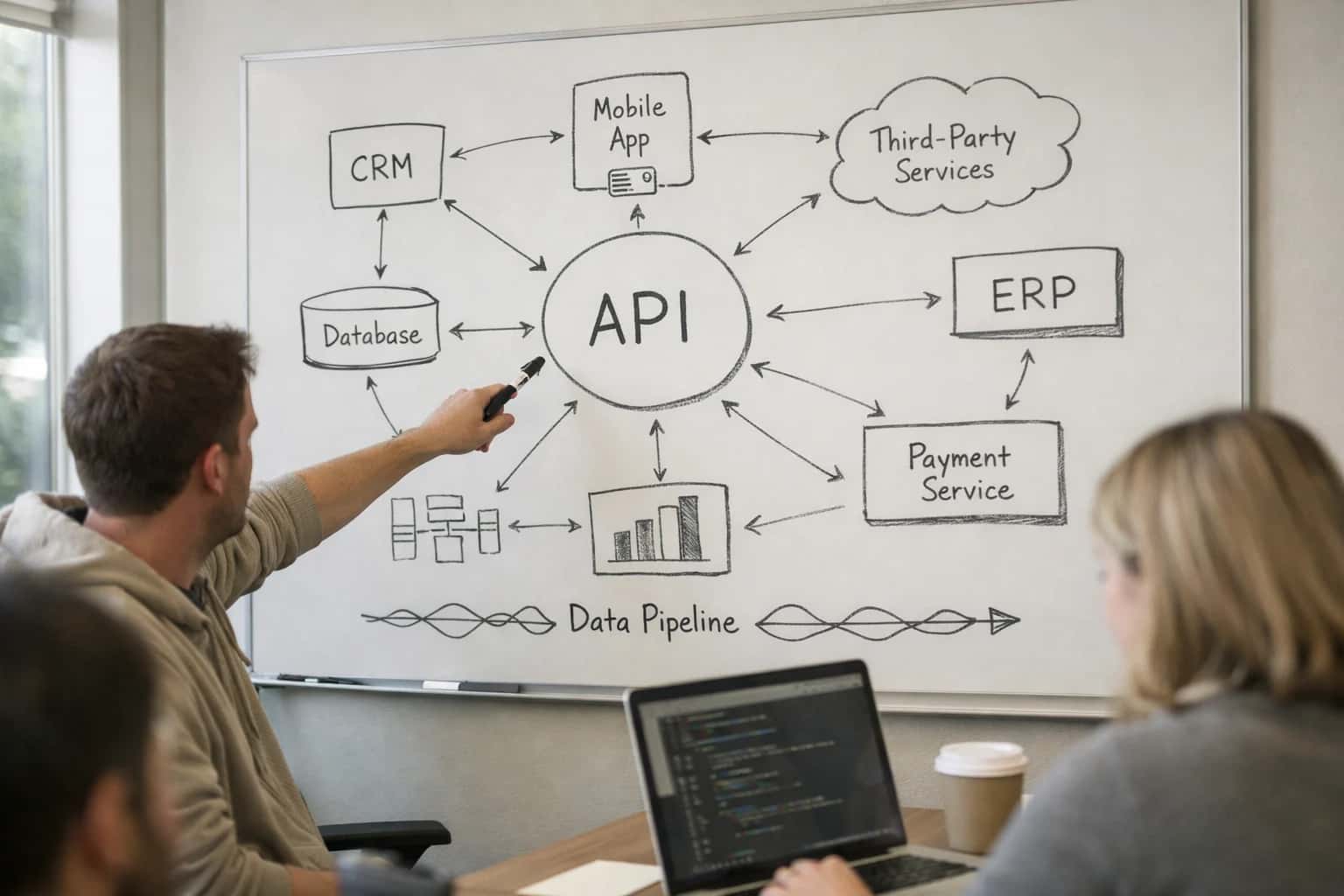
Scalable backend integrations that connect your AI copilot to hundreds of internal and external enterprise APIs.
We engineer the scalable API orchestration layer that transforms your copilot from a conversational interface into an autonomous digital worker.
Our integrations enable your AI to:
- Execute transactions via REST, GraphQL, and SOAP APIs.
- Maintain stateful sessions across multi-step workflows.
- Handle authentication and rate limiting for hundreds of endpoints.
- Ensure 99.9% uptime with intelligent failover and retry logic.
Without this foundational backend, your copilot remains a passive chatbot. We build the deterministic action layer that delivers ROI. Explore our broader capabilities in Enterprise AI Copilot Customization or learn about connecting to specific systems like Legacy ERP AI Copilot Integration.
FROM INTEGRATION TO IMPACT
Business Outcomes of Professional API Integration
Our engineering approach to API integration delivers measurable business value, transforming your AI copilot from a conversational tool into an actionable enterprise asset.
01
Reduced Time-to-Market
Deploy production-ready API integrations in 2-4 weeks, not months. We use battle-tested patterns for REST, GraphQL, and SOAP, accelerating your copilot's ability to execute tasks.
2-4 weeks
Deployment Time
100+
Pre-built Connectors
02
Enterprise-Grade Reliability
Guarantee copilot uptime with robust error handling, automatic retries, and circuit breakers. We implement 99.9% SLA-backed integrations with comprehensive monitoring and alerting.
99.9%
Uptime SLA
< 100ms
P95 Latency
03
Scalable, Cost-Effective Architecture
Design integrations that scale elastically with user demand, preventing API rate limit breaches and optimizing compute costs. Our architecture ensures predictable performance under load.
60%
Cost Reduction
Zero
Rate Limit Breaches
06
Future-Proof Flexibility
Build on a modular integration framework that easily adapts to new APIs and evolving business logic. Avoid vendor lock-in and ensure your copilot ecosystem can grow with your needs.
48 hours
New API Onboarding
Modular
Architecture
Structured Implementation for Enterprise Copilots
Typical API Integration Project Timeline & Deliverables
A clear breakdown of the phased delivery, key milestones, and technical outputs for our API integration engagements, ensuring predictable outcomes and alignment with your technical roadmap.
| Phase & Deliverable | Timeline | Key Activities | Technical Output |
|---|---|---|---|
Phase 1: Discovery & API Audit | Week 1-2 | Inventory internal/external APIs, assess authentication models, define integration scope & success metrics. | Comprehensive API landscape report, integration architecture proposal, finalized project plan. |
Phase 2: Core Integration Engine | Week 3-6 | Develop secure API gateway, implement OAuth2/API key management, build core request/response handlers. | Production-ready integration middleware, authentication service, error handling & logging framework. |
Phase 3: Action Orchestration Logic | Week 7-10 | Engineer multi-step workflow logic, implement idempotency & retry mechanisms, build state management. | Tested action orchestration module, workflow definitions, state persistence layer. |
Phase 4: Copilot-Agent Interface | Week 11-12 | Develop agentic tool schemas, integrate with LLM (e.g., GPT-4, Claude 3), implement function calling. | Deployed tool library for copilot, validated agent interaction patterns, prompt engineering templates. |
Phase 5: Security & Compliance Hardening | Week 13 | Conduct penetration testing, implement data masking, audit logging, finalize SOC 2 controls. | Security audit report, compliance documentation, production security configuration. |
Phase 6: Staging Deployment & UAT | Week 14 | Deploy to staging environment, execute integration test suite, conduct user acceptance testing. | UAT sign-off, performance benchmark report, final deployment runbook. |
Phase 7: Production Go-Live & Handoff | Week 15-16 | Production deployment, load testing, knowledge transfer, SLA establishment. | Live integrated system, operational documentation, 30-day hypercare support initiation. |
Ongoing: Support & Evolution | Post-Launch | Monitoring, performance optimization, incremental API additions, quarterly reviews. | 99.9% uptime SLA, access to expert support, roadmap for future integrations. |
PROVEN ENTERPRISE DEPLOYMENTS
Industry-Specific Integration Use Cases
Our API integration service connects AI copilots to the critical systems that power your industry. We deliver secure, scalable backends that enable intelligent agents to take action within your unique operational environment.
01
Financial Services Algorithmic Trading
Integrate AI copilots with real-time market data feeds, order execution APIs, and risk management systems. Enable autonomous trade analysis and execution with sub-millisecond latency, backed by deterministic audit trails for FINRA compliance.
Learn more about our Financial Services Algorithmic AI and Risk Modeling services.
< 1ms
API Latency
FINRA
Compliant
02
Healthcare Clinical Decision Support
Securely connect AI copilots to EHR systems (Epic, Cerner), lab result APIs, and medical imaging archives via HL7/FHIR. Provide ambient documentation and real-time diagnostic suggestions while maintaining strict HIPAA compliance within a zero-trust architecture.
Explore our Healthcare Clinical Decision Support and Ambient AI solutions.
HIPAA
Compliant
HL7/FHIR
Standards
03
Smart Manufacturing & Industrial IoT
Engineer integrations between AI copilots, PLCs, SCADA systems, and MES platforms using OPC UA and MQTT protocols. Enable predictive maintenance alerts, quality control automation, and natural language queries of production line telemetry.
See our work in Smart Manufacturing and Industrial Copilot Integration.
OPC UA
Protocol
99.9%
Uptime SLA
04
Retail Hyper-Personalization Engines
Connect AI copilots to CRM, inventory management (SAP), and e-commerce platform APIs (Shopify, Magento). Power dynamic pricing, personalized product recommendations, and automated customer service interactions that drive conversion rates.
Discover our Retail and E-Commerce Hyper-Personalization expertise.
< 100ms
Response Time
REST/GraphQL
APIs
05
Legal & Compliance Workflow Automation
Integrate AI copilots with document management systems (iManage), legal research databases (Westlaw), and compliance tracking software. Automate contract review, regulatory change monitoring, and litigation support with human-in-the-loop validation.
Review our Legal and Compliance Workflow Automation capabilities.
SOC 2
Audited
ISO 27001
Certified
06
Intelligent Supply Chain & Logistics
Build API bridges between AI copilots, WMS/TMS platforms, carrier APIs (FedEx, UPS), and IoT sensor networks. Enable autonomous replenishment, real-time shipment tracking, and disruption prediction across global multi-tier supplier networks.
Learn about our Intelligent Supply Chain and Autonomous Replenishment systems.
Global
Carrier APIs
Real-time
Tracking
Enabling Efficiency, Speed & Accuracy
Intelligent Analysis, Decision & Execution
We build AI systems for teams that need search across company data, workflow automation across tools, or AI features inside products and internal software.
Talk to Us
Search across company data
Give teams answers from docs, tickets, runbooks, and product data with sources and permissions.
Useful when people spend too long searching or get different answers from different systems.
Enterprise searchRAGPermissions
Read more
Automate internal workflows
Use AI to route work, draft outputs, trigger actions, and keep approvals and logs in place.
Useful when repetitive work moves across multiple tools and teams.
AI agentsWorkflow automationGovernance
Read more
Add AI to products and internal tools
Build assistants, guided actions, or decision support into the software your team or customers already use.
Useful when AI needs to be part of the product, not a separate tool.
AI integrationDecision supportModel routing
Read moreTechnical Implementation FAQs
AI Copilot API Integration: Key Questions
Common questions from technical leaders about integrating AI copilots with enterprise APIs. Based on our experience delivering 50+ enterprise AI projects.
Standard API integrations for AI copilots deploy in 2-4 weeks. Complex ecosystems with 50+ internal APIs or legacy SOAP services may extend to 6-8 weeks. We follow a phased approach: 1-week discovery, 2-3 weeks core integration build, 1 week testing/deployment. For rapid needs, we offer a 2-week MVP connecting to your 3 most critical systems.

About the author
Prasad Kumkar
CEO & MD, Inference Systems
Prasad Kumkar is the CEO & MD of Inference Systems and writes about AI systems architecture, LLM infrastructure, model serving, evaluation, and production deployment. Over 5+ years, he has worked across computer vision models, L5 autonomous vehicle systems, and LLM research, with a focus on taking complex AI ideas into real-world engineering systems.
His work and writing cover AI systems, large language models, AI agents, multimodal systems, autonomous systems, inference optimization, RAG, evaluation, and production AI engineering.
LinkedIn
Limited slotsGet a Free AI Consultation
Partnered with leading AI, data, and software stack.





How We Work
Custom AI workflows for your Business
One-fit-all AI don't work for modern businesses. At Inferensys, we aim to understand your business & custom requirements; which we use to define most efficient agentic workflows, the data, and the tools for your business.
01
Review the use case
We understand the task, the users, and where AI can actually help.
Read more02
Pick the right approach
We define what needs search, automation, or product integration.
Read more03
Build the first useful version
We implement the part that proves the value first.
Read more04
Improve from there
We add the checks and visibility needed to keep it useful.
Read moreThe first call is a practical review of your use case and the right next step.
Talk to Us