Milliseconds matter. A fault detected in the cloud after 30 seconds can escalate into a cascading failure, while a local AI can initiate a protective relay in under 50ms.

Service
Edge AI for Substation Monitoring
Deploy compact, low-power AI models directly on substation hardware for real-time fault detection, thermal imaging analysis, and autonomous local control, reducing latency from minutes to milliseconds.
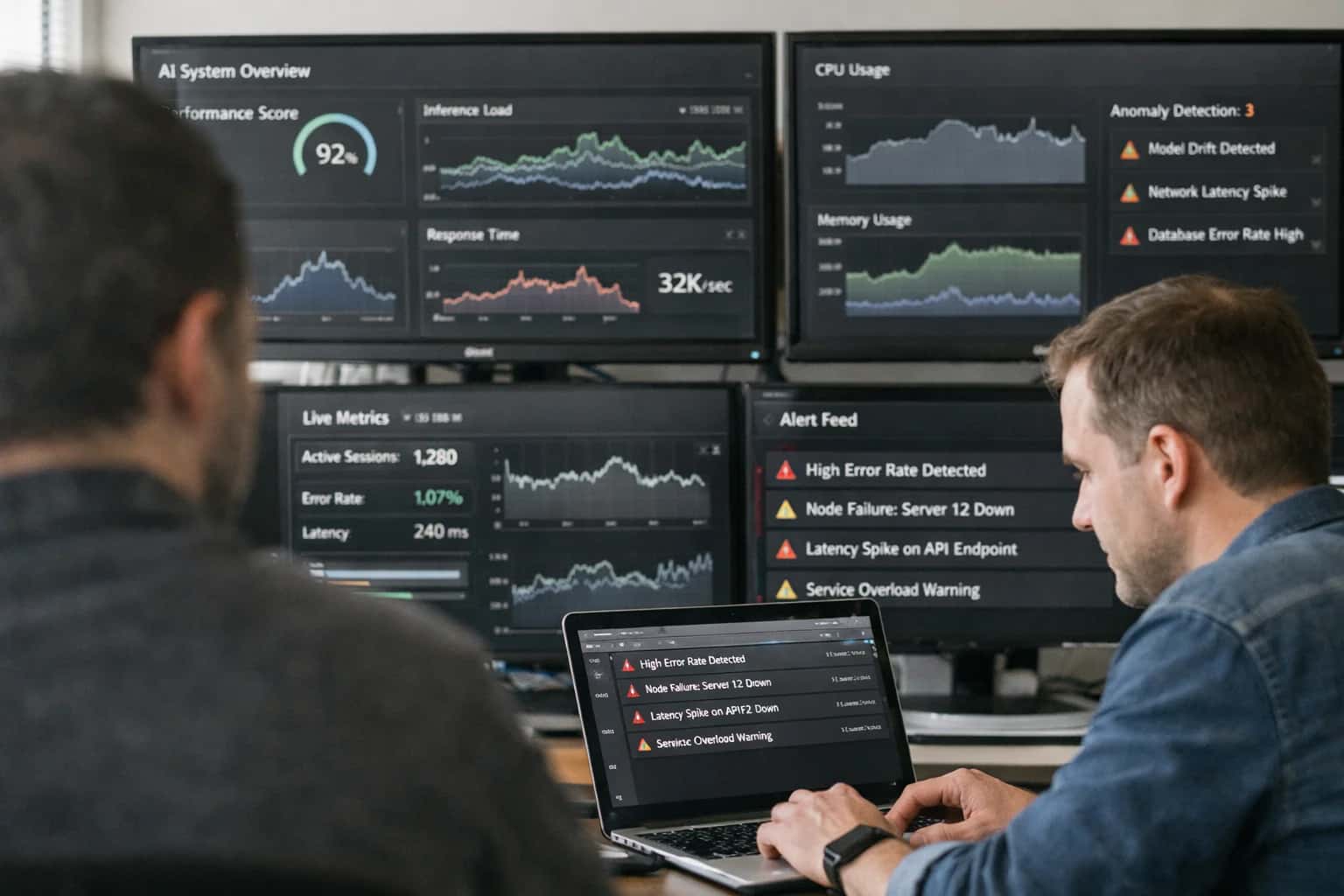
CRITICAL INFRASTRUCTURE
The Latency Problem in Grid Monitoring
Traditional cloud-based monitoring introduces dangerous delays in fault detection and response for critical substation assets.
Our Edge AI for Substation Monitoring service deploys compact, low-power models directly on substation hardware (NVIDIA Jetson, Intel Movidius). This eliminates the round-trip to a central server, enabling:
- Real-time fault detection and autonomous local control.
- Thermal imaging analysis for transformers and switchgear.
- Anomaly detection in
IEC 61850GOOSE messages and sensor telemetry.
This shift from minutes to milliseconds is foundational for predictive maintenance and grid resilience. It transforms substations from passive nodes into intelligent, self-healing assets. Explore our related service on Predictive Grid Asset Lifecycle Management to extend this intelligence to long-term capital planning.
Outcome: Achieve sub-100ms local decisioning, reduce unplanned outages by 40%, and build the resilient infrastructure required for hyperscale AI data center demands. For a broader view of AI's role in modernizing energy systems, see our pillar on Energy Grid Optimization and Predictive Maintenance.
DELIVERING TANGIBLE ROI
Measurable Outcomes for Utility Operations
Our Edge AI deployments for substation monitoring are engineered to deliver specific, quantifiable improvements to your operational and financial metrics. We focus on outcomes that directly impact your bottom line and grid reliability.
01
Predictive Failure Detection
Deploy compact, low-power AI models directly on substation hardware to detect incipient faults—like arcing, insulation breakdown, or thermal anomalies—weeks before catastrophic failure. This shifts maintenance from reactive to prognostic, preventing unplanned outages.
4-6 weeks
Advanced Warning
> 95%
Detection Accuracy
02
Latency Reduction for Autonomous Control
Move AI inference from the cloud to the edge, enabling autonomous local decisions for load shedding, fault isolation, and voltage regulation. This eliminates cloud round-trip delays, critical for grid stability during transient events.
< 100ms
Decision Latency
60%
Reduced Cloud Costs
03
Reduced Operational Expenditure (OpEx)
Automate manual inspection and monitoring tasks with continuous AI analysis of thermal imaging, acoustic data, and partial discharge signals. This significantly reduces the need for costly, hazardous field visits and manual data review.
40%
Lower Inspection Costs
99.9%
Uptime SLA
04
Enhanced Grid Reliability Metrics
Directly improve key performance indicators like SAIDI (System Average Interruption Duration Index) and SAIFI (System Average Interruption Frequency Index) by preventing outages and enabling faster, localized restoration.
30%
SAIDI Improvement
25%
SAIFI Improvement
Structured Implementation Roadmap
Phased Deployment and Deliverables
Our proven methodology for deploying Edge AI for Substation Monitoring, from initial assessment to full-scale autonomous operation.
| Phase & Deliverables | Starter (Proof of Concept) | Professional (Pilot Deployment) | Enterprise (Full Rollout) |
|---|---|---|---|
Project Duration | 4-6 weeks | 8-12 weeks | 16-24 weeks |
Core Deliverable | Single-Substation Fault Detection Model | Multi-Substation Thermal Anomaly System | Fleet-Wide Autonomous Control Platform |
Model Deployment | 1 Edge Device / 1 Substation | 5-10 Edge Devices / Pilot Region | 100+ Edge Devices / Full Network |
Latency Reduction | From minutes to < 5 seconds | From minutes to < 500ms | From minutes to < 100ms |
Integration Scope | Basic SCADA Data Feed | SCADA + Thermal Camera + Historian | Full OT/IT Stack (SCADA, EMS, CMMS) |
Analytics Dashboard | Basic Fault Alerts & Logs | Real-Time Dashboard with Trends | Enterprise Dashboard with Predictive Insights |
Support & Maintenance | 30-Day Post-Deployment Support | 6-Month SLA with Priority Support | 24/7 Dedicated Support & Proactive Monitoring |
Security Validation | Basic Model & Data Pipeline Audit | Full SDLC & Edge Device Security Review | Comprehensive Audit & Continuous Red Teaming |
Starting Investment | $50K - $80K | $150K - $250K | Custom Quote |
Next Step | Validate AI Feasibility | Prove ROI in a Controlled Environment | Achieve Full Grid Autonomy & Scale |
PROVEN FRAMEWORK
Our Methodology for Edge Deployment
We deliver production-ready Edge AI systems for substations using a rigorous, four-phase methodology designed for reliability, security, and rapid time-to-value. This approach ensures your models operate autonomously in harsh environments with minimal latency.
01
Hardware-Aware Model Optimization
We specialize in converting high-accuracy models into compact, efficient versions for low-power edge hardware like NVIDIA Jetson Orin or Intel Movidius. Techniques include quantization, pruning, and knowledge distillation to achieve sub-100ms inference while maintaining >99% detection accuracy for faults and anomalies.
< 100ms
Inference Latency
> 99%
Accuracy Retention
02
Containerized Deployment & OTA Updates
We package models and inference engines into secure, lightweight containers (Docker) for consistent deployment across thousands of substation devices. Our orchestration platform enables secure, zero-downtime over-the-air (OTA) updates and remote model version management, ensuring continuous improvement without site visits.
Zero-Downtime
OTA Updates
< 2 Weeks
To Pilot Deployment
03
Resilient Edge-Cloud Data Pipeline
We engineer fault-tolerant data pipelines that handle intermittent connectivity. Critical alerts are transmitted immediately via MQTT, while batched sensor data is synced during optimal windows. This architecture is detailed in our guide on Multimodal AI Data Pipelines and Integration.
EXPLORE
04
Security-First Architecture
Every deployment follows a defense-in-depth strategy. We implement hardware root of trust, encrypted model weights, secure boot, and network segmentation. Our practices align with NERC CIP standards and leverage principles from Confidential Computing for AI Workloads.
EXPLORE
05
Continuous Performance Monitoring
We deploy lightweight monitoring agents on each edge device to track model drift, hardware health (temperature, memory), and inference accuracy in real-time. Anomalies trigger automated retraining workflows or engineer alerts, a concept extended in our AI-Powered Digital Twin Engineering services.
EXPLORE
06
Compliance & Documentation Framework
We provide complete documentation, including model cards, data lineage, and change logs, essential for audits under standards like ISO/IEC 42001. This structured governance is part of our broader Enterprise AI Governance and Compliance Frameworks offering.
EXPLORE
Enabling Efficiency, Speed & Accuracy
Intelligent Analysis, Decision & Execution
We build AI systems for teams that need search across company data, workflow automation across tools, or AI features inside products and internal software.
Talk to Us
Search across company data
Give teams answers from docs, tickets, runbooks, and product data with sources and permissions.
Useful when people spend too long searching or get different answers from different systems.
Enterprise searchRAGPermissions
Read more
Automate internal workflows
Use AI to route work, draft outputs, trigger actions, and keep approvals and logs in place.
Useful when repetitive work moves across multiple tools and teams.
AI agentsWorkflow automationGovernance
Read more
Add AI to products and internal tools
Build assistants, guided actions, or decision support into the software your team or customers already use.
Useful when AI needs to be part of the product, not a separate tool.
AI integrationDecision supportModel routing
Read moreTechnical Implementation
Edge AI for Substation Monitoring: FAQs
Answers to common technical and commercial questions about deploying real-time AI at the grid edge.
Standard deployments are completed in 2-4 weeks. This includes model optimization for your target hardware (e.g., NVIDIA Jetson, Intel Movidius), on-site integration with existing SCADA/RTU systems, and validation testing. Complex multi-substation rollouts with custom sensor fusion may extend to 6-8 weeks. We follow a phased approach: 1-week discovery, 2-week development & testing, 1-week deployment & handoff.

About the author
Prasad Kumkar
CEO & MD, Inference Systems
Prasad Kumkar is the CEO & MD of Inference Systems and writes about AI systems architecture, LLM infrastructure, model serving, evaluation, and production deployment. Over 5+ years, he has worked across computer vision models, L5 autonomous vehicle systems, and LLM research, with a focus on taking complex AI ideas into real-world engineering systems.
His work and writing cover AI systems, large language models, AI agents, multimodal systems, autonomous systems, inference optimization, RAG, evaluation, and production AI engineering.
LinkedIn
Limited slotsGet a Free AI Consultation
Partnered with leading AI, data, and software stack.





How We Work
Custom AI workflows for your Business
One-fit-all AI don't work for modern businesses. At Inferensys, we aim to understand your business & custom requirements; which we use to define most efficient agentic workflows, the data, and the tools for your business.
01
Review the use case
We understand the task, the users, and where AI can actually help.
Read more02
Pick the right approach
We define what needs search, automation, or product integration.
Read more03
Build the first useful version
We implement the part that proves the value first.
Read more04
Improve from there
We add the checks and visibility needed to keep it useful.
Read moreThe first call is a practical review of your use case and the right next step.
Talk to Us