Cloud-based digital twins introduce 100-500ms network latency, making real-time control and autonomous decision-making impossible for latency-sensitive operations like robotic assembly lines or autonomous vehicle coordination.

Service
Edge AI Digital Twin Deployment
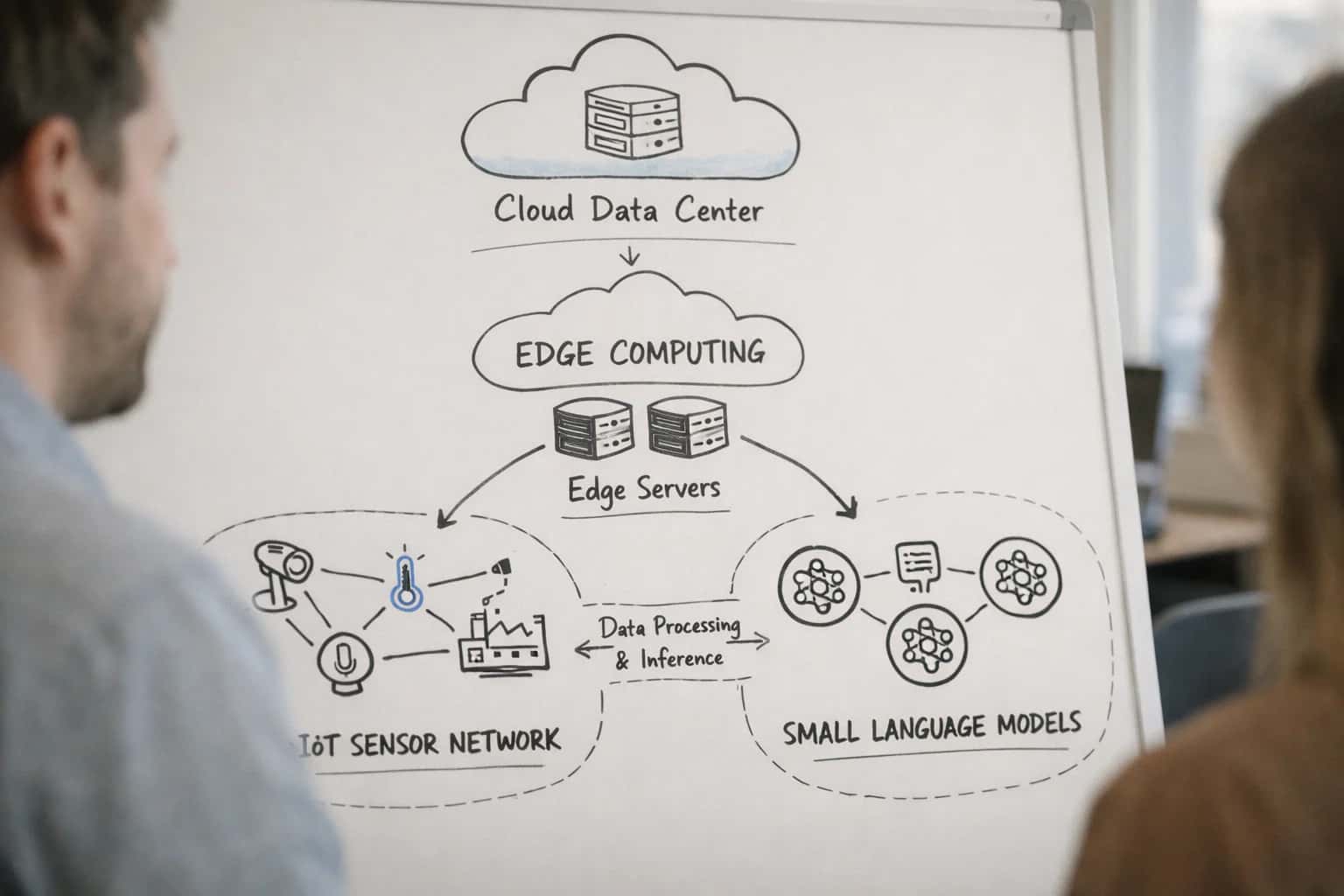
Deploy lightweight, latency-sensitive digital twin inference models directly on edge devices and local servers for autonomous decision-making and real-time response in bandwidth-constrained or offline industrial settings.
CLOUD LIMITATIONS
The Latency Problem with Cloud-Based Digital Twins
Cloud latency cripples real-time digital twin performance for industrial automation and autonomous systems.
Edge AI deployment slashes inference latency to <10ms, enabling true real-time response and autonomous operation without cloud dependency.
Our Edge AI Digital Twin Deployment service delivers:
- On-premise or on-device model inference using optimized frameworks like TensorFlow Lite and ONNX Runtime.
- Bandwidth-optimized data sync that transmits only critical anomalies, not raw telemetry streams.
- Offline-capable operation for mission-critical processes in remote or bandwidth-constrained environments.
- Hardware-agnostic deployment across industrial PCs, NVIDIA Jetson, and custom IoT gateways.
This approach directly enables use cases like predictive maintenance triggering local shutdowns or autonomous robotics adjusting to sensor anomalies without waiting for a cloud round-trip. For a complete view of intelligent simulation platforms, explore our NVIDIA Omniverse Digital Twin Engineering services or learn about foundational Digital Twin Development and Integration.
TANGIBLE ROI
Business Outcomes of Edge AI Digital Twin Deployment
Deploying AI-driven digital twins at the edge delivers immediate operational and financial impact. Our clients achieve measurable improvements in efficiency, cost reduction, and decision-making autonomy.
01
Real-Time Autonomous Decision-Making
Deploy lightweight inference models directly on edge hardware, enabling sub-second response to sensor anomalies without cloud latency. This allows for immediate corrective actions in manufacturing lines or utility grids, preventing costly downtime.
< 100ms
Local Inference Latency
Offline Capable
Operational Resilience
02
Drastic Bandwidth & Cloud Cost Reduction
Process and analyze terabytes of IoT sensor data locally, sending only critical insights or aggregated summaries to the cloud. This reduces data egress costs by over 70% and eliminates dependency on continuous high-bandwidth connections for remote sites.
>70%
Data Transfer Reduction
Local Compute
Predictable OPEX
03
Enhanced Data Privacy & Sovereignty
Keep sensitive operational data—like proprietary manufacturing processes or real-time infrastructure telemetry—confined to your local network. This ensures compliance with data residency requirements and mitigates the risk of cloud-based data breaches.
On-Premise
Data Processing
Zero Raw Data Egress
Privacy Guarantee
From Discovery to Autonomous Operation
Typical Edge Digital Twin Deployment Timeline
A phased breakdown of a typical Edge AI Digital Twin deployment project with Inference Systems, outlining key deliverables and timeframes for predictable delivery.
| Phase & Key Activities | Duration | Core Deliverables | Client Involvement |
|---|---|---|---|
Phase 1: Discovery & Architecture | 1-2 Weeks | Technical Design Document (TDD), Edge Hardware Specification, Data Pipeline Architecture | Stakeholder Interviews, Data Access Provisioning |
Phase 2: Data Pipeline & Model Optimization | 2-3 Weeks | Validated Edge Data Feeds, Lightweight Inference Model (<100MB), Initial Simulation Environment | Feedback on Model Accuracy, Sensor Connectivity Testing |
Phase 3: Edge Deployment & Integration | 1-2 Weeks | Deployed Containerized Twin on Edge Hardware, Integrated with Local Control Systems (e.g., PLCs) | On-site Access for Staging, UAT Coordination |
Phase 4: Validation & Calibration | 1 Week | Calibrated Twin (<5ms Latency Discrepancy), Performance Benchmark Report, Operational Runbook | Live Scenario Testing, Approval Sign-off |
Phase 5: Handoff & Monitoring | Ongoing | Full System Documentation, Dashboard for Twin Health & Drift, Optional SLA Support | Internal Team Training, Quarterly Review Meetings |
Total Project Timeline | 5-8 Weeks | Fully Operational, Autonomous Edge Digital Twin | Collaborative Partnership |
ENABLING AUTONOMY AT THE EDGE
Core Capabilities of Our Edge Deployment Service
We deploy optimized, latency-sensitive digital twin inference models directly on your edge hardware, enabling real-time decision-making without cloud dependency. This ensures operational continuity, data sovereignty, and sub-second response for critical industrial processes.
01
Lightweight Model Optimization
We specialize in pruning, quantizing, and distilling large digital twin models for deployment on resource-constrained edge devices (Jetson, Raspberry Pi, industrial gateways) without sacrificing predictive accuracy. This reduces model size by 60-80% for efficient local inference.
60-80%
Model Size Reduction
< 100ms
Local Inference
02
Offline-First Architecture
Our deployment architecture is designed for intermittent or zero connectivity, ensuring your digital twin continues autonomous operation and local data logging. This is critical for remote mining, maritime, or secure defense applications where bandwidth is unreliable.
Zero
Cloud Dependency
100%
Offline Capable
03
Secure, Air-Gapped Deployment
We implement hardware-rooted security and confidential computing principles for edge deployments, ensuring sensitive operational data from IoT sensors never leaves your local network. This is foundational for compliance with frameworks like the EU AI Act in sovereign AI contexts. Learn more about our approach to Sovereign AI Infrastructure Development.
On-Prem
Data Processing
TEE Support
Hardware Security
04
Real-Time Sensor Fusion & Inference
Our edge pipelines perform low-latency fusion of live telemetry from PLCs, cameras, and IoT sensors, feeding a continuously updating digital twin for immediate anomaly detection and autonomous control signals, bypassing cloud round-trip latency.
Sub-Second
Control Loop
Multi-Stream
Sensor Fusion
05
Federated Learning Integration
Enable continuous improvement of your edge-deployed models without centralizing raw data. Our systems facilitate secure, bandwidth-efficient parameter exchange between distributed digital twins, building collective intelligence while preserving data locality. This complements our dedicated Federated Learning Systems Engineering service.
Local Training
Data Privacy
Global Updates
Model Improvement
06
Predictive Maintenance at the Edge
Deploy anomaly detection and failure forecasting models directly on machinery, enabling immediate alerts and preemptive shutdown commands. This reduces mean time to repair (MTTR) and prevents catastrophic downtime by acting on predictions locally. Explore our dedicated Predictive Maintenance Digital Twin Solutions for deeper capabilities.
Weeks Ahead
Failure Prediction
40% Reduction
Unplanned Downtime
Enabling Efficiency, Speed & Accuracy
Intelligent Analysis, Decision & Execution
We build AI systems for teams that need search across company data, workflow automation across tools, or AI features inside products and internal software.
Talk to Us
Search across company data
Give teams answers from docs, tickets, runbooks, and product data with sources and permissions.
Useful when people spend too long searching or get different answers from different systems.
Enterprise searchRAGPermissions
Read more
Automate internal workflows
Use AI to route work, draft outputs, trigger actions, and keep approvals and logs in place.
Useful when repetitive work moves across multiple tools and teams.
AI agentsWorkflow automationGovernance
Read more
Add AI to products and internal tools
Build assistants, guided actions, or decision support into the software your team or customers already use.
Useful when AI needs to be part of the product, not a separate tool.
AI integrationDecision supportModel routing
Read moreTechnical and Commercial Questions
Edge AI Digital Twin Deployment: FAQs
Get clear, specific answers to the most common questions about deploying AI-powered digital twins at the edge for real-time, autonomous industrial operations.
A standard deployment for a single asset or production line takes 2-4 weeks from finalized data contracts to a production-ready pilot. Complex, multi-asset deployments across a facility typically require 6-8 weeks. Our phased approach includes a 1-week discovery and architecture sprint, followed by iterative development and validation. For context, see our broader approach to Digital Twin Development and Integration.

About the author
Prasad Kumkar
CEO & MD, Inference Systems
Prasad Kumkar is the CEO & MD of Inference Systems and writes about AI systems architecture, LLM infrastructure, model serving, evaluation, and production deployment. Over 5+ years, he has worked across computer vision models, L5 autonomous vehicle systems, and LLM research, with a focus on taking complex AI ideas into real-world engineering systems.
His work and writing cover AI systems, large language models, AI agents, multimodal systems, autonomous systems, inference optimization, RAG, evaluation, and production AI engineering.
LinkedIn
Limited slotsGet a Free AI Consultation
Partnered with leading AI, data, and software stack.





How We Work
Custom AI workflows for your Business
One-fit-all AI don't work for modern businesses. At Inferensys, we aim to understand your business & custom requirements; which we use to define most efficient agentic workflows, the data, and the tools for your business.
01
Review the use case
We understand the task, the users, and where AI can actually help.
Read more02
Pick the right approach
We define what needs search, automation, or product integration.
Read more03
Build the first useful version
We implement the part that proves the value first.
Read more04
Improve from there
We add the checks and visibility needed to keep it useful.
Read moreThe first call is a practical review of your use case and the right next step.
Talk to Us