Cloud-based AI inference introduces critical delays—often 100-500ms—that can cause collisions, dropped payloads, or mission failure. For true autonomy, AI must run directly on the robot's controller.

Service
Edge AI Deployment for Robotics
Engineering of low-latency, high-reliability AI inference pipelines deployed directly on robotic controllers and edge devices, ensuring autonomous decisions are made in real-time without cloud dependency.
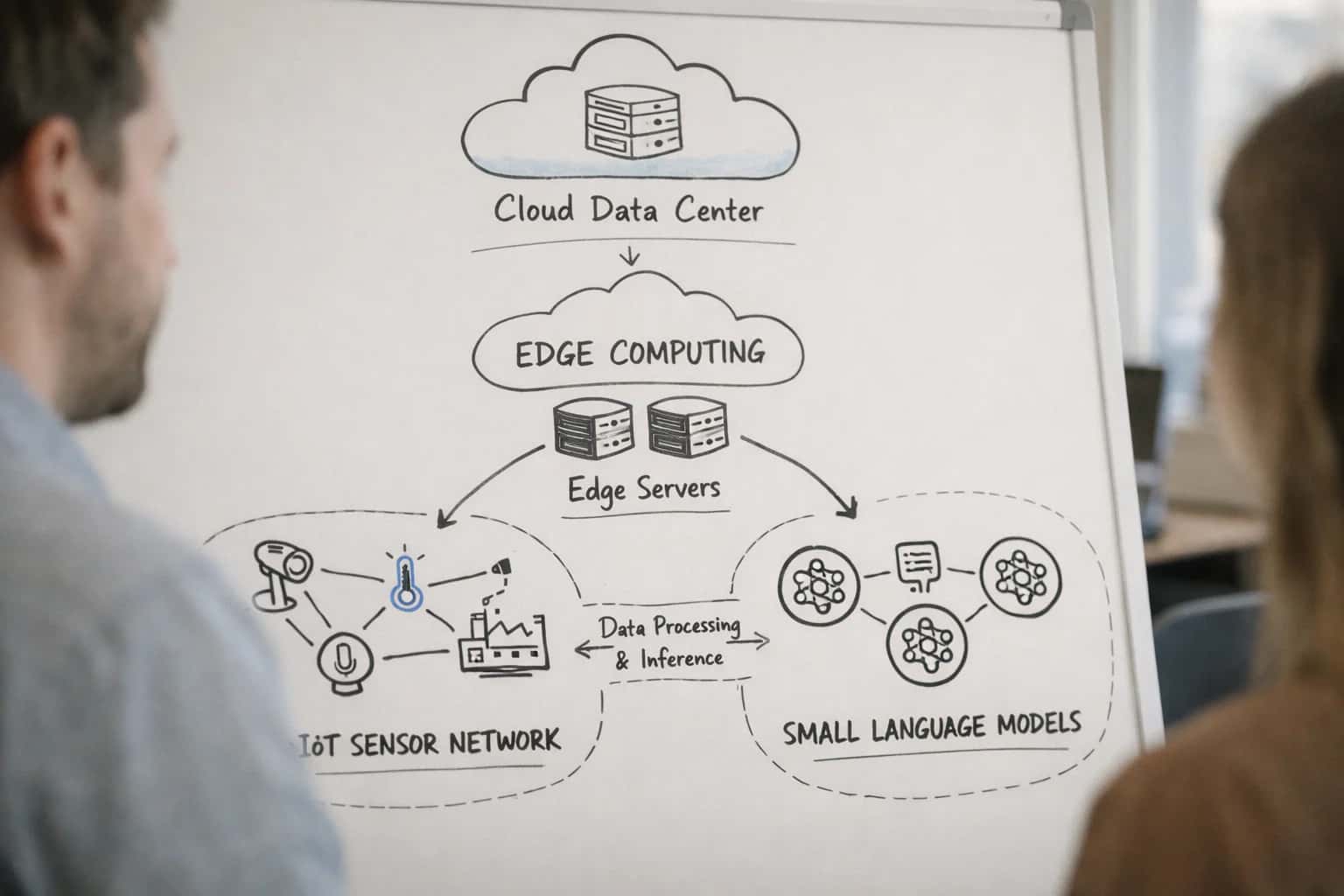
EDGE AI DEPLOYMENT FOR ROBOTICS
The Latency Problem in Robotic Autonomy
Real-time decision-making is non-negotiable for autonomous systems operating in dynamic environments.
Our service engineers low-latency, high-reliability inference pipelines deployed on edge hardware, ensuring decisions are made in single-digit milliseconds without cloud dependency. We specialize in:
- Model optimization for
NVIDIA Jetson,Qualcomm RB5, andIntel Movidiusplatforms. - Deterministic inference with 99.9% uptime SLA for continuous operation.
- Sensor fusion integration that processes LiDAR, vision, and IMU data in a unified pipeline.
Reduce your robot's decision latency by 80% and eliminate cloud communication as a single point of failure.
This capability is foundational for our broader work in Industrial AI Agent Development and Autonomous Mobile Robot (AMR) AI Integration. For systems requiring the highest level of precision, explore our AI for Robotic Arm Precision Control services.
DELIVERING OPERATIONAL AUTONOMY
Business Outcomes of Edge AI Robotics
Our edge AI deployment for robotics translates into measurable improvements in operational efficiency, safety, and total cost of ownership. We engineer systems where intelligence meets action, directly on the device.
01
Sub-Second Decision Latency
Deploy inference pipelines directly on robotic controllers to eliminate cloud round-trip delays. Achieve deterministic, real-time responses for collision avoidance and precision manipulation, critical for safe human-robot collaboration.
< 100ms
Inference Latency
0%
Cloud Dependency
02
Guaranteed Operational Uptime
Engineer for resilience with offline-capable AI that functions independently of network connectivity. Maintain continuous operation in warehouses, remote sites, or areas with intermittent coverage, ensuring production never stops.
99.9%
System Uptime
ISO 13849
Safety Compliance
03
Predictable Total Cost of Ownership
Shift from variable cloud compute costs to fixed, upfront edge deployment. Eliminate recurring data egress fees and reduce bandwidth requirements by over 90%, delivering a clear ROI within the first operational year.
> 90%
Bandwidth Reduction
Fixed Cost
Operational Model
04
Enhanced Data Security & Sovereignty
Keep sensitive operational data, such as facility layouts and proprietary processes, on-premise. Process video and sensor telemetry locally to comply with data residency regulations and protect intellectual property from exposure.
On-Device
Data Processing
Zero Egress
Data Policy
05
Scalable Fleet Intelligence
Deploy consistent, certified AI models across hundreds of robots via secure OTA updates. Enable fleet-wide learning where insights from one unit can improve the performance of all, without retraining in the cloud.
Bulk Deployment
Update Strategy
Federated Learning
Capability
06
Rapid Integration & Time-to-Value
Leverage our pre-validated edge AI stack and integration expertise for NVIDIA Jetson, Intel Movidius, and Qualcomm platforms. Move from proof-of-concept to production deployment in weeks, not months.
< 6 weeks
Avg. Deployment
Pre-Validated
Hardware Stack
From Assessment to Production
Typical Edge AI Deployment Timeline
A detailed breakdown of the phased approach Inference Systems takes to deploy robust, low-latency AI models directly onto robotic hardware, ensuring predictable delivery and measurable outcomes.
| Phase | Key Activities | Duration | Deliverables |
|---|---|---|---|
Phase 1: Assessment & Planning | Hardware audit, latency requirements analysis, model compatibility review, data pipeline scoping. | 1-2 weeks | Technical specification document, architecture proposal, project roadmap. |
Phase 2: Model Optimization & Quantization | Model pruning, quantization for target hardware (TensorRT, OpenVINO), accuracy validation, custom kernel development. | 2-3 weeks | Optimized model binaries, performance benchmark report, validation suite. |
Phase 3: On-Device Integration | Embedded SDK integration, real-time inference pipeline development, sensor fusion API development, power profiling. | 3-4 weeks | Integrated software stack on target device, power consumption report, initial latency metrics. |
Phase 4: Testing & Validation | Real-world scenario testing, stress testing under variable conditions, failover and recovery validation, safety compliance checks. | 2-3 weeks | Validation test report, performance SLA confirmation, safety certification support documentation. |
Phase 5: Deployment & Monitoring | OTA update pipeline setup, edge monitoring dashboard deployment, alert system configuration, handoff to operations team. | 1-2 weeks | Production-ready system, monitoring dashboard access, operational runbook, final project documentation. |
Total Project Timeline | 9-14 weeks | Fully operational Edge AI system with <100ms inference latency and 99.9% uptime SLA. |
PROVEN USE CASES
Industrial Applications of Edge AI Robotics
We engineer Edge AI systems that transform robotic fleets from scripted machines into intelligent, autonomous assets. Our deployments deliver measurable operational impact by enabling real-time decision-making at the source of action.
01
Autonomous Quality Inspection
Deploy real-time computer vision models directly on robotic arms or fixed-mount cameras to perform 100% inline defect detection. Eliminate cloud latency for instant pass/fail decisions, reducing scrap rates and preventing faulty products from advancing down the line.
< 100ms
Inference Latency
> 99.5%
Detection Accuracy
02
Predictive Maintenance for Robotic Fleets
Implement on-device anomaly detection models that analyze vibration, thermal, and current sensor data from motors and actuators. Predict component failures weeks in advance, enabling condition-based maintenance that minimizes unplanned downtime and extends asset life.
30-50%
Downtime Reduction
Weeks
Failure Prediction Lead Time
03
Intelligent Bin Picking & Assembly
Enable robots to handle unstructured environments with edge-deployed 6D pose estimation and grasp planning AI. Systems adapt to variable part orientation, lighting, and bin clutter in real-time, unlocking automation for complex kitting and assembly tasks without human intervention.
> 99%
Grasp Success Rate
Sub-mm
Positioning Accuracy
04
Dynamic Fleet Orchestration for AMRs
Run decentralized multi-agent coordination algorithms on Autonomous Mobile Robot (AMR) controllers. Enable real-time, collision-free path planning, dynamic task allocation, and traffic optimization across large fleets without dependency on a central server, ensuring resilient material flow.
40%
Throughput Increase
Zero Cloud
Dependency
05
Human-Robot Collaborative Safety
Deploy low-latency perception models for real-time human presence detection and intent prediction. Create safe collaborative workspaces (Cobots) that dynamically adjust speed and force, ensuring compliance with ISO/TS 15066 and enabling flexible, efficient human-robot teamwork.
< 50ms
Reaction Time
ISO 10218
Compliance
06
Precision Robotic Welding & Dispensing
Integrate adaptive AI control loops that process vision and force-torque sensor feedback in real-time to compensate for part variances, seam tracking errors, and environmental drift. Achieve consistent, high-quality welds and adhesive beads on complex, non-uniform surfaces.
60%
Rework Reduction
Consistent
Bead Quality
Enabling Efficiency, Speed & Accuracy
Intelligent Analysis, Decision & Execution
We build AI systems for teams that need search across company data, workflow automation across tools, or AI features inside products and internal software.
Talk to Us
Search across company data
Give teams answers from docs, tickets, runbooks, and product data with sources and permissions.
Useful when people spend too long searching or get different answers from different systems.
Enterprise searchRAGPermissions
Read more
Automate internal workflows
Use AI to route work, draft outputs, trigger actions, and keep approvals and logs in place.
Useful when repetitive work moves across multiple tools and teams.
AI agentsWorkflow automationGovernance
Read more
Add AI to products and internal tools
Build assistants, guided actions, or decision support into the software your team or customers already use.
Useful when AI needs to be part of the product, not a separate tool.
AI integrationDecision supportModel routing
Read moreTechnical Implementation
Edge AI Deployment for Robotics: FAQs
Get clear answers on timelines, costs, and technical details for deploying low-latency AI directly onto your robotic systems.
A standard deployment for a single robotic system or fleet type takes 2-4 weeks from finalized model to production-ready edge deployment. This includes containerization, optimization for the target hardware (e.g., NVIDIA Jetson, Intel Movidius), and integration with the robot's control stack. Complex multi-modal systems or novel hardware may extend to 6-8 weeks. We provide a detailed project plan with weekly milestones during the initial scoping phase.

About the author
Prasad Kumkar
CEO & MD, Inference Systems
Prasad Kumkar is the CEO & MD of Inference Systems and writes about AI systems architecture, LLM infrastructure, model serving, evaluation, and production deployment. Over 5+ years, he has worked across computer vision models, L5 autonomous vehicle systems, and LLM research, with a focus on taking complex AI ideas into real-world engineering systems.
His work and writing cover AI systems, large language models, AI agents, multimodal systems, autonomous systems, inference optimization, RAG, evaluation, and production AI engineering.
LinkedIn
Limited slotsGet a Free AI Consultation
Partnered with leading AI, data, and software stack.





How We Work
Custom AI workflows for your Business
One-fit-all AI don't work for modern businesses. At Inferensys, we aim to understand your business & custom requirements; which we use to define most efficient agentic workflows, the data, and the tools for your business.
01
Review the use case
We understand the task, the users, and where AI can actually help.
Read more02
Pick the right approach
We define what needs search, automation, or product integration.
Read more03
Build the first useful version
We implement the part that proves the value first.
Read more04
Improve from there
We add the checks and visibility needed to keep it useful.
Read moreThe first call is a practical review of your use case and the right next step.
Talk to Us