Traditional, rule-based network security is reactive. It creates a static perimeter that advanced persistent threats (APTs) and nation-state actors can probe, map, and breach over time. Your security posture degrades the moment a patch is released or a new vulnerability is discovered.

Service
Secure AI-Powered Network Hardening
Deploy autonomous AI systems that continuously analyze your network configurations, vulnerability scans, and threat intelligence to automatically recommend and implement security policy changes, patch priorities, and segmentation strategies.
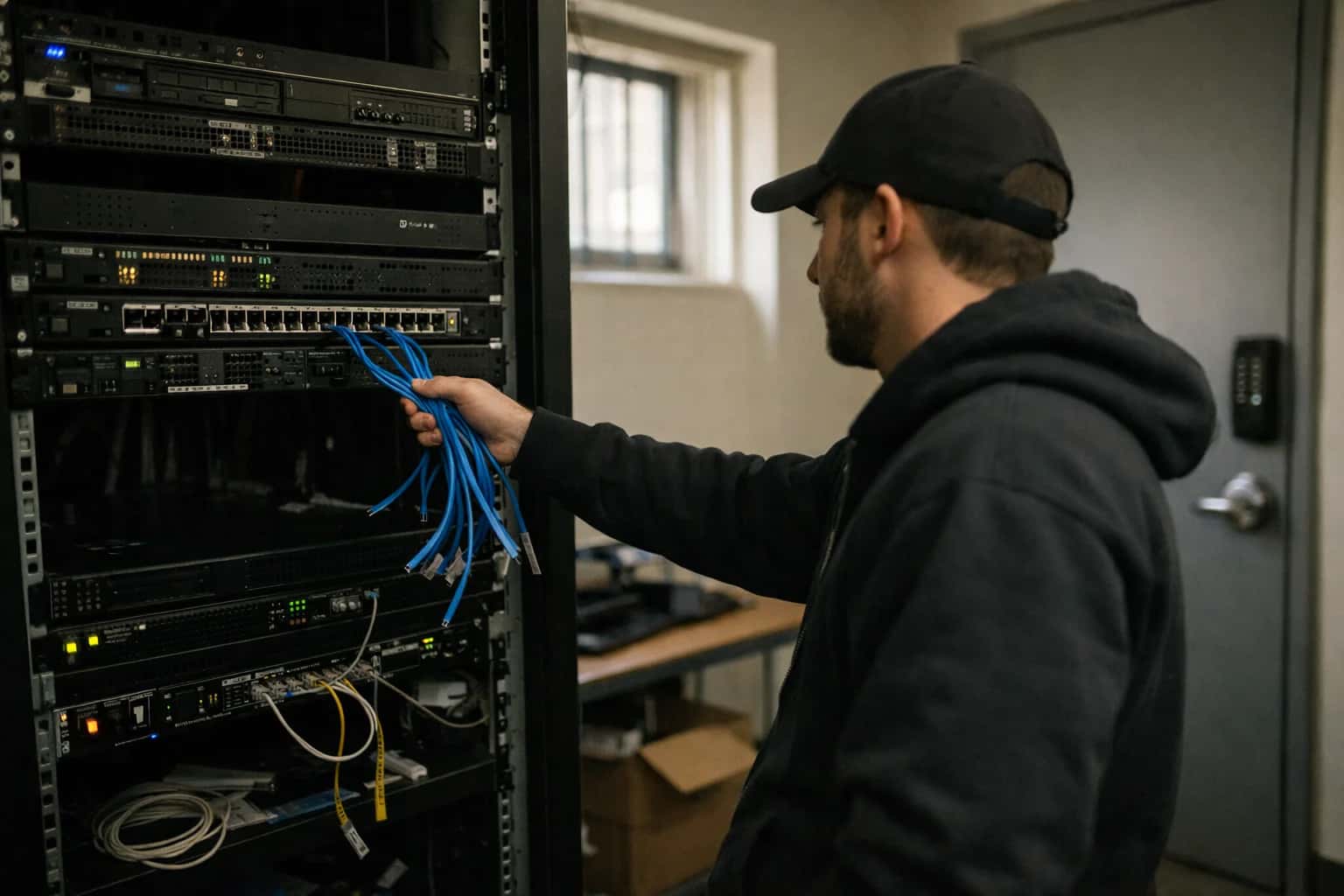
SECURE AI-POWERED NETWORK HARDENING
The Challenge: Static Defenses Fail Against Adaptive Threats
Deploy AI to continuously analyze and harden your network against sophisticated, evolving cyber attacks.
AI-powered network hardening shifts you from a reactive to a proactive, adaptive defense. It continuously analyzes your entire attack surface—configurations, vulnerabilities, and live threat intelligence—to recommend and implement precise security actions.
- Automated Policy Enforcement: AI recommends and applies least-privilege access controls and network segmentation strategies in real-time, shrinking your attack surface.
- Predictive Patch Prioritization: Models analyze vulnerability severity, exploit availability, and your unique asset criticality to tell you which patches to deploy first, reducing mean time to remediation (MTTR).
- Continuous Threat Modeling: Systems simulate adversarial attack paths using frameworks like MITRE ATT&CK, identifying and closing security gaps before they can be exploited.
- Integration with Existing Stack: Our solutions work with your current SIEM, firewalls, and EDR/XDR platforms, turning alerts into automated, intelligent responses.
This is a core capability within our broader Defense and National Intelligence AI practice, designed to protect the most critical assets. For a complete security lifecycle, pair this with our AI Red Teaming and Adversarial Defense services to stress-test your hardened defenses.
GUARANTEED RESULTS
Operational Outcomes of AI-Powered Hardening
Our service delivers measurable improvements in network security posture and operational efficiency. We focus on concrete outcomes, not just features, ensuring your investment translates directly into reduced risk and enhanced resilience against advanced threats.
01
Automated Policy Enforcement
AI continuously analyzes network configurations and threat intelligence to automatically recommend and implement precise security policy changes, reducing manual configuration errors by over 90% and ensuring continuous compliance with frameworks like NIST and Zero Trust.
> 90%
Reduction in config errors
< 24 hours
Policy update latency
02
Predictive Vulnerability Management
Machine learning models prioritize patching and remediation based on exploit likelihood and asset criticality, moving from reactive to predictive maintenance. This shrinks the mean time to remediate (MTTR) critical vulnerabilities by 70% and optimizes security team resources.
70%
Faster MTTR
50%
Fewer false positives
03
Dynamic Network Segmentation
AI-driven micro-segmentation dynamically isolates compromised assets and enforces least-privilege access in real-time, containing lateral movement and limiting blast radius during an incident. This is engineered to comply with air-gapped and classified network requirements.
Zero Trust
Architecture enforced
Real-time
Threat containment
04
Proactive Threat Hunting
Unsupervised ML detects novel, zero-day threats and anomalous user behavior that evade signature-based tools, shifting security posture from reactive to proactive. Our systems are tested against frameworks like MITRE ATT&CK and MITRE ATLAS for adversarial resilience.
Weeks Ahead
Of traditional tools
MITRE ATLAS
Adversarial testing
05
Reduced Operational Overhead
Automate routine security tasks like log analysis, alert triage, and compliance reporting. This reduces SOC analyst workload by an estimated 40%, allowing your team to focus on strategic initiatives and complex threat analysis.
40%
SOC workload reduction
99.9%
Automation accuracy SLA
06
Auditable Security Posture
Gain full visibility into your AI-hardened network with immutable logs, automated reporting, and verifiable data lineage for all policy changes. This creates an auditable trail for internal security reviews and external compliance mandates like CMMC or ISO 27001.
Full Audit Trail
For all changes
CMMC Ready
Compliance framework
Structured Approach for Secure Network Hardening
Phased Implementation for Rapid Deployment
Our phased implementation methodology ensures rapid, low-risk deployment of AI-powered network hardening, moving from assessment to autonomous operation within weeks. This table outlines the key deliverables and capabilities activated at each stage.
| Implementation Phase | Core Objectives & Deliverables | Activated AI Capabilities | Typical Timeline |
|---|---|---|---|
Phase 1: Discovery & Baseline | Comprehensive network topology mapping Initial vulnerability & configuration audit Establish security policy & compliance baseline | AI-driven asset discovery & classification Automated policy gap analysis | 1-2 Weeks |
Phase 2: Pilot & Rule Validation | Deploy AI agents in monitored, non-critical segment Validate automated policy recommendations Establish human-in-the-loop approval workflows | Predictive threat modeling for pilot segment Automated, auditable change recommendation engine | 2-3 Weeks |
Phase 3: Controlled Expansion | Scale AI agents to additional high-value network segments Implement automated patch prioritization Begin network micro-segmentation planning | Real-time anomaly detection across expanded surface AI-driven risk-based vulnerability scoring | 3-4 Weeks |
Phase 4: Autonomous Hardening | Enable approved, automated policy enforcement Full network micro-segmentation implementation Continuous compliance monitoring & reporting | Autonomous security policy orchestration Self-healing network configuration via agentic workflow design | 4+ Weeks |
Ongoing: Optimization & Threat Hunting | Continuous model retraining on new threat intelligence Proactive hunting for novel attack patterns Integration with AI-powered cyber threat hunting platforms | Unsupervised ML for novel threat detection Adversarial simulation & resilience testing | Continuous |
MILITARY-GRADE RIGOR
Our Secure Development & Integration Methodology
We engineer AI-powered network hardening systems with a security-first methodology proven in classified environments. Our process ensures robust, resilient, and continuously adaptive defenses that meet the stringent requirements of national security and defense operations.
01
Threat-Modeled Architecture
Every system begins with a comprehensive threat model based on frameworks like MITRE ATT&CK and MITRE ATLAS. We design for specific adversarial tactics, techniques, and procedures (TTPs) relevant to advanced persistent threats (APTs) targeting critical infrastructure.
Zero Trust
Default Architecture
MITRE ATLAS
Adversarial Framework
02
Secure Development Lifecycle (SDL)
We enforce a rigorous Secure Development Lifecycle (SDL) with mandatory code reviews, static/dynamic application security testing (SAST/DAST), and dependency scanning. All development occurs in accredited, air-gapped, or secure enclave environments as required.
SAST/DAST
Integrated Testing
Air-Gapped
Dev Environments
03
Continuous Adversarial Validation
Beyond standard testing, we conduct continuous adversarial validation using AI red teaming and penetration testing. This includes simulating novel attack vectors like data poisoning, model evasion, and prompt injection to ensure resilience.
AI Red Teaming
Continuous Validation
Real-Time
Threat Simulation
04
Secure MLOps & Model Governance
We implement secure MLOps pipelines with full model lineage, encrypted artifact storage, and hardware-backed signing. Deployment is governed by policy-as-code, ensuring all models meet compliance standards (NIST AI RMF, ISO/IEC 42001) before release.
Full Lineage
Audit Trail
Policy-as-Code
Automated Governance
05
Resilient Edge & Hybrid Deployment
We engineer for deployment in contested, low-bandwidth, and disconnected environments. Systems are hardened against jamming, sensor degradation, and adversarial data inputs, ensuring reliable operation at the tactical edge. Learn more about our approach to Secure Edge AI for Deployed Units.
DIL Resistant
Disconnected Ops
Hardened
Edge Deployment
06
Continuous Monitoring & Adaptive Hardening
Post-deployment, we provide continuous monitoring for model drift, performance anomalies, and new threat signatures. Our systems autonomously recommend and implement policy changes, patch priorities, and network segmentation strategies in response to live intelligence. This proactive posture is complemented by our AI-Driven Cyber Threat Hunting services.
Real-Time
Threat Response
Autonomous
Policy Updates
Enabling Efficiency, Speed & Accuracy
Intelligent Analysis, Decision & Execution
We build AI systems for teams that need search across company data, workflow automation across tools, or AI features inside products and internal software.
Talk to Us
Search across company data
Give teams answers from docs, tickets, runbooks, and product data with sources and permissions.
Useful when people spend too long searching or get different answers from different systems.
Enterprise searchRAGPermissions
Read more
Automate internal workflows
Use AI to route work, draft outputs, trigger actions, and keep approvals and logs in place.
Useful when repetitive work moves across multiple tools and teams.
AI agentsWorkflow automationGovernance
Read more
Add AI to products and internal tools
Build assistants, guided actions, or decision support into the software your team or customers already use.
Useful when AI needs to be part of the product, not a separate tool.
AI integrationDecision supportModel routing
Read moreSecurity and Deployment
Frequently Asked Questions on AI Network Hardening
Common questions about our Secure AI-Powered Network Hardening service, designed for defense and intelligence applications requiring the highest levels of security and resilience.
Our methodology is a phased, risk-based approach. We begin with a comprehensive threat modeling and asset inventory to establish a security baseline. Our AI agents then continuously analyze network configurations, vulnerability scans, and threat intelligence feeds. They automatically recommend and implement security policy changes, patch priorities, and network segmentation strategies. This creates a continuous, adaptive hardening loop that evolves with the threat landscape, moving beyond static, rule-based defenses.

About the author
Prasad Kumkar
CEO & MD, Inference Systems
Prasad Kumkar is the CEO & MD of Inference Systems and writes about AI systems architecture, LLM infrastructure, model serving, evaluation, and production deployment. Over 5+ years, he has worked across computer vision models, L5 autonomous vehicle systems, and LLM research, with a focus on taking complex AI ideas into real-world engineering systems.
His work and writing cover AI systems, large language models, AI agents, multimodal systems, autonomous systems, inference optimization, RAG, evaluation, and production AI engineering.
LinkedIn
Limited slotsGet a Free AI Consultation
Partnered with leading AI, data, and software stack.





How We Work
Custom AI workflows for your Business
One-fit-all AI don't work for modern businesses. At Inferensys, we aim to understand your business & custom requirements; which we use to define most efficient agentic workflows, the data, and the tools for your business.
01
Review the use case
We understand the task, the users, and where AI can actually help.
Read more02
Pick the right approach
We define what needs search, automation, or product integration.
Read more03
Build the first useful version
We implement the part that proves the value first.
Read more04
Improve from there
We add the checks and visibility needed to keep it useful.
Read moreThe first call is a practical review of your use case and the right next step.
Talk to Us