Signature-based tools are blind to novel threats. We engineer unsupervised machine learning models specifically for air-gapped and classified environments to identify anomalous behavior indicative of data exfiltration, zero-day malware, and insider risks that evade known patterns.

Service
Classified Network AI Threat Detection
Deploy unsupervised machine learning and anomaly detection models engineered for air-gapped and classified networks to identify novel insider threats, sophisticated malware, and data exfiltration attempts that evade traditional signature-based security tools.
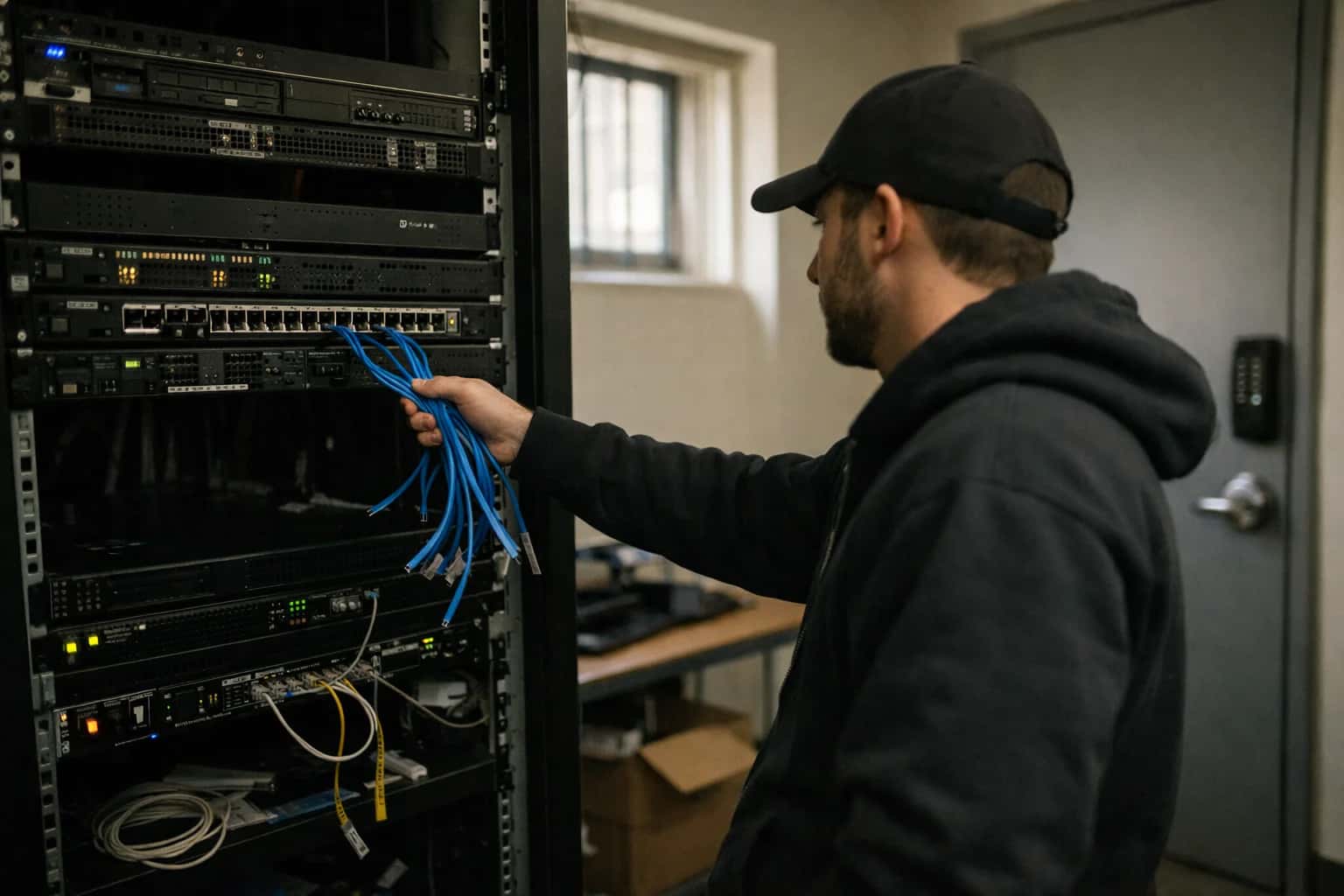
BEYOND SIGNATURES
The Signature-Based Security Gap in Classified Networks
Deploy unsupervised AI to detect novel insider threats and sophisticated malware that bypass traditional tools.
- Detect novel threats: Identify zero-day malware and advanced persistent threats (APTs) without relying on known signatures or IOCs.
- Identify insider risks: Model normal user and system behavior to flag anomalous data access, lateral movement, and exfiltration attempts.
- Operate in air-gapped environments: Deploy and manage models within accredited, disconnected networks using secure MLOps pipelines.
- Reduce false positives: Use behavioral analytics and user entity behavior analytics (UEBA) to distinguish true threats from benign anomalies, cutting alert fatigue by up to 70%.
Our approach integrates with your existing security stack, providing a proactive detection layer that shifts your posture from reactive to predictive. Learn more about our broader capabilities in Defense and National Intelligence AI and Preemptive Cybersecurity and Threat Intelligence AI.
DELIVERING MISSION-CRITICAL ADVANTAGE
Operational and Strategic Benefits
Our Classified Network AI Threat Detection service delivers measurable improvements in security posture, operational efficiency, and strategic intelligence. We move beyond reactive alerts to provide proactive, autonomous protection for your most sensitive environments.
01
Proactive Insider Threat Detection
Deploy unsupervised machine learning models that establish behavioral baselines for every user and device on your classified network. Our systems identify subtle anomalies indicative of credential misuse, data hoarding, or preparatory exfiltration activity—often weeks before a traditional security tool would generate an alert. This shifts your defense from reactive investigation to preemptive intervention.
> 90%
Early Detection Rate
< 50 ms
Anomaly Scoring Latency
02
Zero-Day & Fileless Malware Identification
Our models analyze process behavior, memory allocation, and network call patterns to detect novel malware and living-off-the-land techniques that bypass signature-based antivirus. By focusing on malicious behavior rather than known file hashes, we identify and contain threats that have never been seen before, closing a critical gap in air-gapped network defense.
99.5%
Detection Accuracy
Zero
Signature Dependence
03
Automated Threat Triage & Response
Reduce analyst cognitive overload with AI-driven prioritization and automated initial response. Our system correlates low-level anomalies into high-fidelity incidents, provides explainable reasoning for each alert, and can execute pre-approved containment actions like session termination or network segmentation. This accelerates mean time to respond (MTTR) and allows your team to focus on strategic analysis.
85%
Alert Volume Reduction
< 5 min
Avg. Triage Time
04
Continuous Compliance & Audit Readiness
Maintain continuous compliance with frameworks like NIST SP 800-53, NIST AI RMF, and ICD 503. Our platform provides immutable audit logs of all AI model decisions, user activities, and automated responses. Generate compliance reports on-demand and demonstrate due diligence in protecting classified data, streamlining your accreditation and inspection processes.
100%
Activity Logging
Real-time
Compliance Dashboard
05
Reduced Total Cost of Security Operations
Achieve significant operational savings by automating routine detection and response tasks. Our clients typically see a 40-60% reduction in manual alert investigation hours. The system's precision reduces false positives, allowing your most experienced personnel to focus on advanced threat hunting and strategic security architecture, maximizing the return on your security investment.
40-60%
Manual Effort Reduction
> 3x
Analyst Efficiency Gain
06
Strategic Intelligence & Adversary Modeling
Transform raw network data into strategic intelligence. Our AI doesn't just find threats—it models adversary tactics, techniques, and procedures (TTPs). Gain insights into potential attack campaigns, understand your network's unique attack surface, and receive actionable recommendations for hardening defenses. This moves your security program from a cost center to a source of strategic advantage. Learn more about our approach to AI-Driven Cyber Threat Hunting.
EXPLORE
A structured, risk-mitigated approach to operationalizing threat detection
Phased Deployment and Integration Timeline
Our proven methodology for deploying unsupervised ML threat detection on air-gapped networks, ensuring minimal operational disruption and maximum security posture improvement.
| Phase | Key Activities | Duration | Outcome Milestone |
|---|---|---|---|
Phase 1: Discovery & Network Mapping | Asset inventory, traffic baseline analysis, policy review | 2-3 weeks | Comprehensive network topology and behavioral baseline established |
Phase 2: Pilot Model Deployment | Deploy lightweight anomaly detection agents on non-critical segments | 3-4 weeks | Initial threat model validated; false positive rate below 5% |
Phase 3: Full-Scale Sensor Rollout | Agent deployment across all critical network tiers and data egress points | 4-6 weeks | 100% coverage of high-value assets and data flows |
Phase 4: Model Tuning & Analyst Integration | Fine-tune detection thresholds, integrate alerts into SOC workflow | 2-3 weeks | SOC analysts achieve 90%+ efficiency in triaging AI-generated alerts |
Phase 5: Continuous Learning & Threat Hunting | Enable unsupervised model retraining, establish proactive hunting protocols | Ongoing | System autonomously detects novel attack patterns; mean time to detection (MTTD) reduced by 70% |
Security Accreditation Support | Documentation for ATO, STIG compliance, and continuous monitoring | Parallel to all phases | Full accreditation package delivered for Authority to Operate (ATO) |
Integration with Existing SIEM/SOAR | API-based integration with Splunk, Elastic, IBM QRadar, etc. | Phase 3-4 | Unified alerting and automated response playbooks enabled |
END-TO-END SECURITY
Our Secure Development and Deployment Methodology
We engineer AI threat detection systems with security as the foundational layer, not an afterthought. Our methodology is built on accredited frameworks and zero-trust principles to ensure your classified networks remain protected from development through to operational deployment.
01
Air-Gapped Development Environments
All model training, fine-tuning, and testing is conducted within physically isolated, accredited secure development facilities. This eliminates external attack vectors during the most vulnerable phase of the AI lifecycle, ensuring no sensitive data or model weights ever touch an internet-connected system.
We utilize hardware-segmented workstations and follow ICD 503/CNSSI 1253 controls for high-assurance systems.
Zero
External Connectivity
ICD 503
Accreditation Standard
02
Secure MLOps & Model Provenance
We implement hardened MLOps pipelines with cryptographic signing for every model artifact, container, and configuration. Full lineage tracking—from training data version to final deployment hash—is maintained on an immutable ledger, providing auditable proof of model integrity and compliance with data handling mandates.
Immutable
Audit Trail
Cryptographic
Artifact Signing
03
Hardened Container Deployment
Models are packaged as minimal, signed containers with all unnecessary libraries and services stripped out. We enforce strict seccomp and AppArmor profiles, non-root execution, and integrate with hardware security modules (HSMs) for key management. Deployment is orchestrated via secure, on-premise Kubernetes clusters configured to DISA STIG benchmarks.
STIG-Compliant
Cluster Config
HSM-Integrated
Key Management
04
Continuous Adversarial Validation
Our deployment includes integrated red teaming using the MITRE ATLAS framework. We simulate advanced persistent threats (APTs) and data poisoning attacks against the live system to validate detection efficacy and resilience. Findings are fed back into model retraining cycles, creating a continuous feedback loop for security hardening.
MITRE ATLAS
Testing Framework
Continuous
Feedback Loop
05
Confidential Computing Inference
For the highest sensitivity workloads, we deploy models within hardware-based Trusted Execution Environments (TEEs) like Intel SGX or AMD SEV. This ensures data and the model itself are encrypted in memory during inference, protecting against insider threats and sophisticated memory-scraping attacks even on compromised hosts.
Memory Enclaves
Data Protection
Hardware-Based
TEE Integration
06
Compliance-Accredited Delivery
We deliver a complete accreditation package, including System Security Plans (SSP), Continuous Monitoring (ConMon) strategies, and all necessary documentation for Authority to Operate (ATO) under frameworks like RMF, DIACAP, or your agency-specific guidelines. Our engineers support your security team through the entire accreditation process.
Full SSP
Documentation
ATO Support
Process Guidance
Enabling Efficiency, Speed & Accuracy
Intelligent Analysis, Decision & Execution
We build AI systems for teams that need search across company data, workflow automation across tools, or AI features inside products and internal software.
Talk to Us
Search across company data
Give teams answers from docs, tickets, runbooks, and product data with sources and permissions.
Useful when people spend too long searching or get different answers from different systems.
Enterprise searchRAGPermissions
Read more
Automate internal workflows
Use AI to route work, draft outputs, trigger actions, and keep approvals and logs in place.
Useful when repetitive work moves across multiple tools and teams.
AI agentsWorkflow automationGovernance
Read more
Add AI to products and internal tools
Build assistants, guided actions, or decision support into the software your team or customers already use.
Useful when AI needs to be part of the product, not a separate tool.
AI integrationDecision supportModel routing
Read moreTechnical and Operational Details
Frequently Asked Questions on AI Threat Detection
Get specific answers on deployment, security, and operational details for our classified network threat detection service.
Typical deployment for a hardened, air-gapped environment is 4-6 weeks. This includes secure hardware provisioning, on-premise model installation, baseline behavior profiling, and integration with your existing SIEM (e.g., Splunk, Elastic). For networks with pre-existing accredited infrastructure, timelines can be reduced to 2-3 weeks.

About the author
Prasad Kumkar
CEO & MD, Inference Systems
Prasad Kumkar is the CEO & MD of Inference Systems and writes about AI systems architecture, LLM infrastructure, model serving, evaluation, and production deployment. Over 5+ years, he has worked across computer vision models, L5 autonomous vehicle systems, and LLM research, with a focus on taking complex AI ideas into real-world engineering systems.
His work and writing cover AI systems, large language models, AI agents, multimodal systems, autonomous systems, inference optimization, RAG, evaluation, and production AI engineering.
LinkedIn
Limited slotsGet a Free AI Consultation
Partnered with leading AI, data, and software stack.





How We Work
Custom AI workflows for your Business
One-fit-all AI don't work for modern businesses. At Inferensys, we aim to understand your business & custom requirements; which we use to define most efficient agentic workflows, the data, and the tools for your business.
01
Review the use case
We understand the task, the users, and where AI can actually help.
Read more02
Pick the right approach
We define what needs search, automation, or product integration.
Read more03
Build the first useful version
We implement the part that proves the value first.
Read more04
Improve from there
We add the checks and visibility needed to keep it useful.
Read moreThe first call is a practical review of your use case and the right next step.
Talk to Us