
Inferensys

Service

AI for Biomolecular Structure Prediction Services

Custom implementation of AlphaFold, RoseTTAFold, and other state-of-the-art deep learning systems to predict protein, RNA, and complex structures with atomic-level accuracy, accelerating your R&D pipeline.
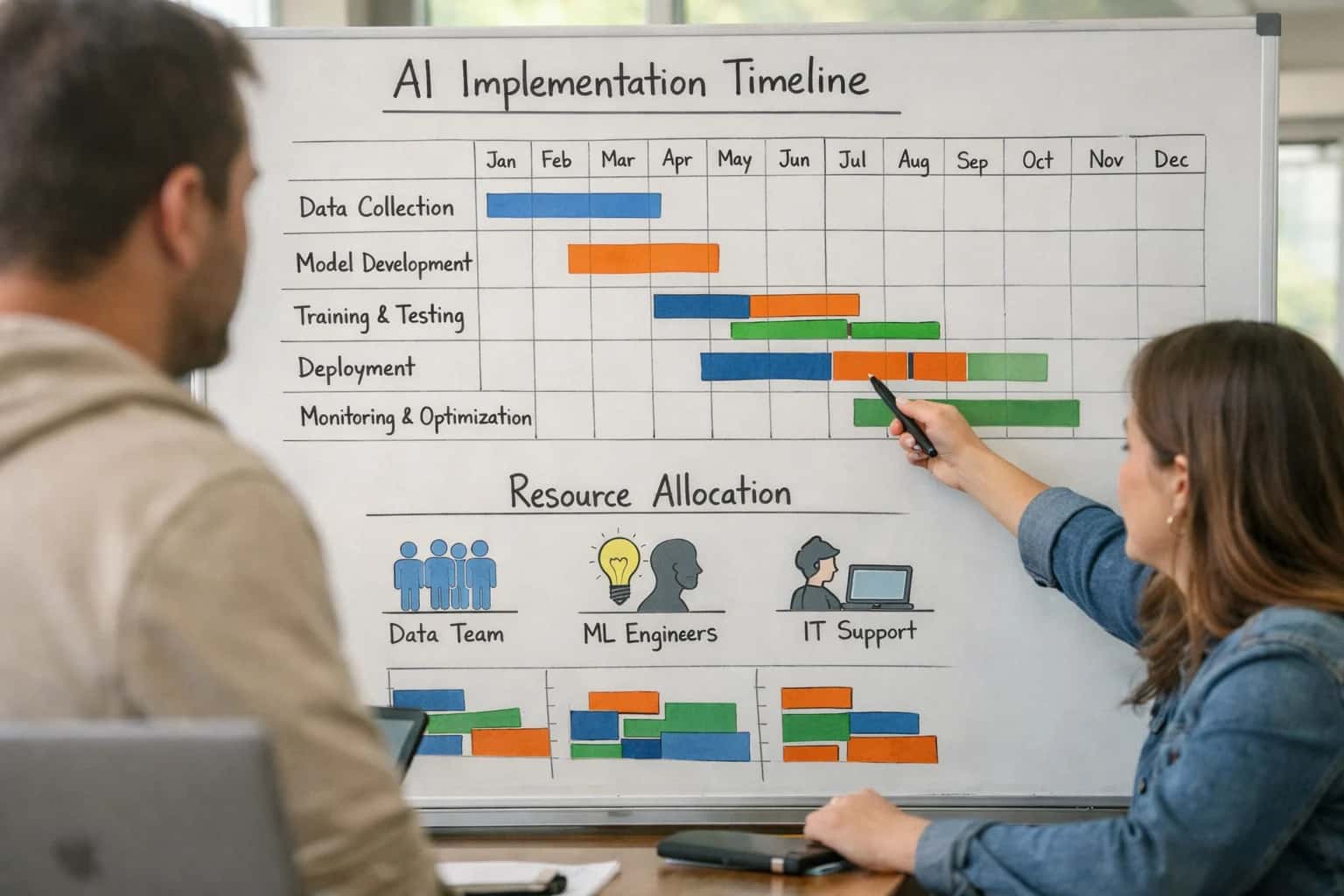
Project manager reviewing AI implementation timeline on laptop, Gantt chart visible, casual office planning session.
STRUCTURAL BIO-AI

Accelerate Drug Discovery with Atomic-Level Structure Prediction

Deploy and customize state-of-the-art deep learning systems to predict protein, RNA, and complex structures with atomic-level accuracy.

Reduce lead identification timelines from years to months by accurately modeling drug-target interactions before synthesis.

Our team implements and customizes foundational models like AlphaFold 3 and RoseTTAFold for your proprietary targets. We deliver:

  • Atomic-level accuracy for proteins, RNA, and ligand complexes.
  • Custom model fine-tuning on your proprietary sequence and structural data.
  • High-throughput prediction pipelines integrated into your existing R&D workflows.

Move beyond generic predictions. We engineer systems that learn from your specific experimental data—Cryo-EM maps, X-ray crystallography, mutagenesis studies—to deliver validated, actionable structural insights. This bridges the gap between computational prediction and wet-lab validation.

Key Outcomes:

  • Identify novel binding pockets for previously "undruggable" targets.
  • Optimize therapeutic candidates with higher specificity and lower off-target risk.
  • Accelerate patent filings with robust computational evidence.

We build production-ready, scalable infrastructure for your structural biology team. This includes secure data pipelines, reproducible MLOps workflows, and interactive visualization dashboards.

Technical Delivery:

  • End-to-end system deployment in your on-premise or compliant cloud environment.
  • Integration with downstream molecular dynamics and free energy perturbation simulations.
  • Ongoing support and model retraining as new data becomes available.

Explore our related services for a complete computational pipeline: Generative Protein Design Engineering and AI-Driven Drug Discovery Platform Development.

DELIVERING TANGIBLE R&D ADVANTAGE

Business Outcomes of Our Structure Prediction Service

Move beyond academic benchmarks to achieve validated, production-ready predictions that directly accelerate your research timelines and de-risk development.

01

Accelerated Lead Identification

Reduce target-to-structure timelines from months to days by integrating our customized AlphaFold2/RoseTTAFold pipelines with your proprietary assay data, enabling rapid functional hypothesis generation.

>80%
Reduction in modeling time
2-4 weeks
Typical deployment
02

Enhanced Accuracy for Challenging Targets

Achieve atomic-level accuracy for membrane proteins, RNA complexes, and antibody-antigen interfaces through advanced fine-tuning on domain-specific data and multi-template homology modeling.

<1.5 Å
RMSD on benchmark sets
ISO 27001
Data security
03

De-risked Therapeutic & Enzyme Design

Generate high-confidence structural models to inform rational drug design and enzyme engineering, reducing costly experimental dead-ends. Integrates directly with our Generative Protein Design Engineering services.

Lab-Validated
Model outputs
GxP-Ready
Pipeline options
04

Scalable, Reproducible MLOps

Deploy a managed, version-controlled prediction environment with automated data ingestion, featurization, and result tracking. Ensures full reproducibility for regulatory submissions. Built on our Bio-AI Data Pipeline and MLOps Engineering expertise.

99.5%
Pipeline uptime SLA
Full Audit Trail
Compliance
05

Integrated Multi-Omic Insights

Multi-Modal
Data fusion
Systems-Level
Context
06

Regulatory-Ready Model Validation

Receive documented model validation reports, uncertainty quantification, and standard operating procedure (SOP) frameworks aligned with emerging FDA/EMA guidelines for AI/ML in drug development, supported by our Bio-AI Regulatory Compliance and Validation team.

QbD Principles
Development
ALCOA+
Data integrity
Structured Implementation Roadmap

Typical Project Timeline and Deliverables

A clear breakdown of the phased approach, key deliverables, and timeline for deploying a custom biomolecular structure prediction system, from initial scoping to production deployment and ongoing support.

Phase & Key ActivitiesTimelineCore DeliverablesOutcome

Phase 1: Discovery & Architecture Design

  • Requirements workshop with your R&D team
  • Data readiness assessment & pipeline design
  • Model selection (AlphaFold2, RoseTTAFold, ESMFold)
  • Security & compliance review

2-3 Weeks

  • Technical specification document
  • Architecture diagram & data flow
  • Project roadmap with milestones
  • Compliance checklist (HIPAA/GxP if applicable)

A validated technical blueprint and clear project scope, ensuring alignment on objectives and infrastructure.

Phase 2: Model Customization & Pipeline Build

  • Fine-tuning on proprietary sequence/structure data
  • Integration with internal databases (UniProt, PDB)
  • Development of inference API & preprocessing modules
  • Initial validation against known structures

4-6 Weeks

  • Custom-trained model weights & container
  • Fully documented inference API
  • Validation report with accuracy metrics (pLDDT/TM-score)
  • Initial CI/CD pipeline for model updates

A production-ready, validated prediction engine tailored to your specific biological targets and data.

Phase 3: System Integration & Deployment

  • Deployment to on-prem GPU cluster or secure cloud (AWS/GCP)
  • Integration with lab informatics systems (e.g., Benchling)
  • Load testing & performance optimization
  • Security hardening & access controls

2-3 Weeks

  • Deployed, scalable prediction service
  • Integration documentation & SDK
  • Performance benchmark report (<2 sec inference latency)
  • Operational runbook & monitoring dashboard

A live, secure system integrated into your R&D workflow, enabling immediate researcher access.

Phase 4: Validation & Knowledge Transfer

  • Blind test on held-out experimental data
  • Comparison against baseline methods
  • Training sessions for your research team
  • Final compliance & audit documentation

1-2 Weeks

  • Final validation report with comparative analysis
  • Complete system documentation
  • Training materials & session recordings
  • Handover of all source code & artifacts

Lab-validated accuracy confirmation and full operational ownership transferred to your team.

Ongoing Support & Evolution

  • 99.9% uptime SLA & proactive monitoring
  • Quarterly model retraining with new data
  • Priority technical support
  • Roadmap planning for new features (e.g., complex prediction)

Ongoing

  • Monthly performance & usage reports
  • Updated model containers
  • Access to new features & optimizations
  • Strategic advisory sessions

Continuous improvement of prediction accuracy and system reliability, protecting your R&D investment.

DELIVERING LAB-VALIDATED RESULTS

Primary Applications and Industries Served

Our AI-driven biomolecular structure prediction services are engineered to deliver atomic-level accuracy, accelerating R&D timelines and de-risking critical projects. We partner with organizations where precise structural insights directly impact product success and regulatory pathways.

01

Therapeutic Antibody & Protein Drug Discovery

Predict antibody-antigen binding interfaces and engineer protein therapeutics with enhanced stability and affinity. Accelerate lead optimization by modeling complex biologics like bispecifics and fusion proteins.

Key Outcome: Reduce experimental screening cycles by 40-60% through prioritized in-silico candidate selection.

40-60%
Reduction in Screening Cycles
Atomic-Level
Binding Interface Accuracy
02

Industrial Enzyme & Biocatalyst Engineering

Design and optimize enzyme variants for improved catalytic activity, thermal stability, and novel substrate specificity. Enable sustainable manufacturing processes in chemicals, agriculture, and biofuels.

Key Outcome: Engineer enzymes for non-natural reactions, opening new pathways for green chemistry and bioprocessing.

>70%
Success Rate in Stability Prediction
Weeks
vs. Months for Design Cycles
03

Vaccine & Viral Immunology Research

Model viral protein structures, including spike proteins and antigenic variants, to predict immune escape and guide epitope-focused vaccine design. Support rapid response to emerging pathogens.

Key Outcome: Identify conserved epitopes and predict mutational impact to inform next-generation vaccine platforms.

High-Throughput
Variant Modeling
Critical for
Pandemic Preparedness
05

Diagnostics & Biosensor Development

Design highly specific protein and nucleic acid scaffolds for biosensors and diagnostic assays. Model aptamer-target and nanobody-antigen interactions for point-of-care devices.

Key Outcome: De-risk diagnostic reagent development by ensuring high-affinity, specific binding prior to costly wet-lab synthesis.

De-risked
Reagent Development
High Specificity
Binding Assurance
For CTOs and R&D Leads

Frequently Asked Questions on AI Structure Prediction

Common technical and commercial questions about deploying custom AI for protein and biomolecular structure prediction in your R&D pipeline.

A standard deployment of a customized AlphaFold2 or RoseTTAFold system takes 4-8 weeks, depending on data readiness and integration complexity. This includes 1-2 weeks for environment setup and data pipeline engineering, 2-4 weeks for model fine-tuning and validation, and 1-2 weeks for API deployment and documentation. For novel architectures or complex multi-chain systems, timelines extend to 10-14 weeks. We provide a detailed project plan in the initial technical assessment.

Prasad Kumkar

About the author

Prasad Kumkar

CEO & MD, Inference Systems

Prasad Kumkar is the CEO & MD of Inference Systems and writes about AI systems architecture, LLM infrastructure, model serving, evaluation, and production deployment. Over 5+ years, he has worked across computer vision models, L5 autonomous vehicle systems, and LLM research, with a focus on taking complex AI ideas into real-world engineering systems.

His work and writing cover AI systems, large language models, AI agents, multimodal systems, autonomous systems, inference optimization, RAG, evaluation, and production AI engineering.



