Traditional post-hoc bias correction is often insufficient. Our engineers embed fairness constraints and adversarial debiasing algorithms directly into your training loop. This in-processing approach produces models that are fair by design, without sacrificing core predictive accuracy or requiring constant external monitoring.

Service
Fairness-Aware Model Training
Engineering services to integrate in-processing bias mitigation algorithms directly into your model training pipeline, producing inherently fairer AI systems without sacrificing core performance metrics.
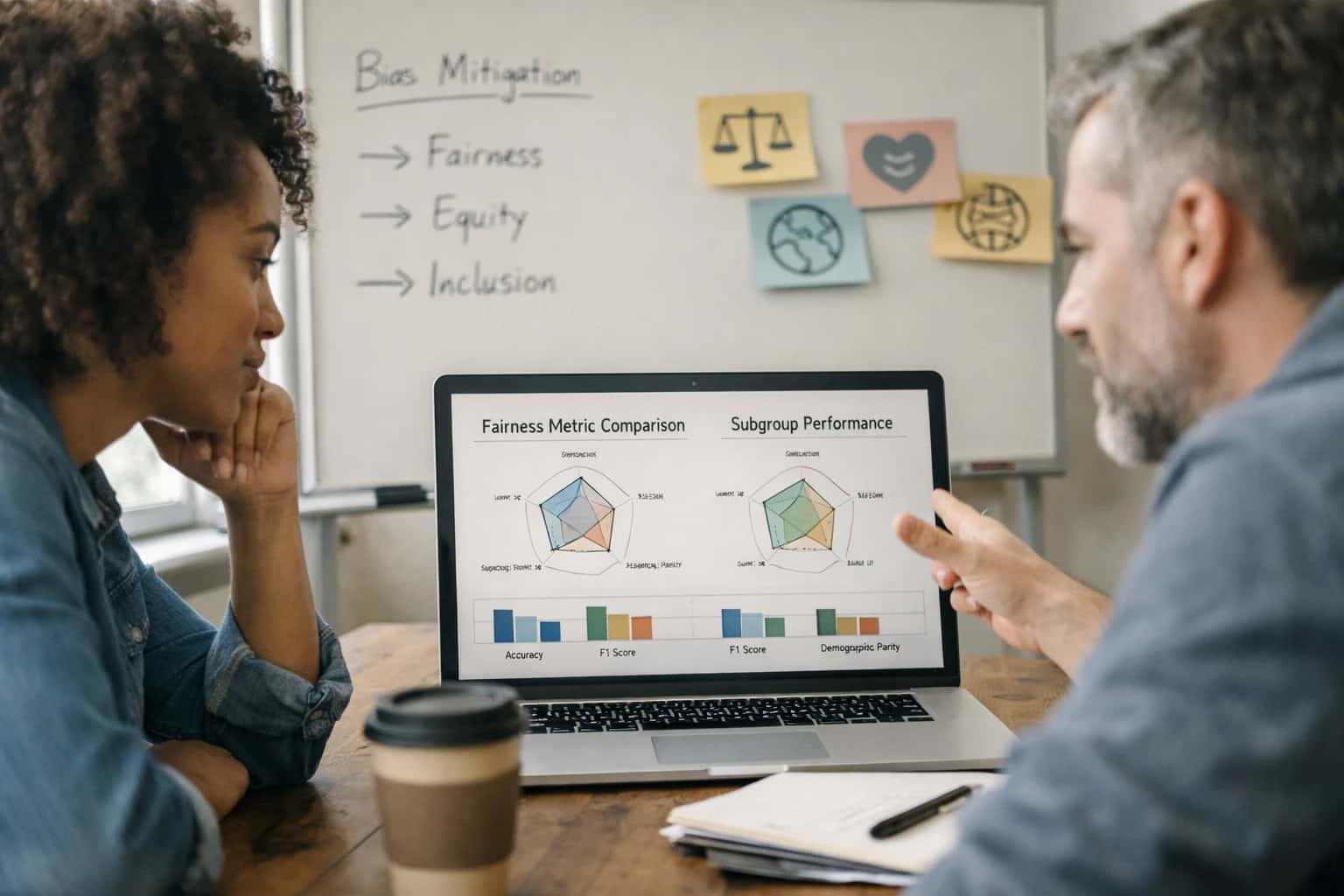
Integrate bias mitigation directly into the model training pipeline to produce inherently fairer AI.
- Adversarial Debiasing: Train your primary model against an adversarial network that penalizes predictions correlated with protected attributes.
- Fairness Constraints: Apply mathematical fairness regularizers (e.g., demographic parity, equalized odds) as core optimization objectives.
- Reduced Technical Debt: Eliminate the need for complex, fragile post-deployment correction systems.
- Audit-Ready Artifacts: Generate clear documentation of the fairness-aware training process for compliance with NIST AI RMF and ISO/IEC 42001.
Fairness isn't a filter you add later—it's a foundational property engineered into the model's logic.
We ensure your models meet statistical fairness thresholds while maintaining performance. This technical rigor prevents disparate impact in high-stakes applications like HR screening, credit scoring, and law enforcement, directly mitigating legal risk under frameworks like the EU AI Act. For a complete fairness strategy, pair this with our Algorithmic Bias Risk Assessment and AI Fairness Governance Implementation services.
TANGIBLE ROI
Business Outcomes of Fairness-Aware Model Training
Beyond compliance, fairness-aware models deliver measurable business value by reducing legal risk, building brand trust, and unlocking new markets. Our in-processing techniques ensure fairness is a core feature, not an afterthought.
02
Enhanced Brand Trust & Market Access
Deploy AI that earns user trust and expands your addressable market. Fair models prevent reputational damage from biased outcomes and demonstrate a commitment to ethical innovation, appealing to conscious consumers and B2B partners.
03
Improved Model Robustness & Performance
Fairness-aware training often leads to more generalizable and stable models. By reducing reliance on spurious correlations linked to protected attributes, models perform more consistently across diverse user segments and edge cases.
06
Future-Proofed AI Strategy
Anticipate and adapt to the global regulatory landscape. Building fairness into your core AI development lifecycle positions your products for international markets with strict AI ethics standards, avoiding costly retrofits later.
From Initial Assessment to Production Deployment
Typical Fairness-Aware Training Project Timeline
A detailed breakdown of the key phases and deliverables for a professional fairness-aware model training engagement, showing how we systematically integrate bias mitigation into your AI development lifecycle.
| Project Phase | Key Activities & Deliverables | Typical Duration | Client Involvement |
|---|---|---|---|
Phase 1: Fairness Scoping & Metric Definition | Identify protected attributes, define fairness objectives (e.g., demographic parity, equalized odds), select quantitative fairness metrics, establish baseline model performance. | 1-2 weeks | Provide domain expertise, access to data stewards, approve fairness definitions. |
Phase 2: In-Processing Algorithm Integration | Implement chosen mitigation techniques (e.g., adversarial debiasing, fairness constraints) into training pipeline. Develop prototype model with initial fairness-performance trade-off analysis. | 2-4 weeks | Review technical approach, provide feedback on initial trade-offs. |
Phase 3: Iterative Training & Validation | Conduct multiple training runs to optimize for fairness and accuracy. Perform rigorous validation using hold-out test sets and bias audits. Generate fairness reports. | 3-5 weeks | Validate business logic of model outputs, review fairness audit results. |
Phase 4: Explainability & Documentation | Apply XAI techniques (SHAP, LIME) to explain model decisions, particularly for sensitive attributes. Produce comprehensive technical documentation and compliance-ready fairness statements. | 1-2 weeks | Review explanations for stakeholder transparency, finalize compliance documentation. |
Phase 5: Deployment & Monitoring Framework | Containerize the fair model for production. Implement continuous monitoring for fairness drift and performance degradation. Set up alerting systems. | 1-2 weeks | Provide deployment environment access, integrate with existing MLOps pipelines. |
Total Project Timeline | End-to-end development of a production-ready, fairness-aware model with full documentation and monitoring. | 8-12 weeks | Ongoing collaboration with our ML engineers and fairness experts. |
COMPLIANCE-DRIVEN SECTORS
Industries We Serve with Fairness-Aware AI
Our fairness-aware model training services are engineered for industries where algorithmic bias poses significant regulatory, reputational, and operational risks. We deliver mathematically rigorous unbiasing integrated directly into your AI pipeline.
01
Financial Services & Lending
Deploy credit scoring and loan approval models that meet stringent fair lending regulations (e.g., ECOA). We integrate adversarial debiasing to decouple predictions from protected attributes, reducing disparate impact risk while preserving predictive power for default rates.
40-60%
Disparate Impact Reduction
< 2%
Predictive Performance Trade-off
02
Healthcare & Clinical Decision Support
Develop diagnostic and treatment recommendation AI that mitigates bias across race, gender, and socioeconomic status. Our in-processing techniques ensure equitable care predictions, supporting compliance with healthcare equity mandates and improving patient outcomes across demographics.
ISO/IEC 42001
Compliance Framework
NIST AI RMF
Risk Management
04
Insurance & Risk Assessment
Create pricing and underwriting models that are actuarially sound yet fairness-constrained. We implement fairness-aware regularization to minimize discriminatory pricing across protected classes while maintaining portfolio profitability and aligning with state-level insurance regulations.
Statistical Parity
Primary Metric
Multi-state
Regulatory Alignment
05
Government & Public Sector
Engineer AI for public benefit allocation, law enforcement prioritization, and social service delivery with transparent fairness guarantees. Our systems incorporate fairness constraints to ensure equitable resource distribution and build public trust in automated decision-making.
EU AI Act
High-Risk Compliance
Algorithmic Impact
Assessments
06
Retail & E-Commerce Personalization
Develop recommendation and dynamic pricing engines that avoid discriminatory outcomes. We apply counterfactual fairness methods to ensure personalized experiences do not unfairly exclude or target user groups based on sensitive attributes, protecting brand integrity.
Equalized Odds
Optimization Goal
A/B Testing
Fairness Validation
Enabling Efficiency, Speed & Accuracy
Intelligent Analysis, Decision & Execution
We build AI systems for teams that need search across company data, workflow automation across tools, or AI features inside products and internal software.
Talk to Us
Search across company data
Give teams answers from docs, tickets, runbooks, and product data with sources and permissions.
Useful when people spend too long searching or get different answers from different systems.
Enterprise searchRAGPermissions
Read more
Automate internal workflows
Use AI to route work, draft outputs, trigger actions, and keep approvals and logs in place.
Useful when repetitive work moves across multiple tools and teams.
AI agentsWorkflow automationGovernance
Read more
Add AI to products and internal tools
Build assistants, guided actions, or decision support into the software your team or customers already use.
Useful when AI needs to be part of the product, not a separate tool.
AI integrationDecision supportModel routing
Read moreTechnical Implementation
Fairness-Aware Model Training FAQs
Get specific answers on how we engineer inherently fairer AI models through in-processing techniques, ensuring compliance and performance.
A standard engagement for integrating in-processing bias mitigation takes 4-6 weeks. This includes a 1-week fairness audit of your existing model/data, 2-3 weeks for algorithm integration and iterative training, and 1-2 weeks for validation and deployment support. Complex deployments with custom fairness constraints may extend to 8-10 weeks. All projects include a fixed-price proposal after an initial scoping call.

About the author
Prasad Kumkar
CEO & MD, Inference Systems
Prasad Kumkar is the CEO & MD of Inference Systems and writes about AI systems architecture, LLM infrastructure, model serving, evaluation, and production deployment. Over 5+ years, he has worked across computer vision models, L5 autonomous vehicle systems, and LLM research, with a focus on taking complex AI ideas into real-world engineering systems.
His work and writing cover AI systems, large language models, AI agents, multimodal systems, autonomous systems, inference optimization, RAG, evaluation, and production AI engineering.
LinkedIn
Limited slotsGet a Free AI Consultation
Partnered with leading AI, data, and software stack.





How We Work
Custom AI workflows for your Business
One-fit-all AI don't work for modern businesses. At Inferensys, we aim to understand your business & custom requirements; which we use to define most efficient agentic workflows, the data, and the tools for your business.
01
Review the use case
We understand the task, the users, and where AI can actually help.
Read more02
Pick the right approach
We define what needs search, automation, or product integration.
Read more03
Build the first useful version
We implement the part that proves the value first.
Read more04
Improve from there
We add the checks and visibility needed to keep it useful.
Read moreThe first call is a practical review of your use case and the right next step.
Talk to Us