Move from static policy documents to dynamic, enforceable governance with automated monitoring dashboards and bias alerting systems.

Service
AI Fairness Governance Implementation
Technical deployment of policy-as-code frameworks and monitoring dashboards to operationalize enterprise fairness policies, enabling continuous tracking of fairness metrics, automated bias alerts, and audit trails for regulatory compliance.
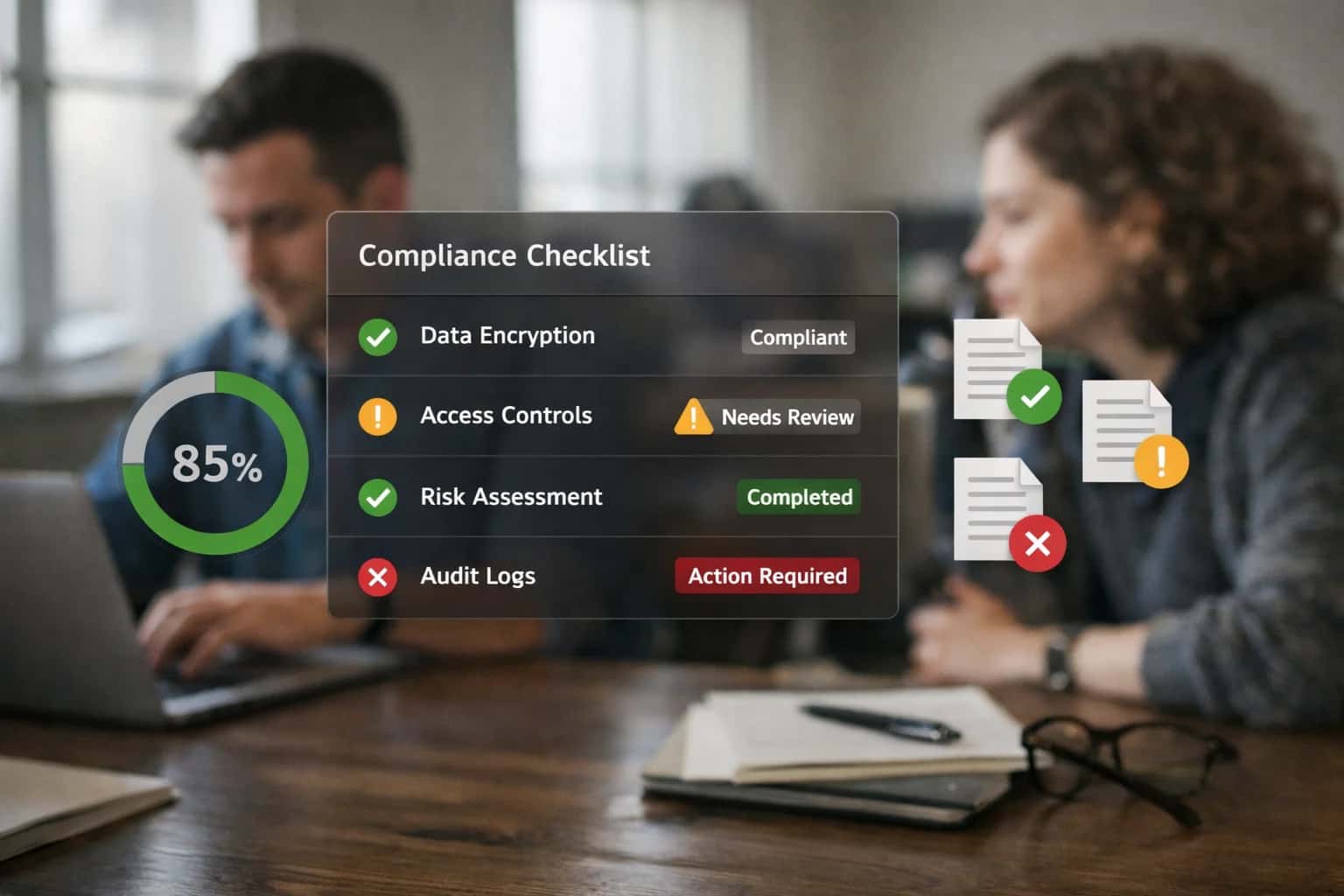
Deploy technical frameworks that automatically enforce your enterprise's AI fairness policies for continuous compliance.
- Automated Fairness Metrics Tracking: Continuously monitor key indicators like demographic parity, equal opportunity, and disparate impact across all deployed models using frameworks like
AIF360andFairlearn. - Policy-as-Code Implementation: Codify your organization's ethical AI principles into executable rules within your MLOps pipeline, ensuring consistent enforcement at every stage from training to inference.
- Regulatory Audit Trail Generation: Automatically document all fairness checks, model decisions, and mitigation actions to create a verifiable record for compliance with the EU AI Act, NIST AI RMF, and ISO/IEC 42001.
We engineer the bridge between your compliance team's requirements and your engineering team's deployment reality. This transforms fairness from a post-hoc audit burden into a real-time operational feature, reducing remediation costs and protecting your brand.
TANGIBLE ROI
Business Outcomes of a Governed AI System
Implementing a technical fairness governance framework delivers measurable business value beyond compliance. It builds trust, reduces risk, and creates a foundation for scalable, responsible AI innovation.
01
Regulatory Compliance & Audit Readiness
Automated policy-as-code enforcement and continuous monitoring dashboards provide immutable audit trails for regulations like the EU AI Act and NIST AI RMF. Eliminate manual reporting and pass audits with verifiable evidence.
ISO/IEC 42001
Alignment
Real-time
Audit Trail
02
Reduced Legal & Reputational Risk
Proactive detection of algorithmic bias and disparate impact prevents costly litigation, regulatory fines, and brand damage from discriminatory AI outcomes. Shift from reactive damage control to proactive risk management.
Automated
Bias Alerts
Pre-deployment
Risk Quantification
03
Accelerated, Trusted AI Deployment
Standardized governance pipelines and pre-approved fairness checks enable engineering teams to ship new AI features faster, with built-in compliance guardrails. Reduce approval bottlenecks without sacrificing safety.
Weeks
Faster Time-to-Market
Self-Service
Developer Portal
04
Enhanced Model Performance & Fairness
Continuous fairness metric tracking (demographic parity, equalized odds) ensures models perform equitably across all user segments. Improve accuracy for underserved groups and build more robust, generalizable AI.
>95%
Fairness Metric Coverage
Continuous
Performance Monitoring
05
Stakeholder Trust & Market Differentiation
Demonstrable commitment to ethical AI becomes a competitive advantage. Build trust with customers, investors, and partners by providing transparency into how your AI makes decisions.
Public
Transparency Reports
Brand Equity
Positive Impact
06
Operational Efficiency in Governance
Centralized dashboards and automated reporting eliminate siloed, manual compliance efforts. Provide leadership with a single source of truth for all AI fairness and performance metrics across the organization.
80% Reduction
Manual Effort
Centralized
Governance View
A Phased Approach to Operational Governance
Implementation Roadmap: From Assessment to Automation
Our structured implementation process ensures a scalable, compliant, and effective fairness governance framework, moving from foundational assessment to fully automated monitoring.
| Phase & Key Activities | Starter (Assessment & Foundation) | Professional (Implementation & Integration) | Enterprise (Automation & Scale) |
|---|---|---|---|
Initial Fairness & Risk Assessment | |||
Policy-as-Code Framework Design | |||
Integration with ML Pipeline & CI/CD | |||
Real-Time Monitoring Dashboard Deployment | |||
Automated Bias Alerting & Incident Workflow | |||
Continuous Compliance Reporting (EU AI Act, NIST RMF) | Manual | Semi-Automated | Fully Automated |
Ongoing Model Fairness Tuning & Validation | Ad-hoc | Quarterly Reviews | Continuous A/B Testing |
Dedicated Technical Support & SLA | Priority (4-hr response) | Dedicated Engineer & 99.9% Uptime | |
Typical Implementation Timeline | 2-4 weeks | 6-10 weeks | 12+ weeks (enterprise-wide) |
Starting Engagement | From $15K | From $50K | Custom Quote |
HIGH-RISK SECTORS
Industries Requiring Robust AI Fairness Governance
Our AI Fairness Governance Implementation service provides the technical frameworks and monitoring systems enterprises need to operationalize fairness policies, ensure continuous compliance, and mitigate legal and reputational risk. These sectors face the most stringent regulatory scrutiny and operational exposure.
01
Financial Services & Lending
Deploy policy-as-code frameworks for credit scoring, loan approval, and insurance underwriting AI to prevent disparate impact across protected classes. Ensure compliance with the Equal Credit Opportunity Act (ECOA) and Fair Housing Act.
Key Deliverables: Automated bias detection in risk models, audit trails for regulatory examinations (e.g., CFPB), and real-time fairness dashboards for model performance.
ISO/IEC 42001
Compliance Framework
NIST AI RMF
Risk Management
02
Healthcare & Clinical Decision Support
Implement governance for AI-driven diagnostics, treatment recommendations, and patient risk stratification to prevent biases that could worsen health disparities. Critical for compliance with anti-discrimination provisions in the Affordable Care Act.
Key Deliverables: Demographic parity monitoring for diagnostic algorithms, explainable AI (XAI) reports for clinical boards, and integration with EHR systems for continuous bias auditing.
HIPAA-Aligned
Data Security
Real-Time
Bias Alerts
03
Human Resources & Talent Management
Govern AI tools for resume screening, video interview analysis, and promotion pipeline management to mitigate risks under Title VII of the Civil Rights Act. Prevent automated replication of historical hiring biases.
Key Deliverables: Disparate impact ratio tracking, adversarial debiasing integration in training pipelines, and secure audit logs for EEOC or OFCCP reporting.
4/5ths Rule
Compliance Testing
Automated
Audit Trails
04
Criminal Justice & Public Safety
Engineer high-stakes governance for predictive policing, recidivism risk assessment, and forensic analysis tools. Requires extreme rigor to meet due process standards and prevent systemic discrimination.
Key Deliverables: Counterfactual fairness analysis, robust adversarial testing frameworks, and immutable logs for legal discovery and public transparency initiatives.
MITRE ATLAS
Adversarial Framework
Air-Gapped
Deployment Options
05
Insurance & Actuarial Science
Operationalize fairness in premium pricing, claims adjudication, and fraud detection AI. Navigate complex regulations across states and countries to avoid discriminatory pricing practices.
Key Deliverables: Granular fairness metric tracking per jurisdiction, integration with actuarial models, and automated reporting for state insurance commissioners.
Multi-Jurisdiction
Policy Mapping
Actuarial
Standard Compliance
06
Government & Public Sector Benefits
Deploy sovereign, auditable AI governance for welfare eligibility, social service routing, and public resource allocation. Essential for public trust and compliance with governmental equity mandates.
Key Deliverables: Sovereign AI infrastructure integration, public-facing algorithmic impact assessments, and continuous monitoring dashboards for oversight committees.
FedRAMP Ready
Infrastructure
EU AI Act
High-Risk Compliance
Enabling Efficiency, Speed & Accuracy
Intelligent Analysis, Decision & Execution
We build AI systems for teams that need search across company data, workflow automation across tools, or AI features inside products and internal software.
Talk to Us
Search across company data
Give teams answers from docs, tickets, runbooks, and product data with sources and permissions.
Useful when people spend too long searching or get different answers from different systems.
Enterprise searchRAGPermissions
Read more
Automate internal workflows
Use AI to route work, draft outputs, trigger actions, and keep approvals and logs in place.
Useful when repetitive work moves across multiple tools and teams.
AI agentsWorkflow automationGovernance
Read more
Add AI to products and internal tools
Build assistants, guided actions, or decision support into the software your team or customers already use.
Useful when AI needs to be part of the product, not a separate tool.
AI integrationDecision supportModel routing
Read moreTechnical Deployment & Compliance
AI Fairness Governance Implementation FAQs
Get clear answers on the process, timeline, and technical details of implementing a robust AI fairness governance framework for your enterprise.
A complete deployment, from initial policy mapping to a fully operational monitoring dashboard, typically takes 4-8 weeks. This includes 1-2 weeks for technical discovery and policy-as-code mapping, 2-4 weeks for core framework development and integration, and 1-2 weeks for dashboard deployment and team training. Complex integrations with legacy HR or lending systems may extend this timeline. We provide a detailed project plan in the first week of engagement.

About the author
Prasad Kumkar
CEO & MD, Inference Systems
Prasad Kumkar is the CEO & MD of Inference Systems and writes about AI systems architecture, LLM infrastructure, model serving, evaluation, and production deployment. Over 5+ years, he has worked across computer vision models, L5 autonomous vehicle systems, and LLM research, with a focus on taking complex AI ideas into real-world engineering systems.
His work and writing cover AI systems, large language models, AI agents, multimodal systems, autonomous systems, inference optimization, RAG, evaluation, and production AI engineering.
LinkedIn
Limited slotsGet a Free AI Consultation
Partnered with leading AI, data, and software stack.





How We Work
Custom AI workflows for your Business
One-fit-all AI don't work for modern businesses. At Inferensys, we aim to understand your business & custom requirements; which we use to define most efficient agentic workflows, the data, and the tools for your business.
01
Review the use case
We understand the task, the users, and where AI can actually help.
Read more02
Pick the right approach
We define what needs search, automation, or product integration.
Read more03
Build the first useful version
We implement the part that proves the value first.
Read more04
Improve from there
We add the checks and visibility needed to keep it useful.
Read moreThe first call is a practical review of your use case and the right next step.
Talk to Us