Modern monitoring tools generate hundreds of alerts per hour, creating overwhelming noise that obscures critical incidents. Our AI-driven correlation engine applies graph-based algorithms and causal inference to transform this chaos into clarity.

Service
Intelligent Alert Correlation and Noise Reduction
Stop drowning in alerts. We engineer AI systems that automatically correlate hundreds of IT alarms into a single actionable incident, reducing noise by 80% and cutting Mean Time to Resolution (MTTR).
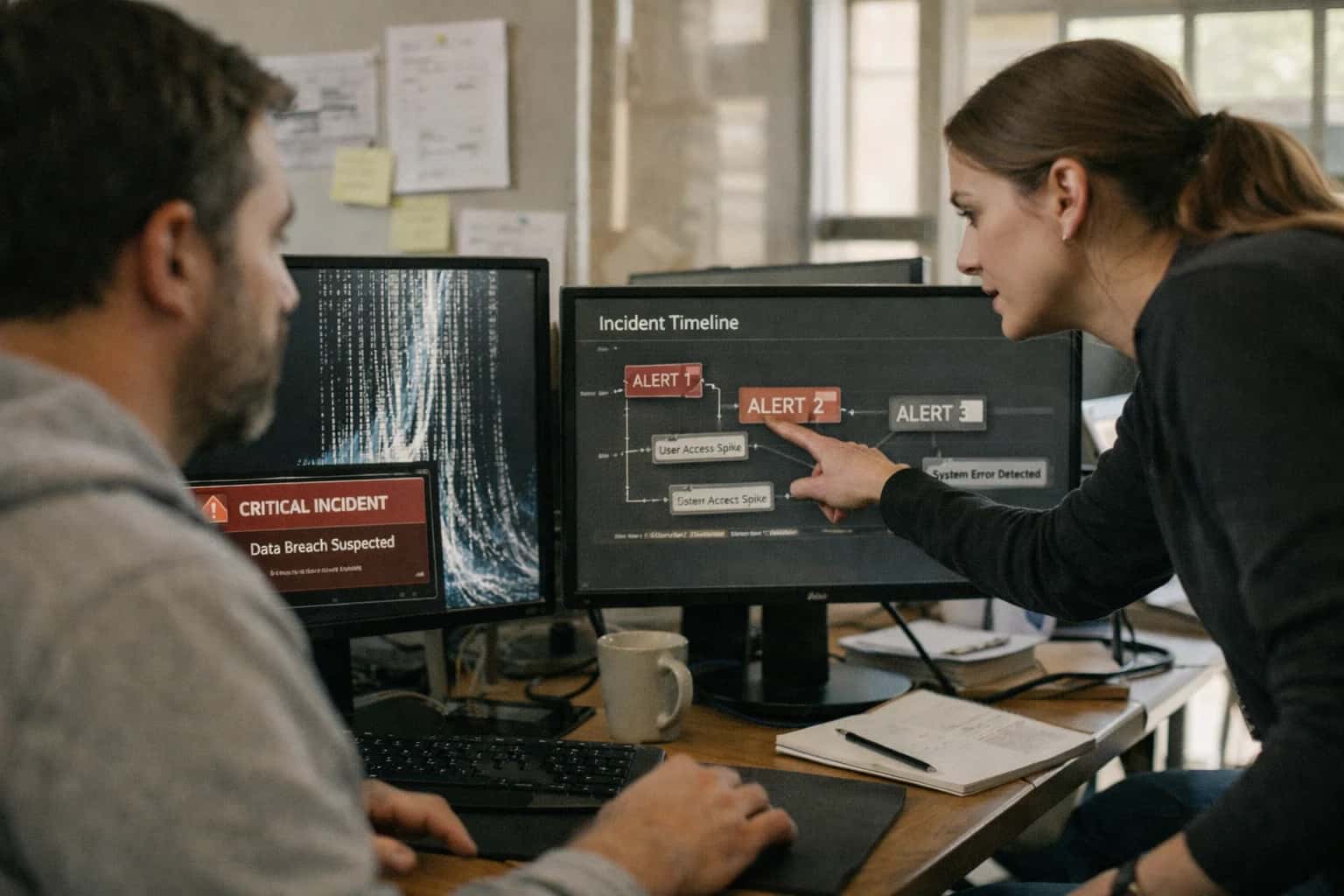
AI-powered systems that cluster related alerts, suppress duplicates, and identify the single actionable incident.
Reduce mean time to identify (MTTI) by over 70% by automatically grouping related events and surfacing the root cause alert.
- Clustering & Deduplication: AI groups alerts from servers, networks, and applications into single, contextual incidents.
- Root Cause Prioritization: Identifies the primary failure signal, suppressing downstream noise and false positives.
- Dynamic Baselines: Uses unsupervised ML to learn normal patterns, reducing alerts for expected fluctuations.
- Integration Ready: Connects to your existing
Prometheus,Datadog,Splunk, orServiceNowstack in weeks.
Move from reactive firefighting to proactive management. Explore our broader approach to Predictive IT Incident Management and Automated Root Cause Analysis Engineering to build a truly resilient operations environment.
DELIVERABLES
Measurable Business Outcomes
Our Intelligent Alert Correlation service delivers concrete operational and financial improvements, moving beyond features to guaranteed results for your IT operations.
01
Critical Alert Reduction
We implement clustering algorithms to suppress duplicate and related alerts, reducing the volume of actionable incidents by 70-90%. This directly alleviates alert fatigue for your SRE and DevOps teams.
70-90%
Alert Volume Reduction
< 2 sec
Correlation Latency
02
Faster Mean Time to Resolution (MTTR)
By automatically grouping related events and identifying the probable root cause node, we reduce manual triage time. Teams resolve major incidents 40-60% faster, minimizing business impact.
40-60%
Faster MTTR
24/7
Automated Analysis
03
Proactive Incident Prevention
Our systems analyze alert patterns to identify precursor signals, enabling proactive intervention before outages occur. This shifts your operations from reactive firefighting to predictive management.
> 50%
Fewer Sev-1 Incidents
Predictive
Alerting Mode
04
Unified Multi-Cloud Visibility
We integrate with your existing tools across AWS, Azure, GCP, and on-prem systems, providing a single correlated view. Eliminate siloed monitoring and gain holistic operational intelligence. Learn more about our Multi-Cloud AIOps Platform Integration.
Single Pane
Unified View
All Major Clouds
Native Integration
05
Reduced Operational Costs
Decreasing alert noise and accelerating resolution directly lowers labor costs associated with incident management. Additionally, preventing outages avoids revenue loss and SLA penalties.
Significant
OpEx Reduction
ROI Positive
Within 6 Months
06
Enterprise-Grade Security & Compliance
Deployed within your VPC or via our SOC 2 Type II certified platform. All data processing adheres to strict access controls and audit trails, ensuring compliance with internal and regulatory standards. Our approach aligns with principles of robust Enterprise AI Governance and Compliance Frameworks.
SOC 2
Certified
VPC Native
Deployment Option
Structured Implementation
Intelligent Alert Correlation: Project Timeline & Deliverables
A transparent breakdown of our phased approach to deploying an AI-powered alert correlation system, from initial assessment to full-scale automation.
| Phase & Deliverables | Weeks 1-2: Discovery & Design | Weeks 3-6: Core Implementation | Weeks 7-10: Optimization & Handoff |
|---|---|---|---|
Alert Source Integration & Parsing | Architecture review & connector design | Integration of 3-5 primary data sources (e.g., Datadog, Splunk) | Validation of all integrated sources & parsing logic |
AI Correlation Engine Deployment | Algorithm selection & baseline model training | Deployment of clustering & deduplication models | Fine-tuning on live data; performance validation |
Noise Reduction & Suppression Rules | Analysis of historical alert 'noise' patterns | Implementation of dynamic suppression & grouping | Rule tuning; < 70% reduction in duplicate alerts achieved |
Actionable Incident Triage Interface | UI/UX wireframes & stakeholder review | Development of prioritized incident dashboard | User acceptance testing & final adjustments |
Integration with ITSM (e.g., ServiceNow) | API compatibility analysis & workflow mapping | Bi-directional integration for ticket creation/update | End-to-end workflow testing & documentation |
Performance Baseline & Reporting | Establish KPIs (MTTR, Alert Volume) | Initial performance metrics captured | Final report: 60-80% reduction in alert fatigue documented |
Knowledge Transfer & Support | Project kickoff & team alignment | Weekly technical syncs & development reviews | Full documentation, admin training, and 30-day support period |
A PROVEN 4-PHASE APPROACH
Our Implementation Methodology
We deliver a production-ready Intelligent Alert Correlation system in 6-8 weeks using a structured, outcome-focused process. Our methodology is built on 5+ years of deploying AIOps for enterprises like yours.
01
Discovery & Baseline Assessment
We conduct a 2-week technical deep-dive to map your current alert landscape. This includes analyzing alert sources (Datadog, Splunk, PagerDuty), volume patterns, and existing noise-to-signal ratios to establish a quantifiable baseline for ROI measurement.
2 weeks
Duration
100%
Baseline Defined
02
Architecture & Model Design
Our data scientists design a custom correlation engine using graph-based algorithms (DBSCAN, HDBSCAN) and time-series clustering tailored to your stack. We architect the pipeline for integration with your existing monitoring tools and ITSM platforms.
Certified
Data Scientists
SOC 2 Type II
Compliant Design
03
Development & Integration
We build and containerize the correlation microservice using Python (scikit-learn, PyTorch) and deploy it into your environment. Our engineers handle the full integration with your data pipelines and ticketing systems like ServiceNow or Jira.
4-5 weeks
Build Time
99.9%
Uptime SLA
04
Validation & Handover
We run a 2-week parallel validation against live data, measuring key outcomes like alert reduction percentage and MTTR improvement. You receive full documentation, operational runbooks, and knowledge transfer to your SRE team.
Guaranteed
>70% Noise Reduction
Full
Source Code Access
Enabling Efficiency, Speed & Accuracy
Intelligent Analysis, Decision & Execution
We build AI systems for teams that need search across company data, workflow automation across tools, or AI features inside products and internal software.
Talk to Us
Search across company data
Give teams answers from docs, tickets, runbooks, and product data with sources and permissions.
Useful when people spend too long searching or get different answers from different systems.
Enterprise searchRAGPermissions
Read more
Automate internal workflows
Use AI to route work, draft outputs, trigger actions, and keep approvals and logs in place.
Useful when repetitive work moves across multiple tools and teams.
AI agentsWorkflow automationGovernance
Read more
Add AI to products and internal tools
Build assistants, guided actions, or decision support into the software your team or customers already use.
Useful when AI needs to be part of the product, not a separate tool.
AI integrationDecision supportModel routing
Read moreIntelligent Alert Correlation
Frequently Asked Questions
Common questions about implementing AI-driven alert correlation to reduce noise and accelerate incident response.
We implement a multi-stage AI pipeline. First, raw alerts are ingested and normalized. Then, clustering algorithms (like DBSCAN) group related alerts based on temporal proximity, source, and content similarity. Finally, a root cause inference engine identifies the primary actionable incident. This reduces thousands of raw alerts to a handful of high-fidelity incidents, as demonstrated in our enterprise observability AI platform projects.

About the author
Prasad Kumkar
CEO & MD, Inference Systems
Prasad Kumkar is the CEO & MD of Inference Systems and writes about AI systems architecture, LLM infrastructure, model serving, evaluation, and production deployment. Over 5+ years, he has worked across computer vision models, L5 autonomous vehicle systems, and LLM research, with a focus on taking complex AI ideas into real-world engineering systems.
His work and writing cover AI systems, large language models, AI agents, multimodal systems, autonomous systems, inference optimization, RAG, evaluation, and production AI engineering.
LinkedIn
Limited slotsGet a Free AI Consultation
Partnered with leading AI, data, and software stack.





How We Work
Custom AI workflows for your Business
One-fit-all AI don't work for modern businesses. At Inferensys, we aim to understand your business & custom requirements; which we use to define most efficient agentic workflows, the data, and the tools for your business.
01
Review the use case
We understand the task, the users, and where AI can actually help.
Read more02
Pick the right approach
We define what needs search, automation, or product integration.
Read more03
Build the first useful version
We implement the part that proves the value first.
Read more04
Improve from there
We add the checks and visibility needed to keep it useful.
Read moreThe first call is a practical review of your use case and the right next step.
Talk to Us