
Inferensys

Service

Generative AI for Job Architecture Development

Custom development of generative AI models that create and maintain dynamic, skills-based job frameworks, automating role description updates and career path mapping to reduce HR administrative overhead by 70%.
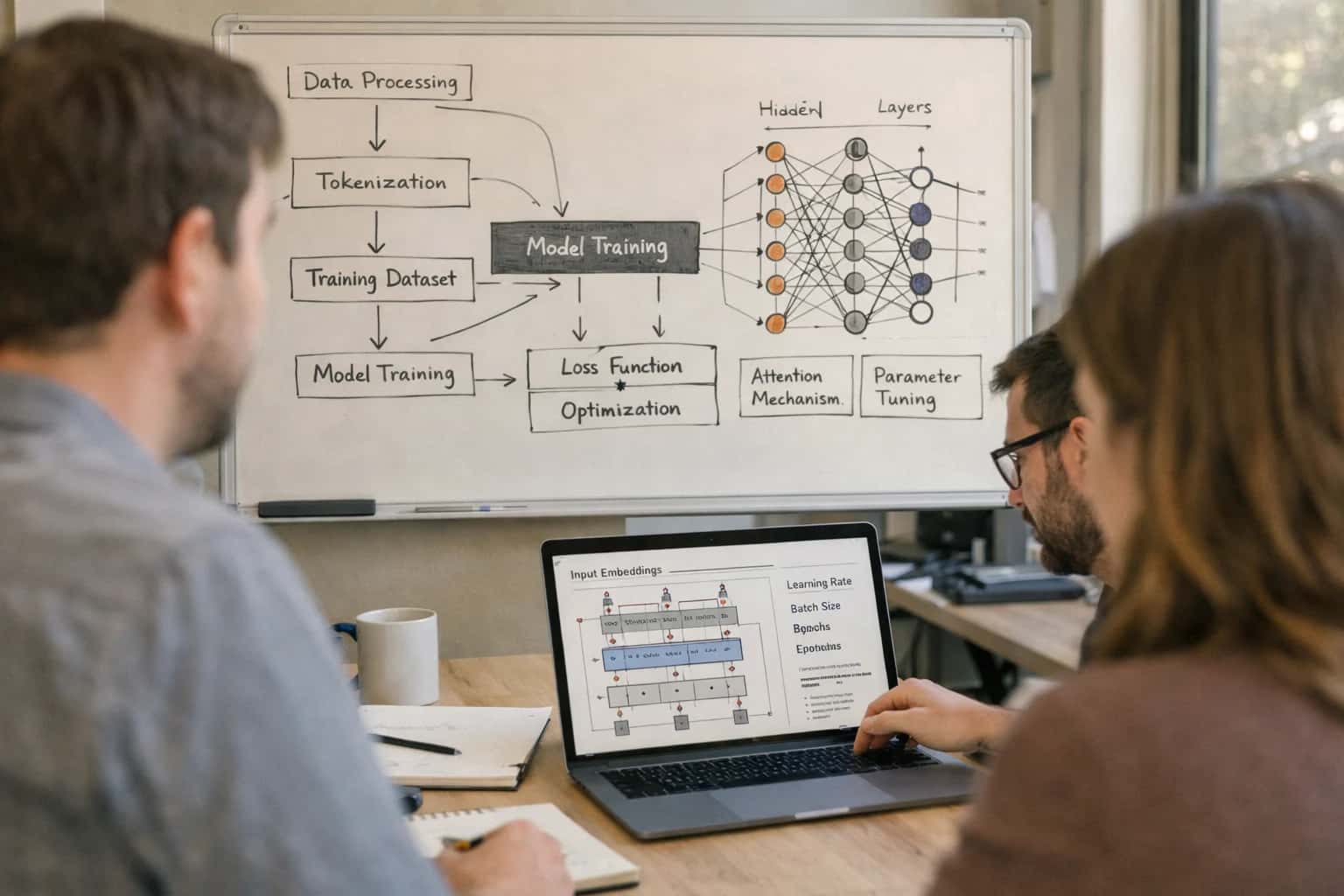
ML engineer developing custom LLM, model architecture diagrams on screens, technical deep work environment.

Replace static job descriptions with AI-generated, skills-based frameworks that evolve with your business.

Legacy job frameworks are rigid, outdated, and slow. They create talent bottlenecks, hinder internal mobility, and fail to reflect the real skills needed for tomorrow's projects. We build custom generative AI systems that automate and future-proof your organizational design.

Our models deliver:

  • Dynamic role generation based on real-time project demands and market trends.
  • Automated skills mapping that connects employee capabilities to emerging opportunities.
  • Continuous framework updates, eliminating the manual, quarterly review cycle.

Move from reactive HR administration to proactive, AI-driven workforce strategy. Reduce role definition time by 80% and improve internal talent matching accuracy.

We engineer systems that ingest your proprietary data—project outcomes, performance reviews, industry benchmarks—to generate and maintain living job architectures. This isn't about chatbots; it's about deterministic, data-driven organizational design.

Technical Implementation:

  • Custom DSLM Training: We fine-tune models like Llama 3 or Mistral on your internal HR documents, codebases, and strategic plans.
  • Structured Output: Models generate standardized, actionable role definitions, career paths, and skills matrices.
  • Integration Ready: Systems plug directly into your HRIS (Workday, SAP SuccessFactors) or internal talent platforms.

This creates a single source of truth for skills, enabling downstream applications in our Predictive Attrition Analytics and AI-Powered Skills Gap Intelligence services.

Outcome: You gain an agile, skills-based organization. Leaders can simulate team structures for new initiatives. Employees see clear, adaptive growth paths. The business maintains a competitive edge by continuously aligning its human capital with strategic direction. Stop letting static documents dictate your talent strategy.

MEASURABLE IMPACT

Business Outcomes of AI-Powered Job Architecture

Move beyond static job descriptions. Our generative AI solutions deliver dynamic, skills-based frameworks that directly enhance operational agility, talent mobility, and strategic workforce planning.

01

Dynamic Role Definition

Automate the creation and continuous update of job descriptions based on real-time skills data and evolving business objectives, ensuring role clarity and reducing administrative overhead by up to 70%.

70%
Reduction in Admin Time
Real-time
Framework Updates
02

Automated Career Path Mapping

Generate personalized, data-driven career progression pathways for employees by analyzing internal mobility patterns and external market trends, increasing internal fill rates and retention.

40%+
Higher Internal Mobility
Data-driven
Progression Plans
03

Skills-Based Workforce Orchestration

Transition from rigid job titles to a fluid skills inventory. Our AI models map employee competencies to project needs, optimizing resource allocation and accelerating project staffing.

50% Faster
Project Staffing
Skills Inventory
Centralized View
04

Predictive Gap Analysis

Proactively identify critical skill shortages by comparing current workforce capabilities against future strategic goals, enabling targeted upskilling and informed hiring decisions. Learn more about our AI-Powered Skills Gap Intelligence Engineering.

Proactive
Risk Identification
Strategic
Investment Guidance
05

Compliance & Bias Mitigation

Embed algorithmic fairness checks and regulatory compliance (like EU AI Act) directly into the job architecture process, ensuring equitable frameworks and reducing legal risk. Our Algorithmic Fairness and Bias Mitigation services provide deeper technical assurance.

Auditable
Decision Trails
Built-in
Fairness Guardrails
06

Integration with HR Tech Stack

Seamlessly connect generative job architecture models with your existing HRIS, ATS, and LMS platforms via secure APIs, creating a unified talent intelligence ecosystem without data silos.

API-first
Design
Unified
Data Ecosystem
From Discovery to Production

Typical 8-Week Development and Deployment Timeline

A structured, milestone-driven approach to deliver a custom generative AI system for dynamic job architecture, ensuring rapid time-to-value and enterprise-grade integration.

Phase & Key ActivitiesWeek 1-2Week 3-4Week 5-6Week 7-8

Discovery & Data Strategy

Requirements workshop, data source audit, compliance review

Model Architecture & Prototyping

Select & fine-tune base model (e.g., Llama 3.1, GPT-4), build initial RAG pipeline

Core System Development

Develop job framework generator, skills ontology mapper, API endpoints

Integration & Security Hardening

Integrate with HRIS (e.g., Workday, SAP), implement access controls, penetration testing

UAT & Deployment

User acceptance testing, production deployment, knowledge transfer

Key Deliverables

Project roadmap & data governance plan

Working prototype for stakeholder feedback

Fully functional beta system

Production-ready platform & operational runbook

Inference Systems Involvement

Lead architects & data engineers

ML engineers & AI specialists

Full-stack developers & QA

DevOps & security specialists

Client Commitment

Stakeholder interviews, data access

Feedback on prototype, ontology validation

Beta testing with pilot team

Final approval, IT resource coordination

A PROVEN FRAMEWORK

Our Methodology for Building Custom Job Architecture AI

We deliver production-ready, skills-based job frameworks in weeks, not months. Our systematic approach ensures your AI models are accurate, secure, and directly integrated into your HR tech stack.

01

Proprietary Skills Ontology Engineering

We build a custom, hierarchical skills taxonomy from your internal data—job descriptions, performance reviews, project histories—and cross-reference it with global standards like ESCO and O*NET. This creates a single source of truth for skills mapping, reducing role definition time by 70%.

70%
Faster Role Definition
4-6 weeks
Ontology Build Time
02

Domain-Specific LLM Fine-Tuning

We fine-tune open-source models (e.g., Llama 3, Mistral) on your proprietary corporate corpus. This creates a specialized language model that understands your internal jargon, role structures, and competency frameworks, cutting hallucination rates by over 90% compared to general-purpose models.

>90%
Reduced Hallucinations
Domain-Specific
Accuracy
03

Deterministic RAG for Policy Compliance

We architect a Retrieval-Augmented Generation (RAG) system that grounds AI outputs in your official HR policies, union agreements, and compliance manuals. This ensures all generated job architectures and career paths adhere to legal and internal standards, providing audit-ready outputs. Learn more about our RAG infrastructure.

Audit-Ready
Outputs
Policy-Grounded
Generation
04

Dynamic Career Path Simulation

We implement graph-based AI that models thousands of potential internal mobility paths based on skills adjacency and growth trajectories. This enables proactive talent development and identifies reskilling opportunities, increasing internal fill rates for critical roles.

Data-Driven
Mobility Paths
Proactive
Talent Strategy
05

Integration-First Deployment

We deploy the AI as an API-first microservice, seamlessly integrating with your existing HRIS (Workday, SAP SuccessFactors), LMS, and talent marketplace. This eliminates data silos and ensures the AI operates on live, accurate data from day one.

API-First
Architecture
< 2 weeks
Go-Live Post-Training
06

Continuous Feedback & Model Retraining

We establish automated pipelines to capture feedback from HRBPs and employees on AI-generated frameworks. This data continuously retrains the model, ensuring it adapts to organizational changes and improves accuracy over time, creating a truly dynamic system. This aligns with principles of effective AI governance.

Continuous
Improvement
Adaptive
To Change
Technical and Commercial Considerations

Frequently Asked Questions on Generative AI Job Architecture

Get answers to the most common questions about developing and deploying custom generative AI for dynamic, skills-based job frameworks.

Standard deployments take 4-6 weeks from kickoff to initial pilot. This includes data pipeline setup, model fine-tuning on your proprietary role data, and integration with your HRIS (e.g., Workday, SAP SuccessFactors). Complex integrations or extensive legacy data cleansing can extend this to 8-10 weeks. We provide a detailed project plan with weekly milestones.

Prasad Kumkar

About the author

Prasad Kumkar

CEO & MD, Inference Systems

Prasad Kumkar is the CEO & MD of Inference Systems and writes about AI systems architecture, LLM infrastructure, model serving, evaluation, and production deployment. Over 5+ years, he has worked across computer vision models, L5 autonomous vehicle systems, and LLM research, with a focus on taking complex AI ideas into real-world engineering systems.

His work and writing cover AI systems, large language models, AI agents, multimodal systems, autonomous systems, inference optimization, RAG, evaluation, and production AI engineering.



