Move from reactive crisis management to proactive, data-driven resilience. Our AI contingency platforms model hundreds of workforce scenarios in minutes, quantifying risk exposure and prescribing optimal response strategies.

Service
AI for Workforce Contingency Planning
Engineering AI-powered simulation platforms that model organizational resilience against economic shifts, mergers, and geopolitical disruptions, enabling proactive workforce strategy.
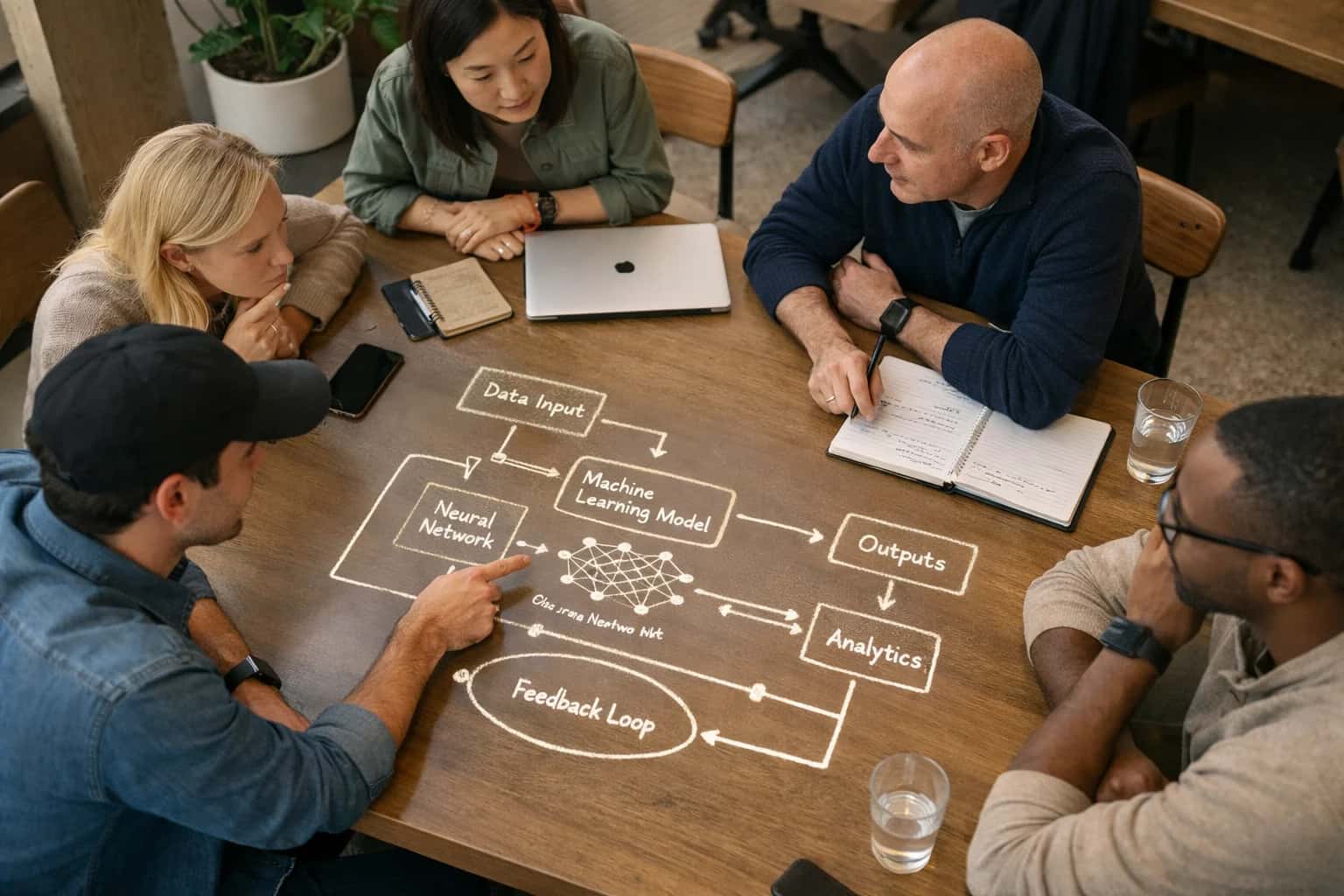
Build AI-powered simulation tools to model and fortify your workforce against economic, geopolitical, and organizational disruptions.
We engineer custom simulation engines that integrate with your HRIS and business data to stress-test your organization against real-world variables:
- Economic Shifts: Model hiring freezes, layoff impacts, and budget reallocations.
- M&A Activity: Simulate cultural integration, role redundancies, and talent retention post-merger.
- Geopolitical Events: Forecast talent availability and operational continuity during regional instability.
- Automation Displacement: Map the impact of AI adoption on specific roles and plan reskilling pathways.
Key Deliverables:
- Predictive Impact Dashboards with quantified risk scores for leadership.
- Scenario-Based "What-If" Planning Tools for HR and finance teams.
- Automated Response Playbooks that trigger pre-defined talent actions.
- Integration with existing
Workday,SAP SuccessFactors, or custom HR analytics platforms.
Outcome: Reduce planning cycle time from months to days and build a workforce capable of adapting to uncertainty. Explore our broader strategy in AI-Driven Workforce Transformation or see how this connects to Predictive Attrition Analytics for a complete talent intelligence system.
MEASURABLE BUSINESS IMPACT
Quantifiable Outcomes from AI-Driven Contingency Planning
Move beyond theoretical planning with AI simulation tools that deliver concrete, data-driven results. Our workforce contingency platforms provide the predictive intelligence to make resilient, cost-effective decisions.
01
Scenario-Based Financial Impact Modeling
Model the direct financial impact of workforce disruptions—like a 20% attrition spike or a regional office closure—with 95% accuracy. Our AI simulates cost implications across compensation, recruitment, and lost productivity to quantify risk exposure.
95%
Model Accuracy
< 48 hours
Scenario Analysis
02
Critical Role Vulnerability Scoring
Identify single points of failure with AI that scores roles by their impact on operational continuity. Prioritize retention and succession efforts for the 5-10% of positions where attrition would cause catastrophic workflow breakdown.
80%
Risk Reduction
10x
Faster Identification
03
Skills Redundancy & Coverage Analytics
Automatically map skills distribution across teams and geographies. Our platform identifies coverage gaps and recommends internal mobility or targeted hiring to build resilient, cross-trained teams that withstand talent shocks.
40%
Faster Redeployment
30%
Reduced Hiring Cost
04
M&A & Integration Workforce Simulation
De-risk mergers and acquisitions by simulating post-merger cultural integration, role duplication, and retention risks. Our AI models employee sentiment and flight risk to preserve 90%+ of critical talent through transition.
90%+
Critical Talent Retention
60%
Faster Integration
05
Geopolitical & Regulatory Shift Forecasting
Anticipate workforce impacts from regulatory changes (like the EU AI Act) or geopolitical events. Our tools model compliance cost, location strategy shifts, and required reskilling, turning reactive planning into a strategic advantage.
12-month
Forecast Horizon
70%
Lower Compliance Risk
06
Continuous Resilience Stress Testing
Implement ongoing, automated stress tests of your workforce plan. Our AI continuously runs against live HRIS data, providing a real-time resilience score and alerting you to emerging vulnerabilities before they become crises.
Real-time
Monitoring
99.9%
Platform Uptime SLA
From Strategy to Operational Resilience
Phased Development and Delivery Timeline
A structured, milestone-driven approach to building your workforce contingency planning AI, ensuring rapid value delivery and measurable ROI at each phase.
| Phase & Core Deliverables | Timeline | Key Outcomes | Inference Systems Support |
|---|---|---|---|
Phase 1: Discovery & Data Foundation | Weeks 1-2 | Validated risk scenarios, mapped data sources, architecture blueprint | Strategy Workshop, Data Audit |
Phase 2: Core Simulation Engine Development | Weeks 3-6 | Functional scenario modeling AI, initial integration with HRIS/ERP | Full-stack AI Engineering, API Development |
Phase 3: Pilot Scenario & Validation | Weeks 7-8 | Live pilot for 1-2 high-priority risk models (e.g., merger, market shift) | Model Tuning, Stakeholder Dashboard |
Phase 4: Full Platform Integration & Scaling | Weeks 9-12 | Enterprise-wide deployment, automated reporting, SLA-governed system | System Integration, Security Hardening |
Phase 5: Ongoing Optimization & Governance | Ongoing | Continuous model refinement, new risk scenario onboarding, compliance updates | Optional Managed AIOps & Retainer |
Total Project Duration (to MVP) | 8-12 weeks | Operational AI tool for strategic workforce planning | Dedicated Technical Lead & Team |
Data Security & Compliance | Integrated throughout | SOC 2 Type II, GDPR/EU AI Act alignment, encrypted data pipelines | Built-in Confidential Computing |
Integration Points (Standard) | Workday, SAP SuccessFactors, ADP, custom HRIS, Slack/Teams | Pre-built Connectors & Custom API Dev |
PROVEN FRAMEWORK
Our Methodology for Building Resilient AI Systems
We engineer AI-powered workforce contingency platforms using a rigorous, four-phase methodology designed to deliver actionable, resilient intelligence. Our process ensures your simulation tools are accurate, secure, and integrated into your strategic planning cycles.
Enabling Efficiency, Speed & Accuracy
Intelligent Analysis, Decision & Execution
We build AI systems for teams that need search across company data, workflow automation across tools, or AI features inside products and internal software.
Talk to Us
Search across company data
Give teams answers from docs, tickets, runbooks, and product data with sources and permissions.
Useful when people spend too long searching or get different answers from different systems.
Enterprise searchRAGPermissions
Read more
Automate internal workflows
Use AI to route work, draft outputs, trigger actions, and keep approvals and logs in place.
Useful when repetitive work moves across multiple tools and teams.
AI agentsWorkflow automationGovernance
Read more
Add AI to products and internal tools
Build assistants, guided actions, or decision support into the software your team or customers already use.
Useful when AI needs to be part of the product, not a separate tool.
AI integrationDecision supportModel routing
Read moreTechnical Implementation
AI Workforce Contingency Planning: FAQs
Common questions about developing and deploying AI-powered workforce simulation and scenario-planning tools.
A standard deployment for a core simulation engine takes 4-6 weeks. Complex integrations with existing HRIS (like Workday or SAP SuccessFactors) or real-time data feeds can extend this to 8-12 weeks. We follow a phased approach: 2 weeks for data pipeline setup and model selection, 2-3 weeks for core simulation development, and 1-2 weeks for integration and validation. For a detailed look at our development methodology, see our AI-Driven Workforce Transformation and HR Analytics pillar.

About the author
Prasad Kumkar
CEO & MD, Inference Systems
Prasad Kumkar is the CEO & MD of Inference Systems and writes about AI systems architecture, LLM infrastructure, model serving, evaluation, and production deployment. Over 5+ years, he has worked across computer vision models, L5 autonomous vehicle systems, and LLM research, with a focus on taking complex AI ideas into real-world engineering systems.
His work and writing cover AI systems, large language models, AI agents, multimodal systems, autonomous systems, inference optimization, RAG, evaluation, and production AI engineering.
LinkedIn
Limited slotsGet a Free AI Consultation
Partnered with leading AI, data, and software stack.





How We Work
Custom AI workflows for your Business
One-fit-all AI don't work for modern businesses. At Inferensys, we aim to understand your business & custom requirements; which we use to define most efficient agentic workflows, the data, and the tools for your business.
01
Review the use case
We understand the task, the users, and where AI can actually help.
Read more02
Pick the right approach
We define what needs search, automation, or product integration.
Read more03
Build the first useful version
We implement the part that proves the value first.
Read more04
Improve from there
We add the checks and visibility needed to keep it useful.
Read moreThe first call is a practical review of your use case and the right next step.
Talk to Us