Reactive management costs the average 1,000-head operation over $250,000 annually in preventable losses from illness, reduced fertility, and inefficient feed conversion.

Service
Livestock Monitoring AI Solutions
Build AI systems that use computer vision and sensor fusion to monitor animal health, behavior, and welfare, enabling early illness detection, optimized feeding, and improved breeding management.
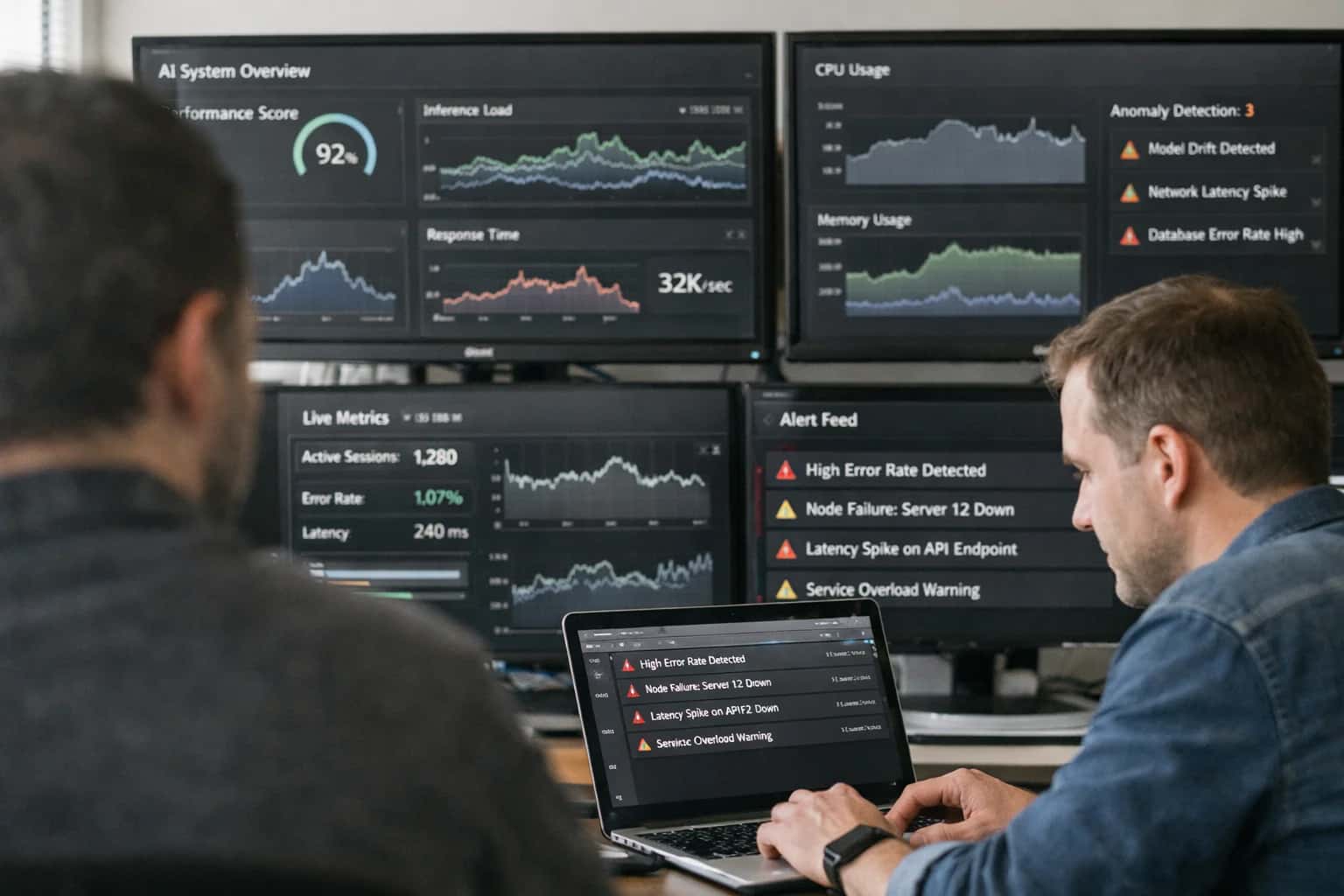
FROM LOSS TO LEAD
The High Cost of Reactive Livestock Management
Stop losing revenue to preventable health events and suboptimal yields with proactive, AI-driven livestock monitoring.
Our Livestock Monitoring AI Solutions replace guesswork with deterministic, data-driven oversight. We build systems that fuse computer vision and sensor fusion to deliver continuous, non-invasive monitoring, enabling:
- Early illness detection 3-5 days before visible symptoms, reducing mortality by up to 60%.
- Optimized feeding schedules based on individual animal behavior and weight gain, improving feed conversion ratios.
- Automated heat detection and breeding management, increasing successful conception rates.
- 24/7 welfare monitoring for compliance and ethical husbandry standards.
Move from costly reaction to profitable prediction. We engineer the complete AI stack—from edge-deployed models on barn cameras to centralized analytics dashboards—giving your operations team a single source of truth. This is a core component of our broader Agri-Tech and Smart Farming AI Development pillar, which integrates AI as the connective layer across your entire operation.
Explore related precision solutions like Precision Agriculture AI System Development or Agricultural Computer Vision Development to build a fully intelligent farm.
ACTIONABLE INSIGHTS
Measurable Outcomes for Your Operation
Our Livestock Monitoring AI Solutions deliver concrete, data-driven results that directly impact your bottom line and animal welfare standards.
02
Optimized Feed Efficiency
Sensor fusion and predictive AI correlate individual animal intake with growth metrics, dynamically adjusting feed schedules and compositions to reduce waste and improve feed conversion ratios (FCR).
5-15%
Feed Cost Reduction
Improved FCR
Key Metric
03
Enhanced Breeding Management
AI-driven analysis of estrus behavior and physiological signals identifies optimal breeding windows with high precision, increasing conception rates and improving genetic selection outcomes.
10-20%
Conception Rate Lift
Accurate Timing
Estrus Detection
04
Labor Productivity Gains
Automated 24/7 monitoring reduces manual inspection rounds. AI alerts direct personnel to specific animals needing attention, allowing a single worker to manage larger herds effectively.
30-50%
Reduction in Manual Checks
Targeted Alerts
Operational Focus
06
Predictive Herd Analytics
Aggregate herd-level AI models forecast weight gain trajectories, identify social stressors, and predict optimal market timing, transforming raw data into strategic operational intelligence.
Data-Driven Decisions
Strategic Planning
Risk Mitigation
Proactive Management
A Structured, Risk-Mitigated Approach
Phased Development and Deployment Timeline
Our proven methodology for delivering production-ready Livestock Monitoring AI, from initial proof-of-concept to full-scale enterprise deployment. Each phase delivers tangible value and de-risks the project.
| Phase | Duration | Key Deliverables | Outcome & Investment |
|---|---|---|---|
Phase 1: Discovery & Feasibility | 2-3 weeks | Technical requirements document Sensor & camera compatibility audit Initial health detection model PoC | Validated project scope & architecture Clear ROI projection Investment: < $15K |
Phase 2: Core MVP Development | 4-6 weeks | Deployable computer vision models (health/behavior) Real-time alert dashboard (web/mobile) Basic data pipeline & API | Functional system on pilot herd (50-100 animals) Initial accuracy metrics (>90%) Investment: $30K - $60K |
Phase 3: Pilot Deployment & Tuning | 4-8 weeks | Full-stack deployment in pilot environment Model fine-tuning on live data Integration with farm management software | Validated performance in real conditions Refined SLA (e.g., <2s alert latency) Investment: $25K - $40K |
Phase 4: Scale & Enterprise Integration | 6-10 weeks | Multi-site deployment architecture Advanced analytics (breeding, feed optimization) Full API suite & legacy system integration | System operational across entire operation Actionable insights dashboard Investment: Custom (typically $80K+) |
Phase 5: Ongoing Optimization & Support | Ongoing | Model retraining & drift monitoring Feature updates & expansion Dedicated technical support | Continuous performance improvement Adaptation to new livestock or conditions Optional SLA from $2K/month |
END-TO-END DELIVERY
Our Development and Integration Methodology
We deliver production-ready livestock monitoring systems through a structured, four-phase process designed for seamless integration with your existing farm infrastructure and operational workflows.
01
1. Edge AI System Design
We architect the optimal sensor and edge compute stack for your environment, selecting hardware for durability, power efficiency, and connectivity. This includes designing custom computer vision models for on-device animal behavior analysis and health anomaly detection, ensuring real-time insights without constant cloud dependency.
Learn more about our approach to edge AI in our guide on Small Language Model (SLM) Edge Deployment.
On-Device
Inference
< 100ms
Latency Target
02
2. Multimodal Data Pipeline Engineering
We build robust pipelines to fuse and process data from cameras, RFID tags, environmental sensors, and milking/feeding systems. Our systems apply AI to correlate visual cues (posture, gait) with sensor telemetry (temperature, activity) for a holistic view of animal welfare, transforming raw data into structured insights for your dashboards.
CV + IoT
Sensor Fusion
24/7
Data Ingestion
03
3. Integration & Deployment
Our engineers handle the full integration lifecycle, connecting the AI system to your farm management software, feeding robots, and veterinary alert systems. We manage deployment with zero operational disruption, providing comprehensive documentation and on-site training for your staff to ensure smooth adoption and daily use.
API-First
Design
2-4 Weeks
Typical Rollout
04
4. Continuous Optimization & Support
Post-deployment, we provide ongoing model retraining with new farm data to improve accuracy, proactive system monitoring, and dedicated technical support. This ensures your livestock monitoring AI adapts to herd changes and seasonal patterns, delivering sustained value and a clear ROI through improved health outcomes and operational efficiency.
For large-scale, multi-farm deployments, explore our expertise in Federated Learning Systems Engineering.
99.9%
Uptime SLA
Model Retraining
Included
Enabling Efficiency, Speed & Accuracy
Intelligent Analysis, Decision & Execution
We build AI systems for teams that need search across company data, workflow automation across tools, or AI features inside products and internal software.
Talk to Us
Search across company data
Give teams answers from docs, tickets, runbooks, and product data with sources and permissions.
Useful when people spend too long searching or get different answers from different systems.
Enterprise searchRAGPermissions
Read more
Automate internal workflows
Use AI to route work, draft outputs, trigger actions, and keep approvals and logs in place.
Useful when repetitive work moves across multiple tools and teams.
AI agentsWorkflow automationGovernance
Read more
Add AI to products and internal tools
Build assistants, guided actions, or decision support into the software your team or customers already use.
Useful when AI needs to be part of the product, not a separate tool.
AI integrationDecision supportModel routing
Read moreTechnical and Commercial Details
Livestock Monitoring AI: Frequently Asked Questions
Get clear answers on implementation timelines, costs, and technical specifics for deploying AI-powered livestock monitoring systems.
A standard deployment for a single facility or herd takes 2-4 weeks. This includes sensor/IoT setup, initial model training on your specific livestock, and integration with your existing farm management software. For multi-site rollouts or complex integrations with autonomous feeding systems, timelines extend to 6-8 weeks. We follow a phased approach to ensure minimal operational disruption.

About the author
Prasad Kumkar
CEO & MD, Inference Systems
Prasad Kumkar is the CEO & MD of Inference Systems and writes about AI systems architecture, LLM infrastructure, model serving, evaluation, and production deployment. Over 5+ years, he has worked across computer vision models, L5 autonomous vehicle systems, and LLM research, with a focus on taking complex AI ideas into real-world engineering systems.
His work and writing cover AI systems, large language models, AI agents, multimodal systems, autonomous systems, inference optimization, RAG, evaluation, and production AI engineering.
LinkedIn
Limited slotsGet a Free AI Consultation
Partnered with leading AI, data, and software stack.





How We Work
Custom AI workflows for your Business
One-fit-all AI don't work for modern businesses. At Inferensys, we aim to understand your business & custom requirements; which we use to define most efficient agentic workflows, the data, and the tools for your business.
01
Review the use case
We understand the task, the users, and where AI can actually help.
Read more02
Pick the right approach
We define what needs search, automation, or product integration.
Read more03
Build the first useful version
We implement the part that proves the value first.
Read more04
Improve from there
We add the checks and visibility needed to keep it useful.
Read moreThe first call is a practical review of your use case and the right next step.
Talk to Us