Supply chain leaders face a constant barrage of disruptions—port closures, supplier bankruptcies, geopolitical events. The traditional pain point is reactive firefighting: teams waste critical hours manually sifting through alerts, unable to distinguish a minor shipping delay from a catastrophic production halt. This lack of prioritization intelligence leads to misallocated resources, stockouts, and missed SLAs, directly impacting customer satisfaction and the bottom line. The cost of inaction is measured in millions.

Use Case
Real-Time Supply Chain Disruption Triage
AI prioritizes supply chain incidents by potential financial and operational impact, recommending immediate actions to stabilize critical operations and protect revenue.
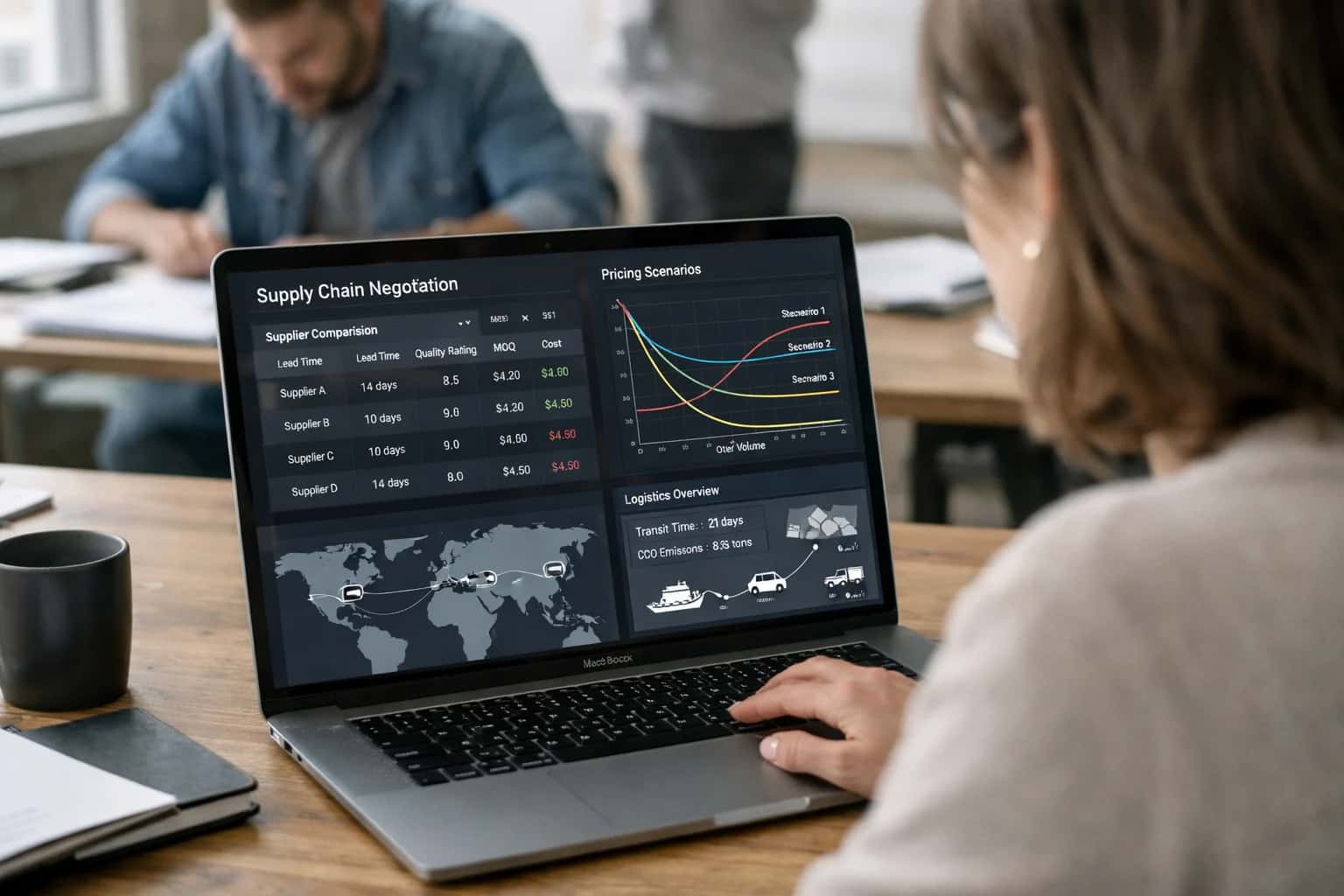
DECISION VELOCITY IN ACTION
What is Real-Time Supply Chain Disruption Triage Used For?
Modern supply chains are fragile networks. Real-time triage is the AI-powered system that transforms chaotic disruption into a managed, prioritized response, protecting revenue and customer trust.
AI-driven triage acts as a 24/7 control tower. It ingests real-time data from IoT sensors, carrier APIs, and weather feeds, instantly scoring each incident by potential financial and operational impact. The system doesn't just alert; it recommends immediate actions—like rerouting shipments or activating backup suppliers—to stabilize your most critical operations first. This shifts the paradigm from reactive to proactive, turning disruption management from a cost center into a source of competitive resilience. For a deeper dive into building this capability, explore our guide on Supply Chain Resilience and Logistics Intelligence.
SUPPLY CHAIN RESILIENCE
Common Use Cases: Where AI Triage Delivers Immediate ROI
When disruptions hit, every minute of indecision costs millions. AI triage moves your supply chain from reactive firefighting to proactive stabilization by instantly prioritizing incidents by financial and operational impact.
01
Critical Component Shortfall Triage
When a key supplier fails, AI instantly analyzes impact severity across your product lines. It evaluates alternative suppliers, expedited shipping costs, and production line dependencies to recommend the single action that prevents the largest revenue loss.
- Real Example: A Tier-1 automotive manufacturer used AI to triage a semiconductor shortage, identifying that reallocating existing stock to high-margin SUV lines would preserve $120M in quarterly revenue, while delaying lower-margin sedan production.
- ROI Driver: Prevents catastrophic line stoppages by focusing expedited logistics spend on the most business-critical components.
02
Port Congestion & Logistics Bottleneck Resolution
AI continuously monitors global shipping lanes, port delays, and customs data. It scores each delayed shipment by its contribution to downstream production halts and customer SLA penalties, then dynamically reroutes cargo.
- Real Example: A consumer electronics company faced a 14-day port delay. AI triage rerouted 60% of the containers through a secondary port with higher fees but ensured flagship product launch dates were met, protecting an estimated $85M in launch-quarter revenue.
- ROI Driver: Converts fixed logistics costs into variable, strategic investments by only paying premiums for shipments that truly matter.
03
Demand-Supply Imbalance Prioritization
Sudden demand spikes or crashes create massive waste or stockouts. AI triage models real-time demand signals against current inventory and production capacity, prioritizing which SKUs to ramp up or down first.
- Real Example: A fashion retailer used AI during an unexpected viral trend. The system prioritized fabric procurement and factory capacity for the trending items, leading to a 40% increase in capture rate for that trend versus historical averages.
- ROI Driver: Maximizes revenue capture from volatile demand while minimizing obsolete inventory write-downs.
04
Supplier Risk & Financial Health Monitoring
AI continuously scores the financial and operational health of your supplier network using news, financial filings, and geopolitical data. It flags at-risk suppliers before they fail, allowing for proactive diversification.
- Real Example: An industrial equipment maker's AI system flagged a key castings supplier with deteriorating liquidity 90 days before it filed for bankruptcy. This enabled a dual-sourcing strategy that avoided a 6-month production delay.
- ROI Driver: Transforms supplier risk management from a quarterly audit to a real-time, predictive shield against disruption.
05
Cross-Functional Crisis Response Orchestration
A major disruption requires coordination across procurement, logistics, manufacturing, and sales. AI acts as a central nervous system, triaging incidents and generating coordinated action plans for each team, ranked by priority.
- Real Example: During a regional flood affecting a primary distribution hub, AI generated a sequenced playbook: Logistics re-routed shipments, Sales communicated delays to top-tier customers first, and Manufacturing adjusted schedules. This coordinated response reduced customer churn by 15% during the event.
- ROI Driver: Eliminates siloed decision-making and conflicting priorities, ensuring the entire organization executes on a single, optimal recovery plan.
06
Transportation Network Optimization Under Duress
When a primary route is blocked (e.g., strike, weather), AI instantly re-optimizes the entire transportation network. It evaluates cost, speed, and reliability of thousands of alternative lanes to maintain service levels for the most critical deliveries.
- Real Example: A global chemical distributor used AI during a major rail strike. The system re-optimized 5,000 shipments in minutes, prioritizing hazardous materials requiring continuous movement and identifying cost-effective trucking alternatives for less time-sensitive goods.
- ROI Driver: Maintains service levels for premium contracts and avoids regulatory fines by ensuring continuous movement of regulated materials.
REAL-TIME SUPPLY CHAIN DISRUPTION TRIAGE
How It Works: The AI Triage Engine
When a disruption hits—a port closure, supplier failure, or sudden demand spike—every minute of indecision costs money. Our AI Triage Engine cuts through the noise to protect your bottom line.
Supply chain leaders face a constant barrage of alerts—weather delays, geopolitical events, machine failures. The critical pain point is decision paralysis: teams waste precious hours manually sifting through data to determine which incident threatens production or customer commitments first. This reactive mode leads to stockouts, expedited freight costs, and eroded margins, as resources are misallocated to low-impact issues while critical ones escalate. In today's volatile environment, slow triage is a direct competitive disadvantage.
Our engine ingests real-time data from ERP, IoT sensors, and news feeds, applying prioritization intelligence to instantly score each incident by potential financial and operational impact. It doesn't just flag problems; it recommends concrete, immediate actions—like rerouting shipments, activating backup suppliers, or adjusting production schedules—to stabilize your most critical operations. This transforms chaos into controlled response, turning potential losses into managed outcomes and providing the decision velocity needed for modern resilience. For a deeper dive into building this capability, explore our pillar on Decision Velocity and Prioritization Intelligence.
Enabling Efficiency, Speed & Accuracy
Intelligent Analysis, Decision & Execution
We build AI systems for teams that need search across company data, workflow automation across tools, or AI features inside products and internal software.
Talk to Us
Search across company data
Give teams answers from docs, tickets, runbooks, and product data with sources and permissions.
Useful when people spend too long searching or get different answers from different systems.
Enterprise searchRAGPermissions
Read more
Automate internal workflows
Use AI to route work, draft outputs, trigger actions, and keep approvals and logs in place.
Useful when repetitive work moves across multiple tools and teams.
AI agentsWorkflow automationGovernance
Read more
Add AI to products and internal tools
Build assistants, guided actions, or decision support into the software your team or customers already use.
Useful when AI needs to be part of the product, not a separate tool.
AI integrationDecision supportModel routing
Read moreREAL-TIME SUPPLY CHAIN TRIAGE
Implementation Roadmap: From Pilot to Scale
Move from reactive firefighting to proactive, AI-driven orchestration. This phased roadmap de-risks investment and builds a clear business case for scaling intelligent disruption management.
01
Phase 1: Pilot - Isolate & Quantify High-Impact Disruptions
Start by focusing AI on the most costly and frequent disruptions—like port delays or critical component shortages. The pilot uses existing ERP and logistics data to create a single pane of glass for incident monitoring. Key activities:
- Integrate with 1-2 core data sources (e.g., shipment tracking, supplier alerts).
- Train a priority scoring model on historical impact data (cost, downtime).
- Deploy a dashboard for the logistics team showing AI-ranked incidents.
Real-World Example: A consumer electronics manufacturer piloted this to identify that 70% of their expedited freight costs were driven by just 15% of late shipments. The AI model flagged these high-cost delays for immediate intervention.
02
Phase 2: Validate - Prove ROI with Actionable Recommendations
Expand the AI's role from monitoring to recommending prescriptive actions. This phase validates the ROI by linking AI insights to concrete cost savings and efficiency gains. Key activities:
- Connect to inventory and production planning systems.
- Enable the model to recommend actions (e.g., reroute shipment, activate alternate supplier, adjust production schedule).
- Measure reduction in manual analysis time and improvement in decision speed.
Quantifiable Benefit: Early adopters see a 25-40% reduction in manual triage time for planners and a 15-30% decrease in expedited freight costs within the first 6-12 months by acting on AI-prescribed alternatives.
03
Phase 3: Scale - Integrate AI into End-to-End Workflows
Embed the AI triage system into the core operational workflows of procurement, logistics, and manufacturing. The system now acts as a central nervous system, triggering automated workflows and notifications. Key activities:
- Integrate with S&OP processes and supplier portals.
- Implement API-driven alerts to relevant teams and systems.
- Establish feedback loops to continuously retrain the model on new disruption patterns.
Business Outcome: This creates enterprise-wide resilience, allowing for dynamic re-routing and inventory rebalancing that can protect millions in potential lost revenue during major events like geopolitical unrest or natural disasters.
04
Phase 4: Optimize - Enable Predictive & Autonomous Response
The final phase shifts from reactive triage to predictive mitigation and semi-autonomous response. AI anticipates disruptions based on external signals (weather, news, social sentiment) and executes pre-approved mitigation plans. Key activities:
- Ingest unstructured external data feeds (news, weather, satellite imagery).
- Develop 'digital twin' simulations to stress-test the supply chain.
- Deploy autonomous agents to execute low-risk, high-frequency adjustments (e.g., booking buffer capacity).
Strategic Advantage: Companies at this stage achieve competitive insulation, turning supply chain agility into a market differentiator by maintaining service levels where competitors fail.
05
The CIO's Business Case: Justifying the Investment
Frame the investment not as an IT cost, but as working capital protection and revenue assurance. Key ROI Levers:
- Cost Avoidance: Reduce expedited freight, excess inventory, and production downtime.
- Efficiency Gain: Free up planner capacity from firefighting to strategic work.
- Revenue Protection: Minimize stockouts and missed customer commitments.
- Risk Mitigation: Quantify the value of avoided single-point-of-failure scenarios.
Justification Template: "For a $5B company, a 2% reduction in supply chain disruption costs can directly protect $100M in annual EBITDA. Our pilot aims to validate a 0.5% saving, funding the full-scale rollout."
06
Avoiding Common Pitfalls: Lessons from Early Adopters
Success depends on managing change, not just technology. Critical success factors include:
- Start with a Clear Pain Point: Don't boil the ocean. Pilot on a specific, high-cost disruption type.
- Ensure Data Quality: Garbage in, garbage out. Budget for data cleansing in Phase 1.
- Design for Human-in-the-Loop: The AI recommends; the human decides. Build trust through transparency.
- Measure Everything: Establish baseline KPIs (Mean Time to Triage, Cost per Disruption) before the pilot begins.
Realistic Challenge: The biggest hurdle is often organizational silos. Secure cross-functional sponsorship from Supply Chain, Finance, and IT leadership from day one.

About the author
Prasad Kumkar
CEO & MD, Inference Systems
Prasad Kumkar is the CEO & MD of Inference Systems and writes about AI systems architecture, LLM infrastructure, model serving, evaluation, and production deployment. Over 5+ years, he has worked across computer vision models, L5 autonomous vehicle systems, and LLM research, with a focus on taking complex AI ideas into real-world engineering systems.
His work and writing cover AI systems, large language models, AI agents, multimodal systems, autonomous systems, inference optimization, RAG, evaluation, and production AI engineering.
LinkedIn
Limited slotsGet a Free AI Consultation
Partnered with leading AI, data, and software stack.





How We Work
Custom AI workflows for your Business
One-fit-all AI don't work for modern businesses. At Inferensys, we aim to understand your business & custom requirements; which we use to define most efficient agentic workflows, the data, and the tools for your business.
01
Review the use case
We understand the task, the users, and where AI can actually help.
Read more02
Pick the right approach
We define what needs search, automation, or product integration.
Read more03
Build the first useful version
We implement the part that proves the value first.
Read more04
Improve from there
We add the checks and visibility needed to keep it useful.
Read moreThe first call is a practical review of your use case and the right next step.
Talk to Us