The core problem is model decay. A credit scoring model trained on 2023 economic data becomes unreliable in a 2026 recession. A recommendation engine degrades as customer tastes shift. This concept drift and data drift erode predictive accuracy, leading to poor decisions—increased loan defaults, lost sales, or flawed inventory forecasts. Without proactive monitoring, these failures are discovered too late, often through customer complaints or financial reports, causing significant revenue loss and reputational damage.

Use Case
Real-Time Drift Detection and Alerting
Automated systems that continuously monitor AI models for performance decay, alerting teams to data and concept drift before business-critical decisions are compromised.
PROTECTING PRODUCTION MODELS
What is Real-Time Drift Detection and Alerting Used For?
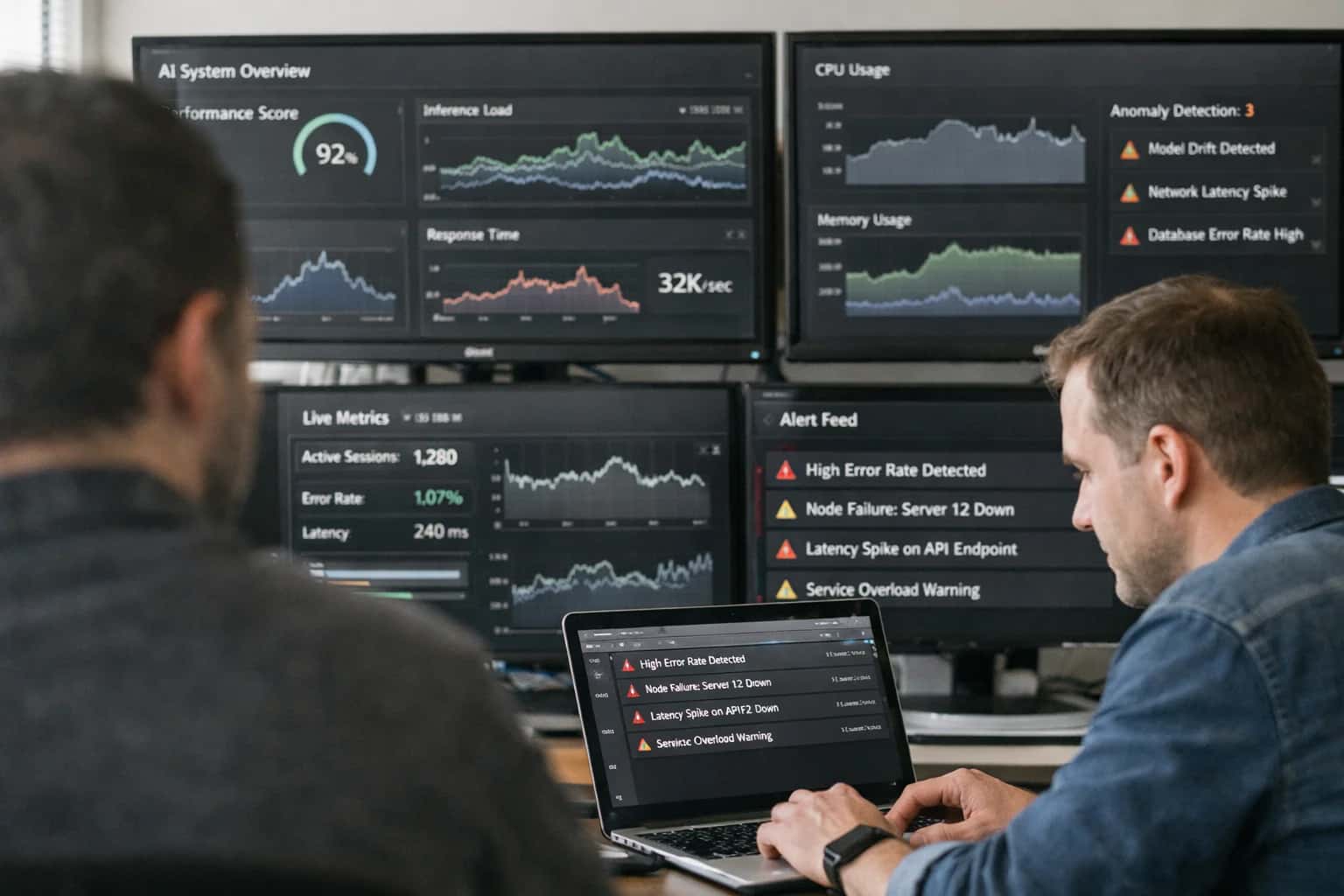
In production, AI models don't fail suddenly—they decay silently as real-world data evolves away from their training assumptions. Real-time drift detection and alerting is the critical MLOps capability that identifies this decay the moment it happens, preventing costly business errors.
The solution is automated, real-time monitoring that compares live inference data against the model's training baseline. When significant drift is detected, the system triggers instant alerts to data science and operations teams. This enables proactive intervention—such as triggering Continuous Model Retraining at Scale or executing an Automated Rollback for Failing Models. The measurable outcome is protected ROI: preventing a 15-20% drop in model accuracy can save millions in erroneous decisions, ensuring AI investments deliver consistent, reliable business value.
REAL-TIME DRIFT DETECTION AND ALERTING
Common Use Cases: Where Drift Causes Real Business Pain
Model decay is inevitable. Without proactive detection, silent failures in production AI erode ROI and introduce strategic risk. These are the high-impact scenarios where real-time drift monitoring delivers immediate business value.
01
Prevent Revenue Loss in Dynamic Pricing
AI-powered pricing models fail when market conditions shift, leading to underpricing or lost sales. Real-time drift detection identifies when customer price sensitivity or competitor behavior changes, triggering an alert for model retraining.
- Example: A travel e-commerce platform prevented an estimated $2.3M in quarterly revenue leakage by detecting a sudden shift in booking patterns post-holiday, allowing immediate pricing strategy adjustment.
- ROI Driver: Protects margin and market share by ensuring pricing intelligence remains current.
02
Maintain Fraud Detection Accuracy
Fraudsters constantly evolve their tactics. A static fraud model quickly becomes obsolete, increasing false negatives (missed fraud) and false positives (blocked legitimate transactions).
- Continuous monitoring of transaction feature distributions (e.g., purchase amount, location, velocity) flags emerging attack patterns.
- Business Impact: A financial services client reduced false positives by 18% and prevented an estimated $850k in fraudulent transactions annually through automated drift-triggered retraining cycles.
- Key Benefit: Sustains trust and reduces operational costs from manual review queues.
03
Ensure Credit Scoring Model Fairness & Compliance
Economic downturns, policy changes, or demographic shifts can cause concept drift, where the relationship between borrower attributes and default risk changes. Undetected, this leads to unfair lending decisions and regulatory non-compliance.
- Proactive alerting on shifts in model output distributions or feature importance triggers a compliance review and model update.
- Mitigates Risk: Prevents potential fair lending violations and reputational damage by ensuring models reflect current economic reality.
- Strategic Advantage: Enables faster, more responsible adaptation to market cycles than competitors relying on manual audits.
04
Optimize Supply Chain Demand Forecasting
Unexpected events—a viral social trend, a port closure, a weather disaster—can instantly invalidate demand forecasts. Drift in forecast error signals a broken model.
- Real-time alerts on spikes in forecast error or shifts in leading indicator data (e.g., web traffic, social sentiment) enable planners to switch to manual overrides or trigger retraining.
- Quantifiable Result: A retail manufacturer avoided $1.1M in excess inventory costs after an alert on abnormal social media chatter preceded a sudden product demand collapse.
- Core Value: Transforms supply chain AI from a static planner into a resilient, sensing system.
05
Safeguard Predictive Maintenance in Manufacturing
Sensor data from industrial equipment can drift due to machine wear, seasonal changes, or new operating conditions. A model trained on 'healthy' data will miss impending failures.
- Detecting data drift in vibration, temperature, or acoustic signatures provides early warning that the model's understanding of 'normal' is outdated.
- Prevents Downtime: A heavy machinery operator achieved a 12% reduction in unplanned downtime by using drift alerts to schedule proactive model refreshes, maintaining >99% prediction accuracy.
- ROI Link: Directly protects capital assets and production throughput.
06
Protect Customer Churn Prediction Investments
Customer behavior and competitive landscapes change rapidly. A churn model that doesn't adapt will waste marketing spend on low-risk customers and miss high-risk ones.
- Monitoring for concept drift in the factors driving churn (e.g., usage patterns, support ticket themes) ensures retention efforts target the right customers.
- Business Case: A SaaS company improved its retention campaign efficiency by 22%, saving over $500k in unnecessary incentive spend annually, by retraining models immediately upon drift detection.
- Strategic Outcome: Maximizes the lifetime value of the customer base.
REAL-TIME DRIFT DETECTION AND ALERTING
How It Works: The Proactive Monitoring Framework
Silent model decay is a primary cause of AI project failure, eroding ROI and damaging trust. Our framework transforms monitoring from a reactive audit into a proactive business safeguard.
The Pain Point: Silent Model Failure. In production, AI models face a constant threat: data and concept drift. Customer behavior shifts, supply chains evolve, and market conditions change, causing the model's underlying assumptions to become outdated. This decay is often invisible until a critical business decision fails—like a fraud model missing new attack patterns or a demand forecast becoming wildly inaccurate. The result is eroded revenue, compliance risk, and a loss of confidence in AI initiatives.
The AI Fix: Automated Sentinel Systems. Our framework embeds lightweight statistical sentinels that continuously analyze incoming data and predictions against the model's training baseline. When drift exceeds a configurable threshold, the system triggers real-time alerts to engineering and business teams via Slack, PagerDuty, or email. This enables immediate investigation and automated rollback to a stable version, preventing business impact. Integrating with our Unified AI Lifecycle Management Platform, it provides the actionable intelligence needed to maintain model ROI.
Enabling Efficiency, Speed & Accuracy
Intelligent Analysis, Decision & Execution
We build AI systems for teams that need search across company data, workflow automation across tools, or AI features inside products and internal software.
Talk to Us
Search across company data
Give teams answers from docs, tickets, runbooks, and product data with sources and permissions.
Useful when people spend too long searching or get different answers from different systems.
Enterprise searchRAGPermissions
Read more
Automate internal workflows
Use AI to route work, draft outputs, trigger actions, and keep approvals and logs in place.
Useful when repetitive work moves across multiple tools and teams.
AI agentsWorkflow automationGovernance
Read more
Add AI to products and internal tools
Build assistants, guided actions, or decision support into the software your team or customers already use.
Useful when AI needs to be part of the product, not a separate tool.
AI integrationDecision supportModel routing
Read moreREAL-TIME DRIFT DETECTION AND ALERTING
Implementation Roadmap: From Pilot to Production Scale
Proactive drift detection is the critical safety net for production AI, transforming reactive firefighting into a predictable, governed process. This roadmap details the phased implementation to secure your AI investment.
01
Phase 1: Pilot - Define Critical Metrics & Baselines
Start by instrumenting a single high-value model to establish a performance baseline and define business-critical Key Performance Indicators (KPIs). This phase focuses on quantifying the cost of drift.
- Example: A credit scoring model where a 5% drop in precision directly correlates to a $2M+ annual loss from bad loans.
- Implement lightweight statistical tests (KS-test, PSI) on a daily batch schedule.
- The deliverable is a clear ROI justification for full-scale rollout, based on pilot data.
02
Phase 2: Standardize - Automated Alerts & Escalation
Scale detection from a pilot to your top 10 models by automating alerts integrated into existing ITSM tools like ServiceNow or PagerDuty. This creates an operational playbook.
- Configure severity-based escalation (e.g., data drift = ticket, concept drift = page).
- Real-world impact: A retail demand forecasting model triggers an alert for sudden feature drift, allowing analysts to investigate a new competitor's pricing strategy within hours, not weeks.
- This phase reduces Mean Time To Detection (MTTD) from days to minutes.
03
Phase 3: Scale - Enterprise-Wide Monitoring & Dashboarding
Deploy a centralized monitoring platform providing a single pane of glass for all models in production. This is where drift detection shifts from IT alerting to executive business intelligence.
- Centralized dashboards show model health KPIs (drift scores, accuracy) linked to business outcomes like customer churn or conversion rates.
- Enable cross-team collaboration between Data Science, DevOps, and Business Units with shared, contextualized alerts.
- Quantifiable Benefit: A 30% reduction in time spent by data scientists manually checking models, redirecting effort to innovation.
04
Phase 4: Optimize - Closed-Loop Retraining & Governance
Mature from detection to automated remediation by integrating drift signals with your MLOps CI/CD pipeline. This creates a self-healing AI ecosystem.
- Automatically trigger model retraining pipelines or canary deployments when significant concept drift is confirmed.
- Example: A fraud detection model auto-retrains on new attack patterns flagged by drift detection, maintaining >99% recall without manual intervention.
- This phase locks in ROI by preventing revenue loss and ensuring continuous model compliance.
05
The CIO Justification: Quantifiable Risk Reduction
Real-time drift detection directly protects revenue and mitigates regulatory risk. Present these clear metrics to the board:
- Prevent Revenue Loss: Catch decaying models before they impact customer-facing applications. A single undetected drift event in a pricing model can cost millions.
- Reduce Compliance Risk: Provide audit trails for model decisions, demonstrating proactive governance for regulators (e.g., SR 11-7, EU AI Act).
- Optimize OpEx: Shift from costly, reactive model failures to predictable, scheduled maintenance. This turns an AI cost center into a governed profit center.
06
Real-World ROI: From Detection to Dollars
Case Study - Financial Services: A global bank deployed drift detection on 50+ trading signal models.
- The Pain: Undetected market regime shift caused model performance to decay by 15%, resulting in $8M in slippage over one quarter.
- The AI Fix: Implemented real-time alerting on feature distributions and model uncertainty.
- The ROI: Detected the next regime shift in 48 hours, triggering a manual override that saved an estimated $3M. The annualized savings from prevented losses justified the platform investment in < 6 months.
$3M+
Loss Prevented Per Event
< 6 Mos.
Platform ROI Payback

About the author
Prasad Kumkar
CEO & MD, Inference Systems
Prasad Kumkar is the CEO & MD of Inference Systems and writes about AI systems architecture, LLM infrastructure, model serving, evaluation, and production deployment. Over 5+ years, he has worked across computer vision models, L5 autonomous vehicle systems, and LLM research, with a focus on taking complex AI ideas into real-world engineering systems.
His work and writing cover AI systems, large language models, AI agents, multimodal systems, autonomous systems, inference optimization, RAG, evaluation, and production AI engineering.
LinkedIn
Limited slotsGet a Free AI Consultation
Partnered with leading AI, data, and software stack.





How We Work
Custom AI workflows for your Business
One-fit-all AI don't work for modern businesses. At Inferensys, we aim to understand your business & custom requirements; which we use to define most efficient agentic workflows, the data, and the tools for your business.
01
Review the use case
We understand the task, the users, and where AI can actually help.
Read more02
Pick the right approach
We define what needs search, automation, or product integration.
Read more03
Build the first useful version
We implement the part that proves the value first.
Read more04
Improve from there
We add the checks and visibility needed to keep it useful.
Read moreThe first call is a practical review of your use case and the right next step.
Talk to Us