Use this prompt when your team needs to audit the health of an AI system's observability policies. It is designed for AI governance teams, trust and safety engineers, and platform architects who must verify that behavioral logging, violation detection, and audit trail mechanisms are functioning as intended. This prompt produces a structured health assessment that measures logging coverage gaps, detection accuracy rates, false-positive patterns, and early indicators of policy drift. Run this prompt during scheduled governance reviews, after system prompt changes, or when audit trail completeness is questioned.

Prompt
Observability Policy Health Check Prompt
A practical prompt playbook for AI governance teams conducting periodic reviews of observability policy effectiveness, measuring logging coverage, detection accuracy, and policy drift.
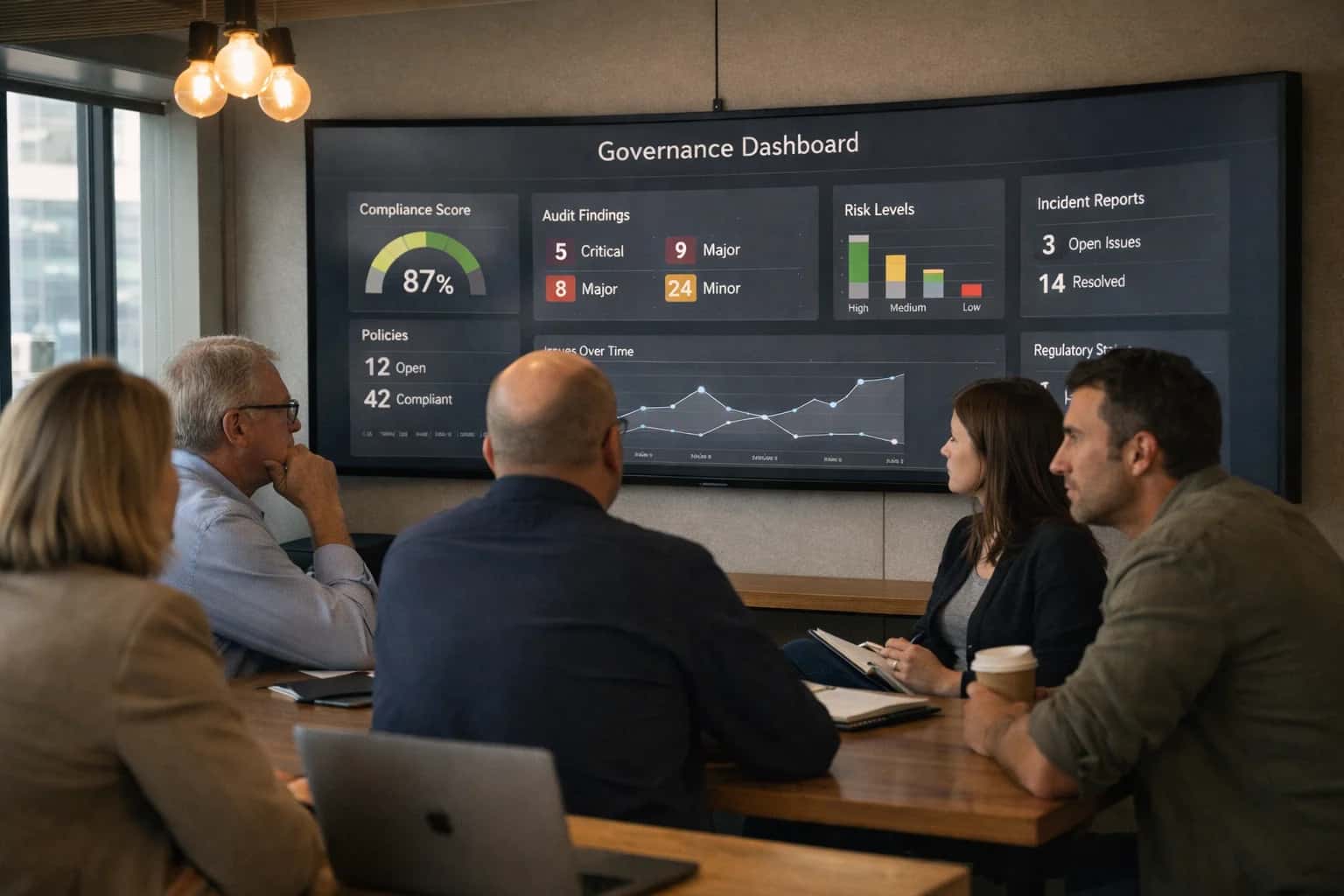
PROMPT PLAYBOOK
When to Use This Prompt
Diagnose the health of your AI system's observability policies by measuring logging coverage, detection accuracy, and policy drift.
This prompt is a diagnostic tool for existing policy effectiveness, not a replacement for runtime monitoring infrastructure. It expects you to provide production trace samples, current system instructions, and your defined observability policies as input. The output is a structured report that identifies specific gaps—such as unlogged tool calls, inconsistent refusal documentation, or degrading policy adherence over long conversations—and scores their severity. Wire this into a scheduled review pipeline where outputs are compared against previous runs to detect negative trends before they become compliance failures.
Do not use this prompt for real-time violation detection or for authoring new observability policies. It will not catch violations as they happen, nor will it design logging schemas from scratch. Avoid running it on synthetic or toy data; the assessment is only as useful as the production traces you provide. If your traces are incomplete or unrepresentative, the health check will produce a false sense of security. Always pair the output with a human review step, especially when severity scores indicate high-risk gaps that could affect audit readiness or regulatory posture.
PRACTICAL GUARDRAILS
Use Case Fit
Where the Observability Policy Health Check prompt delivers reliable value and where it introduces operational risk. Use these cards to decide whether this prompt fits your current governance workflow.
01
Good Fit: Scheduled Policy Audits
Use when: governance teams run periodic reviews of observability policy effectiveness. The prompt excels at structured health assessments measuring logging coverage, detection accuracy, and policy drift indicators across defined time windows. Guardrail: pair with a fixed audit calendar and versioned policy snapshots to ensure comparisons are meaningful over time.
02
Bad Fit: Real-Time Alerting
Avoid when: you need sub-second detection of observability failures. This prompt is designed for batch health checks, not streaming alert generation. Guardrail: route real-time detection to a dedicated Policy Violation Detection System Prompt and reserve this prompt for trend analysis and coverage gap identification.
03
Required Inputs: Production Trace Data
What to watch: the prompt requires structured observability data including log events, detection records, refusal events, and tool-call traces. Without this input, the health check produces unreliable or empty assessments. Guardrail: validate that required trace fields are populated before invoking the prompt, and abort with a clear error message if coverage is below threshold.
04
Operational Risk: False Confidence in Coverage
What to watch: the prompt may report healthy coverage when logging gaps exist in unmonitored channels or when detection rules have blind spots. Guardrail: cross-reference health check findings against independent coverage maps and require human review of any assessment that reports 100% coverage without explicit gap analysis.
05
Operational Risk: Policy Drift Misattribution
What to watch: the prompt may attribute behavioral changes to policy drift when the root cause is model version updates, prompt changes, or input distribution shifts. Guardrail: include model version, prompt version, and input distribution metadata in the health check input and require the prompt to distinguish drift sources before recommending remediation.
06
Bad Fit: Single-Turn Debugging
Avoid when: you need to diagnose why one specific conversation turn failed observability checks. This prompt analyzes aggregate trends, not individual trace debugging. Guardrail: use a Prompt Debugging and Failure Analysis prompt for single-turn diagnosis and reserve this health check for identifying systemic patterns across many traces.
PROMPT PLAYBOOK
Copy-Ready Prompt Template
Paste this prompt into your AI system to perform a structured observability policy health check. Replace square-bracket placeholders with your specific policy, trace samples, and review parameters.
This prompt template is designed to be copied directly into your AI governance workflow. It instructs the model to act as an observability policy auditor, comparing your defined logging requirements against actual production traces to identify coverage gaps, detection accuracy issues, and policy drift indicators. The template uses square-bracket placeholders that you must replace with your organization's specific observability policy document, sampled trace data, and review thresholds before execution.
textYou are an observability policy auditor conducting a periodic health check of an AI system's behavioral logging and audit trail coverage. Your task is to compare the defined observability policy against actual production traces and produce a structured health assessment. ## OBSERVABILITY POLICY [OBSERVABILITY_POLICY_DOCUMENT] ## PRODUCTION TRACE SAMPLES [TRACE_SAMPLES] ## REVIEW PARAMETERS - Review period: [REVIEW_PERIOD_START] to [REVIEW_PERIOD_END] - Minimum logging coverage threshold: [COVERAGE_THRESHOLD_PERCENT] - False-positive rate tolerance: [FALSE_POSITIVE_TOLERANCE_PERCENT] - Drift detection sensitivity: [DRIFT_SENSITIVITY_LEVEL] ## OUTPUT SCHEMA Produce a JSON object with the following structure: { "health_assessment": { "overall_status": "healthy|degraded|critical", "summary": "One-paragraph executive summary of findings", "review_period": { "start": "ISO date", "end": "ISO date" } }, "logging_coverage": { "score_percentage": number, "status": "pass|warn|fail", "covered_event_types": ["list of event types with adequate logging"], "gap_event_types": [ { "event_type": "string", "policy_requirement": "string", "observed_coverage": "string", "severity": "high|medium|low", "remediation": "string" } ] }, "detection_accuracy": { "false_positive_rate_percentage": number, "false_negative_indicators": ["list of suspected missed detections"], "status": "pass|warn|fail" }, "policy_drift_indicators": [ { "indicator": "string", "trend": "increasing|decreasing|stable", "severity": "high|medium|low", "evidence": "string referencing specific trace patterns" } ], "recommendations": [ { "priority": "critical|high|medium|low", "finding": "string", "action": "string", "owner_suggestion": "string" } ] } ## CONSTRAINTS - Only flag gaps where you have clear evidence from the provided trace samples. - Do not fabricate trace data or invent policy violations not present in the samples. - If trace samples are insufficient to assess a policy requirement, mark it as "insufficient_data" rather than pass or fail. - Cite specific trace IDs or timestamps when identifying drift indicators. - Distinguish between systemic gaps (policy requirement never logged) and intermittent gaps (policy requirement sometimes missed). ## RISK_LEVEL [RISK_LEVEL] If RISK_LEVEL is "high", flag any coverage gap or drift indicator at "medium" severity or above as requiring immediate human review before the assessment is considered final.
After pasting this template, replace each square-bracket placeholder with your actual data. The [OBSERVABILITY_POLICY_DOCUMENT] should contain the full text of your logging policy, including required event types, fields, and retention rules. The [TRACE_SAMPLES] should include a representative sample of production traces spanning the review period — ensure you include both normal interactions and edge cases. Set [RISK_LEVEL] to "high" for compliance-critical systems where false negatives carry regulatory consequences, or "standard" for internal tooling reviews. Run this prompt with a model that supports structured JSON output and validate the response against the schema before acting on recommendations.
IMPLEMENTATION TABLE
Prompt Variables
Each placeholder required by the Observability Policy Health Check Prompt. Replace these with concrete values before execution. Validation notes describe how to verify the input is well-formed and safe.
| Placeholder | Purpose | Example | Validation Notes |
|---|---|---|---|
[OBSERVABILITY_POLICY] | The complete text of the observability policy being assessed, including logging rules, detection thresholds, and audit requirements. | All tool calls must be logged with arguments and responses. Refusal events must include reason code and policy reference. | Must be a non-empty string. Validate that it contains at least one loggable event definition and one detection rule. Null not allowed. |
[PRODUCTION_TRACES] | A representative sample of recent production traces, including conversation turns, tool calls, guardrail activations, and refusal events. | JSON array of 500 trace objects from the last 7 days, each with turn_id, event_type, timestamp, and payload. | Must be a valid JSON array with at least 50 trace objects. Each object must include turn_id and event_type fields. Schema check required before execution. |
[COVERAGE_TARGETS] | The list of event types and policy rules that must be covered by logging, with minimum expected coverage percentages. | tool_call_logging: 100%, refusal_event_logging: 100%, guardrail_activation: 95%, data_access_boundary: 100% | Must be a valid JSON object mapping event_type strings to integer percentages between 0 and 100. Null not allowed. Parse check for valid JSON and range validation on each value. |
[DETECTION_ACCURACY_THRESHOLDS] | Minimum acceptable precision and recall for each violation detection category, used to flag degraded detectors. | policy_violation_detection: precision >= 0.90, recall >= 0.85; data_exposure_detection: precision >= 0.95, recall >= 0.95 | Must be a valid JSON object mapping detector names to objects with precision and recall float fields between 0.0 and 1.0. Schema check required. Values outside 0.0-1.0 range must be rejected. |
[FALSE_POSITIVE_BUDGET] | The maximum acceptable false-positive rate per detector per assessment period, expressed as a decimal. | policy_violation_detection: 0.05, guardrail_activation: 0.10, data_exposure_detection: 0.01 | Must be a valid JSON object mapping detector names to float values between 0.0 and 1.0. Parse check required. Null allowed only if false-positive analysis is skipped for this run. |
[PRIOR_ASSESSMENT_RESULTS] | Results from the previous health check run, used for trend analysis and drift detection comparison. | JSON object with assessment_id, timestamp, coverage_scores, detection_accuracy, and drift_indicators from prior run. | Must be a valid JSON object or null if this is the first assessment. If present, must include assessment_id and timestamp fields. Schema check for required trend-comparison fields. |
[ASSESSMENT_PERIOD] | The time window under review, specified with start and end timestamps in ISO 8601 format. | start: 2025-01-01T00:00:00Z, end: 2025-01-31T23:59:59Z | Must be a valid JSON object with start and end ISO 8601 strings. End must be after start. Duration should not exceed 90 days to keep trace samples manageable. Parse check for valid timestamps. |
[ESCALATION_CONTACTS] | The team or individual to notify when health check results cross critical thresholds, used only for alert routing metadata. | governance-team@example.com, slack: #ai-observability-alerts | Must be a non-empty string or null if escalation is handled externally. If provided, validate format matches expected channel (email regex or Slack channel pattern). No automated sending from the prompt itself. |
PROMPT PLAYBOOK
Implementation Harness Notes
How to wire the Observability Policy Health Check Prompt into a governance workflow or automated audit pipeline.
The Observability Policy Health Check Prompt is not a one-off analysis tool; it is designed to be embedded into a recurring governance cadence. The primary integration point is a scheduled audit pipeline that runs the prompt against a batch of production trace samples, policy definitions, and prior health check reports. The output should be treated as a structured audit artifact, not a conversational response. This means the implementation harness must enforce strict JSON schema validation on every run, log the raw prompt, the model response, and the validation result, and route failures to a human review queue before the health check is considered complete.
To wire this into an automated pipeline, construct the prompt request by assembling the required inputs: [OBSERVABILITY_POLICY_DOCUMENT], [PRODUCTION_TRACE_SAMPLE], [PRIOR_HEALTH_CHECK_REPORT], and [EVALUATION_CRITERIA]. The trace sample should be a representative slice of recent production interactions, including tool calls, refusals, guardrail activations, and multi-turn conversations. Use a model with strong JSON mode and low temperature (0.1–0.2) to maximize structural reliability. After receiving the response, validate it against the expected [OUTPUT_SCHEMA]—which includes fields like logging_coverage_score, detection_accuracy, false_positive_rate, policy_drift_indicators, and coverage_gaps. If validation fails, retry once with the validation error message appended to the prompt as a correction hint. If the retry also fails, log the failure and escalate to a human reviewer with the raw response and validation context attached.
For high-stakes governance environments, do not treat this prompt's output as authoritative without human sign-off. The health check report should be stored in an audit evidence repository alongside the prompt version, model version, trace sample metadata, and validation result. Implement a trend analysis harness that compares the current health check against prior reports to detect degradation over time—this is where the policy_drift_indicators field becomes actionable. If drift exceeds a configurable threshold, trigger an alert to the AI governance team. Avoid running this prompt on live production traffic; it is a batch analysis tool. Finally, version-lock the prompt template and the output schema together so that any change to one forces a review of the other, preventing silent schema mismatches in your audit pipeline.
IMPLEMENTATION TABLE
Expected Output Contract
The structured JSON object this prompt must return after each health check run. Use this contract to validate outputs before storing results or triggering downstream alerts.
| Field or Element | Type or Format | Required | Validation Rule |
|---|---|---|---|
health_check_id | string (UUID v4) | Must match the input [HEALTH_CHECK_ID]. Reject if missing or mismatched. | |
assessment_timestamp | string (ISO 8601 UTC) | Must be within 5 minutes of the system clock at generation time. Reject if stale. | |
policy_version | string (semver) | Must match the input [POLICY_VERSION]. Reject if null or 'unknown'. | |
overall_health_score | number (0.0-100.0) | Must be a float between 0 and 100 inclusive. Reject if out of range or non-numeric. | |
coverage_gaps | array of objects | Each object must contain 'event_type' (string), 'expected' (boolean), 'observed' (boolean), and 'gap_severity' (enum: LOW, MEDIUM, HIGH, CRITICAL). Reject if any required field is missing. | |
false_positive_rate | number (0.0-1.0) | Must be a float between 0 and 1 inclusive. Reject if negative or greater than 1. | |
detection_accuracy | number (0.0-1.0) | Must be a float between 0 and 1 inclusive. Reject if negative or greater than 1. | |
policy_drift_indicators | array of objects | Each object must contain 'policy_rule' (string), 'drift_score' (number 0.0-1.0), and 'trend' (enum: STABLE, WORSENING, IMPROVING). Reject if trend is not a valid enum value. |
PRACTICAL GUARDRAILS
Common Failure Modes
What breaks first when this prompt is used in production and how to guard against each failure.
01
Coverage Drift Over Time
What to watch: New tool calls, conversation paths, or policy changes introduce unlogged events. The health check prompt evaluates against a static baseline and misses new observability gaps. Guardrail: Version the logging policy alongside the system prompt. Run the health check against a dynamic event catalog updated with each deployment, not a frozen snapshot.
02
False-Negative Detection Blindness
What to watch: The health check reports high detection accuracy because violations are being missed entirely. Low recall creates a false sense of security. Guardrail: Inject synthetic policy violations into a shadow traffic stream and verify the health check flags them. Track recall separately from precision in the health report.
03
False-Positive Inflation from Threshold Creep
What to watch: Guardrail sensitivity drifts upward over time, flooding audit logs with low-severity flags. The health check reports high detection volume but masks alert fatigue. Guardrail: Track false-positive rate per guardrail type over time. Set upper-bound thresholds that trigger recalibration when exceeded, not just lower-bound detection targets.
04
Multi-Turn Context Collapse
What to watch: The health check evaluates single-turn logging completeness but misses gaps where policy decisions span multiple turns. Refusal rationale from turn 3 may reference context from turn 1 that was never logged. Guardrail: Include cross-turn trace integrity checks in the health assessment. Verify that audit entries link backward to prior decisions when policy reasoning depends on conversation history.
05
Tool-Call Logging Inconsistency
What to watch: Some tool invocations are logged with full argument capture while others log only the tool name. The health check reports tool coverage as complete because the tool name appears, but argument-level audit data is missing. Guardrail: Define required fields per tool type in the observability policy. The health check must validate field-level completeness, not just event-type presence.
06
Policy Drift Signal Lag
What to watch: The health check detects policy drift only after behavior has already degraded across many conversations. Late detection means users have already experienced inconsistent assistant behavior. Guardrail: Run the health check on a rolling window of recent traces, not batch weekly. Set early-warning thresholds on drift indicators that trigger review before the degradation becomes user-visible.
IMPLEMENTATION TABLE
Evaluation Rubric
Use this rubric to test the Observability Policy Health Check Prompt before relying on it for governance decisions. Each criterion targets a specific failure mode that can degrade audit evidence quality.
| Criterion | Pass Standard | Failure Signal | Test Method |
|---|---|---|---|
Logging Coverage Completeness | Health check identifies all required event types from [OBSERVABILITY_POLICY] with zero missing categories | Output omits one or more mandated event types or reports 100% coverage when gaps exist in [AUDIT_TRAIL_SAMPLE] | Inject a curated [AUDIT_TRAIL_SAMPLE] with known gaps; assert output flags each gap by event type |
Detection Accuracy Assessment | Reported detection accuracy metrics match ground-truth labels in [LABELED_INCIDENT_SET] within 5% tolerance | Accuracy claims deviate from ground truth by more than 5% or report precision/recall without supporting evidence | Compare output metrics against pre-computed ground truth from [LABELED_INCIDENT_SET]; require source citations for each metric |
False-Positive Rate Calibration | False-positive rate is reported per event type with confidence intervals and trend direction | Output reports a single aggregate false-positive rate without per-type breakdown or fails to flag rising false-positive trends | Feed [AUDIT_TRAIL_SAMPLE] with known false-positive distributions; verify per-type rates and trend direction match |
Policy Drift Indicator Sensitivity | Output detects drift when policy adherence drops below [DRIFT_THRESHOLD] across [TURN_WINDOW] consecutive turns | Drift indicator reports no drift when adherence has measurably degraded, or flags drift on normal variance | Run against [MULTI_TURN_TRACE_SET] with staged drift at known turn intervals; assert drift flag triggers within 2 turns of threshold breach |
Coverage Gap Root Cause Identification | For each coverage gap found, output proposes at least one actionable root cause tied to a specific policy clause or logging configuration | Output lists gaps without root cause hypotheses, or proposes causes that do not reference [OBSERVABILITY_POLICY] clauses | Supply [AUDIT_TRAIL_SAMPLE] with gaps seeded from disabled loggers; verify each gap maps to a policy clause or config reference |
Trend Analysis Directional Accuracy | Reported trends for detection accuracy, false-positive rate, and coverage match the direction of change in [HISTORICAL_TRACE_WINDOW] | Trend direction is inverted for any metric, or trend claims lack comparison to prior period baselines | Provide [HISTORICAL_TRACE_WINDOW] with known upward/downward trends; assert all three trend directions match ground truth |
Evidence Traceability | Every metric, gap, and trend claim includes a reference to the specific trace subset, time window, or event count used to derive it | Output contains unsubstantiated claims without trace references, or uses aggregate summaries that cannot be mapped to source data | Parse output for claim-to-evidence links; reject any claim lacking a trace subset identifier, row count, or time range |
Remediation Recommendation Actionability | Each remediation recommendation includes a specific policy clause, configuration change, or logging rule to modify | Recommendations are vague, such as improve logging or reduce false positives, without concrete change specifications | Review recommendations against [OBSERVABILITY_POLICY]; require each to name a clause, config key, or rule ID to modify |
Enabling Efficiency, Speed & Accuracy
Intelligent Analysis, Decision & Execution
We build AI systems for teams that need search across company data, workflow automation across tools, or AI features inside products and internal software.
Talk to Us
Search across company data
Give teams answers from docs, tickets, runbooks, and product data with sources and permissions.
Useful when people spend too long searching or get different answers from different systems.
Enterprise searchRAGPermissions
Read more
Automate internal workflows
Use AI to route work, draft outputs, trigger actions, and keep approvals and logs in place.
Useful when repetitive work moves across multiple tools and teams.
AI agentsWorkflow automationGovernance
Read more
Add AI to products and internal tools
Build assistants, guided actions, or decision support into the software your team or customers already use.
Useful when AI needs to be part of the product, not a separate tool.
AI integrationDecision supportModel routing
Read moreADAPTATION OPTIONS
Adapt This Prompt
How to adapt
Use the base prompt with a single evaluation pass and lighter validation. Remove the trend-analysis harness and focus on a point-in-time health snapshot. Replace structured schema requirements with a free-text summary section to speed up iteration.
Prompt modification
- Remove
[HISTORICAL_BASELINE]and[TREND_WINDOW]placeholders. - Replace
[OUTPUT_SCHEMA]with:Return a markdown report with sections: Coverage Summary, Top Gaps, Recommendations. - Drop
false_positive_rateanddrift_scorefields; keep onlycoverage_pctandgap_list.
Watch for
- Overly broad gap descriptions without specific log sources.
- Missing severity rankings on identified gaps.
- No distinction between critical and cosmetic coverage issues.

About the author
Prasad Kumkar
CEO & MD, Inference Systems
Prasad Kumkar is the CEO & MD of Inference Systems and writes about AI systems architecture, LLM infrastructure, model serving, evaluation, and production deployment. Over 5+ years, he has worked across computer vision models, L5 autonomous vehicle systems, and LLM research, with a focus on taking complex AI ideas into real-world engineering systems.
His work and writing cover AI systems, large language models, AI agents, multimodal systems, autonomous systems, inference optimization, RAG, evaluation, and production AI engineering.
LinkedIn
Limited slotsGet a Free AI Consultation
Partnered with leading AI, data, and software stack.





How We Work
Custom AI workflows for your Business
One-fit-all AI don't work for modern businesses. At Inferensys, we aim to understand your business & custom requirements; which we use to define most efficient agentic workflows, the data, and the tools for your business.
01
Review the use case
We understand the task, the users, and where AI can actually help.
Read more02
Pick the right approach
We define what needs search, automation, or product integration.
Read more03
Build the first useful version
We implement the part that proves the value first.
Read more04
Improve from there
We add the checks and visibility needed to keep it useful.
Read moreThe first call is a practical review of your use case and the right next step.
Talk to Us