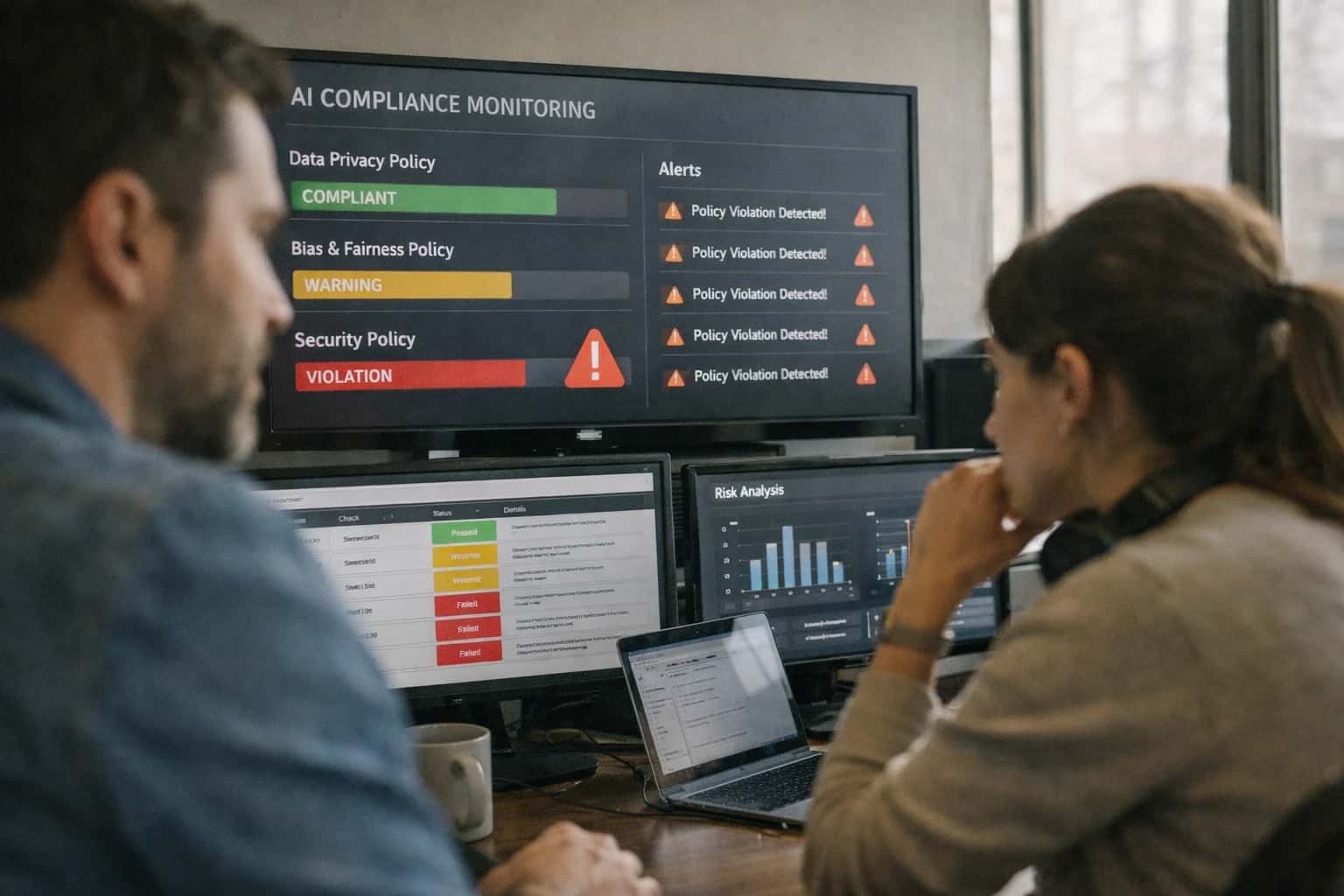
This prompt is designed for compliance officers, audit teams, and AI engineers building systems that must surface contradictory evidence across documents in a machine-readable format. Use it when you have multiple source documents that disagree on factual claims, regulatory interpretations, financial figures, or policy statements, and you need a structured JSON report that can feed into review queues, ticketing systems, or compliance dashboards. The prompt generates conflict reports with source identifiers, claim pairs, conflict categories, severity scores, and recommended actions. It assumes you have already retrieved the relevant document passages and can provide them as context.

Prompt
Structured Conflict Report Generation Prompt
A practical prompt playbook for generating structured JSON conflict reports from contradictory source documents, designed for compliance officers and audit teams who need machine-readable outputs for downstream workflow integration.
PROMPT PLAYBOOK
When to Use This Prompt
Understand the job-to-be-done, ideal user, required context, and when not to use this prompt.
The ideal user is someone integrating this prompt into an automated pipeline where downstream systems consume structured conflict data. For example, a compliance engineer might wire this into a document review system that flags contradictions in vendor contracts before approval. The prompt requires pre-retrieved context passages with source metadata—it does not perform retrieval itself. You must provide document IDs, passage text, and any relevant metadata such as dates, jurisdictions, or authoritativeness scores. The output schema is designed for machine consumption: each conflict entry includes source_a_id, source_b_id, claim_a, claim_b, conflict_category, severity_score, and recommended_action. This structure enables direct ingestion into review queues, ticketing systems like Jira, or compliance dashboards without post-processing.
Do not use this prompt when you need a natural-language summary for human readers only, when sources are fully aligned, or when the conflict resolution logic requires domain-specific legal or regulatory judgment that must be performed by a qualified professional. This prompt identifies and categorizes conflicts but does not resolve them—resolution decisions remain with human reviewers. Also avoid this prompt when you lack source metadata, as the output depends on traceable source identifiers. If your use case involves temporal conflicts where newer documents supersede older ones, pair this prompt with the Temporal Conflict Resolution Prompt to handle effective-date precedence before generating the conflict report. For high-stakes domains like healthcare or legal, always route the output through a human review step before taking action on the conflicts.
PRACTICAL GUARDRAILS
Use Case Fit
Where this prompt works and where it introduces risk. Use these cards to decide if a structured conflict report is the right tool for your workflow.
01
Good Fit: Multi-Source Audit Workflows
Use when: compliance officers or audit teams need machine-readable conflict outputs for downstream ingestion. The prompt excels at producing JSON with source identifiers, claim pairs, and severity scores that feed directly into review queues or dashboards. Guardrail: Validate the output schema before ingestion; a single malformed JSON field can break the pipeline.
02
Bad Fit: Real-Time Chat or Consumer Q&A
Avoid when: latency budgets are under 2 seconds or the end user expects a conversational answer. Structured conflict reports are dense, schema-heavy payloads designed for systems, not people. Guardrail: Route consumer-facing queries to a conflict-aware RAG answer prompt instead, and reserve this prompt for backend processing.
03
Required Inputs: Source Pairs with Metadata
Risk: the prompt cannot detect conflicts without explicit source pairs, document identifiers, and claim excerpts. Missing metadata produces incomplete reports with null source fields. Guardrail: Enforce a pre-processing step that extracts and normalizes source IDs, timestamps, and authoritativeness flags before calling the prompt.
04
Operational Risk: Silent Conflict Suppression
Risk: the model may resolve conflicts it should surface, especially when instructed to be helpful or concise. This hides contradictions from reviewers and creates false consensus. Guardrail: Add an explicit instruction to never resolve conflicts in the report body; resolution recommendations belong in a separate action field with human-review flags.
05
Operational Risk: Severity Score Drift
Risk: severity scores can drift across batches as the model recalibrates its internal thresholds, making historical comparisons unreliable. Guardrail: Anchor severity definitions with concrete examples and numeric thresholds in the prompt. Run periodic calibration checks against a golden set of pre-scored conflicts.
06
Escalation Boundary: Unresolvable Conflicts
Risk: the prompt may hallucinate a resolution or assign equal weight to sources with vastly different credibility. Guardrail: Define an explicit escalation path for conflicts where source credibility differs by more than a configured threshold. Route those cases to human review with the raw evidence and a structured summary.
PROMPT PLAYBOOK
Copy-Ready Prompt Template
A copy-ready prompt for generating machine-readable JSON conflict reports with source identifiers, claim pairs, severity scores, and recommended actions.
This prompt template is designed for compliance officers, audit teams, and knowledge base operators who need structured, machine-readable conflict reports from multi-source evidence. It instructs the model to analyze provided documents, identify contradictory claims, and output a strict JSON schema suitable for downstream workflow integration, review queues, or automated escalation systems. The template uses square-bracket placeholders that you must replace with your actual inputs before sending to the model.
textYou are a structured conflict report generator. Your task is to analyze the provided source documents and identify contradictory claims, inconsistencies, or factual disagreements. You must output a valid JSON object conforming to the schema described below. Do not include any text outside the JSON object. ## INPUT DOCUMENTS [DOCUMENTS] ## OUTPUT SCHEMA You must output a JSON object with the following structure: { "report_id": "string", "generated_at": "ISO-8601 timestamp", "conflicts": [ { "conflict_id": "string", "category": "factual_contradiction | temporal_conflict | definitional_disagreement | methodological_variance | jurisdictional_conflict | data_quality_issue", "severity": "critical | major | minor | informational", "claim_pairs": [ { "claim_a": { "source_id": "string", "source_name": "string", "excerpt": "string (exact quote from source)", "location": "string (page, section, or paragraph reference)" }, "claim_b": { "source_id": "string", "source_name": "string", "excerpt": "string (exact quote from source)", "location": "string (page, section, or paragraph reference)" }, "conflict_description": "string (concise explanation of the contradiction)", "resolution_status": "unresolved | resolved_by_precedence | resolved_by_credibility | escalated" } ], "recommended_action": "string (specific next step for the reviewer)", "escalation_required": true | false, "escalation_reason": "string | null" } ], "summary": { "total_conflicts_found": "integer", "critical_count": "integer", "major_count": "integer", "minor_count": "integer", "informational_count": "integer", "overall_assessment": "string (brief summary of conflict landscape)" } } ## CONSTRAINTS - Only report conflicts where there is genuine contradiction, not stylistic differences or paraphrasing. - Every claim excerpt must be a verbatim quote from the source document. - If no conflicts are found, return an empty conflicts array with a summary explaining why. - Do not fabricate conflicts. If evidence is insufficient to confirm a contradiction, do not include it. - Severity must reflect domain impact, regulatory risk, and decision criticality. - For [RISK_LEVEL] contexts, flag all conflicts as requiring human review.
To adapt this template, replace [DOCUMENTS] with your actual source texts, each clearly labeled with a unique source_id and source_name. For high-stakes domains such as legal or financial compliance, set [RISK_LEVEL] to high to enforce mandatory human review on all conflicts. Before deploying, validate the model's output against the JSON schema using a programmatic validator. Implement a retry loop with a repair prompt if parsing fails. For production systems, log every generated report with the input document hashes and model version for auditability. Always route critical severity conflicts to a human review queue before any automated action is taken.
IMPLEMENTATION TABLE
Prompt Variables
Inputs the prompt needs to work reliably. Validate these before sending to the model.
| Placeholder | Purpose | Example | Validation Notes |
|---|---|---|---|
[RETRIEVED_DOCUMENTS] | Array of source documents with text and metadata | [{"doc_id": "src-42", "text": "...", "source": "policy-v3", "date": "2024-11-01"}] | Must be a non-empty array. Each object requires doc_id, text, and source fields. Reject if text is null or empty string. |
[CONFLICT_CATEGORIES] | Taxonomy of conflict types the model can assign | ["factual_disagreement", "temporal_supersession", "definitional_divergence", "jurisdictional_variance", "methodological_difference"] | Must be a non-empty array of strings. Validate against allowed enum before sending. Unknown categories cause classification failures. |
[SEVERITY_LEVELS] | Ordered list of severity labels for conflict classification | ["critical", "major", "minor", "informational"] | Must be an array of 3-5 strings in descending severity order. First entry is highest severity. Used for priority scoring and routing. |
[OUTPUT_SCHEMA] | JSON Schema the model must conform to in its response | {"type": "object", "properties": {"conflicts": {"type": "array"}}, "required": ["conflicts", "meta"]} | Must be a valid JSON Schema object. Parse with Ajv or similar before use. Schema must include conflicts array, meta object, and required fields. |
[MAX_CONFLICTS] | Upper bound on number of conflict pairs to report | 15 | Must be a positive integer between 1 and 50. Controls response size and latency. Set lower for real-time workflows, higher for batch audit. |
[REQUIRED_ACTIONS] | Allowed action labels for conflict resolution recommendations | ["human_review", "use_newer_source", "flag_for_legal", "note_discrepancy", "suppress_answer"] | Must be a non-empty array of strings. Model output restricted to these values. Validate post-generation that all returned actions are in this set. |
[CONFIDENCE_THRESHOLD] | Minimum confidence score for reporting a conflict | 0.7 | Must be a float between 0.0 and 1.0. Conflicts below this threshold are suppressed. Tune based on false-positive tolerance from eval runs. |
PROMPT PLAYBOOK
Implementation Harness Notes
How to wire the Structured Conflict Report Generation prompt into an application or compliance workflow with validation, retries, logging, and human review gates.
The Structured Conflict Report Generation prompt is designed to be called from an application layer that already has retrieved documents, source metadata, and a defined output schema. The prompt itself is stateless: it receives a set of claims and source passages, then returns a JSON conflict report. The application is responsible for assembling the input context, calling the model, validating the output against the expected schema, and deciding what happens next—retry, repair, escalate, or store. This prompt is not a chatbot. It is a single-turn structured generation call that should be treated like an API endpoint with strict input and output contracts.
Wire the prompt into a pipeline that performs the following steps. Pre-call: assemble the [CLAIMS] array from upstream extraction or fact-checking steps, attach [SOURCE_DOCUMENTS] with unique identifiers and full passage text, and inject [OUTPUT_SCHEMA] as the exact JSON Schema you expect back. Model selection: use a model with strong structured output support (GPT-4o, Claude 3.5 Sonnet, or equivalent) and enable structured output mode or JSON mode if available. Post-call validation: validate the returned JSON against your schema immediately. Check that conflict_id values are unique, source_a_id and source_b_id reference real source identifiers from the input, severity_score falls within the defined range, and recommended_action matches your allowed enum. If validation fails, route to a repair prompt or retry with the validation error message appended as [PREVIOUS_ERROR]. Logging: log the full prompt, response, validation result, and any retry attempts. For compliance workflows, store the conflict report alongside the source document versions and timestamps used at generation time. Human review gate: for conflicts with severity_score above a configurable threshold or recommended_action values of escalate or legal_review, route the report to a review queue before any downstream action is taken. Do not auto-resolve conflicts in regulated domains.
Common failure modes in the harness include: schema drift where the model returns valid JSON that doesn't match your expected field names; hallucinated source identifiers that don't exist in the input; severity inflation where every conflict is marked critical; and false negatives where genuine contradictions are missed. Mitigate these with eval suites that test against known conflict pairs, schema conformance checks, and periodic human audit of a sample of generated reports. The prompt is a component, not the whole system—the harness is where reliability, auditability, and safety are enforced.
IMPLEMENTATION TABLE
Expected Output Contract
Fields, format, and validation rules for the generated JSON conflict report. Use this contract to build downstream parsers, validation checks, and workflow triggers.
| Field or Element | Type or Format | Required | Validation Rule |
|---|---|---|---|
report_id | string (UUID v4) | Must parse as valid UUID v4. Reject on format mismatch. | |
generated_at | string (ISO 8601 UTC) | Must parse as valid ISO 8601 datetime with trailing Z. Reject if timestamp is in the future beyond 60s clock skew tolerance. | |
conflicts | array of conflict objects | Must be a non-null array. Min items: 0. Each item must conform to the conflict object schema below. | |
conflicts[].conflict_id | string | Must be unique within the array. Duplicate IDs trigger a retry or repair step. | |
conflicts[].source_pair | array of two source objects | Must contain exactly 2 source objects. Each source must have a non-empty source_id and a non-empty excerpt field. | |
conflicts[].claim_pair | array of two claim strings | Must contain exactly 2 non-empty strings. Strings must not be identical after whitespace normalization. | |
conflicts[].conflict_category | string enum: [factual_contradiction, temporal_drift, definitional_disagreement, methodological_variance, jurisdiction_conflict, data_quality_issue] | Must match one of the allowed enum values exactly. Case-sensitive. Unknown values trigger a repair attempt or rejection. | |
conflicts[].severity | string enum: [critical, major, minor, informational] | Must match one of the allowed enum values exactly. If severity is critical or major, the recommended_action field must not be no_action. | |
conflicts[].recommended_action | string enum: [escalate_for_human_review, flag_for_audit, surface_to_user, suppress_and_log, no_action] | Must match one of the allowed enum values exactly. If escalate_for_human_review, the escalation_reason field must be non-empty. | |
conflicts[].confidence | number (0.0 to 1.0) | Must be a float between 0.0 and 1.0 inclusive. Values below 0.5 should trigger a low-confidence flag in the eval harness. Null not allowed. |
PRACTICAL GUARDRAILS
Common Failure Modes
What breaks first when generating structured conflict reports and how to guard against it in production.
01
Schema Drift Under Conflict
What to watch: The model drops required fields or invents keys when multiple sources disagree and it cannot resolve a clean value. The output JSON structure breaks downstream parsers. Guardrail: Enforce the output schema with a strict validator before ingestion. Use [OUTPUT_SCHEMA] with explicit null and unresolved sentinel values for every field that can be disputed.
02
False Conflict Detection
What to watch: The model flags paraphrased or synonymous claims as contradictory, flooding the report with low-value noise. This happens when semantic similarity thresholds are missing from the prompt. Guardrail: Include explicit [CONFLICT_DEFINITION] rules requiring factual incompatibility, not just wording differences. Add a severity filter that suppresses conflicts below a configurable threshold.
03
Missing Source Attribution
What to watch: The report lists conflicting claims but omits source identifiers, document sections, or retrieval metadata, making the output unauditable. Guardrail: Require source_id, document_ref, and excerpt fields in the output schema. Validate that every claim pair in the report has non-empty source references before accepting the response.
04
Severity Inflation on Low-Stakes Conflicts
What to watch: Minor terminological differences or formatting variations receive critical severity scores, triggering unnecessary human reviews and alert fatigue. Guardrail: Provide a [SEVERITY_RUBRIC] with domain-specific examples of critical, major, minor, and informational conflicts. Post-process severity scores with a calibration check against known safe baselines.
05
Temporal Context Collapse
What to watch: The model treats a newer document that supersedes an older one as a conflict rather than an update, or fails to recognize that both sources are valid for different effective dates. Guardrail: Include effective_date and supersedes fields in source metadata. Add a [TEMPORAL_PRECEDENCE_RULE] in the prompt that instructs the model to check dates before classifying as conflict.
06
Abstention Avoidance on Unresolvable Conflicts
What to watch: The model forces a resolution or picks a winner when evidence is genuinely irreconcilable, hiding uncertainty from downstream consumers. Guardrail: Add an explicit conflict_status field with values resolved, unresolved, partial. Require the model to set unresolved when evidence is evenly split and include a recommended_action: escalate_to_human_review.
IMPLEMENTATION TABLE
Evaluation Rubric
How to test output quality before shipping. Run these checks on a labeled dataset of at least 50 document pairs with known conflicts.
| Criterion | Pass Standard | Failure Signal | Test Method |
|---|---|---|---|
Conflict Detection Recall |
| Known contradictory claim pairs missing from output; false negative rate > 10% | Compare output [CONFLICT_LIST] against human-labeled conflict pairs in golden dataset; count missed conflicts |
Conflict Detection Precision |
| Output flags non-contradictory statements as conflicts; false positive rate > 15% | Human review of 50 sampled conflict pairs from output; label each as genuine conflict or false alarm |
Conflict Category Accuracy |
| Direct contradiction misclassified as temporal drift; definitional conflict labeled as factual error | Confusion matrix comparing model-assigned categories to human labels across 5 conflict types |
Severity Score Calibration | Mean absolute error between [SEVERITY_SCORE] and human severity rating <= 1.0 on 1-5 scale | Critical regulatory conflicts scored as minor; cosmetic wording differences scored as critical | Calculate MAE between model severity scores and median of 3 human raters on 50 conflicts |
Source Identifier Completeness | 100% of conflict entries include valid [SOURCE_ID] values that resolve to actual documents | Null or placeholder source IDs in conflict report; source IDs that don't match input document set | Schema validation: check all [SOURCE_ID] fields are non-null strings present in input [DOCUMENTS] array |
Claim Pair Quote Accuracy |
| Paraphrased or hallucinated claim text that doesn't appear in source documents | String similarity check between output claim excerpts and source document text; flag similarity < 0.85 |
Recommended Action Validity | 100% of [RECOMMENDED_ACTION] values are from the allowed enum: escalate, resolve_automatically, flag_for_review, suppress, annotate | Invalid action strings; actions that contradict severity score (e.g., suppress on critical conflict) | Enum validation against allowed values; cross-field consistency check between severity and action |
Output Schema Compliance | 100% of output documents pass JSON Schema validation against the defined [OUTPUT_SCHEMA] | Missing required fields; wrong types; extra fields not in schema; malformed JSON | Automated JSON Schema validation on every output; reject and retry on schema failure |
Enabling Efficiency, Speed & Accuracy
Intelligent Analysis, Decision & Execution
We build AI systems for teams that need search across company data, workflow automation across tools, or AI features inside products and internal software.
Talk to Us
Search across company data
Give teams answers from docs, tickets, runbooks, and product data with sources and permissions.
Useful when people spend too long searching or get different answers from different systems.
Enterprise searchRAGPermissions
Read more
Automate internal workflows
Use AI to route work, draft outputs, trigger actions, and keep approvals and logs in place.
Useful when repetitive work moves across multiple tools and teams.
AI agentsWorkflow automationGovernance
Read more
Add AI to products and internal tools
Build assistants, guided actions, or decision support into the software your team or customers already use.
Useful when AI needs to be part of the product, not a separate tool.
AI integrationDecision supportModel routing
Read moreADAPTATION OPTIONS
Adapt This Prompt
How to adapt
Use the base prompt with a frontier model and a small test set of 5-10 conflicting document pairs. Start without strict JSON schema validation in the model call—rely on the prompt's format instructions. Use a simple Python script to parse the output and check for required top-level keys.
Prompt modification
- Remove the
[OUTPUT_SCHEMA]block and replace with a plain-text description of the expected JSON shape. - Add:
If you are unsure about a conflict, still include it and set severity to "uncertain". - Reduce the number of required fields to only
conflict_id,source_a,source_b,claim_a,claim_b, andconflict_type.
Watch for
- Missing
conflict_categoryorrecommended_actionfields when the model is uncertain. - Overly broad conflict detection that flags stylistic differences as factual contradictions.
- Inconsistent JSON keys when the model paraphrases field names.

About the author
Prasad Kumkar
CEO & MD, Inference Systems
Prasad Kumkar is the CEO & MD of Inference Systems and writes about AI systems architecture, LLM infrastructure, model serving, evaluation, and production deployment. Over 5+ years, he has worked across computer vision models, L5 autonomous vehicle systems, and LLM research, with a focus on taking complex AI ideas into real-world engineering systems.
His work and writing cover AI systems, large language models, AI agents, multimodal systems, autonomous systems, inference optimization, RAG, evaluation, and production AI engineering.
LinkedIn
Limited slotsGet a Free AI Consultation
Partnered with leading AI, data, and software stack.





How We Work
Custom AI workflows for your Business
One-fit-all AI don't work for modern businesses. At Inferensys, we aim to understand your business & custom requirements; which we use to define most efficient agentic workflows, the data, and the tools for your business.
01
Review the use case
We understand the task, the users, and where AI can actually help.
Read more02
Pick the right approach
We define what needs search, automation, or product integration.
Read more03
Build the first useful version
We implement the part that proves the value first.
Read more04
Improve from there
We add the checks and visibility needed to keep it useful.
Read moreThe first call is a practical review of your use case and the right next step.
Talk to Us