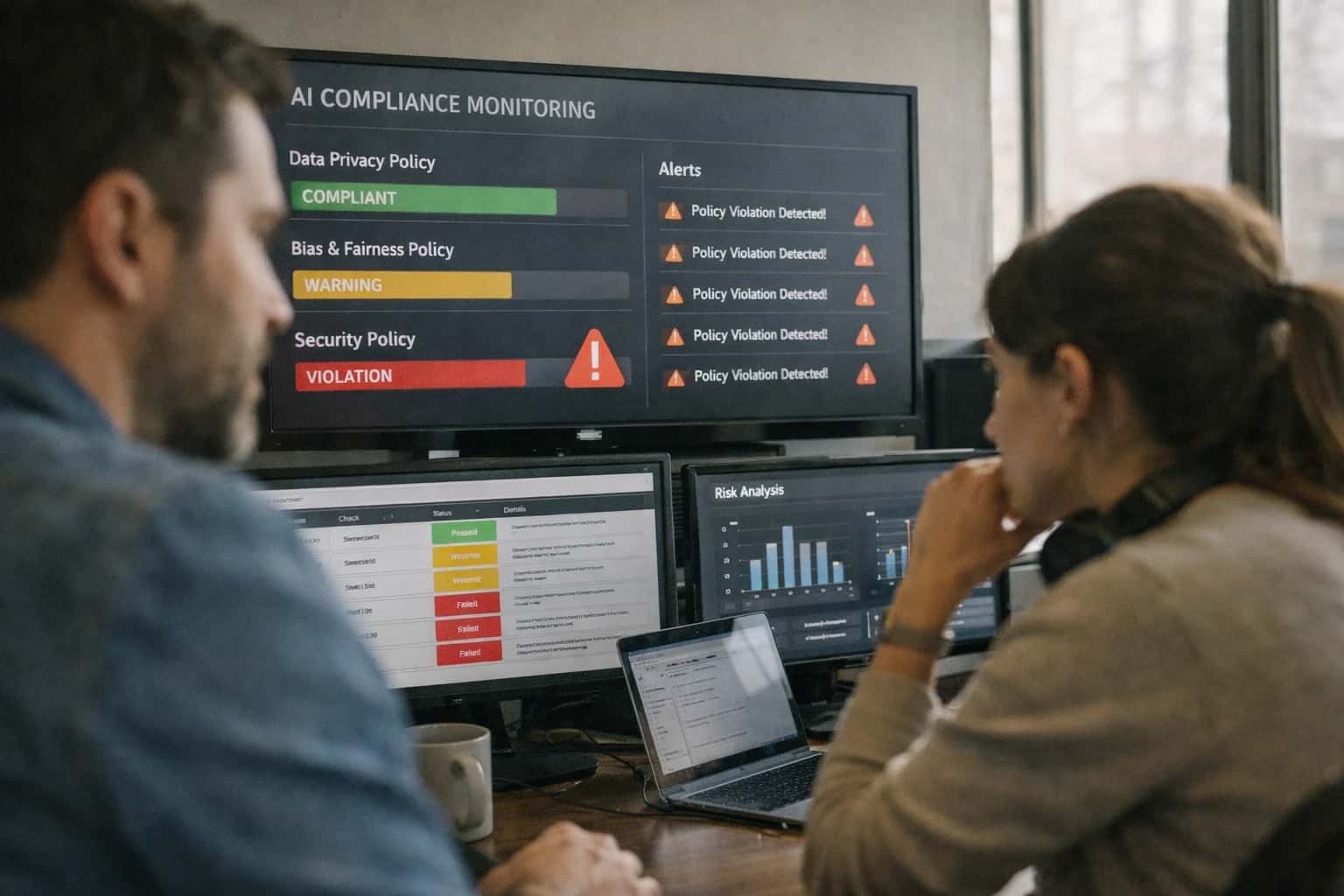
This prompt is designed for RAG platform engineers and quality assurance teams who need to programmatically verify that every claim in a production response is backed by a specific, retrievable source document. The core job-to-be-done is not just to check if citations exist, but to audit their coverage (are all factual claims cited?) and accuracy (does the cited source actually support the claim?). The ideal user is integrating this prompt into a continuous monitoring pipeline where it acts as an automated compliance auditor, processing a stream of production traces that include the final user-facing response, the list of cited document IDs, and the full text of those retrieved documents.

Prompt
Citation Compliance Monitoring Prompt Template
A practical prompt playbook for using Citation Compliance Monitoring Prompt Template in production AI workflows.
PROMPT PLAYBOOK
When to Use This Prompt
Define the job, reader, and constraints for the Citation Compliance Monitoring Prompt Template.
Use this prompt when you have access to the full trace context—specifically the generated_response, retrieved_documents array, and citation_map. It is a post-hoc analysis step, not a real-time generation guardrail. It is most effective when your RAG system already attempts to produce citations and you need to measure its reliability against a defined compliance standard (e.g., '100% of declarative factual statements must have a citation with a confidence score > 0.9'). Do not use this prompt for real-time response filtering due to its inherent latency and cost; instead, use its structured output to trigger asynchronous alerts or to populate a compliance dashboard. It is also unsuitable for evaluating subjective opinions, stylistic choices, or creative text generation where factual grounding is not a strict requirement.
Before deploying this prompt, you must define a clear [COMPLIANCE_POLICY] that specifies what constitutes a violation. A vague policy like 'cite sources' will produce noisy, unactionable results. A strong policy defines specific schemas: for example, 'A citation is non-compliant if the cited text does not contain the key entities from the claim' or 'A missing citation is triggered for any sentence containing a numerical statistic, a named entity, or a technical specification.' The prompt's output is a structured compliance report, not a simple pass/fail boolean. It produces a compliance_score, a list of missing_citations, and a list of inaccurate_citations with trace-level correlation IDs. This detailed output is what allows you to build reliable alert thresholds, such as 'Alert if compliance_score < 0.95 over a 10-minute rolling window.' The next step after reading this section is to prepare your trace data schema and define your organization's specific citation compliance rules before copying the prompt template.
PRACTICAL GUARDRAILS
Use Case Fit
Where the Citation Compliance Monitoring Prompt works, where it fails, and what you must have in place before relying on it in production.
01
Good Fit: Structured RAG Pipelines
Use when: you have a RAG pipeline that logs retrieved chunks, source document IDs, and final responses into a trace store. The prompt excels at correlating claims back to specific chunk IDs and flagging unsupported statements. Guardrail: ensure your trace schema includes retrieved_chunks[].chunk_id, retrieved_chunks[].text, and response.text before running compliance checks.
02
Bad Fit: Black-Box LLM Outputs
Avoid when: you only have the final model response without retrieval traces or source documents. The prompt cannot verify citations if it cannot see what evidence was available to the model. Guardrail: instrument your RAG pipeline to log retrieval results alongside generation output before enabling this monitoring prompt.
03
Required Inputs: Trace Schema Dependencies
Risk: running the prompt without required trace fields produces false negatives or meaningless scores. Guardrail: validate that each trace contains retrieved_chunks array, response.text, response.citations (if present), and source_documents[].doc_id before evaluation. Reject traces that are missing these fields with a schema validation error.
04
Operational Risk: Citation Style Variance
Risk: different RAG implementations use different citation formats (inline numbers, footnote references, parenthetical doc IDs). A single prompt template may misclassify valid citations as missing if the format doesn't match expectations. Guardrail: parameterize the citation format as a [CITATION_PATTERN] variable in the prompt template and validate against your system's specific convention before deployment.
05
Operational Risk: Grounding vs. Attribution Confusion
Risk: the prompt may conflate factual grounding (does the evidence support the claim?) with attribution (is the source cited?). A response can be factually grounded but lack explicit citation markers. Guardrail: split the evaluation into two separate checks: a grounding score (claim-to-evidence match) and an attribution score (citation presence and format). Report both metrics independently in the output schema.
06
Scale Risk: Per-Trace Cost Accumulation
Risk: running a detailed citation compliance prompt on every production trace can become expensive at high volume, especially with long context windows full of retrieved chunks. Guardrail: sample traces based on risk tiers—evaluate 100% of traces from high-stakes domains, use statistical sampling for general traffic, and trigger full evaluation only when aggregate compliance scores breach a threshold.
PROMPT PLAYBOOK
Copy-Ready Prompt Template
A reusable prompt template for evaluating production RAG responses against citation compliance rules, producing structured scores and actionable alerts.
This prompt template is designed to be integrated into a continuous monitoring pipeline. It takes a single production trace—including the user query, retrieved context, final response, and any existing citations—and evaluates it against a configurable set of compliance rules. The output is a structured JSON object containing a compliance score, a list of specific violations, and source-level attribution gaps, ready for ingestion by alerting systems.
textYou are a citation compliance auditor for a production RAG system. Your task is to evaluate a single AI-generated response against a set of citation rules and the provided source documents. ## INPUT **User Query:** [USER_QUERY] **Retrieved Context (source_id: content):** [RETRIEVED_CONTEXT] **Generated Response:** [GENERATED_RESPONSE] **Citation Schema:** Citations in the response are formatted as markdown links: `[source_id]`. ## COMPLIANCE RULES [COMPLIANCE_RULES] ## INSTRUCTIONS 1. **Extract Claims:** Identify every factual claim in the Generated Response. 2. **Verify Citations:** For each claim, check if it is supported by a citation and if that citation points to a valid `source_id` in the Retrieved Context. 3. **Verify Accuracy:** For each cited claim, verify that the content of the cited source accurately and directly supports the claim. Flag any misrepresentation or hallucination. 4. **Check for Gaps:** Identify any factual claims that are missing a required citation. 5. **Check for Orphans:** Identify any citations in the response that point to `source_id`s not present in the Retrieved Context. ## OUTPUT_SCHEMA Return your analysis as a single, valid JSON object conforming to this schema: { "compliance_score": <number 0.0 to 1.0>, "verdict": "compliant" | "non_compliant", "violations": [ { "type": "unsupported_claim" | "missing_citation" | "orphan_citation" | "inaccurate_citation", "claim_text": "<the exact claim text>", "source_id": "<the cited source_id or null>", "reason": "<brief explanation of the violation>" } ], "source_attribution_gaps": [ { "source_id": "<source_id>", "issue": "<description of why this source is a gap, e.g., 'cited but not in context', 'in context but never cited'>" } ] } ## CONSTRAINTS - Base your analysis strictly on the provided User Query, Retrieved Context, and Generated Response. - Do not use outside knowledge. - If no violations are found, the `violations` and `source_attribution_gaps` arrays must be empty. - The `compliance_score` must be 1.0 if and only if there are zero violations.
To adapt this template, replace the [COMPLIANCE_RULES] placeholder with your organization's specific citation policy, such as 'Every factual claim must be cited' or 'Claims derived from source X require a direct quote.' The [RETRIEVED_CONTEXT] should be formatted as a clear mapping of source IDs to their text content. For high-stakes domains, ensure that a human review step is triggered for any non_compliant verdict before the response is surfaced to an end-user or logged as a systemic failure.
IMPLEMENTATION TABLE
Prompt Variables
Required inputs for the Citation Compliance Monitoring Prompt. Each placeholder must be populated before the prompt can evaluate citation coverage and accuracy across production traces.
| Placeholder | Purpose | Example | Validation Notes |
|---|---|---|---|
[TRACE_SPANS] | Raw trace data containing retrieval steps, generated output, and citation markers | JSON array of span objects with span_type, content, and metadata fields | Must contain at least one retrieval span and one generation span. Validate JSON parse succeeds. Reject if spans array is empty. |
[CITATION_SCHEMA] | Expected citation format specification for validation | {"format": "inline_bracket", "pattern": "\[\d+\]", "min_per_claim": 1} | Must be valid JSON with format and pattern fields. Pattern must compile as valid regex. Reject if schema is null or malformed. |
[SOURCE_DOCUMENTS] | Retrieved documents used as evidence for generated claims | Array of {doc_id, content, retrieval_score, index_name} objects | Must contain doc_id and content fields for each document. Validate that doc_ids referenced in citations exist in this array. Null allowed if no retrieval occurred. |
[COMPLIANCE_THRESHOLD] | Minimum acceptable citation coverage score before alerting | 0.85 | Must be a float between 0.0 and 1.0. Values below 0.7 indicate lenient monitoring. Validate type coercion succeeds. Reject if outside range. |
[ALERT_SEVERITY_MAP] | Severity levels mapped to compliance score ranges for alert routing | {"critical": [0.0, 0.5], "warning": [0.5, 0.85], "pass": [0.85, 1.0]} | Must be valid JSON with non-overlapping numeric ranges. Validate that ranges cover 0.0 to 1.0 without gaps. Reject if severity labels are empty. |
[SESSION_METADATA] | Contextual identifiers for trace correlation and alert attribution | {"session_id": "sess_abc123", "prompt_version": "v2.4.1", "model": "claude-3-opus"} | Must include session_id and prompt_version at minimum. Validate that session_id is non-empty string. Used for alert grouping and dashboard drill-down. |
[EVAL_WINDOW] | Time window or session count for aggregation before compliance evaluation | {"unit": "sessions", "count": 100} | Must specify unit and count. Supported units: sessions, minutes, hours. Validate count is positive integer. Reject if window would aggregate fewer than 10 traces. |
PROMPT PLAYBOOK
Implementation Harness Notes
How to wire the Citation Compliance Monitoring prompt into a production RAG pipeline with validation, retries, and trace correlation.
The Citation Compliance Monitoring prompt is designed to run as a post-generation evaluation step, not as part of the primary user-facing response flow. After your RAG system produces an answer with citations, pass the generated answer, the retrieved source documents, and the expected citation schema into this prompt. The model returns a structured compliance report that your application can parse and act on. This separation keeps compliance checking out of the latency-critical generation path and allows you to run it asynchronously or in batch.
Wire the prompt into an evaluation harness that calls your LLM provider's API with response_format set to json_object (or the equivalent structured output mode for your model). The output schema should be validated immediately after the API call returns. At minimum, validate that compliance_score is a float between 0.0 and 1.0, that missing_citations is an array of objects with claim_text and source_document_id fields, and that source_attribution_gaps contains document-level trace correlation identifiers. If validation fails, retry once with the validation errors appended to the prompt as additional [CONSTRAINTS]. After two consecutive validation failures, log the raw output and escalate for human review rather than silently accepting malformed compliance data.
For production observability, attach the compliance report to the original trace span using your observability platform's SDK (OpenTelemetry, Datadog, or custom logging). Tag the span with compliance_score, citation_count, and missing_citation_count as span attributes so they become queryable in dashboards and alert conditions. This enables the continuous monitoring workflows described in sibling playbooks like Trace-Based SLO Threshold Evaluation and Hallucination Rate Monitoring Query. If the compliance score drops below your defined threshold (typically 0.85 for high-trust domains), trigger an alert that includes the trace ID and affected document IDs for rapid root-cause investigation.
Model choice matters here. Use a model with strong instruction-following and structured output capabilities—GPT-4o, Claude 3.5 Sonnet, or Gemini 1.5 Pro are appropriate. Avoid smaller or older models that may hallucinate compliance scores or fail to correlate claims back to specific document chunks. If cost is a concern, consider running this prompt on a sampled percentage of production traffic (e.g., 10% for low-risk queries, 100% for regulated domains) rather than degrading accuracy with a cheaper model. Never use the same model instance that generated the original answer to also evaluate its own citation compliance; this creates a self-review blind spot that masks systematic citation failures.
IMPLEMENTATION TABLE
Expected Output Contract
Fields, types, and validation rules for the citation compliance monitoring prompt output. Use this contract to parse and validate the model response before ingestion into dashboards or alerting pipelines.
| Field or Element | Type or Format | Required | Validation Rule |
|---|---|---|---|
compliance_score | number (0.0-1.0) | Must be a float between 0 and 1 inclusive. Parse as float and check bounds. If null or out of range, trigger retry. | |
citation_coverage_rate | number (0.0-1.0) | Must be a float between 0 and 1 inclusive. Represents fraction of claims with at least one citation. Reject if > 1.0. | |
missing_citation_alerts | array of objects | Must be a JSON array. Each object requires 'claim_text' (string) and 'severity' (enum: 'high', 'medium', 'low'). If empty array, confirm no claims are unsupported. | |
source_attribution_gaps | array of objects | Must be a JSON array. Each object requires 'document_id' (string), 'gap_description' (string), and 'affected_claims_count' (integer >= 0). Null not allowed; use empty array if no gaps. | |
document_level_trace_correlation | object | Must be a JSON object mapping document_id strings to arrays of trace span IDs. Validate that each key is a non-empty string and each value is a non-empty array of strings. | |
citation_schema_validation_errors | array of strings | Must be a JSON array of strings describing format violations. If empty, schema is valid. Each string must be non-empty. Null not allowed. | |
overall_assessment | string | Must be a non-empty string. Must be one of: 'compliant', 'warning', 'non_compliant'. Exact match required. Reject and retry if missing or invalid. | |
trace_span_ids_analyzed | array of strings | Must be a JSON array of non-empty strings. Must contain at least one span ID. Validate format matches expected trace ID pattern (e.g., hex string). |
PRACTICAL GUARDRAILS
Common Failure Modes
Citation compliance monitoring fails in predictable ways. These are the most common failure patterns observed in production RAG systems and the guardrails that catch them before they reach users.
01
Silent Citation Omission
What to watch: The model generates a factual claim that is supported by retrieved context but fails to attach a citation marker, producing an answer that appears unsupported. This is the most common failure mode and often goes unnoticed without automated checks. Guardrail: Implement a post-generation citation density check that flags responses where the ratio of cited claims to total claims falls below a configurable threshold, and route flagged responses for repair or human review.
02
Hallucinated Source Attribution
What to watch: The model cites a document ID, section heading, or page number that does not exist in the retrieved context, creating a false sense of grounding. This is especially dangerous in regulated domains where auditors may trust the citation. Guardrail: Validate every citation reference against the actual retrieved document set using exact-match or fuzzy-match lookup on document IDs, chunk indices, and section headers before the response is returned to the user.
03
Citation-Content Mismatch
What to watch: A citation points to a real document, but the cited passage does not actually support the claim made in the response. The model paraphrased incorrectly or drew an inference the source does not warrant. Guardrail: Run a pairwise entailment check between each cited passage and the claim it supposedly supports, using a lightweight NLI model or an LLM judge prompt that asks whether the passage entails the claim, and flag contradictions or neutral scores.
04
Over-Citation Dilution
What to watch: The model attaches citations to every sentence indiscriminately, including boilerplate transitions, opinions, or common knowledge statements that do not require grounding. This dilutes the signal and makes it harder for reviewers to spot genuinely unsupported claims. Guardrail: Classify each sentence as requiring citation or not based on whether it contains a verifiable factual claim, and enforce a policy that only claim-bearing sentences carry citation markers, reducing noise in compliance dashboards.
05
Context Window Truncation Masking Gaps
What to watch: Retrieved documents are truncated because they exceed the context window, and the model generates an answer without knowing that critical evidence was dropped. The response may appear well-cited but is actually missing the most relevant passages. Guardrail: Log context-window utilization per request and trigger an alert when retrieved documents exceed a safe threshold, forcing either chunk re-ranking, context compression, or an explicit abstention with a note about incomplete evidence.
06
Citation Format Drift Under Load
What to watch: Under high throughput or when the model encounters unusual input patterns, citation formatting degrades—markers become inconsistent, bracketed numbers shift to prose references, or structured citation objects revert to free text. This breaks downstream compliance parsers. Guardrail: Validate every response against the expected citation schema immediately after generation, and if the schema check fails, route the response through a repair prompt that reformats citations before the compliance score is computed.
IMPLEMENTATION TABLE
Evaluation Rubric
Criteria for evaluating the Citation Compliance Monitoring Prompt Template before deployment. Use these tests to verify that the prompt reliably detects citation gaps, suppresses false positives, and produces structured compliance scores.
| Criterion | Pass Standard | Failure Signal | Test Method |
|---|---|---|---|
Citation Coverage Recall | Detects >= 95% of intentionally missing citations in a 50-sample test set | Misses more than 2 known citation gaps; score is inflated | Run against golden set with known citation omissions; compare detected gaps to ground truth |
False Positive Rate | Flags fewer than 5% of correctly cited statements as missing citations | Flags correctly cited statements at > 5% rate; erodes trust in alerts | Feed 50 correctly cited responses; measure false flag rate per statement |
Source Attribution Accuracy | Links each missing-citation alert to the correct document ID from the retrieval trace | Alert references wrong document or null document ID for a verifiable gap | Cross-reference alert document IDs against trace-level retrieved document list |
Schema Compliance | Output matches [OUTPUT_SCHEMA] exactly: all required fields present, correct types, no extra fields | Missing compliance_score, alert_details, or trace_correlation fields; type mismatch on severity enum | Validate output against JSON Schema; reject on additionalProperties or missing required fields |
Severity Classification | Assigns 'critical' to safety/regulated claims without citations; 'warning' to non-critical gaps | Marks a safety claim gap as 'warning' or a minor style gap as 'critical' | Use 10 labeled examples spanning severity levels; check exact match on severity field |
Trace Correlation Accuracy | Each alert includes correct span_id and session_id from the production trace | Span ID references wrong step or is null when trace data is available | Verify span_id against trace JSON; confirm session_id matches parent trace metadata |
Confidence Threshold Behavior | Suppresses alerts when confidence_score < [CONFIDENCE_THRESHOLD]; includes score in output | Emits alert with confidence_score below threshold or omits score entirely | Feed borderline cases at threshold boundary; confirm suppression and score presence |
Multi-Turn Context Handling | Evaluates citations across full conversation context, not just final turn | Misses citation gap from earlier turn when final turn is correctly cited | Test with 3-turn conversations where gap exists in turn 1; verify detection |
Enabling Efficiency, Speed & Accuracy
Intelligent Analysis, Decision & Execution
We build AI systems for teams that need search across company data, workflow automation across tools, or AI features inside products and internal software.
Talk to Us
Search across company data
Give teams answers from docs, tickets, runbooks, and product data with sources and permissions.
Useful when people spend too long searching or get different answers from different systems.
Enterprise searchRAGPermissions
Read more
Automate internal workflows
Use AI to route work, draft outputs, trigger actions, and keep approvals and logs in place.
Useful when repetitive work moves across multiple tools and teams.
AI agentsWorkflow automationGovernance
Read more
Add AI to products and internal tools
Build assistants, guided actions, or decision support into the software your team or customers already use.
Useful when AI needs to be part of the product, not a separate tool.
AI integrationDecision supportModel routing
Read moreADAPTATION OPTIONS
Adapt This Prompt
How to adapt
Start with the base prompt and a single document trace pair. Remove the batch-processing loop and focus on one [RESPONSE_TEXT] and its [RETRIEVED_DOCUMENTS]. Use a lightweight JSON output without the full compliance report envelope—just the claims array and compliance_score. Run manually against 10–20 examples before adding automation.
Watch for
- The model inventing citations when [RETRIEVED_DOCUMENTS] is empty or sparse
- Overly generous
coverage_scorevalues when claims are vague - Missing
source_spanreferences that make verification impossible

About the author
Prasad Kumkar
CEO & MD, Inference Systems
Prasad Kumkar is the CEO & MD of Inference Systems and writes about AI systems architecture, LLM infrastructure, model serving, evaluation, and production deployment. Over 5+ years, he has worked across computer vision models, L5 autonomous vehicle systems, and LLM research, with a focus on taking complex AI ideas into real-world engineering systems.
His work and writing cover AI systems, large language models, AI agents, multimodal systems, autonomous systems, inference optimization, RAG, evaluation, and production AI engineering.
LinkedIn
Limited slotsGet a Free AI Consultation
Partnered with leading AI, data, and software stack.





How We Work
Custom AI workflows for your Business
One-fit-all AI don't work for modern businesses. At Inferensys, we aim to understand your business & custom requirements; which we use to define most efficient agentic workflows, the data, and the tools for your business.
01
Review the use case
We understand the task, the users, and where AI can actually help.
Read more02
Pick the right approach
We define what needs search, automation, or product integration.
Read more03
Build the first useful version
We implement the part that proves the value first.
Read more04
Improve from there
We add the checks and visibility needed to keep it useful.
Read moreThe first call is a practical review of your use case and the right next step.
Talk to Us