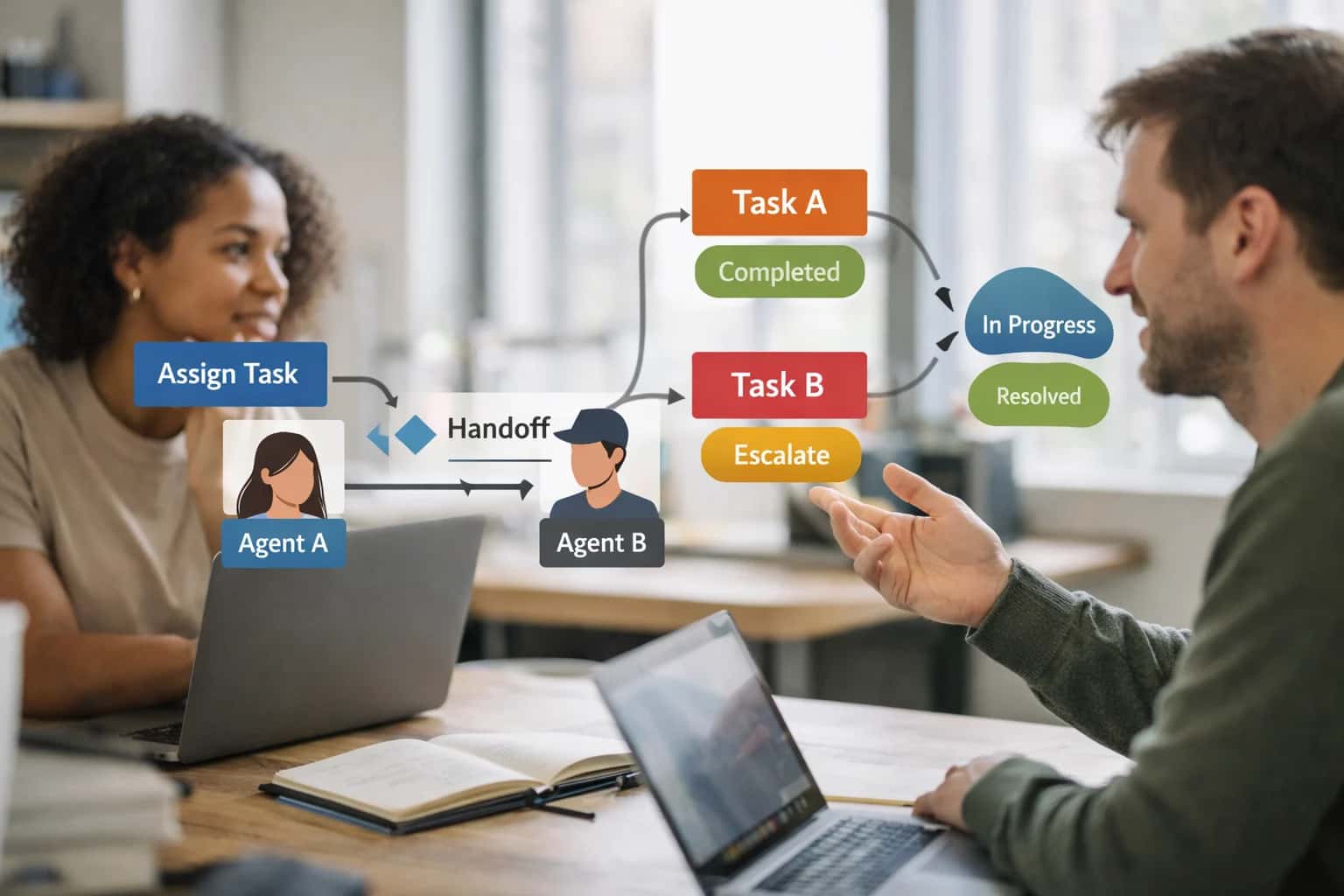
This prompt template is designed for operations teams and platform engineers who need to bridge the gap between autonomous AI agents and human reviewers. Its primary job is to transform raw agent execution traces, tool-call logs, and internal state into a structured, immediately actionable summary for a human operator. The ideal user is a developer or AI architect integrating an agent into a support, moderation, or review workflow where the agent handles routine tasks but must escalate complex, ambiguous, or high-risk cases. The required context includes the agent's original objective, the actions it took, the evidence it gathered, and the specific decision or input now required from the human.

Prompt
Agent-to-Human Handoff Summary Prompt Template
A practical prompt playbook for using Agent-to-Human Handoff Summary Prompt Template in production AI workflows.
PROMPT PLAYBOOK
When to Use This Prompt
Define the job, reader, and constraints for the Agent-to-Human Handoff Summary Prompt Template.
Use this prompt when the cost of a wrong autonomous decision is high, when the agent has exhausted its capability or authority, or when a workflow policy mandates human approval. It is specifically designed for scenarios where the human reviewer is time-constrained and must not read raw logs. Do not use this prompt for simple status updates that don't require a decision, for logging agent activity to a passive audit trail, or for handoffs between two autonomous agents. For agent-to-agent handoffs, use a structured state-transfer object, not a natural-language summary designed for human cognition. This prompt is also inappropriate when the agent's task was trivial and a handoff would create more overhead than value.
Before implementing, define the human's decision space clearly. The prompt must constrain the output to present only the information a human needs to make that specific decision. Avoid the common failure mode of dumping all agent context into the summary. Instead, the harness should filter the agent's trace to include only actions relevant to the pending decision, evidence that supports or contradicts the agent's recommendation, and a clear statement of what the human is being asked to do. The next step is to pair this prompt with an evaluation rubric that checks for completeness, clarity, and the absence of hallucinated actions or evidence.
PRACTICAL GUARDRAILS
Use Case Fit
Where the Agent-to-Human Handoff Summary Prompt works well, where it breaks down, and the operational risks to manage before deploying it into a production review queue.
01
Good Fit: Structured Review Queues
Use when: human reviewers pick up tasks from a queue and need a consistent summary format. The prompt excels at distilling agent actions, pending decisions, and required input into a predictable structure. Guardrail: define a fixed output schema and validate it before the summary enters the queue.
02
Bad Fit: Real-Time Chat Handoffs
Avoid when: a user is waiting in a live chat session and expects an instant human takeover. This prompt produces a structured summary, not a conversational handoff. The latency and format mismatch will frustrate users. Guardrail: use a lightweight context-passing prompt for live handoffs and reserve this template for asynchronous review.
03
Required Inputs: Agent Trace and Task Context
Risk: the prompt cannot fabricate missing agent history. If the agent's action log, original user request, or tool outputs are unavailable, the summary will be hollow. Guardrail: enforce required input fields in the harness. Reject the handoff request if agent_actions, task_context, or pending_decisions are empty or truncated.
04
Operational Risk: Summary Drift Over Time
Risk: as the upstream agent's behavior changes, the handoff summary may silently omit new action types or decision categories. Reviewers learn to trust an incomplete summary. Guardrail: version the handoff prompt alongside the agent prompt. Run periodic eval suites that check for coverage of all expected action categories and decision types.
05
Operational Risk: Over-Summarization of Critical Details
Risk: the model may compress nuanced agent reasoning or ambiguous evidence into a confident-sounding sentence, stripping the human of the context needed to make a different judgment. Guardrail: require the prompt to preserve verbatim key findings, confidence scores, and source excerpts. Add an eval check that flags summaries where critical qualifiers were dropped.
06
Bad Fit: Fully Autonomous Workflows
Avoid when: the system is designed to run without human intervention. Generating a handoff summary for every task in a no-review pipeline wastes tokens and compute. Guardrail: gate the handoff prompt behind an escalation condition. Only invoke it when confidence is below threshold, a policy trigger fires, or a human review step is explicitly configured.
PROMPT PLAYBOOK
Copy-Ready Prompt Template
A reusable prompt template for generating structured agent-to-human handoff summaries with square-bracket placeholders for integration into your application harness.
This template produces a structured handoff summary that a human reviewer can act on without reading raw agent logs. It forces the model to separate what the agent did from what the human needs to decide, and it requires explicit next-step labeling. Use this template when an agent reaches a decision boundary, exhausts its authority, hits a confidence threshold, or encounters an exception that requires human judgment. Do not use it for routine status updates or internal agent-to-agent communication—those need different schemas with less decision framing.
textYou are an agent preparing a handoff summary for a human reviewer. Your goal is to provide exactly the context the human needs to make a decision or take action—no more, no less. Generate a handoff summary using the structure below. Use square-bracket placeholders only where data is unavailable; otherwise, provide the actual value. ## HANDOFF SUMMARY ### Task Context - **Original Request:** [RESTATE_THE_USER_REQUEST_OR_TRIGGERING_EVENT] - **Task ID:** [TASK_IDENTIFIER] - **Agent Role:** [YOUR_ROLE_AND_CAPABILITY_BOUNDARY] - **Handoff Reason:** [WHY_THIS_REQUIRES_HUMAN_INPUT: e.g., confidence below threshold, action outside authority, exception encountered, approval required] ### Actions Taken [List each action you performed, one per line, with outcome] - [ACTION_1] → [OUTCOME_1] - [ACTION_2] → [OUTCOME_2] ### Evidence Collected [For each piece of evidence, include source and relevance] - **Source:** [SOURCE_IDENTIFIER_OR_REFERENCE] - **Excerpt:** [RELEVANT_EXCERPT] - **Relevance:** [WHY_THIS_MATTERS_TO_THE_DECISION] ### Current State - **Completed:** [WHAT_IS_DONE] - **Pending:** [WHAT_REMAINS] - **Blockers:** [ANY_OBSTACLES_PREVENTING_PROGRESS] ### Decision Required - **Question for Human:** [THE_SPECIFIC_QUESTION_YOU_NEED_ANSWERED] - **Options Presented:** [LIST_2-5_OPTIONS_WITH_TRADE_OFFS] - **Recommendation:** [YOUR_RECOMMENDED_OPTION_WITH_RATIONALE] - **Deadline/Urgency:** [TIME_SENSITIVITY_IF_ANY] ### Confidence Assessment - **Overall Confidence:** [HIGH/MEDIUM/LOW] - **Key Uncertainties:** [WHAT_YOU_ARE_UNSURE_ABOUT] - **Worst-Case If Wrong:** [POTENTIAL_IMPACT_OF_INCORRECT_ACTION] ### Next Steps After Human Decision - **If Approved:** [WHAT_HAPPENS_NEXT] - **If Rejected:** [ALTERNATE_PATH] - **If More Info Needed:** [WHAT_CLARIFICATION_IS_REQUIRED] [CONSTRAINTS] - Do not omit any section. If a section has no content, write "None" or "N/A" with a brief explanation. - Cite evidence sources explicitly. Do not summarize evidence without linking it to a source. - If confidence is LOW, the recommendation must include explicit uncertainty language. - Keep the summary under [MAX_WORD_COUNT] words. Prioritize decision-relevant information. - Use plain language. Avoid agent-internal jargon that a human reviewer would not understand.
Adaptation guidance: Replace [MAX_WORD_COUNT] with a concrete limit appropriate to your review interface—typically 300–500 words for a quick review, 800–1,200 for complex decisions. The [CONSTRAINTS] block is where you add domain-specific rules, such as regulatory disclosure requirements, tone policies, or mandatory fields. If your handoff feeds into a ticketing system, add a [TICKET_FIELDS] placeholder for system-mandated metadata. For high-risk domains like healthcare or finance, add a constraint requiring explicit flagging of any action that could cause harm if the human decision is delayed.
Before deploying, test this template against at least three handoff scenarios: a routine approval, an edge-case exception, and a low-confidence escalation. Validate that the output includes all required sections, that evidence citations are traceable to source data, and that the decision question is specific enough for a human to answer without follow-up. If your eval shows that recommendations are consistently overconfident or evidence is thin, tighten the confidence-assessment instructions or add a requirement to list missing evidence explicitly.
IMPLEMENTATION TABLE
Prompt Variables
Required and optional inputs for the Agent-to-Human Handoff Summary prompt. Validate these before sending the prompt to avoid incomplete handoffs.
| Placeholder | Purpose | Example | Validation Notes |
|---|---|---|---|
[AGENT_ID] | Identifies the agent that performed the work | support-triage-agent-v2 | Must match a registered agent ID in the orchestration layer. Non-empty string. |
[TASK_CONTEXT] | Original task or user request the agent was handling | User reported inability to reset MFA token for account ID 88421 | Must contain the original intent. Null not allowed. Check for truncation if sourced from chat logs. |
[ACTIONS_TAKEN] | Ordered list of actions the agent executed |
| Must be a chronological list. Validate each action has a verb and outcome. Empty list triggers a pre-flight rejection. |
[PENDING_DECISIONS] | Decisions that require human judgment before the workflow can proceed | Should we grant temporary MFA bypass for this user given policy exception clause 4.2? | Each decision must be phrased as a question. Minimum 1 decision required for handoff. Null allowed only if task is complete. |
[EVIDENCE_REFERENCES] | Source citations for claims made in the handoff summary | [Doc: MFA-Reset-Policy v3, Section 4.2], [Log: api-reset-attempt-2025-03-15T14:22:01Z] | Each reference must include source type and locator. Validate against a known source registry. Missing evidence for a claim triggers a completeness warning. |
[CONFIDENCE_SCORE] | Agent's self-assessed confidence in its findings (0.0 to 1.0) | 0.72 | Must be a float between 0.0 and 1.0. Scores below [CONFIDENCE_THRESHOLD] should trigger mandatory escalation. Null not allowed. |
[HANDOFF_REASON] | Explicit reason why the task is being handed to a human | Permission boundary reached: agent lacks authority to approve policy exceptions. | Must be one of: capability_boundary, confidence_below_threshold, policy_requires_human, explicit_user_request, repeated_failure. Free-text allowed only with an approved enum prefix. |
[OUTPUT_SCHEMA] | Expected JSON schema for the structured handoff payload | See handoff_output_schema_v2.json | Schema must be versioned and validated before prompt assembly. Mismatched schema version triggers a build error in the harness. |
PROMPT PLAYBOOK
Implementation Harness Notes
How to wire the Agent-to-Human Handoff Summary Prompt into a production application with validation, retries, and review routing.
The Agent-to-Human Handoff Summary Prompt is designed to sit at the boundary between an autonomous agent's execution loop and a human review queue. In a typical implementation, the agent calls this prompt as its final action when it determines that human input is required—either because it has completed its work and needs approval, has encountered an ambiguity it cannot resolve, or has hit a capability boundary. The prompt consumes the agent's internal state (actions taken, evidence gathered, pending decisions) and produces a structured handoff payload that a downstream review system can parse, display, and route. The harness is responsible for ensuring that the handoff is complete, actionable, and traceable before it reaches a human reviewer.
Wire this prompt into your application by wrapping it in a function that accepts the agent's execution trace as input. Before calling the model, assemble the [AGENT_ACTIONS], [EVIDENCE_COLLECTED], [PENDING_DECISIONS], and [REQUIRED_HUMAN_INPUT] fields from the agent's internal state—do not pass raw logs. After receiving the model's output, validate the JSON schema strictly: confirm that required_human_action is a non-empty string, that pending_decisions is an array with at least one item, and that each decision includes a context and options field. If validation fails, retry once with the validation error message appended to the prompt as a correction hint. If the retry also fails, log the failure, attach the raw agent trace as a fallback, and route to a human with a flag indicating that the summary may be incomplete. For high-risk domains such as healthcare or compliance, always require a human to confirm the summary against the raw trace before acting on it.
Model choice matters here. Use a model with strong instruction-following and structured output capabilities—GPT-4o, Claude 3.5 Sonnet, or equivalent. Avoid smaller models that may drop required fields or hallucinate actions the agent did not take. If your agent system already uses tool calling, consider implementing the handoff as a structured tool response rather than a free-text prompt: define a handoff_to_human function with the summary fields as parameters, and have the agent call it directly. This approach gives you schema validation at the tool-calling layer and reduces the risk of malformed JSON. Log every handoff with a unique handoff_id, the agent's session identifier, a timestamp, and the full prompt and response for auditability. Route handoffs to human reviewers based on the priority and category fields in the output—high-priority items should bypass the normal queue and trigger an alert. Finally, capture the human's decision (approved, rejected, modified, escalated) and feed it back into your evaluation pipeline to measure whether handoff summaries are driving correct and timely human actions.
IMPLEMENTATION TABLE
Expected Output Contract
Define the exact shape of the handoff summary payload. Use this contract to build a parser, validator, and downstream routing logic before the prompt goes into production.
| Field or Element | Type or Format | Required | Validation Rule |
|---|---|---|---|
handoff_id | string (UUID v4) | Must match UUID v4 regex; generated by harness, not the model | |
task_summary | string (plain text, max 500 chars) | Must be non-empty and under 500 characters; no markdown allowed | |
agent_actions_taken | array of strings | Must contain at least 1 item; each string under 200 characters; no nested objects | |
pending_decisions | array of objects | Each object must include 'decision_id' (string), 'question' (string, max 300 chars), 'options' (array of strings, min 2), and 'recommendation' (string or null) | |
required_human_input | string (plain text, max 1000 chars) | Must be non-empty; must contain at least one explicit question or action verb; no markdown | |
evidence_package | array of objects | Each object must include 'source_id' (string), 'excerpt' (string, max 500 chars), and 'relevance' (string enum: 'direct' | 'supporting' | 'context') | |
confidence_score | number (0.0 to 1.0) | Must be a float between 0.0 and 1.0 inclusive; null not allowed; parse as float and range-check | |
escalation_reason | string (enum) | If present, must match one of: 'confidence_below_threshold' | 'capability_gap' | 'policy_trigger' | 'human_override_required' | 'edge_case' |
PRACTICAL GUARDRAILS
Common Failure Modes
Agent-to-human handoff summaries fail in predictable ways. These are the most common failure modes and the practical guardrails to prevent them.
01
Missing Decision Point
What to watch: The summary describes what the agent did but never states what the human needs to decide. The reviewer reads a wall of text and still doesn't know what action to take. Guardrail: Require an explicit pending_decision field in the output schema. Validate that it contains a single, specific question the human must answer. Reject summaries where the decision is implied or buried in narrative.
02
Evidence Without Traceability
What to watch: The summary cites 'findings' or 'analysis' without linking back to source records, timestamps, or raw data. The human reviewer cannot verify claims and either trusts blindly or wastes time hunting for sources. Guardrail: Enforce a source_refs array where every factual claim maps to a retrievable source identifier. Add an eval that checks whether each claim in the summary has at least one corresponding source reference.
03
Over-Summarization of Critical Context
What to watch: The agent compresses complex state into a few vague sentences, stripping out the specific error codes, exact user inputs, or configuration details the human needs to act. The handoff is fluent but useless. Guardrail: Define a must_include field list for the output schema based on task type. Validate presence of those fields before surfacing the summary. For high-risk domains, include raw context alongside the summary.
04
False Confidence Presentation
What to watch: The summary presents agent conclusions with definitive language even when the underlying confidence was low or the evidence was ambiguous. The human reviewer is misled into treating uncertain outputs as settled facts. Guardrail: Require a confidence field with an explicit score and a confidence_rationale explaining what lowered it. Add an eval that flags summaries where confidence language doesn't match the score.
05
Actionable Next Steps Omitted
What to watch: The summary explains what happened but doesn't tell the human what to do next. The reviewer must reverse-engineer the required action from context, slowing down the workflow. Guardrail: Require a recommended_actions array with at least one concrete, executable step. Each action must include what to do, what system or record to act on, and the expected outcome. Validate array non-emptiness in the harness.
06
Agent Internal State Leakage
What to watch: The summary includes raw agent reasoning traces, tool-call logs, retry counts, or internal debugging artifacts that confuse the human reviewer. The handoff becomes a debugging dump rather than a decision brief. Guardrail: Separate the human-facing summary from the debugging trace into distinct output sections. Use a human_summary field for the reviewer and a debug_trace field for logging. Validate that the human summary contains no tool-call syntax or internal state references.
IMPLEMENTATION TABLE
Evaluation Rubric
Use this rubric to test the quality of handoff summaries before deploying the prompt into a production agent-to-human workflow. Each criterion targets a specific failure mode observed in agent-generated handoffs.
| Criterion | Pass Standard | Failure Signal | Test Method | |
|---|---|---|---|---|
Actionable Next Step Present | The handoff contains at least one explicit, concrete action for the human reviewer to take, phrased as a directive or question. | The output contains only a summary of agent actions with no clear request for human input or decision. | Parse the output for an imperative sentence or a direct question addressed to the reviewer. Flag if only descriptive past-tense statements are found. | Parse check for directive language; regex for question marks or imperative verbs at the start of a sentence. |
Pending Decision Completeness | Every unresolved decision the agent encountered is listed with its current state, the options considered, and the specific information needed to resolve it. | A pending decision is mentioned without context, or a decision the agent already made is incorrectly listed as pending. | Extract all items under a 'Pending Decisions' section. Verify each has a non-empty state, options array, and required information field. Cross-reference with the agent's action log. | Schema validation against a required fields contract for each pending decision object. |
Evidence Traceability | Every factual claim in the summary is backed by a citation to a source that can be retrieved and verified independently. | A claim is stated as fact without a source reference, or a citation points to a source that does not contain the claimed information. | Parse all citations. For each, attempt to retrieve the source. Check if the cited text supports the claim. Flag any unsupported or hallucinated citations. | Automated retrieval and string-containment check for each citation-claim pair. |
Context Sufficiency | The handoff provides enough background for a human to understand the task without reading the full agent conversation history. | The summary assumes knowledge the human does not have, such as internal agent state, prior conversation turns, or domain jargon without definition. | Present the handoff to a human tester unfamiliar with the original task. Ask them to explain the situation and next steps. Score pass if they can do so without asking clarifying questions. | Blinded human evaluation with a comprehension checklist. |
No Agent Internal State Leakage | The handoff contains no raw tool outputs, internal reasoning traces, or debugging information that would confuse a human reviewer. | The output includes raw JSON from a tool call, internal chain-of-thought text, or system-level error messages not relevant to the business decision. | Scan the output for known internal tool schema patterns, debug flags, or phrases like 'internal reasoning' or 'tool output'. Flag any matches. | Pattern matching against a blocklist of internal tool output signatures. |
Urgency Classification Accuracy | If the handoff includes an urgency or priority level, it matches a predefined taxonomy and is justified by the content of the summary. | The urgency is set to 'critical' for a routine task, or 'low' for a time-sensitive issue, without supporting evidence in the summary. | Extract the urgency field. Compare against the task's actual SLA and the evidence presented. Flag mismatches where the justification does not support the classification. | Rule-based check comparing urgency label against keywords and time-sensitivity indicators in the summary. |
Conciseness Within Token Budget | The handoff summary is complete but does not exceed a predefined token limit, avoiding redundant information. | The summary repeats the same information in multiple sections or includes verbose descriptions of trivial agent actions. | Count output tokens. Check for duplicate sentences across sections using cosine similarity. Flag if token count exceeds the budget or if duplicate clusters are found. | Token counting and intra-document semantic deduplication check. |
Enabling Efficiency, Speed & Accuracy
Intelligent Analysis, Decision & Execution
We build AI systems for teams that need search across company data, workflow automation across tools, or AI features inside products and internal software.
Talk to Us
Search across company data
Give teams answers from docs, tickets, runbooks, and product data with sources and permissions.
Useful when people spend too long searching or get different answers from different systems.
Enterprise searchRAGPermissions
Read more
Automate internal workflows
Use AI to route work, draft outputs, trigger actions, and keep approvals and logs in place.
Useful when repetitive work moves across multiple tools and teams.
AI agentsWorkflow automationGovernance
Read more
Add AI to products and internal tools
Build assistants, guided actions, or decision support into the software your team or customers already use.
Useful when AI needs to be part of the product, not a separate tool.
AI integrationDecision supportModel routing
Read moreADAPTATION OPTIONS
Adapt This Prompt
How to adapt
Start with the base template and a single model call. Skip schema enforcement initially—focus on whether the summary captures the right information. Use plain text output and manually review 10–20 handoffs to calibrate what the model includes and omits.
Replace [AGENT_ACTIONS_TAKEN] with a simple bullet list. Replace [PENDING_DECISIONS] with a free-text field. Keep [REQUIRED_HUMAN_INPUT] as an open-ended question block.
Watch for
- The model inventing actions the agent never took
- Missing the most important pending decision
- Over-summarizing to the point of losing actionable detail
- No way to trace claims back to agent logs

About the author
Prasad Kumkar
CEO & MD, Inference Systems
Prasad Kumkar is the CEO & MD of Inference Systems and writes about AI systems architecture, LLM infrastructure, model serving, evaluation, and production deployment. Over 5+ years, he has worked across computer vision models, L5 autonomous vehicle systems, and LLM research, with a focus on taking complex AI ideas into real-world engineering systems.
His work and writing cover AI systems, large language models, AI agents, multimodal systems, autonomous systems, inference optimization, RAG, evaluation, and production AI engineering.
LinkedIn
Limited slotsGet a Free AI Consultation
Partnered with leading AI, data, and software stack.





How We Work
Custom AI workflows for your Business
One-fit-all AI don't work for modern businesses. At Inferensys, we aim to understand your business & custom requirements; which we use to define most efficient agentic workflows, the data, and the tools for your business.
01
Review the use case
We understand the task, the users, and where AI can actually help.
Read more02
Pick the right approach
We define what needs search, automation, or product integration.
Read more03
Build the first useful version
We implement the part that proves the value first.
Read more04
Improve from there
We add the checks and visibility needed to keep it useful.
Read moreThe first call is a practical review of your use case and the right next step.
Talk to Us