This prompt is designed for the critical merge step in fan-out/fan-in agent architectures. After dispatching work to multiple specialized agents—such as a legal researcher, a financial analyst, and a contract reviewer—you receive raw, unstructured, and potentially conflicting outputs. The job-to-be-done is to fuse these disparate results into a single, structured payload that a downstream synthesis agent or a final reporting agent can consume without confusion, hallucination, or information loss. The ideal user is an orchestration engineer or AI platform builder who has already implemented parallel agent execution and now needs a reliable, programmatic handoff layer rather than an ad-hoc string concatenation.

Prompt
Handoff Context Merging Prompt for Parallel Agent Results
A practical prompt playbook for using Handoff Context Merging Prompt for Parallel Agent Results in production AI workflows.
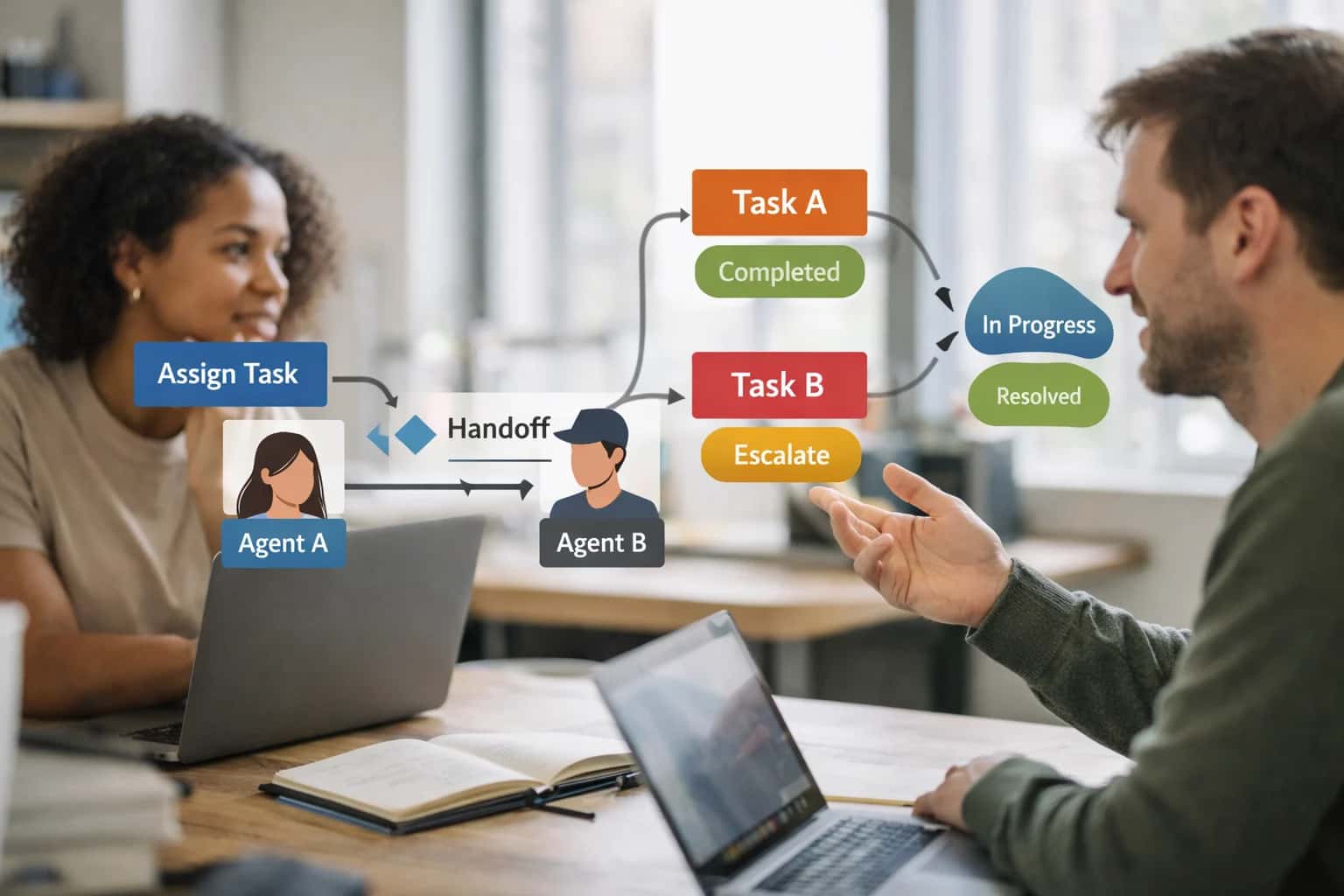
PROMPT PLAYBOOK
When to Use This Prompt
Identify the ideal integration point, required inputs, and failure modes for merging parallel agent outputs into a single coherent handoff context.
Use this prompt when you have two or more agent outputs that overlap in subject matter, may contain contradictory claims, or use different terminology for the same entities. The prompt requires structured inputs: a list of agent outputs with source labels, an optional shared context or original user query, and a defined output schema. It is not suitable for merging outputs from agents that operated on completely unrelated tasks, as the forced reconciliation would create false connections. It is also not a replacement for upstream agent specialization—if your agents are producing wildly divergent formats or low-quality outputs, fix the source agents first. The prompt includes explicit instructions to preserve divergent perspectives when reconciliation is impossible, preventing the common failure mode of forcing a false consensus that hides critical disagreements from downstream agents or human reviewers.
Before integrating this prompt into your pipeline, ensure you have a validation layer that checks the merged output against the expected schema and verifies that no source agent's unique findings were silently dropped. In high-stakes domains like legal, financial, or clinical workflows, always route the merged context through a human review step before it reaches a decision-making agent. The next section provides the copy-ready prompt template with placeholders you can adapt to your specific agent topology and output schema.
PRACTICAL GUARDRAILS
Use Case Fit
Where the Handoff Context Merging Prompt delivers value and where it introduces risk. Use these cards to decide if this prompt fits your orchestration architecture.
01
Good Fit: Parallel Agent Fan-Out
Use when: multiple specialized agents run concurrently on sub-tasks and must produce a single coherent context for a downstream agent. Guardrail: ensure each upstream agent outputs a structured payload with explicit confidence scores before merging.
02
Bad Fit: Sequential Dependency Chains
Avoid when: agents must execute in strict order where each step depends on the previous result. Merging partial parallel outputs creates false dependencies. Guardrail: use sequential handoff prompts instead; reserve merging for true fan-out patterns.
03
Required Input: Structured Agent Outputs
What to watch: the merge prompt fails silently when upstream agents produce unstructured or inconsistent formats. Guardrail: enforce a shared output schema across all parallel agents before invoking the merge step. Validate schema compliance at the orchestration layer.
04
Operational Risk: Conflict Resolution Quality
What to watch: the prompt may reconcile conflicts incorrectly, losing divergent perspectives that a human reviewer would flag. Guardrail: preserve unresolved conflicts in a dedicated unresolved_disagreements field and route to human review when confidence drops below threshold.
05
Operational Risk: Information Loss During Deduplication
What to watch: aggressive deduplication can discard nuanced findings that appear similar but contain distinct evidence. Guardrail: require the prompt to output a deduplication audit log showing which items were merged and why, enabling traceability.
06
Required Input: Merge Priority Rules
What to watch: without explicit tie-breaking rules, the model applies inconsistent heuristics when agents disagree. Guardrail: supply a priority configuration mapping agent roles to precedence levels and specify which agent wins on specific fact types.
PROMPT PLAYBOOK
Copy-Ready Prompt Template
A reusable prompt template for merging parallel agent outputs into a single, conflict-resolved context ready for downstream consumption.
This template is designed to be pasted directly into your orchestration layer. It accepts structured outputs from multiple agents that have worked on the same task concurrently, then produces a merged context document. The prompt resolves factual conflicts, deduplicates overlapping findings, and explicitly preserves divergent perspectives when reconciliation is impossible. Replace every [PLACEHOLDER] with values from your agent framework before execution.
textYou are a context merging engine for a multi-agent orchestration system. Your task is to combine the outputs of [NUMBER] parallel agents into a single, coherent context document for a downstream agent or human reviewer. ## INPUTS You will receive the following inputs: - **Original Task Description:** [TASK_DESCRIPTION] - **Agent Outputs:** A list of [NUMBER] agent outputs, each with an agent identifier, confidence score, and structured result. ```json [AGENT_OUTPUTS]
- Conflict Resolution Policy: [CONFLICT_POLICY]
- Output Schema: [OUTPUT_SCHEMA]
MERGING RULES
- Deduplication: Identify and merge findings that describe the same fact, entity, or conclusion. Keep the version with the highest confidence score and note the supporting agents.
- Conflict Resolution: When agents disagree on a factual claim:
- If [CONFLICT_POLICY] is "majority_vote", select the claim supported by the most agents.
- If [CONFLICT_POLICY] is "highest_confidence", select the claim from the agent with the highest self-reported confidence.
- If [CONFLICT_POLICY] is "escalate", do not resolve; instead, flag the conflict for human review.
- Divergent Perspective Preservation: If agents provide complementary but non-contradictory perspectives, include all perspectives in a "Divergent Views" section. Do not force consensus where none exists.
- Source Attribution: Every merged claim must include a
source_agentsarray listing which agent IDs contributed to it. - Uncertainty Propagation: If any contributing agent expressed low confidence, propagate that uncertainty into the merged output using the
confidencefield and anuncertainty_notesstring.
OUTPUT FORMAT
Return a single JSON object conforming to this schema:
json[OUTPUT_SCHEMA]
CONSTRAINTS
- Do not invent new facts not present in the agent outputs.
- Do not drop findings unless they are exact duplicates.
- If a conflict cannot be resolved per the policy, include both claims in an
unresolved_conflictsarray with arecommended_actionfield set to "human_review". - The merged context must be self-contained and usable without referencing the original agent outputs.
Before wiring this into production, validate that [AGENT_OUTPUTS] conforms to the expected input structure. A common failure mode is passing raw agent text instead of structured JSON, which causes the merge engine to hallucinate findings. Add a pre-validation step in your harness that checks for required fields (agent_id, confidence, result) and rejects malformed inputs before they reach the model. For high-risk domains, always set [CONFLICT_POLICY] to "escalate" and route unresolved conflicts to a human review queue rather than allowing automated resolution.
IMPLEMENTATION TABLE
Prompt Variables
Required inputs for the Handoff Context Merging Prompt. Each variable must be populated before the prompt is assembled. Missing or malformed inputs are the most common cause of merge failures in production.
| Placeholder | Purpose | Example | Validation Notes |
|---|---|---|---|
[AGENT_OUTPUTS] | Array of structured outputs from each parallel agent, including agent identity, task description, findings, confidence scores, and evidence references | [{"agent_id": "legal_review_v2", "task": "Review clause 4.2 for liability exposure", "findings": [...], "confidence": 0.87, "evidence_refs": ["doc_p23_l12"]}] | Schema check: each object must include agent_id, task, findings, confidence (0-1 float), and evidence_refs. Empty array triggers abort. Max 20 agents per merge call. |
[MERGE_STRATEGY] | Instruction for how to handle conflicts: strict consensus, majority vote, preserve all with divergence notes, or escalate on any conflict | preserve_all_with_divergence_notes | Enum check: must be one of strict_consensus, majority_vote, preserve_all_with_divergence_notes, escalate_on_conflict. Invalid value triggers fallback to preserve_all_with_divergence_notes. |
[OUTPUT_SCHEMA] | Expected structure for the merged context, including sections for unified findings, conflicts, unresolved items, and metadata | {"unified_findings": [...], "conflicts": [...], "unresolved": [...], "merge_metadata": {...}} | Schema check: must be a valid JSON Schema object or structured type definition. Missing schema triggers default merge output format. Null allowed if caller handles unstructured output. |
[CONFIDENCE_THRESHOLD] | Minimum confidence score for a finding to be included in unified output without a low-confidence flag | 0.7 | Range check: must be float between 0.0 and 1.0. Defaults to 0.7 if null. Findings below threshold are moved to unresolved section with low_confidence tag. |
[DEDUP_STRATEGY] | Method for identifying and merging duplicate findings across agents: exact match, semantic similarity, or reference overlap | semantic_similarity | Enum check: must be exact_match, semantic_similarity, or reference_overlap. Semantic similarity requires embedding model access. Invalid value triggers exact_match fallback. |
[MAX_CONFLICT_RETRIES] | Number of reconciliation attempts before accepting divergence and flagging for human review | 2 | Range check: integer between 0 and 5. 0 means no retry, conflicts immediately flagged. Retries use re-prompting with conflict context. Null defaults to 1. |
[SOURCE_PRIORITY_HINT] | Optional weighting for agent reliability when resolving conflicts, such as preferring outputs from agents with higher historical accuracy | {"legal_review_v2": 0.9, "contract_analyzer_v1": 0.75} | Schema check: must be object mapping agent_id strings to float weights 0.0-1.0. Null allowed. If provided, weights influence conflict resolution tie-breaking. Missing agents default to 0.5. |
[HUMAN_REVIEW_TRIGGERS] | Conditions that force the merged output into a human review queue instead of automatic acceptance | ["confidence_below_0.6", "conflict_count_gt_3", "regulatory_context"] | Array check: must be list of valid trigger strings. Supported triggers: confidence_below_X, conflict_count_gt_N, regulatory_context, safety_sensitive, missing_evidence. Empty array means no auto-escalation. |
PROMPT PLAYBOOK
Implementation Harness Notes
How to wire the handoff context merging prompt into a production multi-agent orchestration pipeline.
This prompt sits at the convergence point of a parallel agent execution graph. After multiple specialized agents complete their work concurrently, their raw outputs flow into this merging step before any downstream agent or human reviewer receives the combined context. The implementation harness must handle variable arrival times, partial failures, and output format inconsistencies from heterogeneous agents. Treat this prompt as a reducer function in a map-reduce pattern: it consumes a list of agent result objects and produces a single merged context document that resolves conflicts, deduplicates findings, and preserves divergent perspectives when reconciliation fails.
Wire the prompt into your orchestration layer with these concrete integration points. Input assembly: collect agent outputs into a structured array where each element includes agent_id, agent_role, task_description, output, confidence_score, and timestamp. If an agent times out or errors, include a status: failed entry with the error message rather than omitting it—the merging prompt needs to know what's missing. Validation gate: before calling the LLM, validate that at least one agent produced a successful result and that all required fields exist in each agent output object. Reject the merge request if the input array is empty or all agents failed. Retry logic: wrap the LLM call in a retry loop (max 3 attempts) with exponential backoff. On retry, append the previous merge attempt's validation errors to the prompt as additional context so the model can self-correct. Output validation: parse the merged context JSON and run schema validation checks—verify that conflicts array entries include both resolution and unresolved_divergence fields, that deduplicated_findings contains unique entries, and that information_loss_log captures any dropped content with explicit reasons.
For production deployment, add these operational safeguards. Logging: capture the full prompt payload, model response, validation results, and merge latency for every invocation. Store agent output hashes to detect when identical inputs produce different merges across model versions. Human review trigger: if the merge output contains unresolved_divergence entries or the merge_confidence score falls below your threshold (start at 0.7 and calibrate from production data), route the merged context plus raw agent outputs to a human reviewer queue before downstream consumption. Model selection: use a model with strong reasoning and structured output capabilities—GPT-4o or Claude 3.5 Sonnet work well for this task. Avoid smaller models that struggle with multi-document conflict resolution. Idempotency: generate a merge request ID from the sorted agent output hashes so retrying the same merge produces the same result, preventing duplicate downstream processing.
The most common production failure is silent information loss when the model drops findings it considers redundant but aren't. Mitigate this by requiring the information_loss_log field in your output schema and running a post-merge eval that checks whether key facts from each agent's output appear in the merged result. A second failure mode is false consensus where the model resolves a genuine disagreement by picking one side and discarding the other. Your eval suite should include test cases with deliberately conflicting agent outputs and verify that unresolved_divergence entries are preserved. Start with these evals before deploying, and add regression tests whenever a merge failure reaches production.
IMPLEMENTATION TABLE
Expected Output Contract
Fields, types, and validation rules for the merged context payload produced by the Handoff Context Merging Prompt. Use this contract to validate outputs before passing them to downstream agents.
| Field or Element | Type or Format | Required | Validation Rule |
|---|---|---|---|
merged_summary | string (max 500 tokens) | Must contain a coherent synthesis of all agent outputs. Parse check: non-empty, within token limit. Semantic check: no agent output omitted without explicit exclusion reason. | |
conflict_report | array of objects | Each conflict object must include conflicting_agents (array of agent IDs), conflict_description (string), resolution (string enum: resolved, escalated, preserved_divergent). Array must not be empty if conflicts exist. | |
resolved_findings | array of objects | Each finding must include finding_text (string), source_agents (array of agent IDs), confidence (float 0.0-1.0). Schema check: all source_agents must appear in input agent list. No duplicate finding_text after normalization. | |
divergent_perspectives | array of objects | Each perspective must include agent_id (string), perspective_text (string), rationale (string). Required when conflict_report contains preserved_divergent entries. Null allowed when no divergence exists. | |
deduplication_log | array of objects | Each entry must include original_finding (string), duplicate_of (string), removed_agent_sources (array of agent IDs). Schema check: duplicate_of must reference an existing finding in resolved_findings. Empty array allowed if no duplicates found. | |
information_loss_notes | array of strings | Each string must describe a specific piece of information from an agent output that was intentionally excluded, with reason for exclusion. Null allowed if no information was dropped. Approval required if more than 3 loss notes present. | |
merge_confidence_score | float (0.0-1.0) | Overall confidence in merge quality. Must be computed as minimum of individual agent confidence scores adjusted for conflict severity. Validation: score must be <= lowest source agent confidence when unresolved conflicts exist. | |
downstream_agent_readiness | object | Must include ready (boolean), missing_context (array of strings), warnings (array of strings). If ready is false, downstream agent must not be invoked. Parse check: warnings must be non-empty when ready is false. |
PRACTICAL GUARDRAILS
Common Failure Modes
What breaks first when merging parallel agent results and how to guard against it.
01
Silent Information Loss During Deduplication
What to watch: The merging prompt drops findings that appear redundant but contain subtle differences in evidence, confidence, or scope. Two agents may report the same entity with different attributes, and naive deduplication discards the richer record. Guardrail: Require the prompt to output a deduplication log mapping merged items to their source agent outputs. Validate that every source finding appears in either the merged set or the explicit discard list with a reason.
02
False Consensus on Conflicting Results
What to watch: The prompt forces reconciliation when agents genuinely disagree, fabricating a middle-ground answer that neither agent supports. This is common when the prompt prioritizes 'clean output' over accuracy. Guardrail: Add an explicit 'unresolved conflicts' section to the output schema. Set a confidence threshold below which the prompt must preserve divergent perspectives rather than synthesizing a compromise. Validate that conflicting claims are preserved verbatim when reconciliation confidence is low.
03
Context Window Overflow from Parallel Agent Outputs
What to watch: Multiple agent outputs packed into a single merging prompt exceed the model's context window, causing truncation of later results or mid-prompt cutoff. The merge silently operates on incomplete data. Guardrail: Implement pre-merge token counting with a hard budget per agent output. If total inputs exceed the budget, apply lossy compression to each agent output before merging, and flag the merge result with a 'partial-input' warning.
04
Source Attribution Collapse
What to watch: The merged output presents findings without tracking which agent produced them, making downstream debugging and audit impossible. When a merged claim is later found incorrect, there is no way to identify the originating agent or its evidence chain. Guardrail: Require every merged finding to carry a source_agent field and a source_evidence pointer. Validate post-merge that every claim can be traced back to at least one agent output. Fail the merge if attribution coverage drops below 100%.
05
Hallucinated Reconciliation Details
What to watch: The model invents supporting evidence, qualifiers, or nuance to make conflicting agent outputs appear consistent. This is especially dangerous in regulated domains where fabricated details can propagate into downstream decisions. Guardrail: Add a strict grounding constraint: every merged claim must be directly extractable from at least one agent output. Run a post-merge factuality check comparing merged claims against source agent outputs. Flag and remove any claim without a direct source match.
06
Ordering Bias Toward Earlier Agent Outputs
What to watch: The prompt disproportionately weights findings from agents listed first in the input, especially when outputs are long and the model's attention mechanism favors earlier tokens. Later agents' contradictory findings are downweighted or ignored. Guardrail: Randomize agent output ordering in the prompt and run the merge multiple times. Compare results across orderings. If merge output varies significantly by input order, flag the result as unstable and escalate for human review.
IMPLEMENTATION TABLE
Evaluation Rubric
Use this rubric to evaluate the quality of merged context outputs before deploying the Handoff Context Merging Prompt into a production agent pipeline. Each criterion targets a specific failure mode in parallel agent result merging.
| Criterion | Pass Standard | Failure Signal | Test Method |
|---|---|---|---|
Conflict Resolution Quality | All detected conflicts are resolved with explicit rationale or flagged as unresolved with a divergence record | Silent overwrite of one agent's result by another without explanation | Inject two agents with contradictory findings on the same entity; verify output contains either a resolution note or a divergence section for each conflict |
Information Preservation | All unique findings from every input agent appear in the merged output; no fact present in source is absent in merge | A finding present in only one agent's output is dropped from the merged context | Diff each input agent payload against the merged output; flag any fact, value, or entity that exists in a source but not in the merge |
Deduplication Accuracy | Duplicate findings across agents are merged into a single entry with all source agent IDs cited | Same finding appears multiple times in merged output with no deduplication or source attribution | Provide two agents with identical findings; verify merged output contains exactly one instance of the finding with both agent IDs referenced |
Divergent Perspective Retention | When reconciliation fails, divergent perspectives are preserved in a structured disagreement block with agent attribution | Divergent perspectives are collapsed into a single averaged or hedged statement that loses the disagreement | Inject agents with mutually exclusive conclusions on a subjective assessment; verify output contains a divergence block preserving both positions verbatim |
Source Attribution Completeness | Every merged finding includes a traceable reference to the originating agent ID and original evidence snippet | Merged output contains synthesized claims with no source agent or evidence reference | Parse merged output for all factual claims; verify each claim has an agent ID and evidence reference field populated |
Schema Compliance | Merged output passes validation against the defined [OUTPUT_SCHEMA] with no missing required fields or type violations | Output is missing required fields such as conflict_log, divergence_records, or source_map | Run automated schema validator against merged output; check for presence of all required top-level keys and correct nesting |
Confidence Score Calibration | Merged confidence scores for resolved conflicts correlate with agreement level across source agents | High confidence assigned to merged findings where source agents had low individual confidence or high disagreement | Provide agents with varying confidence levels; verify merged confidence is lower when source confidence is low or disagreement is high |
Token Budget Adherence | Merged output stays within the specified [MAX_OUTPUT_TOKENS] constraint without truncating critical information | Output exceeds token budget or truncates mid-record, losing divergence blocks or source attribution | Count output tokens programmatically; verify token count is within budget and that all required sections are complete without mid-field truncation |
Enabling Efficiency, Speed & Accuracy
Intelligent Analysis, Decision & Execution
We build AI systems for teams that need search across company data, workflow automation across tools, or AI features inside products and internal software.
Talk to Us
Search across company data
Give teams answers from docs, tickets, runbooks, and product data with sources and permissions.
Useful when people spend too long searching or get different answers from different systems.
Enterprise searchRAGPermissions
Read more
Automate internal workflows
Use AI to route work, draft outputs, trigger actions, and keep approvals and logs in place.
Useful when repetitive work moves across multiple tools and teams.
AI agentsWorkflow automationGovernance
Read more
Add AI to products and internal tools
Build assistants, guided actions, or decision support into the software your team or customers already use.
Useful when AI needs to be part of the product, not a separate tool.
AI integrationDecision supportModel routing
Read moreADAPTATION OPTIONS
Adapt This Prompt
How to adapt
Start with the base prompt and a single merge pass. Use a lightweight schema—only require merged_summary, resolved_findings, and conflicts arrays. Skip strict enum validation on conflict types. Run with a small set of 2–3 agent outputs and manually review the merge quality.
Prompt modification
Remove the [EVIDENCE_GROUNDING] and [HUMAN_REVIEW_FLAG] sections. Replace [OUTPUT_SCHEMA] with:
json{ "merged_summary": "string", "resolved_findings": [{"finding": "string", "source_agents": ["string"]}], "conflicts": [{"description": "string", "positions": ["string"]}] }
Watch for
- Over-merging: the model collapses divergent views into false consensus
- Missing agent attribution on resolved findings
- Conflicts listed without both positions preserved
- No confidence signals on merged claims

About the author
Prasad Kumkar
CEO & MD, Inference Systems
Prasad Kumkar is the CEO & MD of Inference Systems and writes about AI systems architecture, LLM infrastructure, model serving, evaluation, and production deployment. Over 5+ years, he has worked across computer vision models, L5 autonomous vehicle systems, and LLM research, with a focus on taking complex AI ideas into real-world engineering systems.
His work and writing cover AI systems, large language models, AI agents, multimodal systems, autonomous systems, inference optimization, RAG, evaluation, and production AI engineering.
LinkedIn
Limited slotsGet a Free AI Consultation
Partnered with leading AI, data, and software stack.





How We Work
Custom AI workflows for your Business
One-fit-all AI don't work for modern businesses. At Inferensys, we aim to understand your business & custom requirements; which we use to define most efficient agentic workflows, the data, and the tools for your business.
01
Review the use case
We understand the task, the users, and where AI can actually help.
Read more02
Pick the right approach
We define what needs search, automation, or product integration.
Read more03
Build the first useful version
We implement the part that proves the value first.
Read more04
Improve from there
We add the checks and visibility needed to keep it useful.
Read moreThe first call is a practical review of your use case and the right next step.
Talk to Us