This prompt is designed for platform operators and orchestration engineers who manage multi-agent systems where task contention is a live operational problem. Its job is to resolve conflicts when two or more agents claim ownership of the same task, producing a single, justified assignment decision. The prompt assumes you already have a task router or arbitration service that receives conflicting claims and needs a deterministic, auditable way to select one owner. It is not a general-purpose task dispatcher, a load balancer, or an initial assignment mechanism—use it only when a conflict has been detected and escalated to the arbitration layer.

Prompt
Agent Task Ownership Arbitration Prompt
A practical prompt playbook for using the Agent Task Ownership Arbitration Prompt in production AI workflows to resolve conflicting claims and select a single task owner.
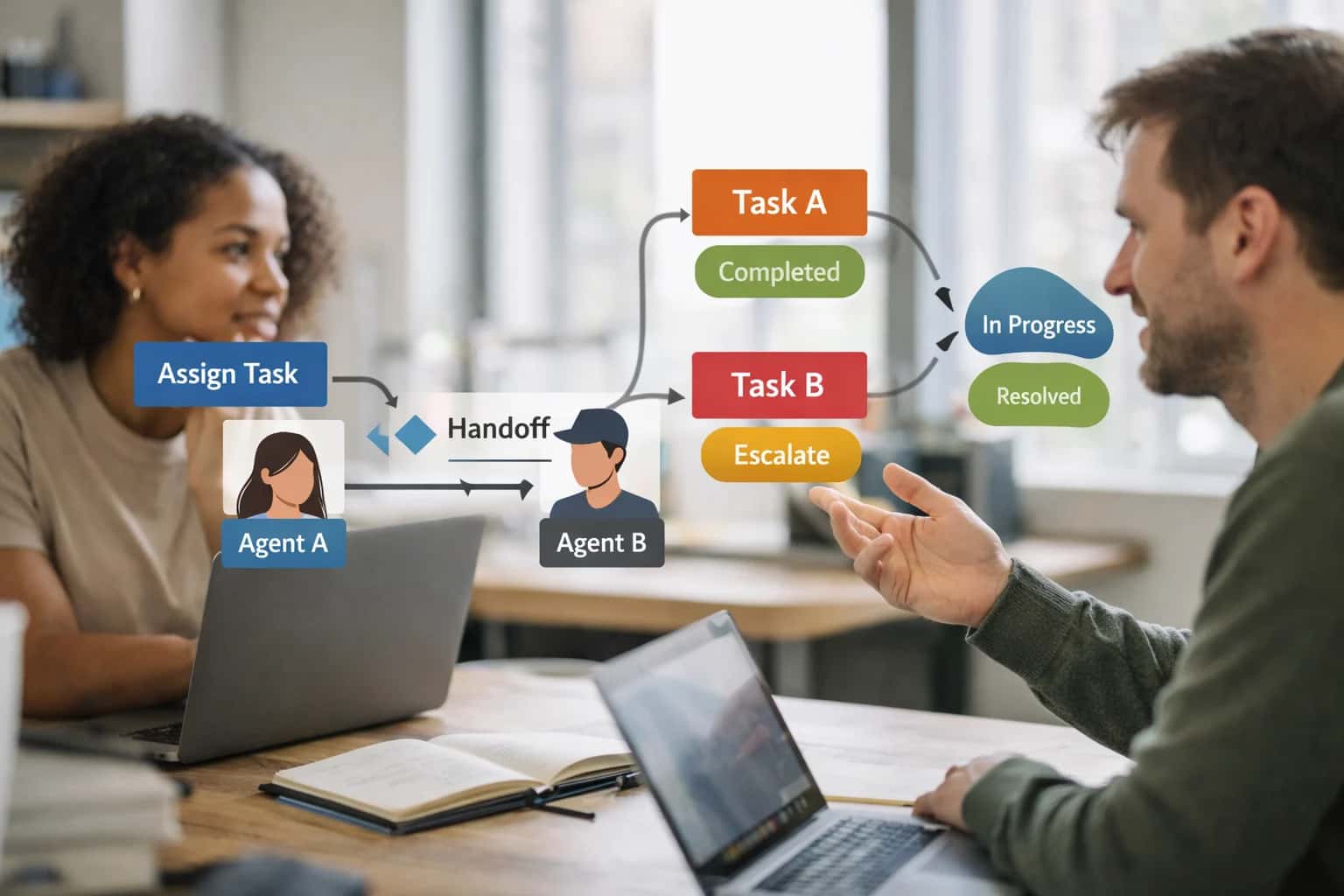
PROMPT PLAYBOOK
When to Use This Prompt
Defines the operational context, required inputs, and boundaries for the Agent Task Ownership Arbitration Prompt.
To use this prompt effectively, each agent claim must include three structured fields: a specialization fit score (how well the agent's declared capabilities match the task requirements), a current load metric (e.g., queue depth, active task count, or utilization percentage), and a claim timestamp (ISO 8601, with timezone). The prompt evaluates these inputs against a defined tie-breaking policy—typically prioritizing specialization fit first, then load, then timestamp—and outputs a structured decision with a justification trace. You must also supply a [CONSTRAINTS] block that defines the arbitration policy (e.g., 'prefer specialization over load balancing' or 'enforce strict FIFO by timestamp') and an [OUTPUT_SCHEMA] that specifies the required fields: selected_agent_id, rejected_agent_ids, justification, and confidence. Without these structured inputs, the prompt will produce inconsistent or unverifiable results.
Do not use this prompt for real-time task assignment where no conflict exists—that path should use a simpler routing prompt with lower latency and cost. Do not use it when claims lack the required metadata fields; the prompt will hallucinate justifications rather than fail gracefully. In high-stakes environments where incorrect ownership could cause data corruption, duplicate mutations, or safety violations, always route the arbitration output through a human approval step before the selected agent proceeds. The next section provides the copy-ready prompt template you can adapt to your arbitration service.
PRACTICAL GUARDRAILS
Use Case Fit
Where the Agent Task Ownership Arbitration Prompt works, where it fails, and the operational prerequisites for safe deployment.
01
Good Fit: High-Contention Agent Pools
Use when: Multiple specialized agents can claim the same task and you need a deterministic owner. Guardrail: The prompt excels when agents have clearly defined capability registries and current load metrics. Feed it structured claim payloads, not free-text agent chatter.
02
Bad Fit: Single-Agent or Statically Routed Systems
Avoid when: Only one agent exists for a task type or a hard-coded router already assigns work. Guardrail: Arbitration adds latency and a failure point. If there is no contention, skip this prompt and use direct dispatch to reduce architectural complexity.
03
Required Inputs: Structured Claim Records
Risk: Arbitration quality collapses if agents submit unstructured justifications. Guardrail: Require each agent to provide a machine-readable claim with agent_id, capability_match_score, current_load, and claim_timestamp. The prompt template expects these fields as [CLAIM_PAYLOADS].
04
Operational Risk: Stale Claims and Zombie Agents
Risk: An agent claims a task, wins arbitration, then crashes. The task is locked but no work happens. Guardrail: Pair this prompt with a [CLAIM_EXPIRY_SECONDS] parameter and an external orchestrator that revokes ownership if a heartbeat or completion signal is not received.
05
Operational Risk: Tie-Breaking Instability
Risk: Two agents with identical scores produce non-deterministic ownership, causing flapping. Guardrail: The prompt must include a deterministic tie-breaker rule (e.g., agent_id lexicographic order). Validate this with a regression test that feeds identical claims and checks for consistent output.
06
Integration Surface: Not a Real-Time Scheduler
Risk: Treating this prompt as a low-latency resource scheduler will cause timeouts. Guardrail: This is a semantic arbitration step, not a kernel scheduler. Run it asynchronously before task dispatch. Use a fast path (round-robin or least-loaded) if sub-100ms decisions are required.
PROMPT PLAYBOOK
Copy-Ready Prompt Template
A reusable prompt with square-bracket placeholders that instructs the model to act as a deterministic arbitrator, weighing specialization, load, and recency to select a single task owner.
This prompt template is the core arbitration instruction you will paste into your model's system or user message. It is designed to be stateless and deterministic: given the same set of claims and agent metadata, it should produce the same owner selection. The template uses square-bracket placeholders that your application must resolve before sending the request. Do not modify the arbitration logic unless you also update the corresponding eval assertions and tie-breaking test cases.
textYou are a deterministic task ownership arbitrator. Your job is to evaluate conflicting claims from multiple agents on a single task and select exactly one owner. You must not split ownership, delegate, or suggest collaboration. Return only the selected owner's agent ID and a structured justification. ## INPUT [AGENT_CLAIMS] ## ARBITRATION RULES 1. **Specialization Fit**: Prefer the agent whose declared specialization most closely matches the task's domain, required tools, and output schema. A perfect match beats a partial match. 2. **Current Load**: If specialization fit is equal, prefer the agent with the lower current load, as indicated by [LOAD_METRICS]. Load is measured by active task count, not queue depth. 3. **Claim Timestamp**: If specialization and load are equal, prefer the earliest claim timestamp. Stale claims older than [STALE_THRESHOLD_SECONDS] seconds must be discarded before comparison. 4. **Tie-Breaking**: If all factors are equal, select the agent with the lexicographically smallest agent ID. This ensures deterministic output. 5. **Single Winner**: You must select exactly one agent. If no valid claims remain after discarding stale ones, return a `no_valid_owner` result. ## CONSTRAINTS - Do not invent agent capabilities not present in [AGENT_CLAIMS]. - Do not consider agents not listed in [AGENT_CLAIMS]. - Do not propose a new agent or a human fallback. - If the task requires capabilities no claiming agent possesses, return `no_valid_owner`. ## OUTPUT_SCHEMA Return a valid JSON object with exactly these fields: { "selected_agent_id": "string | null", "reason": "string", "discarded_claims": [ { "agent_id": "string", "discard_reason": "string" } ] } If no valid owner, set `selected_agent_id` to null and explain why in `reason`.
To adapt this template, replace each placeholder with live data from your agent registry and task queue. [AGENT_CLAIMS] should be a structured array of claim objects, each containing the agent's ID, declared specialization tags, current load metrics, claim timestamp, and any task-relevant capability evidence. [LOAD_METRICS] should be a map of agent IDs to their active task counts. [STALE_THRESHOLD_SECONDS] should match your system's claim expiry policy—typically 30 to 300 seconds depending on task latency requirements. Before deploying, run this prompt against the tie-breaking and stale-claim test scenarios described in the evaluation section of this playbook. If your system operates in a regulated domain, log the full arbitration payload and result for audit review.
IMPLEMENTATION TABLE
Prompt Variables
Inputs the Agent Task Ownership Arbitration Prompt needs to work reliably. Validate these before sending the prompt to the model.
| Placeholder | Purpose | Example | Validation Notes |
|---|---|---|---|
[TASK_DESCRIPTION] | The original task or objective that multiple agents are claiming | Update the payment status for order ORD-8842 to 'refunded' | Must be a non-empty string. Check for truncation if sourced from a log or upstream queue. |
[AGENT_CLAIMS] | A structured list of claims from agents asserting ownership of the task | [{"agent_id": "payments-agent-3", "claim_timestamp": "2024-05-12T14:31:05Z", "rationale": "I own the payments domain", "current_load": 2}] | Must be a valid JSON array with at least 2 claim objects. Each claim must include agent_id, claim_timestamp, and rationale fields. Reject if any claim is missing a timestamp. |
[AGENT_SPECIALIZATIONS] | A registry mapping agent IDs to their declared capabilities and domain fit scores | {"payments-agent-3": {"domains": ["billing", "refunds"], "fit_score": 0.95}} | Must be a valid JSON object. Every agent_id in [AGENT_CLAIMS] must have a corresponding entry. Fit scores must be numeric between 0 and 1. |
[CURRENT_WORKLOADS] | The current task queue depth or load metric for each claiming agent | {"payments-agent-3": 2, "order-agent-1": 5} | Must be a valid JSON object. Load values must be non-negative integers. Missing agents default to a load of 0, but log a warning. |
[STALENESS_THRESHOLD_SECONDS] | The maximum age of a claim in seconds before it is considered stale and ignored | 300 | Must be a positive integer. Claims with timestamps older than this threshold relative to the arbitration time are excluded before evaluation. |
[TIE_BREAKING_POLICY] | A rule string specifying how to resolve ties when specialization fit and load are equal | earliest_claim_timestamp | Must be one of: earliest_claim_timestamp, lowest_agent_id_lexical, random_with_log. Reject any unrecognized policy value. |
[OUTPUT_SCHEMA] | The exact JSON schema the arbitration output must conform to | {"type": "object", "properties": {"selected_agent_id": {"type": "string"}, "reasoning": {"type": "string"}}, "required": ["selected_agent_id", "reasoning"]} | Must be a valid JSON Schema object. The prompt's output is validated against this schema post-generation. Reject the prompt if the schema is not parseable. |
PROMPT PLAYBOOK
Implementation Harness Notes
How to wire the arbitration prompt into an agent orchestration service with validation, retries, and logging.
This prompt should be deployed as a stateless arbitration service called by your agent orchestrator whenever a claim conflict is detected on a task queue. The orchestrator collects all active claims for a given task ID, packages them into the [CONFLICTING_CLAIMS] input, and calls this prompt to produce a single ownership decision. The prompt does not modify the task queue directly—it returns a structured verdict that the orchestrator enforces by revoking losing claims and confirming the winner. Keep the prompt stateless: do not rely on conversation history or session memory. Every call must be self-contained with all evidence provided in the input payload.
Validation and retry logic is critical because an invalid arbitration output can orphan tasks or grant ownership to an agent that has already timed out. After receiving the model response, validate the JSON schema strictly: selected_agent_id must match one of the input claim's agent_id values, reasoning must be a non-empty string, and tie_breaking_factors must be an array of strings. If validation fails, retry once with the same input and an additional [CONSTRAINTS] note flagging the specific validation error. If the second attempt also fails, escalate to a human operator with the full claim set and both failed responses. Log every arbitration call—including input claims, model output, validation result, and final enforced decision—to an append-only audit table. This log becomes your evidence trail for debugging ownership disputes and measuring arbitration accuracy over time.
Model choice and latency budget matter here. This prompt requires careful reasoning over structured evidence, not creative generation. Use a model with strong JSON-following behavior and low hallucination rates on structured comparison tasks. Latency should be budgeted at 2–5 seconds for the arbitration call, including validation. If your orchestrator cannot block that long, implement an asynchronous arbitration pattern: queue the conflict, call the prompt, and apply the verdict to the next scheduling cycle. Do not skip arbitration under load—unresolved claim conflicts compound into duplicate work and state corruption. For high-throughput systems, consider caching recent arbitration decisions keyed by a hash of the sorted claim set to avoid re-arbitrating identical conflicts within a short window.
Tool use and RAG are not required for this prompt. The arbitration decision depends entirely on the claim data provided in the input. Do not inject external context or retrieval results unless your claim records are incomplete and you have a verified source of agent capability metadata. If you do enrich claims with agent capability profiles, add them to the [CONTEXT] section of the prompt template and ensure the enrichment happens before the arbitration call, not inside it. Human review is required when the prompt returns a confidence score below your threshold, when tie-breaking factors are contradictory, or when the losing claim has a timestamp older than your stale-claim expiry window but the agent is still actively reporting. In these cases, surface the full arbitration payload to a review queue with a clear summary of what the model decided and why it was uncertain.
IMPLEMENTATION TABLE
Expected Output Contract
The arbitration prompt must return a single, unambiguous ownership decision. Use this contract to validate the JSON response before passing it to the task router or claim registry.
| Field or Element | Type or Format | Required | Validation Rule |
|---|---|---|---|
assigned_agent_id | string | Must match an agent_id from the input [AGENT_CLAIMS] array. Reject if null or empty. | |
task_id | string | Must exactly match the [TASK_ID] input. Schema check: string equality. | |
decision_rationale | string | Must be non-empty and reference at least one field from the winning agent's claim (specialization, load, or timestamp). | |
confidence_score | number | Must be a float between 0.0 and 1.0 inclusive. Reject if below [CONFIDENCE_THRESHOLD]. | |
tie_breaker_applied | string | If present, must be one of: 'timestamp', 'load', 'specialization', 'random'. Required when multiple agents have identical scores. | |
stale_claims_discarded | array of strings | Each element must be an agent_id present in [AGENT_CLAIMS] whose claim timestamp exceeds [STALE_THRESHOLD_SECONDS]. Empty array is valid. | |
escalation_required | boolean | Must be true if confidence_score is below [CONFIDENCE_THRESHOLD] or if no claims remain after discarding stale ones. False otherwise. |
PRACTICAL GUARDRAILS
Common Failure Modes
When multiple agents claim the same task, arbitration prompts break in predictable ways. Here are the most common failure modes and how to guard against them before they reach production.
01
Stale Claim Stalemate
What to watch: An agent holds an expired claim but the arbitration prompt treats it as valid because the timestamp field is present. The rightful owner is blocked while the stale claimant sits idle. Guardrail: Require the prompt to evaluate claim_expiry against a current timestamp input. Add an explicit rule: 'If claim.expiry < [CURRENT_TIME], treat the claim as void and exclude it from arbitration.' Test with claims expired by 1 second, 1 hour, and 1 week.
02
Specialization Fit Ambiguity
What to watch: Two agents have overlapping capability descriptions, and the arbitration prompt cannot reliably distinguish which is a better fit. The model defaults to first-in-list or random selection, producing non-deterministic ownership. Guardrail: Include a structured capability_match scoring step in the prompt that requires the model to output explicit fit scores per agent before selecting. Validate that tie scores trigger a defined tie-breaker rule, not silent selection.
03
Load Metric Gaming
What to watch: Agents report artificially low load to win arbitration, or load metrics are defined inconsistently across agents (queue depth vs. CPU utilization vs. active task count). The prompt selects a busy agent because the metric is incomparable. Guardrail: Normalize load to a single comparable unit in the prompt input schema (e.g., active_task_count). Add a validation step that rejects claims where load metrics are missing or outside expected ranges. Test with agents reporting zero load and agents reporting null load.
04
Timestamp Ordering Bias
What to watch: The prompt overweights claim_timestamp and always picks the earliest claimant, even when that agent is a poor specialization fit or is overloaded. This turns arbitration into a race condition rather than a fitness decision. Guardrail: Structure the prompt with weighted criteria: specialization fit (highest weight), current load (medium weight), claim timestamp (lowest weight, used only for tie-breaking). Include eval cases where the earliest claimant should lose due to poor fit or high load.
05
Missing Claim Evidence
What to watch: An agent submits a claim with incomplete or missing evidence fields (empty specialization rationale, null capability scores). The prompt treats missing evidence as neutral rather than disqualifying, awarding ownership to an unverified claimant. Guardrail: Add a pre-arbitration validation step: 'If any required claim field is null or empty, exclude that agent from arbitration and log a claim-rejection event.' Test with agents submitting empty claims, partial claims, and claims with placeholder text.
06
Double-Assignment Drift
What to watch: The arbitration prompt runs twice in quick succession for the same task due to a retry or duplicate dispatch. Each run selects a different agent because agent load changed between invocations, creating two owners for one task. Guardrail: Include the task's idempotency key in the prompt input and instruct: 'If a prior arbitration decision exists for task_id [TASK_ID] and was made within the last [COOLDOWN_SECONDS], return the existing decision without re-evaluating.' Test with rapid duplicate invocations.
IMPLEMENTATION TABLE
Evaluation Rubric
Run these test cases against your configured prompt and model to validate arbitration behavior before deployment. Each criterion targets a specific failure mode in task ownership arbitration.
| Criterion | Pass Standard | Failure Signal | Test Method |
|---|---|---|---|
Clear specialization fit | Selected agent has the highest specialization match score for the task domain | Agent selected despite lower specialization score than another claimant | Provide 3 agents with distinct specializations and a task clearly matching one; verify selection |
Load-aware selection | Agent with lower current load wins when specialization scores are within 5% | Overloaded agent selected over equally-specialized idle agent | Set two agents with equal specialization scores but different load levels; verify idle agent wins |
Stale claim rejection | Claims older than [STALE_THRESHOLD_SECONDS] are excluded from arbitration | Stale claim included in candidate set or selected as owner | Inject a claim with timestamp exceeding threshold; verify it is filtered before selection |
Tie-breaking by timestamp | When specialization and load are equal, earliest claim timestamp wins | Random or non-deterministic selection when scores are tied | Submit two identical claims with different timestamps; verify earlier timestamp wins consistently across 5 runs |
Single owner output | Exactly one agent ID returned in [OWNER_ID] field; no ties in final output | Multiple agent IDs returned or null owner when valid claimants exist | Parse output schema; assert [OWNER_ID] is a single non-null string when claimants are present |
Confidence score calibration | [CONFIDENCE_SCORE] is >= 0.8 when clear winner exists, <= 0.5 when scores are ambiguous | High confidence returned for near-tie or low confidence for clear winner | Test with clear-specialization case (expect >= 0.8) and near-equal case (expect <= 0.5) |
Reasoning trace completeness | [RATIONALE] field references specialization, load, and timestamp for selected agent | Rationale missing one or more decision factors or referencing non-claimant agent | String-match check that [RATIONALE] contains specialization, load, and timestamp keywords |
Empty claimant list handling | Returns null [OWNER_ID] and [CONFIDENCE_SCORE] of 0 when no claimants provided | Hallucinated agent ID or non-zero confidence with empty input | Submit empty [CLAIMANTS] array; verify null owner and zero confidence |
Enabling Efficiency, Speed & Accuracy
Intelligent Analysis, Decision & Execution
We build AI systems for teams that need search across company data, workflow automation across tools, or AI features inside products and internal software.
Talk to Us
Search across company data
Give teams answers from docs, tickets, runbooks, and product data with sources and permissions.
Useful when people spend too long searching or get different answers from different systems.
Enterprise searchRAGPermissions
Read more
Automate internal workflows
Use AI to route work, draft outputs, trigger actions, and keep approvals and logs in place.
Useful when repetitive work moves across multiple tools and teams.
AI agentsWorkflow automationGovernance
Read more
Add AI to products and internal tools
Build assistants, guided actions, or decision support into the software your team or customers already use.
Useful when AI needs to be part of the product, not a separate tool.
AI integrationDecision supportModel routing
Read moreADAPTATION OPTIONS
Adapt This Prompt
How to adapt
Use the base prompt with a single model call and no external state. Replace the agent registry and load metrics with hardcoded example arrays. Skip timestamp validation and stale-claim eviction logic. Focus on getting the arbitration reasoning right before adding infrastructure.
code[AGENT_CLAIMS] = [ {"agent_id": "A1", "specialization": "billing", "current_load": 3, "claim_timestamp": "2025-01-01T10:00:00Z"}, {"agent_id": "A2", "specialization": "billing", "current_load": 1, "claim_timestamp": "2025-01-01T10:01:00Z"} ]
Watch for
- Model picking the first agent in the list instead of reasoning about fit
- Ignoring load when specialization matches for both agents
- No handling for claims with identical timestamps

About the author
Prasad Kumkar
CEO & MD, Inference Systems
Prasad Kumkar is the CEO & MD of Inference Systems and writes about AI systems architecture, LLM infrastructure, model serving, evaluation, and production deployment. Over 5+ years, he has worked across computer vision models, L5 autonomous vehicle systems, and LLM research, with a focus on taking complex AI ideas into real-world engineering systems.
His work and writing cover AI systems, large language models, AI agents, multimodal systems, autonomous systems, inference optimization, RAG, evaluation, and production AI engineering.
LinkedIn
Limited slotsGet a Free AI Consultation
Partnered with leading AI, data, and software stack.





How We Work
Custom AI workflows for your Business
One-fit-all AI don't work for modern businesses. At Inferensys, we aim to understand your business & custom requirements; which we use to define most efficient agentic workflows, the data, and the tools for your business.
01
Review the use case
We understand the task, the users, and where AI can actually help.
Read more02
Pick the right approach
We define what needs search, automation, or product integration.
Read more03
Build the first useful version
We implement the part that proves the value first.
Read more04
Improve from there
We add the checks and visibility needed to keep it useful.
Read moreThe first call is a practical review of your use case and the right next step.
Talk to Us