This prompt is designed for operations teams and platform engineers who need to insert a structured human review step when multiple agents produce conflicting, ambiguous, or high-risk outputs that automated arbitration cannot resolve with sufficient confidence. The job-to-be-done is producing a complete, self-contained handoff package that a human reviewer can act on without reading raw agent logs, reconstructing conversation context, or querying external systems. The ideal user is an SRE, ops engineer, or product manager responsible for a production agent pipeline where the cost of an incorrect autonomous decision—such as a wrong financial transaction, a misleading customer communication, or a safety-critical misclassification—exceeds the cost of human review latency. Required context includes the original user request, the conflicting agent outputs, any shared evidence or source documents the agents used, the arbitration attempt and its confidence score, and the specific decision the human must make. Without this context, the handoff package forces the reviewer to hunt for information, defeating the purpose of structured escalation.

Prompt
Agent Arbitration with Human-in-the-Loop Escalation Prompt Template
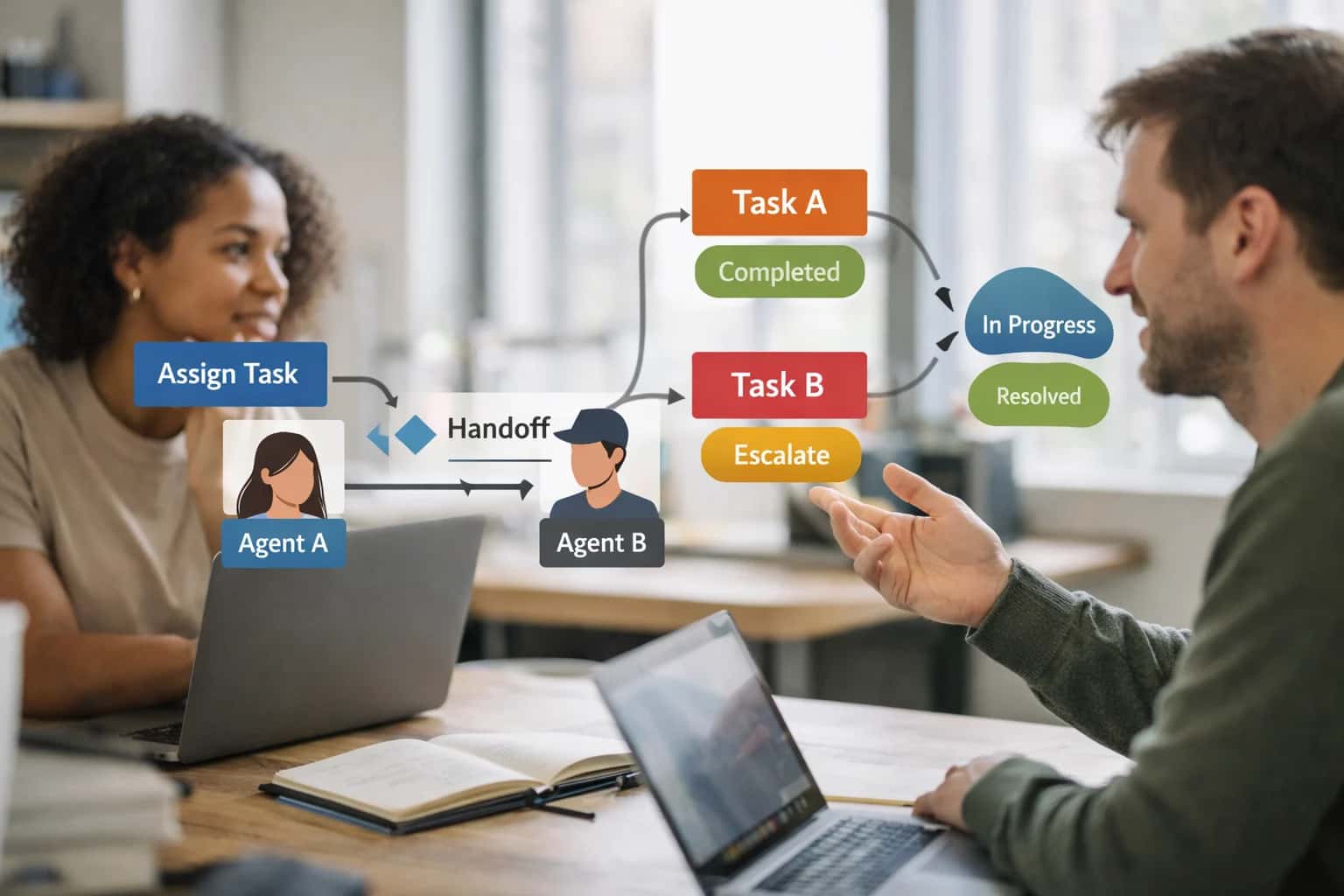
When to Use This Prompt
Defines the operational conditions, user profile, and risk thresholds that justify inserting a structured human review step into an agent arbitration pipeline.
Use this prompt when automated arbitration returns a confidence score below your production threshold, when the conflict involves a high-risk domain (finance, healthcare, safety, legal), when the disagreement is structural rather than superficial (e.g., agents propose incompatible schemas or mutually exclusive actions), or when your system's policy requires human approval for certain action types regardless of confidence. The prompt is also appropriate when the arbitration judge itself flags uncertainty, when the cost of reversal is high, or when you need an audit trail showing that a human reviewed the decision. Do not use this prompt for low-stakes disagreements where a simple vote or confidence-weighted merge is sufficient, when the review SLA is shorter than the time required for a human to read the package, or when the conflict is purely cosmetic (e.g., wording differences with no operational impact). Over-escalating creates reviewer fatigue and slows down the pipeline without improving outcomes.
Before wiring this prompt into production, define your escalation thresholds explicitly: minimum arbitration confidence, maximum acceptable risk level for autonomous decisions, and the list of action types that always require human review. Instrument the handoff with latency tracking, reviewer decision logging, and periodic audits to check whether escalated decisions actually change outcomes—if human reviewers consistently rubber-stamp the top agent's output, your thresholds may be too conservative or your handoff package may not surface the real decision tension. The next step after reading this section is to review the prompt template and adapt the escalation criteria to match your system's risk policy and operational SLAs.
Use Case Fit
Where this prompt works and where it does not. Understand the operational boundaries before wiring it into a production pipeline.
Good Fit: High-Stakes Agent Disagreements
Use when: Multiple agents produce conflicting outputs on a decision with significant business, safety, or user-facing impact. Guardrail: The prompt structures a complete handoff package, ensuring the human reviewer has the conflict summary, agent positions, and evidence alignment needed to make an informed decision without redoing the work.
Bad Fit: Low-Risk, High-Volume Triage
Avoid when: The conflict is over a low-stakes classification or routing decision that can be resolved by a simple confidence threshold or voting mechanism. Guardrail: Human review is expensive and slow. Reserve this prompt for cases where the cost of a wrong automated decision exceeds the cost of human latency.
Required Inputs: Structured Conflict Data
Risk: The prompt will fail to produce a useful handoff if the incoming agent outputs are unstructured, missing evidence, or lack confidence scores. Guardrail: Enforce a strict input contract. The upstream arbitration system must provide agent identifiers, their full outputs, the conflicting claims, and the evidence each agent used before this prompt is invoked.
Operational Risk: Reviewer Queue Overload
Risk: A spike in agent disagreements can flood the human review queue, leading to delayed decisions and reviewer fatigue. Guardrail: Implement circuit breakers. If the escalation rate exceeds a threshold, the system should fall back to a safe, conservative automated decision and alert the operations team to investigate the root cause of the agent instability.
Operational Risk: Incomplete Handoff Package
Risk: The prompt may omit critical context, such as the user's original request or the downstream consequences of each agent's proposed action, forcing the reviewer to seek external information. Guardrail: Validate the generated handoff package against a completeness checklist before it enters the queue. Reject and re-prompt if required sections like 'Conflict Summary' or 'Evidence Alignment' are missing.
Bad Fit: Real-Time, Sub-Second Decisions
Avoid when: The arbitration must happen in milliseconds, such as in a real-time bidding or live conversation flow where any human-introduced latency is unacceptable. Guardrail: For time-sensitive paths, use a lightweight automated arbiter like a confidence-weighted selection prompt. This human-in-the-loop prompt is designed for asynchronous review queues where a decision in minutes is acceptable.
Copy-Ready Prompt Template
A reusable escalation prompt that structures agent conflict data into a clear decision package for a human reviewer.
This prompt template is designed to be the final step in your automated arbitration pipeline. When your primary arbitration logic fails to resolve a conflict between agents—whether due to low confidence scores, irreconcilable factual differences, or a risk level that exceeds your autonomous threshold—this prompt assembles a structured handoff package. It takes the raw, conflicting outputs and transforms them into a concise brief for a human reviewer, ensuring they have the context needed to make a fast, informed decision without digging through logs.
textYou are an escalation handler for a multi-agent system. Your task is to prepare a structured review package for a human operator when automated arbitration has failed. Do not make a decision. Synthesize the conflict clearly and neutrally. [CONTEXT] [CONFLICT_SUMMARY] [AGENT_OUTPUTS] [EVIDENCE_ALIGNMENT] [CONSTRAINTS] - Do not resolve the conflict. Your role is to prepare the information for a human reviewer. - Preserve all direct quotes and citations from the source agents. - Explicitly state where agents agree and where they diverge. - If any agent output is missing required fields, flag it as incomplete. - Adhere strictly to the [OUTPUT_SCHEMA]. [OUTPUT_SCHEMA] { "escalation_id": "string, unique identifier for this review instance", "conflict_type": "string, classification of the disagreement (e.g., factual, structural, policy)", "risk_level": "string, one of: low, medium, high, critical", "summary": "string, a 2-3 sentence neutral summary of the conflict and why it requires human review", "agent_positions": [ { "agent_id": "string", "position": "string, the core claim or output of this agent", "confidence": "number, the agent's self-reported confidence score", "key_evidence": ["string, a cited piece of evidence supporting this position"] } ], "points_of_agreement": ["string, a fact or output field where all agents concur"], "points_of_contention": ["string, a specific fact or field where agents disagree"], "pending_decision": "string, the single, clear question the human reviewer must answer", "decision_options": ["string, a discrete option the reviewer can choose"], "irreconcilable_flag": "boolean, true if no automated resolution path remains" } [RISK_LEVEL]
To adapt this template, wire it into your escalation handler as a fallback. The [CONFLICT_SUMMARY] should be a pre-processed, concise description of the disagreement generated by your conflict detection step. The [AGENT_OUTPUTS] placeholder should contain the raw, unmodified outputs from each conflicting agent. The [EVIDENCE_ALIGNMENT] section is critical for high-stakes domains; it should map each agent's claims to the specific source documents or data they used. Before sending the final package to a human, validate the generated JSON against the [OUTPUT_SCHEMA] to ensure no required fields are missing, which would defeat the purpose of a structured handoff.
Prompt Variables
Placeholders the Agent Arbitration with Human-in-the-Loop Escalation prompt requires. Validate each before calling the model to prevent malformed handoff packages or missing evidence.
| Placeholder | Purpose | Example | Validation Notes |
|---|---|---|---|
[CONFLICT_SUMMARY] | Brief description of the disagreement between agents | Agent A claims the user is eligible for a refund under policy 4.2; Agent B claims policy 4.2 was superseded by policy 4.3a. | Must be non-empty string; max 500 words. Reject if it contains only agent names with no substantive disagreement description. |
[AGENT_POSITIONS] | Structured record of each agent's output, rationale, and confidence | Agent A: Output='Approve refund of $45.00', Rationale='Policy 4.2 allows refunds within 30 days', Confidence=0.92 | Must be valid JSON array with at least 2 entries. Each entry requires 'agent_id', 'output', 'rationale', and 'confidence' fields. Confidence must be float 0.0-1.0. |
[EVIDENCE_ALIGNMENT] | Mapping of claims to source evidence across agents | Claim: 'Refund window is 30 days' -> Agent A cites Policy 4.2; Agent B cites Policy 4.3a with effective date 2025-01-15. | Must be valid JSON array. Each entry requires 'claim', 'agent_sources' map, and 'conflict_flag' boolean. Reject if no evidence citations are present. |
[DECISION_POINTS] | Specific questions the human reviewer must answer |
| Must be non-empty array of strings. Each question must be actionable and answerable. Reject if questions are rhetorical or already answered in agent positions. |
[ESCALATION_REASON] | Why this conflict could not be resolved automatically | Confidence threshold not met: Agent A=0.92, Agent B=0.88, both below arbitration threshold of 0.95. Policy version conflict requires human interpretation. | Must be non-empty string. Reject if reason is 'low confidence' without specific scores or if it describes a resolvable technical error rather than a genuine ambiguity. |
[REVIEWER_INSTRUCTIONS] | Guidance for the human reviewer on how to evaluate and respond | Review the policy version conflict. Select which policy applies and provide a 1-2 sentence justification. Your decision will be logged for audit. | Must be non-empty string. Must include expected response format. Reject if instructions are missing or if they ask the reviewer to perform tasks the system should have completed. |
[OUTPUT_SCHEMA] | Expected structure for the reviewer's decision | { 'decision': 'approve' | 'deny' | 'escalate_further', 'selected_policy': string, 'justification': string, 'reviewer_id': string, 'timestamp': ISO8601 } | Must be valid JSON Schema or example object. Reject if schema does not include reviewer identity and timestamp fields for audit trail. |
[CONSTRAINTS] | Boundaries and rules the reviewer must follow | Do not create new policy. Do not contact the customer directly. Decision must reference at least one cited policy document. If uncertain, select 'escalate_further'. | Must be non-empty string or array. Reject if constraints contradict the decision points or if they permit actions outside the reviewer's authority. |
Implementation Harness Notes
How to wire the Agent Arbitration with Human-in-the-Loop Escalation prompt into a production application with validation, retries, and a human review queue.
This prompt is designed to be the final step in an agent arbitration pipeline before a human is involved. It should only be triggered when upstream conflict detection and automated arbitration have failed to produce a high-confidence resolution. The orchestration layer must catch the arbitration_failed or low_confidence signal from the LLM Arbitration Judge and route it here. The primary job of this harness is to transform raw agent logs and conflicting outputs into a structured, actionable review packet for a human operator, ensuring they have everything they need to make a decision without reading raw trace logs.
The implementation requires a pre-processing step to assemble the [CONFLICT_SUMMARY], [AGENT_POSITIONS], and [SHARED_EVIDENCE] variables. The [CONFLICT_SUMMARY] should be a concise, machine-generated summary of the disagreement, including the specific claims or fields in conflict. The [AGENT_POSITIONS] must be a structured list, mapping each agent's name to its final output, self-reported confidence score, and the key evidence it cited. The [SHARED_EVIDENCE] block should contain the raw source text or data that all agents had access to, deduplicated and formatted for human readability. After the LLM generates the handoff package, a strict post-processing validator must parse the output to confirm it contains all required sections: decision_required, conflict_summary, agent_positions, evidence_alignment, and reviewer_prompt. If the validator fails, the system should retry the prompt once with a more explicit formatting instruction before escalating to a human with a raw data dump.
For high-stakes domains, the human review interface should log the reviewer's identity, decision timestamp, and final selection. This audit trail must be stored alongside the generated handoff package. Avoid using this prompt for low-severity, reversible decisions where the cost of human latency outweighs the risk of an automated fallback. In those cases, a safer default action (e.g., choosing the most conservative agent output) should be taken automatically, and this escalation path should be reserved for actions that are high-risk, irreversible, or regulated. The model choice for this prompt should favor high-instruction-following models with strong structured output capabilities, as format compliance is critical for the downstream review queue.
Expected Output Contract
Fields, data types, and validation rules for the structured handoff package generated by the Agent Arbitration with Human-in-the-Loop Escalation prompt. Use this contract to validate the model's output before presenting it to a human reviewer.
| Field or Element | Type or Format | Required | Validation Rule |
|---|---|---|---|
conflict_summary | string (<=300 chars) | Must be non-empty. Reject if it contains only agent names without describing the disagreement. | |
agent_positions | array of objects | Array length must be >=2. Each object must contain 'agent_id' (string), 'position' (string), and 'confidence' (number 0.0-1.0). Reject if any confidence is outside range. | |
evidence_alignment | object | Must contain 'shared_evidence' (array of strings) and 'contested_evidence' (array of strings). Reject if both arrays are empty. | |
decision_prompt | string | Must end with a question mark. Reject if it is a statement or command rather than a clear question for the reviewer. | |
escalation_reason | string (enum) | Must be one of: 'irreconcilable_facts', 'policy_violation_risk', 'low_confidence_all_agents', 'high_severity_impact', 'capability_gap'. Reject on unknown value. | |
severity_score | string (enum) | Must be one of: 'low', 'medium', 'high', 'critical'. Reject if 'critical' is used without a corresponding high-impact justification in conflict_summary. | |
recommended_reviewer_role | string | If present, must match a predefined role list from the system configuration. Null allowed. | |
pending_decision_points | array of strings | Array length must be >=1. Each string must be a declarative statement of a choice the reviewer must make. Reject if any element is a question. |
Common Failure Modes
What breaks first when using agent arbitration with human-in-the-loop escalation, and how to guard against it in production.
Incomplete Handoff Package
What to watch: The escalation prompt omits critical context—missing agent positions, evidence gaps, or the specific decision required—leaving the human reviewer unable to act without hunting through logs. Guardrail: Validate the handoff payload against a required-fields schema (conflict summary, agent positions, evidence alignment, decision prompt) before queuing for review. Reject incomplete packages and re-prompt the arbitration agent.
Unnecessary Escalation
What to watch: The arbitration agent escalates conflicts that are trivial, already resolved by evidence, or within policy thresholds for autonomous resolution, flooding the human review queue. Guardrail: Implement a severity scoring step before escalation. Set explicit confidence and impact thresholds. Route low-severity disagreements to a fallback resolution path instead of the human queue.
Missed Escalation Trigger
What to watch: High-risk disagreements (safety policy conflicts, contradictory factual claims in user-facing output, irreversible tool calls) pass through arbitration without triggering human review. Guardrail: Define non-negotiable escalation triggers in the arbitration prompt—policy violations, tool misuse risk, and irreconcilable factual disputes always escalate regardless of confidence scores.
Reviewer Decision Latency
What to watch: Human reviewers take too long to respond, causing downstream agent timeouts, stale context, or user-facing delays. The system has no fallback for an unresponsive reviewer. Guardrail: Set a reviewer SLA with a timeout. After the timeout, execute a safe default action (hold output, return a qualified answer with uncertainty, or escalate to a secondary reviewer). Log the timeout for operational review.
Handoff Bias Toward One Agent
What to watch: The arbitration prompt presents one agent's position as more credible through loaded language, unequal evidence presentation, or premature resolution framing, biasing the human reviewer. Guardrail: Enforce a neutral presentation format—each agent's position gets equal structure, evidence alignment is shown side-by-side, and the decision prompt avoids leading language. Audit handoff payloads for framing bias.
Evidence Misattribution in Conflict Summary
What to watch: The arbitration prompt fabricates or misattributes evidence when summarizing agent positions, causing the human reviewer to make decisions on false premises. Guardrail: Require explicit source citations for every evidence claim in the handoff package. Run a fact-checking step against the shared evidence store before presenting the package to the reviewer. Flag unsupported claims.
Evaluation Rubric
How to test output quality before shipping. Run these checks on a golden dataset of at least 20 known agent conflict scenarios with expected handoff packages reviewed by a human.
| Criterion | Pass Standard | Failure Signal | Test Method |
|---|---|---|---|
Handoff Package Completeness | All required fields (conflict_summary, agent_positions, evidence_alignment, decision_prompt) are present and non-null | Missing or null required field in the structured output | Schema validation against the [OUTPUT_SCHEMA] contract on the golden dataset |
Conflict Summary Accuracy | Summary correctly identifies the core disagreement without introducing new claims not present in agent outputs | Summary hallucinates a disagreement, misattributes a position, or omits the central point of conflict | Human review of summary against the provided [AGENT_OUTPUTS] for each golden scenario |
Agent Position Representation | Each agent position is restated faithfully, preserving the original claim, confidence, and cited evidence | An agent position is distorted, its confidence is misrepresented, or its cited evidence is dropped | Pairwise comparison of each restated position in the handoff against the corresponding [AGENT_OUTPUTS] |
Evidence Alignment Correctness | Evidence alignment table correctly maps each piece of shared evidence to supporting or contradicting agent positions | Evidence is mapped to the wrong agent, a piece of shared evidence is omitted, or a fabricated citation is introduced | Spot-check the evidence alignment table against the [SHARED_EVIDENCE] input for 100% of golden scenarios |
Decision Prompt Clarity | The decision prompt presented to the human reviewer is unambiguous, lists the pending decision, and includes all necessary context | The decision prompt is vague, asks the reviewer to resolve an issue not present in the conflict, or omits a key constraint from [CONSTRAINTS] | Human reviewer rates the decision prompt on a 1-5 clarity scale; pass threshold is an average score of 4.5 or higher |
Escalation Justification | The handoff package includes a clear, policy-aligned reason for why escalation is required instead of autonomous resolution | The justification is missing, cites a generic reason not tied to the specific conflict, or escalates a conflict resolvable by the arbitration policy | Check the escalation justification against the [ESCALATION_POLICY] rules; a pass requires an exact policy rule match |
Reviewer Decision Latency | The handoff package is structured so that a human reviewer can reach a decision in under 90 seconds for standard scenarios | Average reviewer decision time exceeds 120 seconds, indicating the package is overloaded or poorly structured | Timed human review exercise on the golden dataset; measure mean time-to-decision across all reviewers |
PII and Data Minimization | The handoff package contains no raw user PII or sensitive data beyond what is strictly necessary for the review decision | A reviewer-visible field contains unmasked PII, raw user input, or data outside the approved review scope | Automated PII scan of the handoff package output using a regex and NER-based detection suite |
Enabling Efficiency, Speed & Accuracy
Intelligent Analysis, Decision & Execution
We build AI systems for teams that need search across company data, workflow automation across tools, or AI features inside products and internal software.
Talk to Us
Search across company data
Give teams answers from docs, tickets, runbooks, and product data with sources and permissions.
Useful when people spend too long searching or get different answers from different systems.

Automate internal workflows
Use AI to route work, draft outputs, trigger actions, and keep approvals and logs in place.
Useful when repetitive work moves across multiple tools and teams.

Add AI to products and internal tools
Build assistants, guided actions, or decision support into the software your team or customers already use.
Useful when AI needs to be part of the product, not a separate tool.
Adapt This Prompt
How to adapt
Use the base prompt with a single model and lighter validation. Replace [EVIDENCE_PACKAGE] with raw agent outputs and a brief conflict summary. Skip the structured handoff schema initially; ask for a markdown summary instead.
Watch for
- Missing schema checks causing downstream parsing failures
- Overly broad escalation triggers flooding the review queue
- Reviewer confusion from unstructured agent positions

About the author
Prasad Kumkar
CEO & MD, Inference Systems
Prasad Kumkar is the CEO & MD of Inference Systems and writes about AI systems architecture, LLM infrastructure, model serving, evaluation, and production deployment. Over 5+ years, he has worked across computer vision models, L5 autonomous vehicle systems, and LLM research, with a focus on taking complex AI ideas into real-world engineering systems.
His work and writing cover AI systems, large language models, AI agents, multimodal systems, autonomous systems, inference optimization, RAG, evaluation, and production AI engineering.
Partnered with leading AI, data, and software stack.





How We Work
Custom AI workflows for your Business
One-fit-all AI don't work for modern businesses. At Inferensys, we aim to understand your business & custom requirements; which we use to define most efficient agentic workflows, the data, and the tools for your business.
01
Review the use case
We understand the task, the users, and where AI can actually help.
Read more02
Pick the right approach
We define what needs search, automation, or product integration.
Read more03
Build the first useful version
We implement the part that proves the value first.
Read more04
Improve from there
We add the checks and visibility needed to keep it useful.
Read moreThe first call is a practical review of your use case and the right next step.
Talk to Us