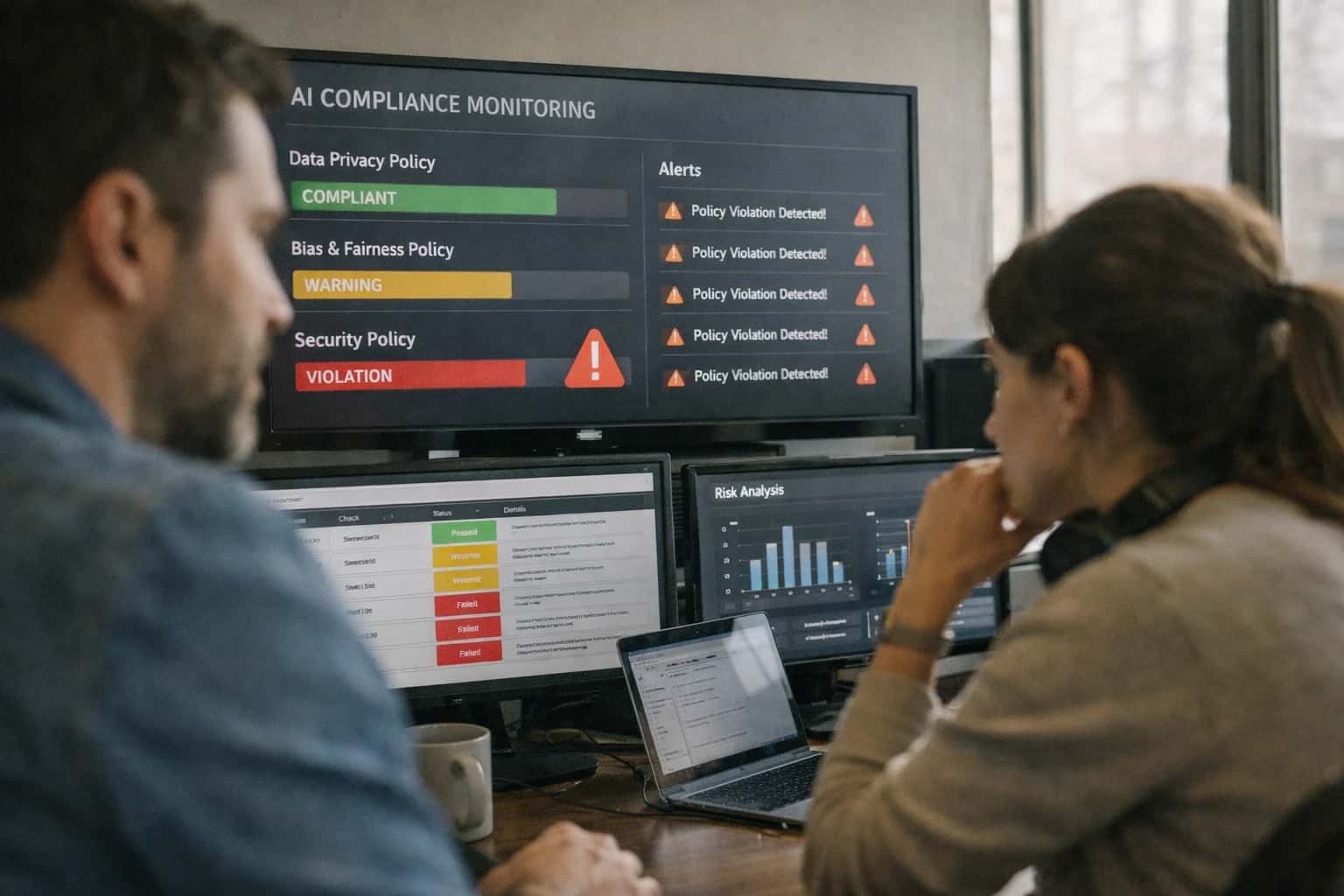
This playbook is for platform and SRE teams who have contractual or internal Service Level Agreements (SLAs) on instruction fidelity for long-running AI agents. When instruction drift causes a model to violate its defined role, policy, or output contract, you need a structured compliance report that maps each drift event to a specific SLA clause, determines if a breach occurred, and tracks remediation. This prompt ingests raw drift detection outputs, session traces, and your SLA definitions to produce an auditable compliance report with trend analysis for threshold calibration. Use this when an automated drift detector has already flagged anomalies and you need to operationalize the business and contractual impact.

Prompt
Instruction Drift SLA Compliance Monitoring Prompt
A practical prompt playbook for using the Instruction Drift SLA Compliance Monitoring Prompt in production AI workflows to track, report, and remediate SLA breaches caused by instruction decay.
PROMPT PLAYBOOK
When to Use This Prompt
Operationalize raw drift detection signals into auditable SLA compliance reports for long-running AI agents.
Do not use this prompt as a real-time drift detector. It is designed for post-detection compliance analysis, not for identifying drift in live sessions. If you need to detect drift first, start with the Session Instruction Drift Detection Prompt Template or the Trace-Level Instruction Adherence Scoring Prompt before feeding results into this compliance workflow. This prompt also assumes you have defined SLA clauses with measurable thresholds—if your SLAs are still informal or qualitative, you will get vague reports that fail audit scrutiny. The prompt works best with structured SLA definitions that include specific metrics (e.g., 'role boundary violations must not exceed 2 per 100 turns'), measurement windows, and breach consequence tiers.
Before running this prompt, ensure you have three inputs ready: (1) the raw drift detection output from your monitoring system, including timestamps, severity scores, and affected instruction layers; (2) the relevant session traces or turn-level adherence scores that provide evidence for each flagged event; and (3) your SLA document with explicit clause identifiers, threshold values, and breach definitions. The prompt will fail silently or produce unreliable reports if any of these inputs are missing or poorly structured. For high-stakes compliance workflows, always route the final report through human review before it reaches external stakeholders or contractual dispute processes.
PRACTICAL GUARDRAILS
Use Case Fit
Where the Instruction Drift SLA Compliance Monitoring Prompt delivers value and where it introduces risk. This prompt is designed for platform teams with contractual obligations, not for ad-hoc debugging.
01
Good Fit: Contractual SLA Obligations
Use when: your team has formal, contractual, or internal SLA commitments on instruction fidelity (e.g., 'system instructions must hold for 99.5% of turns'). Guardrail: Map the prompt's breach definitions directly to your SLA clauses before deployment.
02
Bad Fit: Ad-Hoc Debugging
Avoid when: an engineer just wants to quickly spot-check why a single session went wrong. This prompt produces a full compliance report, not a fast diagnostic. Guardrail: Use a lighter-weight drift detection prompt for real-time debugging; reserve this for scheduled compliance runs.
03
Required Input: Defined SLA Thresholds
Risk: Without explicit thresholds (e.g., 'max 2 minor drift events per 100 turns'), the prompt cannot classify breaches. Guardrail: Provide a structured [SLA_THRESHOLDS] input with severity levels, breach counts, and time windows before invoking the prompt.
04
Required Input: Session Trace Data
Risk: The prompt cannot detect drift without access to the original instruction hierarchy and per-turn model behavior. Guardrail: Supply [SESSION_TRACE] with turn-by-turn outputs and [INSTRUCTION_HIERARCHY] as the ground-truth reference.
05
Operational Risk: False Breach Alerts
Risk: Overly sensitive drift detection flags legitimate instruction adaptation as a breach, eroding trust in the monitoring system. Guardrail: Calibrate severity thresholds using historical data and require human review for breach declarations before triggering contractual penalties.
06
Operational Risk: Remediation Timeline Tracking
Risk: The prompt identifies breaches but doesn't automatically trigger remediation workflows, leaving SLA violations unresolved. Guardrail: Integrate the output's [REMEDIATION_TIMELINE] field into your incident management system with automated escalation if deadlines are missed.
PROMPT PLAYBOOK
Copy-Ready Prompt Template
A production-ready prompt template for generating SLA compliance reports that map instruction drift events to contractual thresholds, identify breaches, and track remediation timelines.
The following prompt template is designed to be pasted directly into your orchestration layer. It expects structured inputs from your drift detection pipeline and SLA registry. Replace every square-bracket placeholder with live data before invoking the model. The prompt enforces a strict JSON output contract suitable for automated ingestion by compliance dashboards, alerting systems, and audit archives.
textYou are an Instruction Drift SLA Compliance Analyst. Your task is to produce a compliance report that maps detected instruction drift events to the SLA thresholds defined in the provided registry. You must identify breaches, calculate severity, and track remediation timelines. ## INPUTS ### DRIFT EVENTS [DETECTED_DRIFT_EVENTS] ### SLA REGISTRY [SLA_REGISTRY] ### REMEDIATION LOG [REMEDIATION_LOG] ### SESSION CONTEXT [SESSION_CONTEXT] ## OUTPUT SCHEMA Return a single JSON object with the following structure: { "report_id": "string", "generated_at": "ISO-8601 timestamp", "assessment_window": { "start": "ISO-8601 timestamp", "end": "ISO-8601 timestamp" }, "sla_compliance_summary": { "total_drift_events": "integer", "breaches_detected": "integer", "overall_compliance_status": "COMPLIANT | BREACHED | AT_RISK" }, "breaches": [ { "breach_id": "string", "sla_threshold_ref": "string (reference to SLA registry entry)", "drift_event_refs": ["string (references to drift event IDs)"], "severity": "CRITICAL | HIGH | MEDIUM | LOW", "breach_description": "string (concise explanation of what threshold was violated and how)", "detected_at": "ISO-8601 timestamp", "remediation_status": "NOT_STARTED | IN_PROGRESS | RESOLVED | ESCALATED", "remediation_deadline": "ISO-8601 timestamp or null", "time_to_detect_minutes": "integer or null", "time_to_remediate_minutes": "integer or null" } ], "trend_analysis": { "drift_frequency_trend": "INCREASING | STABLE | DECREASING | INSUFFICIENT_DATA", "mean_time_to_detect_trend": "IMPROVING | STABLE | WORSENING | INSUFFICIENT_DATA", "mean_time_to_remediate_trend": "IMPROVING | STABLE | WORSENING | INSUFFICIENT_DATA", "sla_threshold_calibration_recommendations": [ { "sla_threshold_ref": "string", "current_threshold": "string", "recommended_threshold": "string", "rationale": "string (data-driven justification based on observed drift patterns)" } ] }, "unmapped_drift_events": [ { "drift_event_id": "string", "reason_unmapped": "string (why no SLA threshold applies)" } ], "remediation_timeline": [ { "timestamp": "ISO-8601 timestamp", "event": "string (detection, notification, remediation start, resolution, escalation)", "breach_ref": "string", "actor": "AUTOMATED | HUMAN | SYSTEM", "notes": "string" } ] } ## CONSTRAINTS 1. Map every drift event in [DETECTED_DRIFT_EVENTS] to the SLA thresholds in [SLA_REGISTRY]. If a drift event does not correspond to any SLA threshold, list it in `unmapped_drift_events` with a clear reason. 2. A breach occurs when a drift event's measured severity, frequency, or duration exceeds the threshold defined in the SLA registry for the affected instruction layer. 3. Use the [REMEDIATION_LOG] to populate `remediation_status`, `time_to_detect_minutes`, `time_to_remediate_minutes`, and the `remediation_timeline`. 4. For `trend_analysis`, compare the current assessment window against the previous window if data is available. If insufficient historical data exists, set trend fields to `INSUFFICIENT_DATA`. 5. `sla_threshold_calibration_recommendations` must only be populated when observed drift patterns suggest a threshold is misaligned with operational reality (e.g., too sensitive causing false positives, or too lenient missing real degradation). 6. If [RISK_LEVEL] is `HIGH` or `CRITICAL`, flag the report for human review by setting a top-level field `"human_review_required": true` and include a `"review_priority": "IMMEDIATE | SCHEDULED"` field. 7. Do not fabricate drift events, SLA thresholds, or remediation actions. Work only from the provided inputs. 8. If any required input is missing or malformed, return a JSON object with `"error": "string"` and `"missing_fields": ["string"]` instead of the full report. ## RISK LEVEL [RISK_LEVEL]
To adapt this template for your environment, wire the [DETECTED_DRIFT_EVENTS] placeholder to the output of your session-level or trace-level drift detection prompts. The [SLA_REGISTRY] should be populated from a configuration store or database that holds your team's agreed-upon thresholds for instruction fidelity, response latency under drift, and maximum allowable degradation per instruction layer. The [REMEDIATION_LOG] must be a structured log of actions taken after drift detection, including timestamps and outcomes. Set [RISK_LEVEL] based on the business criticality of the agent or session under review—this controls whether the report triggers mandatory human review. Before deploying, validate that the JSON output conforms to the schema using a JSON Schema validator in your pipeline, and log any schema violations as separate incidents. For high-risk domains, always route reports with human_review_required: true to an on-call SRE or compliance reviewer before the report is considered final.
IMPLEMENTATION TABLE
Prompt Variables
Each placeholder must be populated for the prompt to produce a reliable compliance report. Validation notes describe how to verify the input before execution.
| Placeholder | Purpose | Example | Validation Notes |
|---|---|---|---|
[SLA_DEFINITIONS] | JSON array of SLA commitments with thresholds, measurement windows, and severity levels | [{"id":"SLA-01","metric":"instruction_adherence_score","threshold":0.95,"window":"rolling_24h","severity":"critical"}] | Parse as JSON array. Each object requires id, metric, threshold, window, and severity fields. Reject if threshold is outside 0.0-1.0 range. |
[DRIFT_EVENT_LOG] | Array of detected drift events with timestamps, affected instruction layers, and measured deviation scores | [{"event_id":"drift-142","timestamp":"2025-01-15T14:22:00Z","layer":"system","deviation_score":0.12,"affected_instructions":["refusal_policy","output_format"]}] | Parse as JSON array. Each event requires event_id, timestamp in ISO 8601, layer from allowed enum, and deviation_score. Reject events with future timestamps. |
[REPORTING_PERIOD] | Date range for the compliance report with start and end timestamps | {"start":"2025-01-01T00:00:00Z","end":"2025-01-31T23:59:59Z"} | Parse as JSON object with start and end fields. Both must be ISO 8601. End must be after start. Period must not exceed 90 days without explicit override. |
[SESSION_CONTEXT] | Metadata about the monitored sessions including agent ID, deployment environment, and instruction hierarchy version | {"agent_id":"prod-agent-7","environment":"production","instruction_version":"v2.4.1","session_count":1243} | Parse as JSON object. agent_id and instruction_version are required. environment must match allowed values: production, staging, shadow. session_count must be positive integer. |
[BREACH_THRESHOLD_CONFIG] | Configuration defining what constitutes an SLA breach including consecutive violation count and minimum duration | {"consecutive_violations_required":3,"minimum_breach_duration_minutes":15,"aggregation_method":"worst_case"} | Parse as JSON object. consecutive_violations_required must be integer >= 1. aggregation_method must be one of: worst_case, average, p95. Reject if minimum_breach_duration_minutes < 5. |
[REMEDIATION_TIMELINE] | Array of remediation actions taken with timestamps, action types, and resolution status | [{"action_id":"rem-89","timestamp":"2025-01-15T14:35:00Z","type":"instruction_reanchor","status":"resolved","resolution_time_minutes":8}] | Parse as JSON array. Each action requires action_id, timestamp, type from allowed enum, and status. resolution_time_minutes required when status is resolved. Reject actions with timestamps outside reporting period. |
[OUTPUT_SCHEMA] | Expected structure for the compliance report including required sections, field types, and format constraints | {"sections":["executive_summary","breach_log","trend_analysis","remediation_tracker","threshold_calibration_recommendations"],"format":"json","include_raw_data":true} | Parse as JSON object. sections must be non-empty array. format must be json or markdown. include_raw_data must be boolean. Reject if required sections are missing from the schema definition. |
[TREND_ANALYSIS_CONFIG] | Parameters for trend analysis including lookback windows, seasonality detection, and significance thresholds | {"lookback_windows_days":[7,30,90],"detect_seasonality":true,"significance_threshold_pvalue":0.05,"min_events_for_trend":10} | Parse as JSON object. lookback_windows_days must be array of positive integers. significance_threshold_pvalue must be between 0.0 and 1.0. Reject if min_events_for_trend < 5 for statistical validity. |
PROMPT PLAYBOOK
Implementation Harness Notes
How to wire the Instruction Drift SLA Compliance Monitoring Prompt into a production AI ops pipeline with validation, logging, and alerting.
This prompt is designed to run as a scheduled or event-driven evaluation job, not as a real-time interceptor. It expects a batch of session traces, the original instruction hierarchy, and the SLA threshold definitions as input. The output is a structured compliance report that downstream systems—alerting, dashboards, incident management—can consume. Because the prompt performs trend analysis and breach identification, it should be invoked on a regular cadence (e.g., hourly for high-volume agents, daily for lower-risk assistants) or triggered when a session exceeds a turn-count threshold that historically correlates with drift.
The implementation harness must enforce input validation before the prompt runs. The [SESSION_TRACES] input must be a list of objects, each containing a session identifier, a turn-by-turn log of model outputs, and the active instruction version at each turn. The [INSTRUCTION_HIERARCHY] must include the canonical system prompt, role definitions, tool-use policies, and output contracts with their version identifiers. The [SLA_THRESHOLDS] must define acceptable drift scores per instruction layer, maximum breach count per session, and the lookback window for trend analysis. Reject malformed inputs before model invocation and log the rejection reason. Use a structured output parser (e.g., a JSON schema validator) to confirm the model's response matches the expected compliance report schema before forwarding it to any downstream consumer.
Model choice matters here. Use a model with strong instruction-following and long-context reasoning capabilities (e.g., Claude 3.5 Sonnet, GPT-4o, or Gemini 1.5 Pro) because the prompt requires comparing many turns against a multi-layer instruction hierarchy. For high-throughput environments, consider a two-stage pipeline: a cheaper model performs initial per-turn adherence scoring, and this prompt synthesizes the scored traces into the SLA compliance report. Always log the raw prompt input, the model's raw output, and the parsed compliance report to an append-only audit store. This supports post-incident review and provides evidence for SLA disputes. If the report identifies a breach, the harness should automatically create an incident ticket with the breach details, affected session IDs, and the remediation timeline from the report. Do not auto-remediate drift based solely on this prompt's output—require human acknowledgment for any corrective action that alters production agent behavior.
Before deploying, calibrate the SLA thresholds using a golden dataset of sessions with known drift severity. Run the prompt against sessions where drift was confirmed by human review and sessions where no drift occurred. Tune the thresholds until the breach identification aligns with your operational tolerance for false positives and false negatives. After deployment, monitor the prompt's own performance: track the rate of unparseable outputs, the distribution of drift scores over time, and whether breach alerts correlate with user-reported quality issues. If the prompt's trend analysis recommends SLA threshold recalibration, route that recommendation to the team responsible for SLA governance rather than applying it automatically.
IMPLEMENTATION TABLE
Expected Output Contract
The JSON schema the model must produce for an SLA compliance report. Validate these fields before accepting the output.
| Field or Element | Type or Format | Required | Validation Rule |
|---|---|---|---|
report_id | string (UUID v4) | Must match regex ^[0-9a-f]{8}-[0-9a-f]{4}-4[0-9a-f]{3}-[89ab][0-9a-f]{3}-[0-9a-f]{12}$ | |
generated_at | string (ISO 8601 UTC) | Must parse as valid datetime; must be within 5 minutes of system clock | |
monitoring_window | object | Must contain start_time and end_time; start_time must precede end_time; both must be ISO 8601 | |
sla_thresholds | array of objects | Each object must have layer (string), metric (string), threshold (number), unit (string); no empty array allowed | |
drift_events | array of objects | Each object must have event_id (string), detected_at (ISO 8601), affected_layer (string), drift_score (number 0-1), severity (enum: LOW|MEDIUM|HIGH|CRITICAL) | |
breach_count | integer | Must equal length of drift_events filtered where drift_score exceeds sla_thresholds threshold for that layer; must be >= 0 | |
remediation_timeline | array of objects | Each object must have event_id (matching a drift_event), correction_applied_at (ISO 8601 or null), adherence_post_correction (number 0-1 or null), status (enum: OPEN|CORRECTED|ESCALATED|FALSE_POSITIVE) | |
trend_analysis | object | Must contain rolling_7d_avg_drift (number 0-1), threshold_calibration_recommendation (string or null), drift_direction (enum: IMPROVING|STABLE|DEGRADING|INSUFFICIENT_DATA) |
PRACTICAL GUARDRAILS
Common Failure Modes
What breaks first when monitoring instruction drift against SLAs and how to guard against it.
01
False-Positive Drift Alerts
What to watch: The monitor flags legitimate stylistic variation or acceptable context adaptation as an SLA breach, causing alert fatigue and eroding trust in the monitoring system. Guardrail: Calibrate drift thresholds using a golden set of known-good session traces. Require severity classification before alerting, and route low-confidence flags to a human review queue instead of triggering an incident.
02
Context Window Positional Decay
What to watch: Instructions placed early in the system prompt lose influence as the context window fills with tool outputs and user turns. The SLA monitor reports high drift severity, but the root cause is instruction placement, not model non-compliance. Guardrail: Periodically re-state critical SLA-linked instructions near the end of the context. Include positional decay analysis in the compliance report to distinguish placement issues from genuine behavioral drift.
03
Tool Output Contamination
What to watch: Retrieved documents or API responses contain language that overrides system-level SLA instructions, causing the model to adopt conflicting output contracts. The monitor detects a breach, but the violation originated in external data, not model intent. Guardrail: Wrap tool outputs with explicit priority markers that reinforce system instruction precedence. Include source attribution in drift events so remediation targets the contaminated tool rather than the model.
04
Threshold Misconfiguration
What to watch: SLA thresholds set too tightly generate noise; thresholds set too loosely miss real degradation. Teams either drown in alerts or discover drift only after user-facing impact. Guardrail: Implement trend analysis over rolling windows rather than single-point thresholds. Use the compliance report's historical drift scoring to recommend threshold recalibration quarterly, and tie threshold changes to a change management process.
05
Remediation Confirmation Gap
What to watch: A correction prompt is applied after a drift event, but no verification confirms the fix held. The SLA report shows a resolved breach that silently reopens in subsequent turns. Guardrail: Require a post-correction adherence verification step before closing any drift incident. The compliance report must include a before/after adherence comparison with a re-drift monitoring window recommendation.
06
Multi-Agent Handoff Drift
What to watch: Instruction hierarchy degrades during agent-to-agent context transfer. The receiving agent inherits a corrupted or incomplete instruction set, and the SLA monitor attributes the breach to the wrong agent. Guardrail: Validate instruction integrity at every handoff boundary. Include sub-agent instruction consistency scoring in the compliance report, and trigger a re-anchoring prompt when handoff fidelity drops below the SLA threshold.
IMPLEMENTATION TABLE
Evaluation Rubric
Use this rubric to test the Instruction Drift SLA Compliance Monitoring Prompt before deployment. Each criterion validates a specific output requirement. Run these tests against a golden dataset of session traces with known drift events and SLA thresholds.
| Criterion | Pass Standard | Failure Signal | Test Method |
|---|---|---|---|
SLA Breach Identification | All drift events exceeding [SLA_THRESHOLD] are correctly flagged as breaches with timestamp and affected instruction layer | Breach events missing from report or false-positive breaches on compliant sessions | Run against 10 session traces with 5 known breaches; verify 100% recall and precision on breach detection |
Remediation Timeline Completeness | Every breach includes a [REMEDIATION_TIMELINE] with detection time, correction time, and resolution time fields populated | Missing or null timeline fields for any confirmed breach; timeline values that are chronologically impossible | Parse output JSON; assert all breach objects contain non-null detection_time, correction_time, and resolution_time; validate chronological ordering |
Drift-to-SLA Mapping Accuracy | Each drift event maps to the correct SLA clause from [SLA_DOCUMENT] with clause reference ID | Drift events mapped to wrong SLA clauses; generic mappings without specific clause references | Cross-reference output clause IDs against [SLA_DOCUMENT]; spot-check 5 mappings for semantic correctness using LLM-as-judge with rubric |
Trend Analysis Data Integrity | Trend section includes drift frequency per time window, mean time-to-detect, and mean time-to-resolve with correct calculations | Trend metrics that don't match source data; missing time windows; calculations with arithmetic errors | Recompute trend metrics from raw drift event timestamps in output; assert values match within 1% tolerance |
SLA Threshold Calibration Recommendation Quality | Recommendations reference historical drift patterns and propose specific threshold adjustments with rationale | Generic recommendations without data references; threshold proposals that would increase breach count without justification | Human review of recommendation section against provided session data; assert each recommendation cites at least one data point from the trend analysis |
Output Schema Compliance | Output matches [OUTPUT_SCHEMA] exactly: all required fields present, correct types, no extra fields | Schema validation errors; missing required fields; string where number expected; additional undeclared fields | Validate output against [OUTPUT_SCHEMA] using JSON Schema validator; assert zero validation errors |
Session Trace Attribution | Every drift event and breach cites the specific session ID and turn number from [SESSION_TRACES] | Drift events without source attribution; incorrect session ID or turn number references | Extract all session_id and turn_number values from output; assert each exists in the input [SESSION_TRACES] dataset |
False-Positive Drift Suppression | Normal instruction variation within SLA tolerance does not generate drift events | Flagging compliant behavior as drift; over-alerting on acceptable output variation | Run against 5 compliant session traces with zero known breaches; assert output contains zero drift events and zero breaches |
Enabling Efficiency, Speed & Accuracy
Intelligent Analysis, Decision & Execution
We build AI systems for teams that need search across company data, workflow automation across tools, or AI features inside products and internal software.
Talk to Us
Search across company data
Give teams answers from docs, tickets, runbooks, and product data with sources and permissions.
Useful when people spend too long searching or get different answers from different systems.
Enterprise searchRAGPermissions
Read more
Automate internal workflows
Use AI to route work, draft outputs, trigger actions, and keep approvals and logs in place.
Useful when repetitive work moves across multiple tools and teams.
AI agentsWorkflow automationGovernance
Read more
Add AI to products and internal tools
Build assistants, guided actions, or decision support into the software your team or customers already use.
Useful when AI needs to be part of the product, not a separate tool.
AI integrationDecision supportModel routing
Read moreADAPTATION OPTIONS
Adapt This Prompt
How to adapt
Start with the base SLA compliance monitoring prompt but replace the full historical trace input with a single representative session log. Use a lightweight output schema that captures only breach flag, severity, and affected SLA clause. Run against 5-10 known drift examples to calibrate thresholds before adding trend analysis.
code[SYSTEM_INSTRUCTIONS_REFERENCE] [SESSION_TRACE_SAMPLE] [SLA_THRESHOLDS: response_time_max, format_compliance_pct, refusal_rate_max] Produce: { breach_detected, severity, affected_clause, evidence_turns }
Watch for
- Over-flagging minor deviations as SLA breaches when thresholds aren't tuned
- Missing false positives from ambiguous instruction wording
- No baseline comparison—prototype runs need a known-clean session for contrast

About the author
Prasad Kumkar
CEO & MD, Inference Systems
Prasad Kumkar is the CEO & MD of Inference Systems and writes about AI systems architecture, LLM infrastructure, model serving, evaluation, and production deployment. Over 5+ years, he has worked across computer vision models, L5 autonomous vehicle systems, and LLM research, with a focus on taking complex AI ideas into real-world engineering systems.
His work and writing cover AI systems, large language models, AI agents, multimodal systems, autonomous systems, inference optimization, RAG, evaluation, and production AI engineering.
LinkedIn
Limited slotsGet a Free AI Consultation
Partnered with leading AI, data, and software stack.





How We Work
Custom AI workflows for your Business
One-fit-all AI don't work for modern businesses. At Inferensys, we aim to understand your business & custom requirements; which we use to define most efficient agentic workflows, the data, and the tools for your business.
01
Review the use case
We understand the task, the users, and where AI can actually help.
Read more02
Pick the right approach
We define what needs search, automation, or product integration.
Read more03
Build the first useful version
We implement the part that proves the value first.
Read more04
Improve from there
We add the checks and visibility needed to keep it useful.
Read moreThe first call is a practical review of your use case and the right next step.
Talk to Us