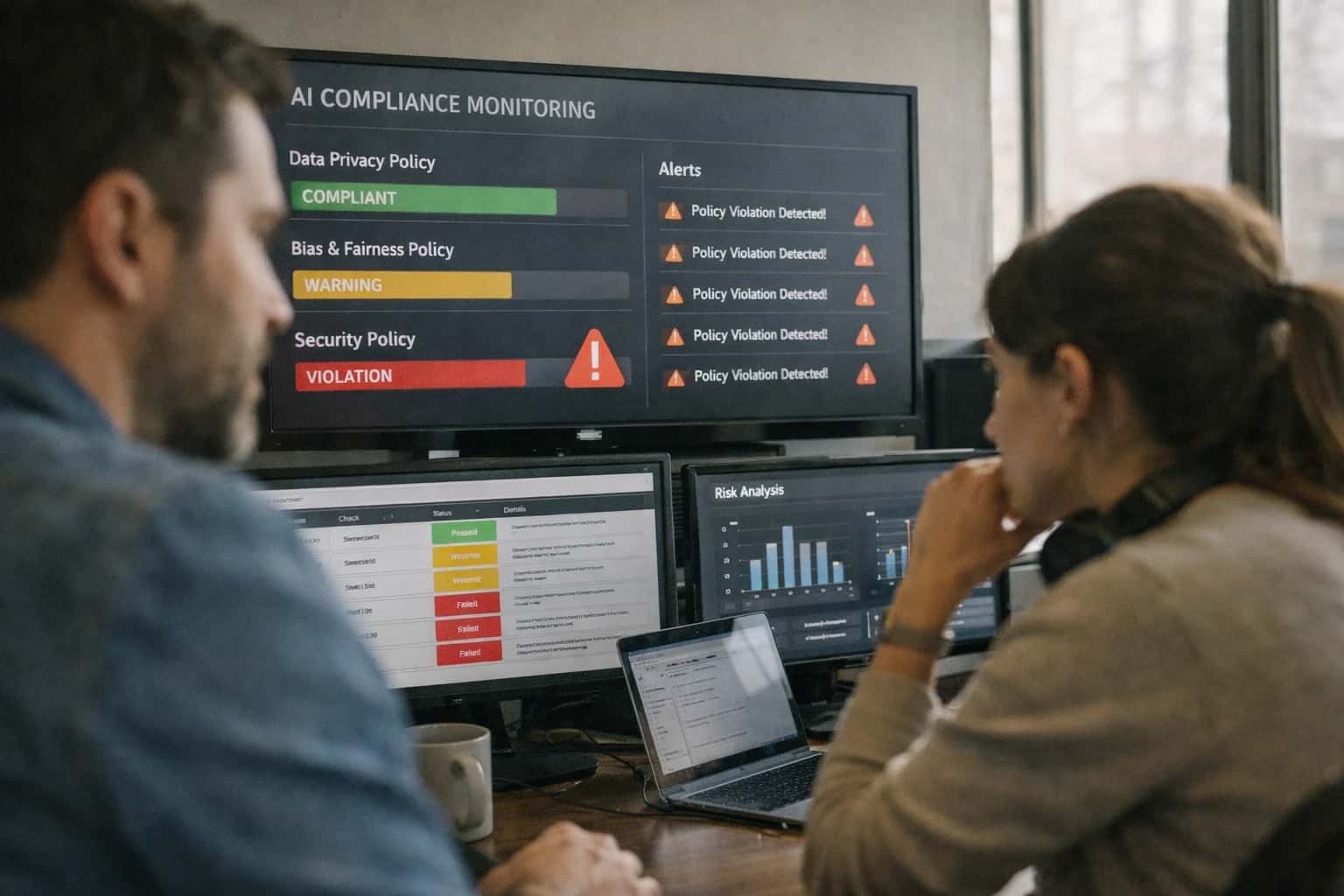
Use this prompt when a human reviewer has decided to override an AI system's recommendation, refusal, or autonomous decision, and you need to verify that the override complies with organizational policy before it executes. The primary user is a compliance engineer embedding a policy gate into an override workflow. The prompt assumes you have already retrieved the relevant policy documents and the structured override justification. It produces a compliance assessment with specific policy references, flagged gaps, and a recommended action: proceed, block, or escalate.

Prompt
Override Decision Policy Compliance Check Prompt
A practical prompt playbook for compliance engineers verifying that a human override aligns with organizational policy before execution. Includes policy document retrieval and human-in-the-loop confirmation for violations.
PROMPT PLAYBOOK
When to Use This Prompt
Defines the job-to-be-done, ideal user, required context, and boundaries for the Override Decision Policy Compliance Check Prompt.
This prompt is designed for a pre-execution gate, not a post-hoc audit. The ideal workflow is synchronous: a human submits an override, the system retrieves policy documents via RAG, the prompt evaluates the justification against those policies, and the output determines whether the action proceeds. The prompt requires a structured override justification as input, which should include the original AI decision, the proposed override, the reviewer's rationale, and any risk context. The policy documents must be retrieved and provided as context; this prompt does not perform retrieval itself. The output is a structured compliance assessment, not a simple yes/no, because borderline cases require escalation rather than binary decisions.
Do not use this prompt for real-time decision-making where policy retrieval latency would block a user. It is not a replacement for legal review in regulated domains—if the override involves legal interpretation, the prompt should escalate for human legal review rather than attempting to resolve ambiguity. Do not use this prompt without a human-in-the-loop confirmation step for any violation or gap it flags. The prompt identifies compliance issues; it does not resolve them. Finally, do not use this prompt when the override justification is unstructured free-text; pair it with a structured justification extraction prompt first to ensure the compliance check has reliable input.
PRACTICAL GUARDRAILS
Use Case Fit
Where the Override Decision Policy Compliance Check Prompt delivers value and where it introduces risk or unnecessary complexity.
01
Good Fit: Regulated Override Workflows
Use when: human overrides of AI decisions must be auditable against specific, codified policies (e.g., SOC 2, HIPAA, internal InfoSec standards). Guardrail: Ensure the policy documents are version-controlled and retrievable by the harness to prevent the prompt from evaluating against an outdated standard.
02
Good Fit: Pre-Execution Gate Checks
Use when: blocking a high-risk action until a human justification is reviewed for policy alignment. Guardrail: The prompt must return a structured BLOCK | PROCEED | FLAG decision; never rely on the model to execute the action itself. The application layer enforces the block.
03
Bad Fit: Real-Time Safety Interventions
Avoid when: latency is critical, such as halting a physical machine or preventing immediate financial fraud. Guardrail: Use a deterministic rules engine for sub-second safety stops. This prompt is for asynchronous, post-hoc or pre-execution compliance review, not real-time circuit breaking.
04
Bad Fit: Ambiguous or Unwritten Policies
Avoid when: organizational policy exists only as tribal knowledge or vague principles. Guardrail: If the policy cannot be retrieved as explicit text, the prompt must default to FLAG and escalate for human policy clarification rather than hallucinating a standard.
05
Required Input: Ground-Truth Policy Documents
Risk: The model will fabricate plausible-sounding policy violations if it lacks the actual text. Guardrail: The harness must retrieve the exact policy clauses via RAG and inject them into the prompt's [POLICY_CONTEXT] placeholder. Never rely on the model's parametric knowledge of regulations.
06
Operational Risk: Rubber-Stamping Automation
Risk: Over-reliance on the prompt can lead to humans blindly approving the AI's compliance assessment. Guardrail: The output must present a concise summary and explicitly ask the human reviewer to confirm or refute each flagged gap. Log the human's final decision separately from the model's recommendation.
PROMPT PLAYBOOK
Copy-Ready Prompt Template
Paste this prompt into your harness to evaluate whether a human override decision complies with organizational policy before execution.
This template is the core instruction set for the Override Decision Policy Compliance Check Prompt. It is designed to be wired into a production harness that retrieves the relevant policy documents, the original AI decision, and the proposed human override. The prompt instructs the model to act as a compliance engineer, cross-referencing the override against specific policy clauses and producing a structured assessment. Do not use this prompt in isolation; it requires a retrieval-augmented generation (RAG) step to supply the authoritative policy text, ensuring the model grounds its analysis in your actual rules rather than general knowledge.
textYou are a compliance review agent. Your task is to evaluate a proposed human override of an AI decision against the organization's official policy documents. ## INPUT DATA - **Original AI Decision:** [ORIGINAL_AI_DECISION] - **Proposed Human Override:** [PROPOSED_OVERRIDE] - **Override Justification:** [OVERRIDE_JUSTIFICATION] - **Retrieved Policy Documents:** [POLICY_DOCUMENTS] - **Risk Level of Action:** [RISK_LEVEL] ## OUTPUT SCHEMA You must respond with a single JSON object conforming to this schema: { "compliance_status": "compliant" | "non_compliant" | "policy_gap" | "requires_clarification", "policy_references": [ { "policy_id": "string", "clause": "string", "relevance": "string" } ], "gaps_flagged": [ { "gap_type": "violation" | "missing_authorization" | "insufficient_justification" | "policy_silence", "description": "string", "severity": "critical" | "high" | "medium" | "low" } ], "recommended_action": "proceed" | "block" | "escalate_for_review" | "request_clarification", "assessment_summary": "A concise, factual summary of the compliance evaluation." } ## CONSTRAINTS 1. **Ground every finding in a specific policy reference.** If a policy document does not explicitly address a point, flag it as a 'policy_gap' or 'policy_silence' rather than inferring a rule. 2. **Do not make risk tolerance decisions.** If the policy is silent on a high-risk action, your recommended_action must be 'escalate_for_review'. 3. **Treat the override justification as a claim to be verified.** If the justification contradicts the policy or the original decision's context, flag it as 'insufficient_justification'. 4. **If multiple policies conflict, flag the conflict** and set compliance_status to 'requires_clarification'. 5. **For any 'non_compliant' or 'policy_gap' finding on a high-risk action, the recommended_action must be 'block' or 'escalate_for_review'.** ## EVALUATION STEPS 1. Parse the original AI decision and the proposed override to understand the delta. 2. Identify all policy clauses in the retrieved documents that govern this type of action. 3. For each relevant clause, determine if the override is permitted, prohibited, or unaddressed. 4. Evaluate the override justification against policy requirements for documentation and authorization. 5. Assemble the output JSON with specific references and a clear recommended action.
To adapt this template, replace the square-bracket placeholders with live data from your application. The [POLICY_DOCUMENTS] placeholder should be populated by a retrieval system that searches your policy knowledge base using the action type and risk category as queries. The [RISK_LEVEL] input should come from your application's risk scoring model, not from the LLM's own judgment. After generating the compliance assessment, your harness must enforce a human-in-the-loop confirmation step for any output where recommended_action is not proceed. Log the full assessment, the final human decision, and the policy documents used for a complete audit trail.
IMPLEMENTATION TABLE
Prompt Variables
Each placeholder must be populated before the prompt is sent. Validation notes describe what makes each variable fit for purpose.
| Placeholder | Purpose | Example | Validation Notes |
|---|---|---|---|
[OVERRIDE_DECISION] | The human override action being reviewed for policy compliance | APPROVED: Override model refusal for transaction TX-9821 | Must contain the action taken and the original AI decision being overridden. Parse check: non-empty string with both action and context. |
[OVERRIDE_JUSTIFICATION] | The human-provided reason for the override | Customer verified identity through secondary channel; transaction amount within established pattern | Must be a complete justification statement. Null allowed if justification is pending. Validate minimum 20 characters and presence of causal reasoning. |
[POLICY_DOCUMENTS] | Retrieved policy documents against which the override will be checked | ["fraud-review-policy-v3.md", "override-authorization-matrix.md"] | Must be an array of document identifiers or full text. Validate that each document is retrievable and version-pinned. Empty array triggers retrieval failure escalation. |
[REVIEWER_IDENTITY] | The identity and role of the human who performed the override | {"user_id": "jane.doe", "role": "senior_compliance_analyst", "team": "fraud_ops"} | Must include user_id and role at minimum. Validate against active directory or IdP. Null role triggers insufficient-authorization flag. |
[OVERRIDE_TIMESTAMP] | When the override occurred, for policy version alignment | 2025-01-15T14:32:00Z | Must be ISO 8601 UTC. Validate timestamp is not in the future and falls within policy document effective dates. Null triggers policy-version-ambiguity warning. |
[DECISION_CONTEXT] | Surrounding context including original model output, risk scores, and affected entities | {"risk_score": 0.87, "affected_accounts": ["ACC-4512"], "model_decision": "BLOCK"} | Must include risk_score and model_decision at minimum. Validate risk_score is numeric 0-1. Missing fields trigger incomplete-context flag and may reduce compliance assessment confidence. |
[COMPLIANCE_THRESHOLD] | The minimum compliance level required for the override to proceed | STRICT | Must be one of enum: STRICT, STANDARD, ADVISORY. STRICT blocks on any violation. STANDARD blocks on critical violations only. ADVISORY flags but does not block. Invalid value defaults to STRICT with warning. |
PROMPT PLAYBOOK
Implementation Harness Notes
How to wire the override compliance check prompt into an application as a gated step within a larger approval pipeline.
This prompt is not a standalone chat interaction; it is a synchronous gate inside an override execution pipeline. When a human reviewer submits an override request, the application must first retrieve the relevant policy documents, assemble the context, and call this prompt before the override is committed. The prompt's output determines whether the override proceeds, is blocked, or is routed for secondary review. Treat this as a deterministic policy evaluation step, not a conversational assistant.
The implementation harness requires three components: a policy retrieval system, a structured invocation layer, and a post-inference decision router. Before calling the model, use the override's target decision type and the reviewer's department to query your policy knowledge base (vector search over policy documents, a graph of regulatory rules, or a SQL query against a compliance rules table). Retrieve the top-k relevant policy sections and format them into the [POLICY_DOCUMENTS] placeholder. The invocation layer should set a low temperature (0.0–0.2) for deterministic compliance assessments and enforce a strict JSON output schema using the model's structured output or function-calling capabilities. After receiving the response, validate that the compliance_status field is one of the allowed enum values (COMPLIANT, NON_COMPLIANT, CONDITIONAL). If the status is NON_COMPLIANT, block the override and log the violation. If CONDITIONAL, route to a senior compliance officer with the prompt's required_conditions and policy_gaps fields pre-populated in the review UI. Only COMPLIANT overrides should proceed automatically.
For high-risk domains such as financial controls or healthcare data access, add a human-in-the-loop confirmation even for COMPLIANT assessments. The harness should log the full prompt input, model response, policy document versions, and reviewer identity to an append-only audit store before any override is executed. Implement a retry strategy for malformed JSON responses: if the output fails schema validation, retry once with a stricter system message that includes the exact validation error. If the retry also fails, escalate the entire override request to a manual review queue with the raw model output attached. Do not silently default to allowing the override on failure—fail closed. Model choice should favor models with strong instruction-following and low hallucination rates on structured extraction tasks; test across at least two model families to ensure the prompt's policy reasoning generalizes and does not rely on a single vendor's behavior.
IMPLEMENTATION TABLE
Expected Output Contract
The structured JSON object the Override Decision Policy Compliance Check Prompt must return. Validate these fields before accepting the output.
| Field or Element | Type or Format | Required | Validation Rule |
|---|---|---|---|
compliance_assessment | object | Top-level object must exist and be non-null | |
compliance_assessment.status | enum: compliant | non_compliant | review_required | Must be exactly one of the three enum values; reject any other string | |
compliance_assessment.policy_references | array of objects | Array must contain at least one object; each object must have policy_id and clause fields | |
compliance_assessment.policy_references[].policy_id | string | Must match a known policy ID from the provided policy document set; reject unknown IDs | |
compliance_assessment.policy_references[].clause | string | Must be a non-empty string quoting or paraphrasing the specific policy clause; null or whitespace-only strings fail | |
compliance_assessment.gaps_flagged | array of strings | Array required even if empty; each string must describe a specific compliance gap with a policy reference; empty array only allowed when status is compliant | |
compliance_assessment.recommended_action | string | Must be a non-empty string; must align with status field: approve override for compliant, block override for non_compliant, escalate for review_required | |
compliance_assessment.confidence_score | number | If present, must be between 0.0 and 1.0 inclusive; scores below 0.7 must trigger human review regardless of status field | |
compliance_assessment.evidence_links | array of strings | If present, each string must be a valid URI or document section reference; null entries rejected; empty array allowed |
PRACTICAL GUARDRAILS
Common Failure Modes
What breaks first when verifying override decisions against policy, and how to prevent compliance gaps before they reach production.
01
Policy Retrieval Misses the Relevant Clause
What to watch: The RAG system retrieves adjacent but non-applicable policy sections, causing the compliance check to evaluate against the wrong standard. Guardrail: Require the prompt to cite specific policy document IDs and section numbers. Implement a retrieval verification step that checks citation accuracy before the compliance assessment runs.
02
Override Justification Is Accepted Without Evidence
What to watch: The prompt accepts a human's override reason at face value without checking whether the justification references concrete evidence or policy clauses. Guardrail: Add an evidence-grounding check in the prompt that flags justifications lacking specific policy references, timestamps, or supporting data. Route insufficient justifications back to the reviewer before marking compliance.
03
Policy Ambiguity Produces False Compliance
What to watch: When policy language is vague or contradictory, the model defaults to marking the override as compliant rather than flagging the ambiguity. Guardrail: Instruct the prompt to explicitly detect and surface policy conflicts or gaps. When multiple interpretations exist, require human clarification and log the ambiguity for policy owners to resolve.
04
Override Context Is Stripped Before Review
What to watch: The prompt receives only the override decision without the original AI recommendation, risk score, or surrounding context, making policy alignment impossible to verify. Guardrail: Enforce a required input schema that bundles the original decision, override reason, risk context, and reviewer identity. Fail fast with a structured error if any required field is missing.
05
Compliance Assessment Drifts Across Policy Versions
What to watch: Policy documents are updated, but the prompt continues evaluating against stale cached versions, producing assessments that don't reflect current rules. Guardrail: Embed policy version metadata in every compliance assessment output. Implement a version freshness check that compares the retrieved policy version against the latest published version before the assessment is considered valid.
06
High-Risk Violations Are Logged Without Escalation
What to watch: The prompt correctly identifies a policy violation but only produces a compliance report without triggering an active block or human review. Guardrail: Add a severity classification field to the output schema. For critical or high-severity violations, the harness must route to a human approval queue and prevent the override from executing until signoff is complete.
IMPLEMENTATION TABLE
Evaluation Rubric
Test cases and acceptance criteria to validate this prompt before shipping. Run these against a golden dataset of override-policy pairs with known compliance outcomes.
| Criterion | Pass Standard | Failure Signal | Test Method |
|---|---|---|---|
Policy Reference Accuracy | Every cited policy clause matches the exact policy document text and section number | Hallucinated policy clause or incorrect section reference | Compare each cited reference against source policy documents in golden dataset; require exact match |
Compliance Verdict Correctness | Verdict matches golden dataset label for all 50 test cases | Any false positive (non-compliant marked compliant) or false negative (compliant marked non-compliant) | Run against labeled golden dataset; measure precision and recall; require 100% on safety-critical cases |
Gap Flagging Completeness | All known compliance gaps in golden dataset are identified with specific policy references | Missing gap that golden dataset annotators identified as material | Compare flagged gaps against golden dataset gap annotations; require recall >= 0.95 |
Recommended Action Appropriateness | Recommended action matches golden dataset action label (proceed, block, escalate, request-clarification) | Action mismatch that would cause compliance exposure if executed | Exact match against golden dataset action labels; weighted penalty for block-vs-proceed confusion |
Justification Grounding | Every justification sentence is traceable to either a policy clause or an override detail in [OVERRIDE_RECORD] | Unsupported claim or speculative reasoning without source anchor | Manual review of justification traceability on 20 random outputs; require >= 90% sentences grounded |
Null Handling for Missing Fields | When [OVERRIDE_RECORD] is missing required fields, prompt returns missing-field error rather than guessing | Output proceeds with assessment despite missing required override detail | Inject records with deliberately missing fields; verify error response matches [MISSING_FIELD_RESPONSE] schema |
Confidence Calibration | Low-confidence outputs include explicit uncertainty markers and recommend escalation | High-confidence language on incorrect verdicts or ambiguous cases | Compare confidence markers against actual correctness on borderline golden dataset cases; check escalation rate on ambiguous cases |
Output Schema Compliance | Output validates against [OUTPUT_SCHEMA] with zero schema violations | Missing required fields, wrong types, or extra fields not in schema | Automated JSON Schema validation on all test outputs; require 100% structural compliance |
Enabling Efficiency, Speed & Accuracy
Intelligent Analysis, Decision & Execution
We build AI systems for teams that need search across company data, workflow automation across tools, or AI features inside products and internal software.
Talk to Us
Search across company data
Give teams answers from docs, tickets, runbooks, and product data with sources and permissions.
Useful when people spend too long searching or get different answers from different systems.
Enterprise searchRAGPermissions
Read more
Automate internal workflows
Use AI to route work, draft outputs, trigger actions, and keep approvals and logs in place.
Useful when repetitive work moves across multiple tools and teams.
AI agentsWorkflow automationGovernance
Read more
Add AI to products and internal tools
Build assistants, guided actions, or decision support into the software your team or customers already use.
Useful when AI needs to be part of the product, not a separate tool.
AI integrationDecision supportModel routing
Read moreADAPTATION OPTIONS
Adapt This Prompt
How to adapt
Add a retrieval step that fetches the current policy version from a policy store before the compliance check. Include a structured output schema with policy references, gap flags, and a recommended action enum. Add a retry loop for malformed JSON and log every check with a trace ID.
codeRetrieve [POLICY_ID] from policy store. If retrieval fails, return { error: "POLICY_UNAVAILABLE", action: "BLOCK_OVERRIDE" }. Check [OVERRIDE_DETAILS] against retrieved policy. Return: { compliant: boolean, policy_refs: [{ section: string, clause: string }], gaps: [{ description: string, severity: "LOW"|"MEDIUM"|"HIGH" }], recommended_action: "PROCEED"|"BLOCK"|"ESCALATE", reasoning: string }
Watch for
- Policy version drift between retrieval and check
- Silent failures when policy store returns partial content
- Overly permissive gap analysis that flags everything as LOW severity

About the author
Prasad Kumkar
CEO & MD, Inference Systems
Prasad Kumkar is the CEO & MD of Inference Systems and writes about AI systems architecture, LLM infrastructure, model serving, evaluation, and production deployment. Over 5+ years, he has worked across computer vision models, L5 autonomous vehicle systems, and LLM research, with a focus on taking complex AI ideas into real-world engineering systems.
His work and writing cover AI systems, large language models, AI agents, multimodal systems, autonomous systems, inference optimization, RAG, evaluation, and production AI engineering.
LinkedIn
Limited slotsGet a Free AI Consultation
Partnered with leading AI, data, and software stack.





How We Work
Custom AI workflows for your Business
One-fit-all AI don't work for modern businesses. At Inferensys, we aim to understand your business & custom requirements; which we use to define most efficient agentic workflows, the data, and the tools for your business.
01
Review the use case
We understand the task, the users, and where AI can actually help.
Read more02
Pick the right approach
We define what needs search, automation, or product integration.
Read more03
Build the first useful version
We implement the part that proves the value first.
Read more04
Improve from there
We add the checks and visibility needed to keep it useful.
Read moreThe first call is a practical review of your use case and the right next step.
Talk to Us